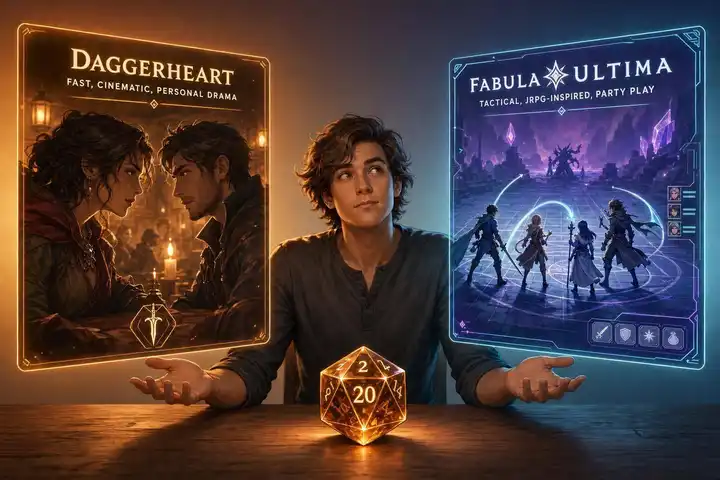
If I had to boil it down fast: Daggerheart fits tables that want fast, character-first scenes, while Fabula Ultima fits tables that want party bonds, turn-based fights, and more player control over the story.
I see the split as pace vs. planning, personal drama vs. party drama, and GM-led scenes vs. shared story input. Both games put relationships and emotion near the center, but they do it in different ways. One uses 2 d12 on each action with Hope and Fear. The other leans on Bonds, Fabula Points, and multiclass growth to shape play over time.
Here’s the short version:
-
Choose Daggerheart if you want:
- fast scene flow
- no-initiative combat
- simple character setup
- strong personal arcs
- lower rules load
-
Choose Fabula Ultima if you want:
- JRPG-style party play
- turn-based tactical combat
- more direct player input in scenes
- multiclass character growth
- stronger group-focused story tools
Quick Comparison
| What matters | Daggerheart | Fabula Ultima |
|---|---|---|
| Main feel | Cinematic fantasy | JRPG-style fantasy |
| Combat | Fluid, no initiative | Turn-based and tactical |
| Story control | More GM-led | More shared across the table |
| Character tools | Experiences, Connections | Bonds, Fabula Points, multiclassing |
| Rules load | Low to mid | Mid |
| Best for | Character tension and fast sessions | Party bonds and build growth |
A plain way to think about it: if your group wants to move fast and stay close to each character’s inner conflict, I’d point to Daggerheart. If your group wants more say over the fiction and likes planning builds and combat turns, I’d point to Fabula Ultima.
Daggerheart: Cinematic Fantasy Built Around Character Identity and Tension

How Daggerheart Feels at the Table
Daggerheart runs on a duality dice system: on every action, you roll one Hope d12 and one Fear d12. That one idea does a lot of work. Turns move fast, combat skips old-school initiative, and scenes stay fluid and reactive.
The feel at the table is very story-first. Each roll moves the fiction, and each fight carries weight beyond hit points. That pace is a big part of the game’s identity. Daggerheart puts character tension right in the middle of play.
Defense follows the same approach. Instead of just soaking hits, characters rely on Evasion and armor durability. You can spend durability to cut damage, then get it back during a rest. So there’s still resource pressure, but it doesn’t bog combat down.
Character Creation, Growth, and Party Bonds
Daggerheart builds character identity through Ancestry and Community, and those choices shape both roleplay and mechanics.
At character creation, each player writes two short Experiences, like "Bodyguard" or "Sharpshooter." When one fits the moment, it can stand in for a normal attribute. That gives each character a clear lane. Experiences show what your character brings to the group, while Connections show who matters to them.
Connections are built into party setup through class prompts, which tie characters to other party members or NPCs. That means party history starts at session zero instead of getting patched in later. For powers and spells, Daggerheart uses a card-based Domain system: you pick two Domains at creation, then add cards as you level up.
Daggerheart: Strengths, Limits, and Best-Fit Groups
Daggerheart fits groups that want character drama front and center. Character creation stays simple with a fixed six-stat spread of -1, 0, 0, +1, +1, +2, while the Hope/Fear system gives even plain actions story weight.
The tradeoff is pretty clear. The game cares more about flow than strict turn order. It also asks the GM to do the work of framing scenes, while players help shape what happens through Experiences and Connections.
| Consideration | Daggerheart |
|---|---|
| Rules weight | Low to moderate |
| GM workload | Moderate (GM drives scene framing) |
| Combat feel | Cinematic, fluid, no initiative |
| Character identity tools | Experiences, Connections, Ancestry, Community |
| Best fit | Players who want emotional arcs and fast fiction |
Fabula Ultima goes after a similar character-focused style, but with more shared story control and party-level growth.
Fabula Ultima: JRPG-Style Progression and Shared Story Control

How Fabula Ultima Feels at the Table
Where Daggerheart leans toward fast turns and smooth scene movement, Fabula Ultima puts more weight on party tactics and shared control of the story.
Fabula Ultima goes hard into classic JRPG fantasy: high stakes, odd monsters, and drama built around the party.
"Fabula Ultima is a TTRPG that draws from the world of JRPGs... It's a collaborative system built to evoke JRPG play: the fantastical worlds, the high drama, the strange monsters." - Ayman Itani, Game Master
Combat is tactical, and that gives Fabula Ultima a very different feel from Daggerheart’s fluid, no-initiative style. If your group likes thinking a few moves ahead and working through a more structured combat loop, this game will likely click. The tone starts adventurous, but it still has room for heavier themes.
Bonds, Fabula Points, and Multiclass Growth
Character identity in Fabula Ultima is built around Bonds. The story also runs on each character’s hopes, dreams, and the pull of destiny, which keeps party relationships front and center in play. So even when the action gets big, the group dynamic still matters every session.
Fabula Points give players a hand on the wheel. They can steer scenes and influence outcomes, which means story control is shared in a direct way. For groups that want players to shape the fiction instead of just respond to it, that’s a big draw.
Progression also feels very JRPG. Fabula Ultima uses a multiclass system, so characters can pull abilities from more than one class as they level up. You can see your build change over time, and that gives advancement a clear sense of growth.
Fabula Ultima: Strengths, Limits, and Best-Fit Groups
The Press Start tutorial module helps new groups get into the game without too much friction.
The tradeoff is more tactical overhead. If you want deep strategy, Fabula Ultima gives you that. If you want the lightest combat flow possible, it may feel a bit heavier than you’d like.
| Consideration | Fabula Ultima |
|---|---|
| Rules weight | Moderate, with tactical depth |
| GM workload | Shared, with players adding narrative input through Fabula Points |
| Combat feel | Tactical, strategic, JRPG-style |
| Character identity tools | Bonds, Fabula Points, multiclassing |
| Best fit | Players who want JRPG progression and shared story authorship |
Those differences stand out even more when the two games are placed side by side.
Daggerheart vs. Fabula Ultima: Side-by-Side Comparison

Daggerheart vs. Fabula Ultima: TTRPG Comparison Chart
Comparison Table
The biggest gaps show up in pacing, player agency, and character growth. Each game works on its own terms. But when you put them next to each other, the tradeoffs get a lot easier to spot.
| Category | Daggerheart | Fabula Ultima |
|---|---|---|
| Core inspiration | Cinematic heroic fantasy | JRPG-inspired fantasy (Final Fantasy, Chrono Trigger, Octopath Traveler) |
| Dice system | 2d12 "Duality Dice" | Turn-based tactical play |
| Combat feel | No-initiative, fluid, and narrative-driven | Turn-based, tactical, and strategic |
| Identity + relationships | Experiences, Connections, Ancestry, Community | Bonds, Destinies, multiclassing |
| Progression | Domain cards and Health/Armor scaling | Multiclass growth tied to Bonds and Destinies |
| Narrative control | Player-defined traits modify rolls | Fabula Points steer scenes |
| Rules complexity | Low-to-medium, storytelling-first | Medium, with tactical depth |
| GM/player workload | GM-led scene framing | Shared narrative load |
| Best fit | Groups wanting cinematic drama and fluid sessions | Groups wanting JRPG progression and shared story control |
Where Each Game Creates Friction
Daggerheart leans more on improvisation and roleplay. Fabula Ultima gives those character ties more direct rules support. In plain English, that makes Daggerheart feel faster at the table, while Fabula Ultima spells more things out. Daggerheart leaves more of the emotional weight in the hands of the group.
Fabula Ultima’s Bond and Fabula Point systems give players clear tools to push scenes in a direction they want. That’s a big draw if your group likes having a hand on the wheel. The tradeoff is extra structure: tactical combat and multiclass planning ask for more focus during play.
Progression is the other big split. Daggerheart puts subclass identity up front at level 1, then moves growth toward Domain cards. That keeps advancement simple, but it also means a lot of your character’s core feel is set early. Fabula Ultima keeps builds changing over time, which can be a better match for longer campaigns.
So the choice isn’t just about rules. It’s about table rhythm. Do you want something looser and more dramatic, or something with more build planning and shared story control?
Which Game Fits Your Table
After the side-by-side comparison, this choice mostly comes down to pace, who steers the story, and how much rules structure your group likes at the table.
Choose Daggerheart for Cinematic Character Drama
Daggerheart is a strong fit for groups that want fantasy play to move fast and stay centered on who the characters are. As Jon Muller, Educator & Game Master, puts it:
"Daggerheart is a fantasy tabletop role-playing game that focuses on storytelling over crunchy mechanics to create an experience that is quick, fluid, and responsive."
That focus shows up in its familiar class setup and in player-shaped Experiences, which help define a character in a direct, flexible way. If your table wants strong personal arcs without getting buried in rules, Daggerheart fits that style well.
If your group wants more shared control over the story and more room for long-term party development, Fabula Ultima may be the better match.
Choose Fabula Ultima for JRPG Party Dynamics
Fabula Ultima fits tables that want a party-first campaign, where Bonds, Destinies, and multiclass growth help drive the story. Players who like having a direct role in shaping the fiction will likely enjoy how much the game supports group input.
"Players that are looking for roleplay will enjoy the game's storytelling focus, while players that are looking for fun mechanics will find that Fabula Ultima is rich in tactics and strategy."
Final Takeaway
Neither game is better across the board. They just aim at different kinds of play.
Daggerheart leans into cinematic tension and character identity through narrative traits like Experiences. Fabula Ultima leans into JRPG-style progression, relationship mechanics, and shared story input through Bonds and group-led play. The right pick comes down to speed vs. structure, individual identity vs. party-driven play, and GM-led vs. shared story control.
FAQs
Which game is easier for new players?
Fabula Ultima is usually the easier pick for new players. Its intro module, Press Start, walks the group through the rules step by step and comes with pre-generated characters, so it’s simpler to get a game up and running.
Daggerheart goes for fast, fluid play with its duality dice and card-based mechanics. Fabula Ultima, though, gives first-time players a more guided way in.
Which system works better for long campaigns?
Fabula Ultima tends to fit long campaigns better. Its JRPG-inspired design leans into character goals, hopes, and dreams, along with strong story beats and easy onboarding. That mix helps the group keep its rhythm over time.
Daggerheart is built more for fast, fluid, responsive play. Its lighter, less rules-heavy structure can make long-term progression and planning tougher to keep going.
How much control do players have over the story in each game?
In Daggerheart, players have a lot of say in where the story goes. The game leans hard into a storytelling-first approach, and the rules stay light, so play moves fast and can bend with the moment.
In Fabula Ultima, players also help build the story together, with a strong focus on character-driven play. But its module framing points to a more structured campaign opening, which can give your early scenes a clearer path.


