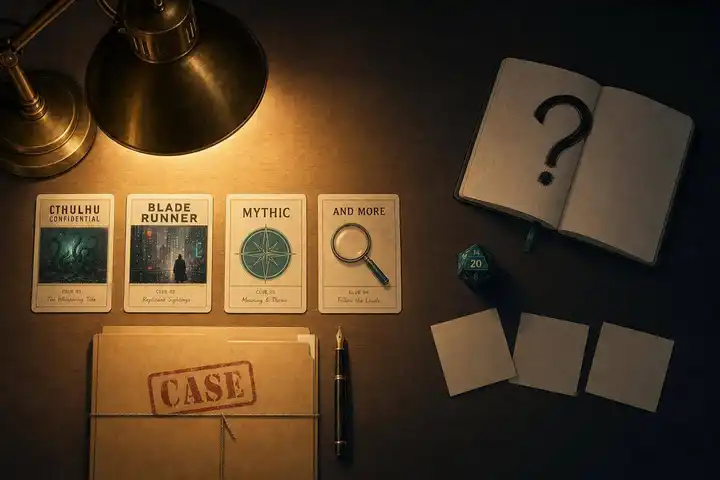
If I had to cut this down to one answer, it’s simple: pick based on how much structure you want. Out of 5 solo mystery options, 2 are tightly guided, 1 sits in the middle, and 2 lean open-ended. That one choice shapes clue flow, pacing, replay value, and how much note-taking you’ll do.
Here’s the short version:
- Cthulhu Confidential: best when I want a guided noir case with steady clue flow
- Blade Runner Solo Mode: best when I want a case-first sci-fi noir investigation
- Mythic GME: best when I want to build the mystery during play
- Alone Against: best when I want a scripted horror case with almost no setup
- Solo journaling mystery RPGs: best when I want prompt-led play and character-heavy mystery
The article compares them on 4 things:
- Investigation structure
- Clue delivery
- Pacing
- Solo support
The main takeaway: if you want less guesswork, go with Cthulhu Confidential or Alone Against. If you want more freedom, use Mythic or a journaling RPG. If you want a middle ground, Blade Runner fits that spot.

Best Solo Mystery TTRPGs: Structure vs. Freedom Comparison Chart
Picking the best TTRPG for you to Solo ~ Solo RPGs – Useful Tips and Advice
Quick Comparison
| Game/Tool | Style | Clue Flow | Setup | Replay Value | Best For |
|---|---|---|---|---|---|
| Cthulhu Confidential | Guided case | Built into the case | Low | Low | Noir horror investigation |
| Blade Runner Solo Mode | Case-driven | Steady, skill-based | Low to medium | Medium | Sci-fi noir |
| Mythic GME | Oracle-led | Player-generated | Medium to high | High | Open solo mystery play |
| Alone Against | Scripted solo adventure | Fixed and guided | Very low | Low | Beginners and horror fans |
| Solo journaling mystery RPG | Prompt-led writing | Emergent | Very low | High | Personal, mood-heavy cases |
I also see one useful split right away: standalone solo games versus tools added onto another game. That matters because standalone games handle the case loop on their own, while add-on tools often ask me to do more scene and clue work myself.
So if you’re trying to pick fast, start with this question: Do I want to solve a case, or do I want to build one as I play?
1. TTRPG Games Directory

TTRPG Games Directory (ttrpg-games.com) is a broad catalog of tabletop RPGs, including classic and indie titles. It includes descriptions of mechanics, themes, and features, which makes comparisons much faster when you're trying to pick a solo investigation style.
A simple way to use it is to narrow the field first, then compare clue flow, pacing, and solo support. That saves time and cuts down on random browsing.
It’s also handy for separating standalone solo games from add-on support built for an existing game. That distinction matters. Standalone designs handle pacing and clue flow on their own, while add-on support leans on the base game's structure.
The directory can also help you spot games that pair well with Mythic-style oracle tools for resolving unanswered investigative questions during play. In practice, that split is the fastest way to judge how much solo structure a game gives you.
2. Cthulhu Confidential

Cthulhu Confidential gives you a tight noir investigation with clear scene pressure and a steady clue trail. It also works well with oracle tools when a question doesn't have an obvious answer.
You can see the split most clearly in how it handles unanswered questions. Compared with Mythic's open-ended oracle play, Cthulhu Confidential is more structured and more prescriptive. It gives you a firmer case framework and less need to invent scenes on the fly. That tighter frame makes it easier to place on the spectrum between guided cases and freeform solo mystery tools.
Use it when you want atmosphere and momentum, not open-ended case-building. If you'd rather build the mystery as you go, Mythic is the better fit. For solo play, Cthulhu Confidential's main edge is lower prep: the case structure drives scene direction, so you can focus on deduction instead of construction.
3. Blade Runner: The Roleplaying Game Solo Mode

After Cthulhu Confidential leans into noir-horror, Blade Runner: The Roleplaying Game takes that same pressure and moves it into sci-fi noir. The result feels sharp and focused. It brings a strong sci-fi noir mood to solo play, with a solo mode built for investigations that stay close to the setting, follow clues at a steady pace, and move through a clear case structure.
Where it parts ways with Cthulhu Confidential is flexibility. Blade Runner is much more case-driven. Mythic, by contrast, works better as an oracle when you want to build scenes on the fly and leave room for unanswered clues to grow as you play.
So the split is pretty simple. Blade Runner fits players who want a focused, atmospheric investigation. Mythic fits players who want a more flexible mystery engine. That makes Blade Runner the stronger pick for setting-first solo cases.
4. Mythic Game Master Emulator

Mythic Game Master Emulator is the most flexible option here. Instead of handing you a preset mystery, it helps you build one as you play. So if you want the case to take shape at the table, rather than follow a fixed solution, this is the better fit.
You can use the Fate Chart for yes-or-no answers and the Meaning Tables to spark clues, NPC dialogue, and scene details.
Event Focus Tables help keep the investigation moving. They can throw in scene interrupts, NPC actions, or remote events that shift the case in new directions.
Mythic also works well if you want to solo an existing scenario. Mythic Magazine #3 covers soloing published adventures, and Mythic Magazine #50's "Deconstruct the Known" method lets you hide the answer from yourself while playing through a prepared mystery.
The trade-off is that you'll have more to track. As leads pile up and suspects start to overlap, things can get messy fast. A Thread Chart helps you track open leads, and a Character Roster gives you a clean way to manage suspects as the case grows. If you want a bit more structure, pairing Mythic with The Adventure Crafter can help with scene setup and make longer investigations easier to run, especially when the plot starts branching in a few directions.
5. Call of Cthulhu Alone Against Solo Adventures
If Mythic asks you to build the case as you go, the Alone Against series hands you the whole case from the start. These are prepared adventures with a set structure and a fixed ending. You trade some improv for a lot more guidance. You read the text, make the choices the story gives you, and roll dice when the book tells you to.
Clue discovery is guided and linear. The scenario points out key findings and tells you what they mean, so you don't have to do much lead-sorting on your own. That cuts down on guesswork and keeps play moving.
Where the Alone Against series shines is its mystery-horror tone. Since these adventures are written for Call of Cthulhu, that sense of dread is baked in from the first scene.
Your choices still matter, but only inside the limits of the scenario. You can steer the story, just not rewrite the road.
That makes Alone Against a strong fit for players who want a full solo mystery with very little setup. If you want that same mystery focus but with more room to shape events yourself, the standalone solo journaling option goes further.
6. Standalone Solo Mystery Journaling RPG
Case-driven solo games give you a frame to work inside. A standalone solo mystery journaling RPG does something different: it gives you the parts, then lets the case take shape as you play.
There’s no preset answer waiting at the end. The mystery grows through your writing, with dice and prompts nudging events in new directions.
A lot of these games use a four-step loop to keep things moving: Travel, Encounter, Action, Journaling. Prompt tables then help set your goal, the obstacle in your way, and the next lead to follow.
"Soloing is playing a ttrpg by yourself, whether that's using an emulator to play 5e... or writing-with-dice, open-ended play built on improv." - Tam H, Tabletop RPG Designer
The clue work here is more interpretive than deductive. Oracle prompts hint at what could be going on, and you decide what those hints mean. That pushes play toward an emergent story instead of a fixed chain of clues. Put simply, this is the least prescriptive option in this lineup.
That can be a great match if you like improvisation and want room to surprise yourself. If you’re after a tight, logic-first mystery with one exact answer, it may feel too loose. These games also suit personal character drama and psychological suspense, especially when the investigator’s own inner image shapes the world around them.
Standalone journaling RPGs are also made for zero-prep or rapid zero-prep sessions. The tables, goals, blockers, and prompts are packed into one volume.
So while other solo mystery formats give you more rails, this one gives you the widest open space to play in. The comparison below helps show how that openness stacks up against more structured games.
Side-by-Side Comparison: Clues, Pacing, and Solo Support
The tables below make the trade-offs easy to scan: a scripted case, a hybrid oracle setup, or freeform generation.
Table 1: Clue Discovery and Case Management
| Game/Tool | Clue Discovery Model | Prepared Case Support | Emergent Clue Generation | Tracking Load |
|---|---|---|---|---|
| Cthulhu Confidential | Built-in clue flow | High | Low | Moderate |
| Blade Runner | Skill-based | High | Moderate | Moderate |
| Mythic GME | Oracle-driven | High (prepared-adventure support) | High | High |
| Alone Against | Scripted/paragraph branching | Total | None | Low |
| Journaling RPG | Prompt-based | Low | High | Very High |
Table 2: Pacing, Pressure, and Replayability
| Game/Tool | Case File Format | Pacing Controls | Climax Guidance | Replayability |
|---|---|---|---|---|
| Cthulhu Confidential | Scenario-driven | Narrative-driven | Case-dependent | Low |
| Blade Runner | Modular Case Files | Shift-based tracking | Case-dependent | Moderate |
| Mythic GME | Scene-by-scene | Chaos Factor + Event Focus | Emergent | Very high |
| Alone Against | Paragraph-based | Scripted narrative events | Scripted | Low |
| Journaling RPG | Journal-based | Player-defined | Narrative prompts | High |
Table 3: Solo Support and Player Fit
| Game/Tool | Solo Support | Oracle/GM Emulation Strength | Best Genre Fit | Best Player Type |
|---|---|---|---|---|
| Cthulhu Confidential | Moderate | Low | Lovecraftian noir | Story-first players |
| Blade Runner | High | Moderate | Cyberpunk noir | Atmosphere seekers |
| Mythic GME | Strongest built-in oracle support | Very High | System-agnostic | Proactive improvisers |
| Alone Against | Total | None; fully scripted | Cosmic horror | Beginners |
| Journaling RPG | High | Low | Introspective mystery | Writers and journalers |
If you're trying to choose between them, these tables help fast. Cthulhu Confidential and Alone Against lean more structured. Mythic GME gives you far more freedom, but it also asks you to track more moving parts. Blade Runner sits in the middle, while a Journaling RPG can open the door to almost anything if you don't mind doing more of the narrative work yourself.
Use the tables above to compare structure, flexibility, and replay value before the pros and cons breakdown.
Next, the pros and cons section turns these trade-offs into a quick pick list.
Pros and Cons
Each option has a clear best-fit use case. The table below lays out the trade-offs so you can compare clue support, setup, and how much improv each one asks from you.
| Option | Major Pros | Major Cons | Best Use Case |
|---|---|---|---|
| Blade Runner TTRPG | Strong thematic immersion; gritty noir investigation | Tied to the Blade Runner setting | Atmospheric cyberpunk noir for players who want a setting-first detective game |
| Mythic GME | System-agnostic; works with any published module; high replayability | Requires extra setup to run published mysteries without spoilers | Playing existing group modules solo for players who want to use their existing library |
| Call of Cthulhu Alone Against adventures | Highly structured; pre-written cosmic horror; little need to generate the story on the fly | Low replayability once solved; little emergent generation | Cosmic horror with a pre-written narrative for fans who want a guided story |
| Standalone Solo Journaling RPGs | Deep character development; portable; low mechanical overhead | Leans toward writing and reflection over deduction | Narrative-heavy detective noir for writers and narrative-first players |
If you want the most flexibility, Mythic GME stands out. It can plug into almost any game and lets you run material you already own. The catch is that mystery play takes more prep if you want to avoid spoilers.
Blade Runner TTRPG and Call of Cthulhu Alone Against adventures give you more built-in support. That usually means less work at the table, but it also means less room to wander off-script. Standalone solo journaling RPGs go in the other direction. They give you space to dig into character and mood, but they put more of the detective work and story shaping on your shoulders.
So the main choice comes down to structure versus freedom. More structure means less prep and less tracking. More freedom means more improvisation, more interpretation, and a bit more work from you as the player.
Conclusion
After looking at clue flow, pacing, and solo support, the choice comes down to structure vs. freedom.
Cthulhu Confidential and Blade Runner are the guided, atmosphere-first picks. Mythic is the most flexible oracle. Alone Against is the most scripted. And standalone solo journaling RPGs lean toward freeform, prompt-driven mystery play.
If you want to keep browsing solo mystery options, TTRPG Games Directory at ttrpg-games.com is a useful place to keep searching for a better fit.
FAQs
Which solo mystery RPG is easiest for beginners?
For beginners, Mythic is usually the easiest place to start. It leans into solo play from the start, so it helps you run prepared adventures on your own. You get event focus tables and clear guidance for using the app’s tools with published cases.
If you want the simplest investigation-focused option with very little system learning, Mythic is usually the easiest on-ramp.
Can I use Mythic with a published mystery adventure?
Yes. Mythic’s core rules include a section on playing prepared adventures solo.
You use the published adventure as the framework for your campaign, then let Mythic’s oracle help decide what happens next. On top of that, community materials support using Mythic with pretty much any published RPG adventure.
How much note-taking does each option require?
Note-taking changes based on the tool and the way you play. Little GM Emulator leans more on a framework, so you usually don't need to write every little thing down. Most of the time, you're tracking oracle-style results and generated details like events, NPCs, and locations.
A dedicated solo toolkit tends to be more structured. It often includes a clear session history, along with notes for NPCs, hooks, and locations. Some also let you add short recaps if you want.
Mythic usually calls for lighter notes than full GM-as-you-go frameworks. In most cases, it's enough to record clues and oracle outcomes.


