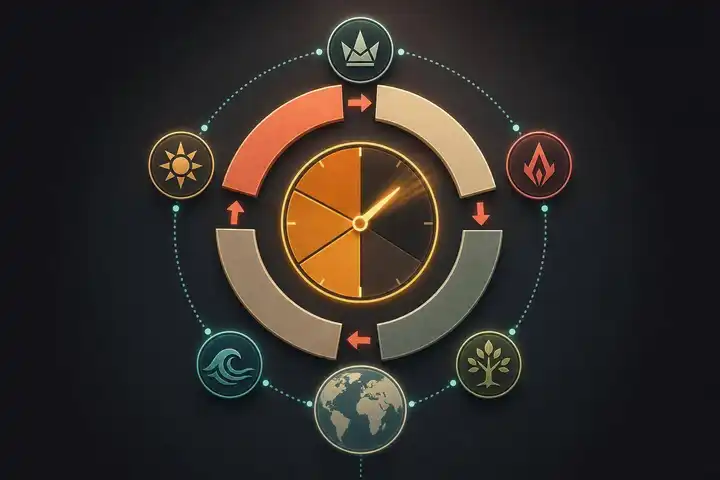
If you want a campaign that doesn’t stall, pick the engine first. In this piece, I’d boil the choice down like this: use clocks for fast table pressure, fronts for step-by-step threat growth, and faction turns for world changes between sessions.
Here’s the short version:
- Clocks work best when you want players to see pressure building now
- Fronts work best when you want a threat to grow across 3–6 sessions
- Faction turns work best when you want groups, rulers, or powers to act off-screen and change the setting
The article compares them by four simple checks:
- between-session motion
- escalation
- prep load
- how hard inaction hits
That last point matters most. A campaign engine answers one blunt question: what happens if the players do nothing? If your group likes visible danger, pick clocks. If you want named steps toward doom, pick fronts. If you want a map that changes from turn to turn, pick faction turns.
Quick Comparison
| Engine | Best use | Prep | Pressure style | Scale |
|---|---|---|---|---|
| Clocks | Immediate danger | Low | Visible countdown | Scene to short arc |
| Fronts | Building threats | Medium | Staged warning signs | Arc or region |
| Faction turns | Living sandbox | High upfront | Off-screen group actions | Setting or world |
So before I pick the setting, tone, or rules crunch, I’d pick the part that keeps play moving. That choice does more to shape a long campaign than almost anything else.

Clocks vs Fronts vs Faction Turns: TTRPG Campaign Engines Compared
Make Campaign Planning EASY with Fronts from Dungeon World! | D&D | 5e | DM Advice
Clocks: Fast Pressure and Low-Prep Momentum
A clock is a segmented circle that fills up as danger gets closer or a situation moves forward. In Blades in the Dark, a 4-segment clock tracks an immediate threat, like a fast-approaching alarm. An 8-segment clock covers a slower burn, such as a rival gang moving toward retaliation.
That simple setup changes how the table feels. The world doesn’t sit still while the players look somewhere else. Pressure stays on the board, and players can see it building and decide: deal with it now, or let it get worse.
While the players are busy with other problems, the GM can advance threats between sessions. That means a threat, faction, or problem keeps moving without a pre-planned story arc - just a situation, a clock, and a clear consequence when it fills.
That’s why clocks work so well. The GM can push threats forward without locking in outcomes. They make sandbox play easier to run again and again without a pre-plotted arc.
How Clocks Change Play Between Sessions
This table shows the two main clock scales and how each one shapes player decisions at the table. Use the smaller scale for immediate danger and the larger scale for campaign pressure.
| Clock Type | Scope | Visibility | What It Drives |
|---|---|---|---|
| Scene-level (e.g., 4-segment alarm) | Single session or encounter | Usually visible | Immediate tactical decisions |
| Campaign-level (e.g., 8-segment retaliation) | Multiple sessions | Visible or hidden | Long-term planning, risk management |
Visible clocks put pressure right in front of the players, while hidden clocks let the GM track off-screen progress behind the screen.
Clocks are a strong fit for groups that want visible pressure and low prep. Give the table a clear goal and a few clocks, and the campaign keeps moving. When a threat needs more shape than a clock can give it, fronts take over that next layer of campaign pressure.
Fronts: Structured Threat Arcs with Open Outcomes
When a clock needs a bit more shape than a plain countdown, fronts give you named steps without pinning down the ending. In Dungeon World, a front has three parts: dangers, grim portents, and an impending doom. Each danger needs a goal and a method. Grim portents show how that danger gets worse over time. The impending doom is what happens if no one stops it.
Put together, those parts give the GM a planned path for escalation, but not a script. You get a direction to follow, not a chain of scenes the players have to march through.
A front moves forward when players ignore it, which lets the GM advance to the next grim portent without railroading anyone. The threat gets worse in a clear, visible sequence, and the campaign still leaves room for player choice.
Fronts sit in the middle on prep. They take more work than clocks, but far less than faction turns. You need to pin down what each danger wants and sketch a few portents, but one front can carry a 3–6 session arc because it can flex around what the players do.
Why Fronts Work for Medium-Prep Sandbox Fantasy
Fronts fit open-world play best, especially when threats keep coming back. If the party spends two sessions chasing something else, the front doesn’t freeze in place. It keeps moving on its own timeline. The world changes because the danger kept building through named steps, not because the GM shoved the group through a fixed event chain.
| Front Element | When It Advances | Prep Demand | Campaign Pressure It Creates |
|---|---|---|---|
| Danger (faction or threat) | Ongoing; reacts to player action or inaction | Low - define goal and methods | Provides the core hook and motivation |
| Grim Portents (escalation steps) | After player inaction or partial failure | Medium - map 3–5 sequential signs | Signals growing stakes and gives players something to react to |
| Impending Doom (crisis point) | When all portents pass unchecked | Low - one clear consequence | Makes success feel meaningful and raises the cost of ignoring threats |
Modular fronts also make sandbox play easier. Encounters and NPCs built for one path can often drop into another, depending on where the party goes. That makes fronts a clean middle ground between simple clocks and full world-level campaign turns. When that pressure needs to move past one threat and start changing the larger world, faction turns take over.
Faction Turns: World-Scale Change for Long Sandboxes
Where clocks track pressure and fronts follow one threat, faction turns move the whole campaign map. This is the biggest-scope engine in the set, and it asks for the most prep. You use it to track whole organizations as they spend resources and take action between sessions.
In Worlds Without Number and Stars Without Number, each faction gets resources, keeps its assets, and takes one major action per turn. That can mean war, shortages, or political shifts that change the campaign map.
The GM tracks each faction’s goals, methods, assets, and relationships, then logs the results in a simple campaign record.
How Faction Turns Feed the Next Session
The payoff shows up in the next session as a changed world state: a stronger rival, a conflict that has been settled, or a new opening the players can jump on. The GM runs the procedure, records what changed, and starts the next session with a clear problem or choice already on the table. The key point is that these developments come from factions acting on their own, not from scripted events.
That makes faction turns a good fit for groups that want campaign-scale politics, territory control, and long emergent campaigns where players decide which conflicts matter.
Next, match that engine to your group’s prep time and campaign style.
Which Framework Fits Your Group
Use the table below to line up the engine with your group. The gaps between them show up most clearly at the table: how pressure shows up, how much prep you need, and how much the campaign shifts from one session to the next.
Each engine nudges play in a different direction. Clocks lean into fast, visible pressure with very little prep. Fronts lean into staged escalation. Faction turns push world change that keeps moving between sessions.
A Short Decision Guide for Your Next Campaign
| Framework | Best For | Prep Load | Play Style | Scale | Examples |
|---|---|---|---|---|---|
| Clocks | Immediate pressure | Low | Fast, reactive | Scene or task | Blades in the Dark, A/state 2E |
| Fronts | Unfolding dangers | Medium | Structured arcs | Regional or arc | Dungeon World |
| Faction Turns | Living world | High upfront | Between sessions, world-scale | World scale | Stars Without Number, Worlds Without Number |
Pick clocks when you want pressure right now. Pick fronts when you want danger to build in clear stages. Pick faction turns when you want a living world that keeps changing between sessions.
FAQs
Can I use clocks, fronts, and faction turns in the same campaign?
Yes. They work well together because they handle different levels of campaign momentum.
- Faction turns handle big world shifts between sessions.
- Fronts keep major threats and campaign arcs organized.
- Clocks track specific events or progress in smaller steps.
Used together, they let you track long-term change without losing sight of what’s happening at the table right now.
Which framework is easiest for a first-time GM to run?
For a first-time Game Master, linear plot structures are usually the easiest option to run. A pre-set story path cuts down prep and makes it easier to focus on scenes and NPCs, instead of trying to keep several storylines moving at once.
Clocks, fronts, and faction turns can create strong campaign momentum. But they also ask the GM to track more moving parts on their own, which can feel like a lot when you're just starting out.
How do I know when to move from clocks to fronts or faction turns?
Move from clocks to fronts or faction turns when your campaign starts pushing past scene-by-scene pressure and into bigger changes across the world.
Use clocks for short-term urgency tied to one clear problem, like unlocking a door or tracking a single threat over 3 to 5 steps. They work best when the pressure is close, immediate, and easy to see.
Once those smaller events start feeding into larger, competing agendas that keep moving with or without the players, shift to fronts or faction turns. That gives you a better way to track groups, plans, and changes happening across the setting instead of one moment at a time.


