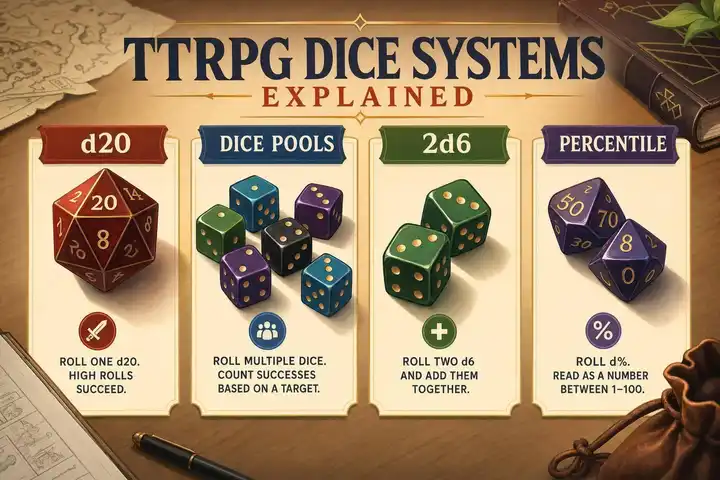
The short answer: each dice system changes how risk feels at the table. A d20 is flat and swingy, dice pools make skill show up through more dice and counted hits, 2d6 pushes results toward the middle, and percentile rolls tell you your odds in plain numbers like 65%.
If you want the fast version, here it is:
- d20: every face has a 5% chance, so each +1 matters a lot
- Dice pools: you roll several dice and count successes, which makes growth easy to see
- 2d6: 7 is the most common result at 16.67%, so middle results happen often
- Percentile: a 60% skill usually means a 60% chance to pass
This also changes play style:
- d20 fits big swings and clear target numbers
- Dice pools fit games where skill should show up more often
- 2d6 fits games built around mixed results and trade-offs
- Percentile fits games where you want odds to be plain and direct

TTRPG Dice Systems Compared: d20 vs Dice Pools vs 2d6 vs Percentile
4 of the Most Common TTRPG Dice Systems
Quick Comparison
| System | How it works | What results feel like | Best fit |
|---|---|---|---|
| d20 | Roll 1d20 + modifier vs. DC/AC | Flat odds, sharp swings | Heroic action, combat-heavy play |
| Dice Pools | Roll several dice, count hits | Steadier results as pools grow | Heists, cyberpunk, horror |
| 2d6 | Roll 2d6 + modifier | Middle results happen a lot | Story-first games, mixed outcomes |
| Percentile | Roll 1d100 under skill | Very clear odds, direct risk | Investigation, grounded play |
I look at these systems as four different ways to handle uncertainty: flat, pooled, curved, and percentage-based. Once you see that, it gets much easier to pick the one that matches your group.
1. d20
In Dungeons & Dragons 5E, attacks are checked against Armor Class (AC), while ability checks and saving throws are checked against a Difficulty Class (DC). If you meet or beat the number, you succeed. It’s a simple target-number setup, which makes the odds easy to grasp, but it also makes outcomes swingy.
Each face on a d20 has a 5% chance of coming up, so every +1 bonus shifts your odds by 5%. That makes bonuses easy to read at the table. You can feel the math right away, even though the die still produces plenty of sharp turns.
In 5E, a natural 20 is a critical hit, and a natural 1 is an automatic miss on attack rolls. Advantage and disadvantage work by rolling two d20s and keeping the higher or lower result. For the GM, that’s a fast, clean way to show an edge or a setback.
Bounded accuracy keeps target numbers in a tight range, so success stays in play across level bands. Low-level characters still have a mathematical chance at hard tasks, and high-level characters can still be hit. That push and pull between risk and dependability is a big part of the d20 feel.
Its appeal comes from speed, clarity, and big swings.
2. Dice Pools
Dice pools have a simple hook: you roll several dice at once, often from Attribute + Skill, and count each die that hits a target number as a success. More successes can mean a stronger effect, extra damage, or more detail from the action. Compared with a d20, where each bonus shifts the result by a flat amount, dice pools make growth feel more physical. When a character improves, players often see it right on the table because they’re adding more dice.
In World of Darkness, players roll pools of d10s and count successes at or above a threshold. Newer Chronicles of Darkness games usually use 8+, while older editions used variable target numbers, and 1s could cancel successes. At high difficulty, even a 6–7 die pool could botch nearly 30% of the time. Chronicles of Darkness later standardized the threshold and removed the subtraction rule.
Shadowrun takes a different path. It rolls Attribute + Skill in d6s, and each 5 or 6 counts as a hit. A handy rule of thumb is about 1 hit per 3–4 dice. Limits can cap how many hits count, which keeps huge pools from running away with the result.
As more dice get added, results tend to bunch closer to the middle. In plain English, that means strong outcomes show up more often, and total failure shows up less.
That said, big pools can slow things down. They take longer to read, and rules like glitches and Limits add extra tracking. So dice pools are often slower than single-roll systems. But they also feel more hands-on, and character growth comes through in a way players can spot at a glance. Next, 2d6 shows the other side of the coin: fewer dice, tighter results, and less swing.
3. 2d6
2d6 gives you a bell curve. In plain English, 7 shows up more than any other result, while 2 and 12 sit out on the edges. There are 36 possible combinations on two six-sided dice, but only one way to get a 2 and only one way to get a 12. 7 is the single most likely result at 16.67%, because six different combinations lead to it. That shape is a big part of why 2d6 works so well for both story-heavy fallout and tighter task checks.
In Powered by the Apocalypse (PbtA) games like Apocalypse World, players roll 2d6 and add a stat modifier, usually from -1 to +3. The total falls into three bands:
- 6 or less: miss
- 7–9: partial success
- 10+: full success
With no modifier, the first two bands each come up at about 41.7%, while a clean 10+ appears only 16.7% of the time. So partial success isn't some side case. It's the heart of the system. In Apocalypse World, a 7–9 might mean you make it out of the gunfire, but someone gets left behind. Or you get the answer you wanted, but show your hand in the process. The roll doesn't shut the scene down. It pushes it in a new direction.
That has a clear effect on play. Since a partial hit is just as common as a miss, players start thinking about trade-offs before they pick up the dice. What cost can they afford? What fallout can they live with?
Traveller uses the same two dice, but the feel is different. Characters roll 2d6 plus skill and characteristic modifiers against a target number - usually 8+ for a standard task. Easier tasks may drop to 4+ or 6+. Harder ones can climb to 10+ or more. Because the curve peaks near 7, even a small bonus can change the odds in a noticeable way. A skilled character may treat an 8+ check as routine, while an unskilled one is taking a real gamble.
Most Traveller checks are simple pass/fail, but the curve gives weight to every modifier. Players often stop and do the math: is this safe enough now, or should we wait, get help, or find another way? That's where 2d6 shines. It's easy to read at the table, but it still gives you odds that feel sharp enough to matter.
| System | Roll Structure | Outcome Format | Gameplay Feel |
|---|---|---|---|
| Powered by the Apocalypse | 2d6 + stat modifier | 6- / 7–9 / 10+ bands | Narrative, consequence-driven |
| Traveller | 2d6 + skill + characteristic modifier | Success/failure vs. target number (e.g., 8+) | Task-focused, modifier-sensitive |
Percentile systems take the opposite approach: they trade the curve for a straight percentage check.
4. Percentile
Percentile systems use a plain 1d100 roll: if you roll your skill value or lower, you pass. A character with 60% Stealth succeeds on any roll of 60 or less.
BRP uses this setup in a direct way. In Basic Roleplaying, skills are written as percentages, and difficulty changes that number: easy tasks double the skill, hard tasks cut it in half, and impossible tasks usually fail outright or drop to a 1% chance.
Call of Cthulhu 7E adds a bit more structure. It uses formal tiers: Regular means under your full skill, Hard means under half, and Extreme means under one-fifth. So if your Spot Hidden is 50%, you need 25 or lower for a Hard success and 10 or lower for an Extreme one. Fumbles happen on 96–100 for skills below 50%, or on 100 exactly for skills at 50% or higher. In opposed checks, the order is Critical > Extreme > Hard > Regular > Failure.
That setup works well for investigative horror. A 35% skill feels risky in a way you can almost feel in your stomach, while a 75% skill feels solid without making you untouchable. Each hard roll feels like a choice, not just a habit.
The downside is that variance stays low. On a d100, every result has a 1% chance, so high skills make routine actions close to automatic, and sharp reversals don't happen often. Compared with the swing of a d20 or the clumping you get from dice pools, percentile rolls stay flat and steady. That's a good fit for skill-first play, but not the best match for big, wild drama.
| System | Core Roll | Success Condition | Difficulty Handling |
|---|---|---|---|
| Basic Roleplaying | 1d100 | Roll ≤ skill % | Multiply skill (×2 easy, ×½ hard) |
| Call of Cthulhu 7E | 1d100 | Roll ≤ skill % | Tiered: Regular / Hard / Extreme |
Strengths, Tradeoffs, and Best Fits for Each System
These four systems all answer the same basic question - how do we resolve uncertain actions? - but they answer it in different ways. And that choice changes a lot at the table: pacing, tone, and how players think about risk. What a system gives you matters. What it asks you to put up with matters too.
d20 is easy to pick up and fast to run. Bonuses are easy to read, but the die can still swing hard. That volatility fits high-fantasy combat well - clutch crits and sudden failures can create huge moments - but it can also annoy players who want skill investment to show up with more regularity. Dice pools push in the other direction. Their steadier spread makes competence feel more consistent. The catch is overhead. Big pools take longer to gather and count, and once target numbers start moving around, the odds get tough to judge even for seasoned players.
2d6 lands in a strong middle ground for narrative play. Because the bell curve stacks results toward the center, complications and costs are built into the math instead of being left only to the fiction. That works very well for story-first campaigns, though it can feel a bit tight if your group wants fine-grained tactical control. Percentile systems take a different path and lean into transparency. The direct mapping makes risk easy to read at a glance, which supports careful, informed choices in investigative horror. The downside is that straight d100 checks can still turn into sharp pass/fail moments, and the more detailed combat subsystems in BRP-derived games can slow things down once a fight starts.
The table below condenses those tradeoffs into a quick reference.
| System | Major Strengths | Major Drawbacks | Best Genre/Style Fit |
|---|---|---|---|
| d20 | Simple math, dramatic swings, clear progression | Swingy outcomes can undermine reliable competence | Heroic fantasy, tactical combat |
| Dice Pools | Consistent skill expression, tactile excitement, multi-tier success | Slower resolution, hard to read odds with variable targets | Cyberpunk, personal horror, heist |
| 2d6 | Narrative-forward, fast resolution, partial success built in | Coarse tuning, less tactical depth | Story-driven, character-focused drama |
| Percentile | Transparent odds, intuitive skill ratings, grounded realism | Abrupt pass/fail results; combat can slow pacing | Investigative horror, grounded realism |
So the choice is less about abstract preference and more about how your table likes to play.
Conclusion
The best dice system is the one that creates the kind of uncertainty your table actually enjoys. At this point, the dice matter less than the style of play they bring to the front.
A d20 leans toward speed and swingy outcomes. Dice pools tend to reward competence with steadier results. 2d6 puts partial success and tradeoffs at the center of play. Percentile systems make the odds plain and easy to judge.
So the choice comes down to table preference. Match the system to your pacing, genre, and how much crunch your group wants. Use d20 for high-variance heroic play, dice pools for steady competence, 2d6 for consequence-driven stories, and percentile for transparent, skill-first investigation. A short test session will tell you pretty fast whether the system supports the story you want.
FAQs
Which dice system is easiest for beginners?
For beginners, 2d6 systems - often used in Powered by the Apocalypse games - are often the easiest place to start. You roll two six-sided dice, add an attribute modifier, and check the result against three clear outcomes: full success, partial success with complications, or failure.
That setup keeps the game moving. It also makes group storytelling feel natural, without a lot of math or a long rules-learning phase.
How do modifiers affect the feel of each system?
Modifiers shape how players read risk and decide what to do. In d20 systems, a modifier gets added to a single roll that has to hit a target number. Because everything hangs on one die, even a small bonus can change how likely success feels at the table.
In 2d6 systems, modifiers tend to push results into better success bands. That often makes outcomes feel steadier, since the bell-shaped distribution pulls many rolls toward the middle instead of swinging as hard from one extreme to the other.
In dice pool systems, modifiers usually mean adding more dice. More dice generally improve the odds of landing at least one success, so players often read that bonus less as a flat bump and more as extra room to work with.
How should I choose a system for my campaign?
Choose based on what your group cares about most: tactical depth or shared storytelling.
If your players like managing resources, tweaking character builds, and thinking through combat turn by turn, a rules-heavy d20 system like Dungeons & Dragons may be a good fit. If they’d rather keep things fluid and story-first, 2d6 systems like Powered by the Apocalypse may work better.


