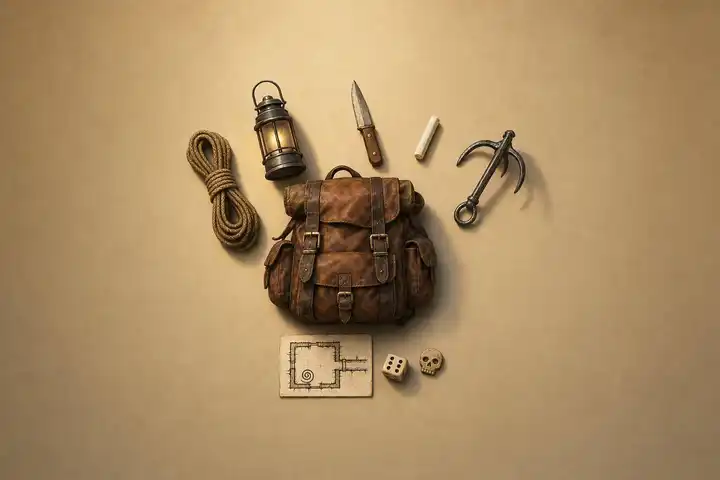
NSR is a style of tabletop RPG play that keeps old-school risk and player choice, but drops close ties to early D&D rules. If I had to sum it up fast, I’d say NSR means light rules, strange settings, GM-run situations instead of plotted stories, and story that grows from what players do.
If you want the short answer, here it is:
- NSR is not one game. It’s a label for a group of games.
- It came out of OSR, but it usually does not aim for old-edition compatibility.
- Play is rules-light but procedure-heavy: turns, encounter checks, supplies, and inventory matter.
- Combat is risky, so players often solve problems through the fiction first.
- Gear often matters more than builds.
- Common examples include Cairn, Into the Odd, Electric Bastionland, and Mörk Borg.
In practice, that means character setup may take just a few minutes, some games use 100+ character starts like Electric Bastionland’s Failed Careers, and some use single-page player rules like Into the Odd. For a GM, the big shift is simple: prep 3–6 places, a few dangers, and a short encounter table - instead of a full plot.
Quick Comparison
| Game/Style | What it points to | How it tends to play |
|---|---|---|
| OSR | Old-school play with closer ties to early D&D | Classes, old module use, more retro rule structure |
| NSR | Old-school play without retro compatibility as the goal | Lean rules, strange worlds, situation-based play |
| Cairn | Easy entry point | Gear pressure, slot inventory, low HP |
| Into the Odd | Very stripped-down expedition play | Auto-hit combat, blunt risk, fast rulings |
| Electric Bastionland | City-based oddness | Debt-driven play, instant character identity |
| Mörk Borg | Dark, lethal fantasy near the edge of NSR | Short brutal play, strong style, crawl-heavy feel |
Bottom line: if you like player-led choices, danger, low-prep GMing, and story that comes from fallout instead of scripts, NSR is probably worth a look.
Defining NSR: Core Ideas, Origins, and Its Relationship to OSR

NSR vs OSR vs Traditional TTRPGs: Key Differences at a Glance
Where the Term Came From and What It Means
NSR is a community label for games that sit outside or alongside the OSR. It’s not an official genre tag or a publisher label. The term grew out of online discussion as a way to describe games that keep old-school priorities - rulings over rules, exploration, danger, and player-led problem solving - without trying to stay mechanically compatible with older D&D editions.
That split shows up most clearly in prep, adjudication, and exploration.
A classic OSR game may put B/X-compatible, BECMI-compatible, or OSR-compatible right on the cover. An NSR game usually doesn’t make that kind of promise. Instead, it borrows the old-school mindset while using newer mechanics instead of a retroclone. NSR games often center a GM, a strange setting, and a world that keeps moving. They tend to use rules-light, deadly systems and focus on emergent narrative, direct interaction with the world, and exploration.
Put simply, NSR leans on design principles more than old-edition compatibility.
The Core Pillars: Weird Worlds, Living Procedures, and Emergent Play
Three traits tend to define NSR at the table.
Weird worlds means settings that feel strange in a real, immediate way - surreal, decayed, or mashed together across genres in ways that make players stop and poke at the edges. Electric Bastionland throws characters into a bizarre electric city packed with failed treasure hunters. Mörk Borg drops them into a dying world drenched in nihilism and art-punk imagery. The weirdness isn’t decoration. It does work. It creates pressure and curiosity without needing a scripted hook.
Living procedures points to the tools these games use to keep the world in motion without a plotted storyline. Random tables, slot-based inventory, exploration procedures, and downtime systems all push toward the same result: the world reacts, changes, and puts pressure on players whether or not the GM mapped out every beat ahead of time. GMs run situations, not stories.
Emergent play is what you get when those two parts meet player choice. Story grows out of decisions, fallout, and risk instead of a prewritten plot. Chris McDowall, designer of Into the Odd and Electric Bastionland, frames the approach as "situations, not plots" and "play to find out what happens."
NSR vs. OSR: Key Differences in Practice
The simplest way to separate OSR from NSR is to ask one thing: does the game need to stay compatible with older editions? OSR games often do. NSR games usually don’t.
That one split affects tone, mechanics, and how the table runs. OSR groups often use classic modules with little conversion, leaning on familiar stat blocks and class structures. NSR tables, by contrast, tend to use bespoke adventures, shorter rulebooks, and unified resolution systems that keep character sheets lean.
| Aspect | OSR | NSR |
|---|---|---|
| Rules complexity | Light to moderate; retains classic subsystems | Minimalist; unified mechanics, very short rulebooks |
| Retro compatibility | High; often B/X-compatible or OSR-compatible | Low; old-school games are inspiration, not a compatibility target |
| Worldbuilding approach | Often surreal, decayed, or genre-bending | Weird, surreal, or genre-bending settings |
| Prep style | Procedure-driven; tables and situations drive play | Low-prep; procedures and tables drive the session |
| Character focus | Classes, advancement tracks, defined builds | Minimal stats, few build choices, and advancement tied to gear, scars, or position |
At the table, those differences matter more than the label. In practice, that often means fewer build choices, faster rulings, and more weight on player decisions. Those design choices shape how NSR sessions actually run.
How NSR Games Play at the Table
Those differences are easiest to see in actual play.
Rules-Light, Procedure-Heavy Play
NSR games usually run on a small ruleset, often with just one main resolution mechanic, and then lean on repeatable procedures to keep the game moving. Cairn is a clear example: a tiny ruleset built around saves and slot inventory. In NSR, procedure does the job that thick rules systems do in other games. It becomes the engine of play, especially during exploration.
And those procedures aren't just filler. They shape the feel of the session. A dungeon crawl often runs on a simple loop: declare an action, advance time, check for encounters, resolve movement, and then track torches, rations, and fatigue. That loop keeps pressure on the table without needing a new subsystem for every little thing. The strain comes from time slipping away and supplies running thin.
Random encounter tables, reaction rolls, morale checks, and exploration turns all stack together to make the world feel active and risky. When a torch is almost gone or an encounter check hits at the wrong moment, the tension lands fast.
Player Agency, Risk, and Fiction-First Problem Solving
Once those procedures start applying pressure, players respond through fiction-first choices.
Characters in NSR games are fragile on purpose. Into the Odd skips the attack roll entirely, so damage is automatic. That changes the feel of combat right away. Every fight feels like a decision, not something you drift into by default.
That danger pushes players to think in a different way. Instead of looking at the character sheet and asking what buttons they can press, they look at the room and ask what the situation gives them. Can they turn the space against the enemy? Can they bribe the guards instead of fighting? Is that treasure worth one more turn in the dungeon before the torches die?
Gear is the build. In many NSR games, a grapnel, a strange artifact, or a useful contact can change your options more than a level-up. That's a big shift. Play tends to reward people who test the fiction first and treat tools, NPCs, and room details as things to work with, not just background flavor.
What Changes for GMs and Players
That shift changes prep just as much as it changes play.
For GMs, the biggest adjustment is moving away from scripted scenes and toward prepped situations. The work goes into maps, factions, encounter tables, and rumors, not a plotted story arc. Procedures create momentum, and the GM rules on what happens next.
For players, the change is just as concrete. Character creation in Into the Odd takes minutes and starts with a few rolls, low hit points, and gear from a table . That speed is there for a reason. If characters are quick to make, players can take bigger risks with them.
| Aspect | NSR Play | Traditional play (e.g., D&D 5e) |
|---|---|---|
| Character creation | Minutes; a few rolls, gear-focused | Longer; build-focused, many choices |
| Encounter resolution | Fiction-first, single flexible mechanic, often automatic damage | Tactical combat, specialized rules per action |
| Advancement | Survival, gear, scars. | XP-based leveling, new mechanical abilities |
| GM prep | Situations, factions, tables, clocks | Plots, balanced encounters, scripted scenes |
The clearest sign of NSR play is simple: the GM puts a situation in front of the table, and the group works through it in the fiction.
NSR Games Worth Knowing and What Each One Does
These games all express NSR in their own way. But they share the same core DNA: light rules, strong table procedures, and fiction-first play. Some lean hard into minimalism. Others add more style or a sharper premise. Either way, they show what NSR looks like at the table.
Cairn as a Clear Starting Point

Cairn is one of the easiest places to start if you want a first NSR game. It’s fast to make a character, has no classes, and progression comes through gear, scars, relationships, and consequences instead of XP or levels.
That changes how people play almost right away. Slot-based inventory turns every item into a tradeoff. Low hit points make every encounter feel risky. Put those together, and players tend to slow down, talk things through, and try odd but smart solutions instead of rushing in. The Warden also makes many rulings on the spot, which helps the fiction stay front and center instead of getting buried under rules.
There’s also a practical reason Cairn is such a common starting point: it’s often free or pay-what-you-want as a digital download, so trying it usually costs nothing.
Into the Odd, Electric Bastionland, and Stripped-Down Weirdness
Into the Odd, designed by Chris McDowall, runs on an extremely light rules chassis. Combat is blunt and dangerous. Attacks usually hit, damage happens right away, and hit points stay low, so even a small fight can leave a mark. As Chris McDowall puts it:
"Combat is deadly because the game wants fair fights to feel like bad planning."
That line gets to the heart of the game. It nudges players to think before they swing. The core player rules fit on a single page, and the industrial-weird setting gives each expedition a clear feel without piling on extra rules.
Electric Bastionland uses that same minimal engine, but shifts play into Bastion, a huge urban setting. Its biggest mechanical twist is Failed Careers: more than 100 character templates that hand players an instant identity, starting gear, and a built-in link to the world. Every character also starts in debt, which gives the group a plain reason to keep going. There’s also a free edition with the player rules and 10 Failed Careers.
Mörk Borg and Other NSR-Adjacent Games

Mörk Borg sits near the edge of NSR. It’s rules-light and lethal, but it leans more toward OSR-style crawls than procedure-first play. A big part of its draw is its visual identity. Even so, its effect on both scenes is hard to miss: it showed that minimal mechanics paired with a strong look could support a large third-party ecosystem.
Other nearby games include Mausritter, Mothership, Shadowdark, and FIST. Each one pulls from a different part of the NSR toolbox.
| Game | Tone | Primary Gameplay Focus |
|---|---|---|
| Cairn | Grounded forest-horror | Cautious exploration, teamwork, survival |
| Into the Odd | Industrial-weird | Lethal expeditions, emergent discovery |
| Electric Bastionland | Urban-weird | Debt-driven adventure, city navigation |
| Mörk Borg | Apocalyptic, black-metal fantasy | Short, brutal campaigns, high-lethality crawls |
Once you know which style fits your group, the next step is learning how to prep your first session.
Getting Started with NSR and Finding Games That Fit
How to Prepare for Your First NSR Session
The biggest shift for a GM is simple: prep situations, not plots. Set up a clear starting point, like a dungeon entrance, a strange district, or a cursed valley. Then sketch a small map, key 3–6 locations, give each one a danger or discovery, and add a short random encounter table.
That same idea changes how players come to the table.
Before play starts, players should know what they could lose: injury, gear, faction blowback, or getting trapped. Start in medias res at the first moment that brings real danger or a real opening. When the stakes are clear, people make risk-based choices much faster.
In play, look for leverage in the fiction. Maybe the guard can be bribed. Maybe the tunnel entrance can be brought down. Maybe the creature wants something and will bargain. Maybe the smart move is to fall back and regroup. In NSR, that kind of leverage matters more than raw stats. Deadly stakes are part of the style, and careful play is completely valid.
Using TTRPG Games Directory to Browse NSR and OSR-Adjacent Games
Use the directory filters to find rules-light games. Then read each entry for signals about danger, GM prep, and how long a campaign is meant to run. Each listing breaks down mechanical complexity, tone, and the kind of group the game suits, so you can quickly spot whether it leans toward cautious dungeon play, weird city adventure, or bleak horror.
It also helps to compare entries by risk level and campaign style before you spend money. Those differences can save you from a bad table fit.
Conclusion: The Traits That Define NSR
NSR points to a shared design direction: design principles over retro compatibility, rules-light systems, and emergent outcomes shaped by player choice instead of authored plot beats. Across Cairn, Into the Odd, Electric Bastionland, and Mörk Borg, the common thread is a living world, clear danger, and fiction-first problem solving.
If your group likes making choices from the fiction and dealing with the results, NSR will probably fit well. If your table wants detailed tactical builds or tightly structured story arcs, another style may work better. Once you know these traits, they become a solid filter for both picking a new game and figuring out how to run the one already on your shelf.
FAQs
Is NSR a genre or a design approach?
NSR is first and foremost a design approach and a movement, not a genre in the usual sense.
It leans on rules-light mechanics, fast character creation, and a rulings-first style. The goal is to keep play flexible, give players more agency, support collaborative storytelling, and make exploration feel risky and high-stakes.
Can I use OSR adventures with NSR games?
Yes. NSR games share key foundations with the OSR, including exploration, player agency, and lethal, high-stakes play.
A lot of NSR systems also work well as toolkits for classic dungeon-crawling content. In most cases, you only need small, common-sense tweaks to make older material fit their leaner rules.
How do I know if NSR fits my group?
NSR works best for groups that want fast, shared play instead of rigid rules and lots of prep. It tends to click with players who like open-ended exploration, solving problems on their own, and a fiction-first approach where smart ideas at the table matter more than character build math.
It can be a weak match for groups that want deep tactical combat, tightly defined campaign systems, or one rulebook that tries to do everything.


