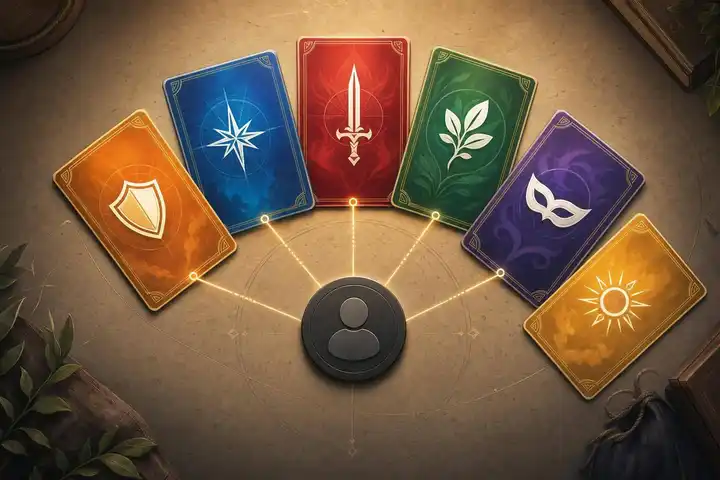
Your class gives you 2 of the 9 Domains, and those 2 Domains control which cards you can take. That means your first big choice in Daggerheart is not just flavor - it sets your role, your card pool, and how you act in combat, support, stealth, and problem-solving scenes.
Here’s the short version:
- You do not pick Domains by themselves; your class picks them for you
- There are 9 total Domains
- You start by choosing 2 Domain Cards
- Those 2 cards can be:
- 1 card from each Domain, or
- 2 cards from 1 Domain
- Domain Cards can be Passive or Active
- Your Domain pair helps define whether you play more like:
- a damage dealer
- a tank
- a support character
- a control-focused character
In plain English: Domains are your class-based ability groups, and your cards are your loadout.
The 9 Domains are:
- Arcana - spell power
- Blade - weapon damage
- Bone - death magic
- Codex - ritual and utility magic
- Grace - speed, finesse, support
- Midnight - stealth and control
- Sage - nature and healing
- Splendor - presence and social power
- Valor - toughness and protection
What matters most for a new player? I’d keep it simple:
- If you want more options early, take 1 card from each Domain
- If you want a narrower role, take 2 cards from the same Domain
- Pick cards that match your party job instead of grabbing random strong effects
A quick fact from the article: with 9 total Domains but only 2 per class, you use about 22% of the full Domain list on a single character. That small pool makes first-time choices easier.
| Domain | Main Idea | Usual Role |
|---|---|---|
| Arcana | Spell damage | Caster |
| Blade | Weapons and offense | Striker |
| Bone | Death-themed magic | Dark caster |
| Codex | Utility magic | Support / control |
| Grace | Speed and finesse | Agile support |
| Midnight | Stealth and shadows | Infiltrator |
| Sage | Nature and healing | Healer |
| Splendor | Presence and leadership | Social support |
| Valor | Toughness and guarding | Front line |
So if you’re new, I’d read Domains like this: class tells you your 2 Domains, Domains tell you your card options, and your cards tell you how you actually play.
Domains in Daggerheart: Lets take a Look at all 9 Domains Available in the Core Rule Book

What Domains Are
Each Domain is a card pool your class can use. Your class gives you access to two Domains, and your cards come from those two pools. Put simply, each class draws from two Domains.
Daggerheart has nine Domains: Arcana, Blade, Bone, Codex, Grace, Midnight, Sage, Splendor, and Valor. No class can use all nine. Instead, every class is tied to exactly two. That keeps your options focused without making the game feel cramped. More than that, the pair gives you a clear sense of what a class does at the table.
How Class Choice Determines Domain Access
Your class decides your two Domains. You don't choose Domains on their own; they come bundled with your class. So if you want to understand how a class plays, start with its two Domains. If those cards sound fun, there's a good chance the class will too.
For example, a class paired with Blade and Valor points toward physical combat and front-line defense. A class tied to Arcana and Codex points toward spellcasting and knowledge-based tools. Even before you read a single card, that Domain pair already tells you a lot about what your character is built to do.
Why Domains Shape More Than Theme
Domains do more than set the mood. They decide which abilities you can take. If a strong ability isn't in one of your two Domains, you can't take it - even if it fits the character in your head.
As you level up, you gain access to stronger cards from those same two Domains. Your character grows into a stronger version of the role you picked at the start, rather than drifting into a totally different one. In practice, those two Domains are the source of the cards you'll be equipping next.
How Domain Cards Work
Once you know your two Domains, the next step is picking the cards that shape how you play. Domain cards are the abilities you equip from those two Domains. For new players, that’s a good thing: your build begins with a small set of actual choices instead of a giant wall of options.
What Domain Cards Can Do
A Domain card can let you attack, cast a spell, add a passive effect, or help during social and exploration scenes. Each card is either Passive or Active.
- Passive cards work on their own.
- Active cards ask you to make a choice during play.
That can mean anything from damage reduction to immunity to a status effect.
Why Picking Domain Cards Is a Loadout Decision
This is why card choice matters just as much as Domain choice. You don’t get every card from your two Domains. As you level up, you pick from a limited set, so each choice counts.
Your cards should back up the job you want to do in the party. In plain English: pick cards that support your role, not cards that just look strong by themselves. A focused loadout tends to do more work than a scattered one.
The Nine Domains at a Glance

Daggerheart's 9 Domains: Roles, Themes & Playstyles at a Glance
Use this quick reference to match each Domain to the kind of role you want to play.
The short labels below make it easier to narrow down your card picks without overthinking it.
Arcana, Blade, and Bone
Start with the Domains that line up with your core playstyle.
Arcana: Pure spell power.
Blade: Weapon mastery and direct damage.
Bone: Death magic, necromancy, and grim force.
Codex, Grace, and Midnight
Codex: Ritual magic and smart utility.
Grace: Speed, finesse, and support.
Midnight: Stealth, shadows, and control.
Sage, Splendor, and Valor
Sage: Nature, healing, and recovery.
Splendor: Leadership, presence, and social influence.
Valor: Front-line durability and protection.
| Domain | Theme | Typical Role |
|---|---|---|
| Arcana | Magic-focused power | Offensive spellcaster |
| Blade | Weapon skill and offense | High-damage striker |
| Bone | Death magic and grim power | Dark or grim-themed character |
| Codex | Ritual magic and utility | Tactical utility caster |
| Grace | Speed and finesse | Finesse-based support |
| Midnight | Stealth and control | Infiltrator, ambush specialist |
| Sage | Nature and healing | Healer, nature-focused support |
| Splendor | Presence and social influence | Charismatic leader |
| Valor | Front-line toughness | Tank, party shield |
How to Pick Domain Cards for Your First Character
Start With the Role You Want to Play
Once you’ve picked your Domains, the next step is simple: decide what job you want to do for the party.
Do that before you start reading every card. It makes the choice much easier.
A good starting point is one of these party roles:
- Damage if you want to hit hard and help end fights fast
- Defense if you want to protect the group and soak pressure
- Support if you want to heal, boost allies, or keep everyone going
- Control if you want to slow enemies down, move them around, or mess with their plans
Then scan your card options for words that line up with that role. If you’re building for defense, look for Armor or Stress. If you want support, look for Hope or Healing. If control is your thing, focus on conditions and forced movement.
One Card From Each Domain vs. Two From One Domain
At character creation, you pick two cards total: either one from each Domain or both from the same Domain.
The 1+1 approach is the safer pick for most new players. It gives you a broader set of tools, which means you’re more likely to have something useful in different scenes.
The 2+0 approach is more specialized. It works best when one Domain lines up with your role so well that doubling down gives you strong synergy right away. The downside is simple: you’ll have fewer answers outside that lane.
A good rule of thumb: pick both cards from one Domain only when one card clearly feeds the other.
Comparison Table: How Early Domain Choices Change Playstyle
These early picks have a big effect on how your character feels at the table. Here’s the short version:
| Loadout Approach | Example Domain Strategy | Primary Strength | Party Role | Feel in Play |
|---|---|---|---|---|
| Aggressive | 2 cards from Blade | High damage output | Primary damage dealer | Fast, focused; ends fights quickly |
| Support-Heavy | 2 cards from Splendor | Maximum healing and buffing | Healer / Buffer | Reactive; keeps the party standing |
| Versatile | 1 card from Bone + 1 from Midnight | Adaptability across scenes | Flexible contributor | Useful in stealth, social, and combat |
| Utility-Focused | 1 card from Arcana + 1 from Sage | Problem-solving and control | Battlefield controller | Tactical; handles what others can't |
Conclusion: A Simple Way to Read Domain Choices
Domains show how your character plays. Each one points to a different playstyle, and your class gives you access to two Domains. That matters because your Domain cards are your loadout - the abilities you bring into play each session.
So Domain choice isn’t just about flavor. It’s about the job you want your character to do at the table. For beginners, the simplest rule works best: pick the Domain that matches the role you want to play.
FAQs
Can I change my Domain cards later?
Yes. As your character grows, you can swap your Domain cards later during advancement or whenever the game's level-up rules allow it.
That means you're not locked into your starting picks forever. Your character's strengths and playstyle can shift over time as the campaign changes and as you figure out what feels fun at the table.
Which Domain pair is easiest for beginners?
There’s no single easiest Domain pair for beginners in Daggerheart. The card-based system has a big effect on how your character plays, so the best pick is usually the two Domains that match the kind of character you want to build.
For example, martial pairings tend to fit combat-focused characters, while magic-focused pairings make more sense for spellcasters. If you choose a pair that lines up with your character idea, the game will usually feel more natural at the table.
How do I know if two cards work well together?
Look for cards that work well together and fit the way you like to play. A strong pairing should build on what you already do well or help you lean into the party role you want to take on.
It also helps to check how the cards fit with abilities you’ve already picked. For example, an attack boost can pair nicely with a defensive effect, giving you more punch without leaving you exposed. The best choices usually support a steady combat plan or a clear story direction, instead of pulling your build in two different ways.


