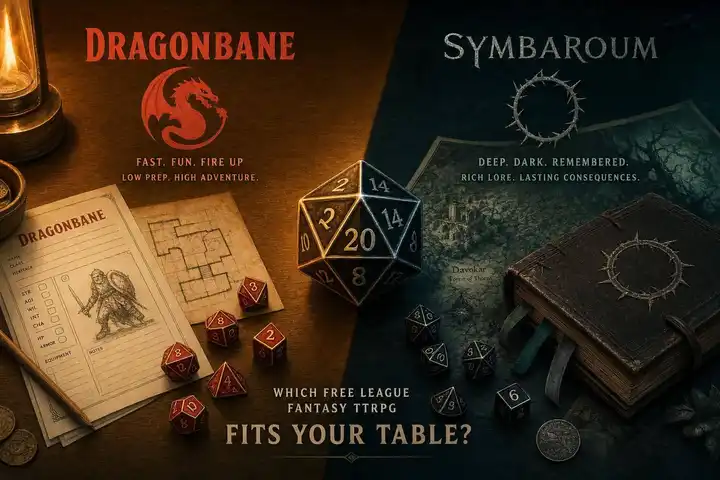
If you want a game you can teach in minutes and run with low prep, I’d pick Dragonbane. If I wanted a darker world, more build choices, and a long campaign, I’d pick Symbaroum.
Here’s the short version: both are Free League fantasy RPGs, both use D20 roll-under play, and both can be deadly. But they serve different tables.
- I’d choose Dragonbane for new players, short arcs, and faster session setup
- I’d choose Symbaroum for dark tone, deeper character builds, and long-term play
- The main things that split them are rules weight, combat pace, GM prep, and how much the setting drives play
- One game gives you a boxed set with a fast start; the other leans hard on lore, tension, and campaign play
That means your choice is less about brand and more about fit. If your group has 4–6 players, limited prep time, or little RPG experience, one game will often click sooner than the other.

Dragonbane vs. Symbaroum: TTRPG Comparison Chart
4 Fantasy RPGs from Free League Publishing Worth Playing
Quick Comparison
| Area | Dragonbane | Symbaroum |
|---|---|---|
| Core mechanics | D20 roll-under, skill-based | Player-facing D20 roll-under |
| Character creation | Fast; six Kins and ten Professions | More build choices with abilities and powers |
| Combat pacing | Faster turns, lighter load | Slower, harsher fights |
| Tone | Lighter fantasy with danger | Dark fantasy with a heavy mood |
| Learning curve | Lower | Higher |
| GM prep | Lower | Higher |
| Campaign style | One-shots, short arcs, or longer play | Long campaigns with strong continuity |
My plain take: Dragonbane is the better pick for tables that want to start tonight. Symbaroum is the better pick for tables that want a grim campaign world that shapes every choice.
Dragonbane and Symbaroum at a Glance
Start with this quick snapshot, then look at how each game feels at the table.
| Feature | Dragonbane | Symbaroum |
|---|---|---|
| Tone | Upbeat fantasy with lethal combat | Grim fantasy with heavy atmosphere |
| Rules Approach | D20 roll-under skill system | Player-facing D20 roll-under |
| Product Format | Boxed set - all-in-one | Core Rulebook - lore-heavy |
| Campaign Style | Short sessions, low prep | Longer campaigns, stronger continuity |
| Ideal Group | New groups or fast-start tables | Lore-driven groups and long-term players |
The big-picture gap is easy to spot. But the sharper difference shows up once you get into the rules, character creation, and how much lifting the GM needs to do.
Dragonbane: Fast Fantasy Adventure in a Box
Dragonbane is a modern take on Drakar och Demoner. Its Core Set comes as an all-in-one box made to get a group playing that same night. No extra books. No drawn-out setup.
Its 1–18 D20 roll-under system keeps things moving, and card-based initiative gives combat a nice jolt of tension. Then there’s the Push Your Luck rule, which adds risk every time players want one more shot at success.
That pace becomes even more obvious once you look at character creation and first-session prep.
Symbaroum: Dark Fantasy Driven by Setting and Consequences
Symbaroum revolves around Davokar, a corrupted forest that sets the mood for the whole game. Dragonbane gives you a ready-to-run table. Symbaroum gives you a world that presses back and shapes each choice.
Its lore-heavy Core Rulebook supports longer campaigns, mystical powers, and steady character growth. The player-facing D20 roll-under system keeps attention on what happens when things go wrong just as much as when they go right.
Next, it helps to compare how each game handles character creation and how fast a group can get started.
Rules and Character Creation: Side by Side
Once you get past the box art and first-session vibe, the split between these two games becomes pretty clear at character creation.
| Feature | Dragonbane | Symbaroum |
|---|---|---|
| Task Resolution | Roll equal to or under a skill rating, typically 1–18 | Attributes, abilities, and powers |
| Character Options | Six Kins and ten Professions | Abilities and mystical powers |
| Character Growth | Spend XP freely on any skill | Long-term character growth |
Character Building Speed vs. Character Depth
Dragonbane moves fast. You pick a Kin, choose a Profession, set your skills, and you're pretty much ready to go. From there, you spend XP on any skill you want. There are no levels, which keeps the whole process light and easy to grasp.
Symbaroum takes a different path. It puts more weight on attributes, abilities, and powers, and that gives players more room to shape a character over time. If Dragonbane feels like jumping straight into the action, Symbaroum feels more like building something piece by piece.
Learning Curve for New and Experienced Tables
Dragonbane is the easier on-ramp. If a skill is 14, you roll 14 or lower. That's the core idea, and it doesn't take long for new players to get it.
Symbaroum asks for more buy-in. Its build-heavy approach tends to reward groups that like thinking ahead and shaping a character over a longer campaign.
So the trade-off is pretty simple:
- Dragonbane fits tables that want to get started fast
- Symbaroum fits groups that don't mind extra build work in exchange for more character depth
That same split shows up in combat too, where Dragonbane keeps things moving and Symbaroum expects more from the table.
Combat, GM Workload, and Campaign Support
| Feature | Dragonbane | Symbaroum |
|---|---|---|
| Combat Speed | Fast; intuitive roll-under D20 | Harsh and high-pressure |
| Lethality | Real danger from session one | Consequence-driven and tense |
| Tactical Weight | Light to moderate; card-based initiative | More deliberate; planning matters |
| GM Prep | Minimal; adventure-first design | Higher; upfront setting and encounter prep |
| Campaign Fit | Fast sessions and long campaigns | Long-form narrative campaigns |
How Combat Plays at the Table
Once the dice start rolling, the gap between these games becomes pretty clear. Dragonbane keeps combat moving because turns resolve fast and players usually don't stop to crunch numbers. Its initiative system stays a bit unpredictable too, which helps fights keep their pace. The result is less table drag and less work behind the screen. Heavier systems tend to ask more from the GM before a fight even starts.
That said, Dragonbane doesn't go easy on the party. Characters are fragile, and pushing a failed roll for a second shot can leave you Exhausted, Dazed, or Angry. That's a sharp little risk-reward trade. Willpower Points add a small resource layer, but they don't bog things down.
Symbaroum takes the opposite path. Combat is slower, harsher, and shaped to make the world feel dangerous. Fights aren't just there to fill time. They carry weight. That works well for groups that want each battle to feel risky and loaded with consequences instead of quick and clean.
What the GM Needs to Prepare
That same split shows up in prep. Dragonbane is built for fast-moving adventures with light prep, and it avoids the power-escalation treadmill you often see in level-based games. In plain English: a GM can usually get a session ready without a ton of lead time.
Symbaroum asks for more up front. The setting is dense, so the GM needs to read ahead and shape encounters to match its tone. The tradeoff is simple: more reading, more setup, and more encounter planning before play begins. You feel that most when comparing a quick one-shot start to a campaign-focused game.
With combat speed and prep load on the table, the next step is figuring out which kind of group each game fits best.
Which Game Fits Your Table
After looking at rules, combat, and prep, the easiest way to choose comes down to what your table wants most. Some groups want to get playing fast. Others want a heavier mood and tougher choices. That difference matters here.
| Table Need | Better Fit |
|---|---|
| New players or first TTRPG | Dragonbane |
| One-shots or short campaigns | Dragonbane |
| Low GM prep time | Dragonbane |
| Dark, atmospheric storytelling | Symbaroum |
| Long-form, lore-driven campaigns | Symbaroum |
| Meaningful consequences and hard choices | Symbaroum |
Choose Dragonbane for Fast Starts and Lighter Adventure Play
Dragonbane works best for tables that want speed, easy onboarding, and a smooth first session. Its roll-under D20 system is simple to teach in just a few minutes, and character creation moves players into the game fast.
Free League shaped it around a lighter, adventurous style, so the game keeps moving even when the dice go cold. If your group wants less setup and more time actually playing, Dragonbane is the clear pick.
Choose Symbaroum for Darker Tone and Long Campaigns
Symbaroum fits groups that want more weight behind each decision. The setting pushes hard choices, and the game is built to support long campaigns with steady character growth over many sessions.
That style lands best when your table cares about atmosphere, tension, and a slower burn. If your group wants a darker story with more consequences, Symbaroum is the stronger fit.
Final Takeaway
Dragonbane is the better fit for fast, low-prep play. Symbaroum is the better fit for darker, longer campaigns.
FAQs
Which game is easier for a first-time GM?
Dragonbane is the easier pick for a first-time GM. It’s built to be fast, approachable, and easy to get to the table without a lot of prep.
It also skips the more involved, level-based progression that can add extra work behind the screen. So right out of the box, Dragonbane is usually simpler to run than the more mood-heavy, learning-curve-driven Symbaroum.
Can Dragonbane support a long campaign?
Yes. Dragonbane works well for both one-shots and long campaigns.
Because it doesn’t rely on level-based power escalation, characters remain capable but mortal over time. That makes it a good fit for steady growth and for campaigns built around exploration, dangerous journeys, and player-driven choices in a reactive world.
How much does the setting matter in each game?
Setting matters in both games, but it does different work in each one.
Dragonbane uses setting to set up fast-moving adventures. The Misty Vale, its dark-fantasy setup, and that mix of danger with dark humor all help the game feel punchy and easy to jump into.
Symbaroum, by contrast, leans on setting as the main driver of dark, moody storytelling. It pushes character-focused play and keeps that heavy atmosphere in the foreground.
Put simply: Dragonbane frames pulpy expeditions. Symbaroum keeps a shadowy mood hanging over the whole game.


