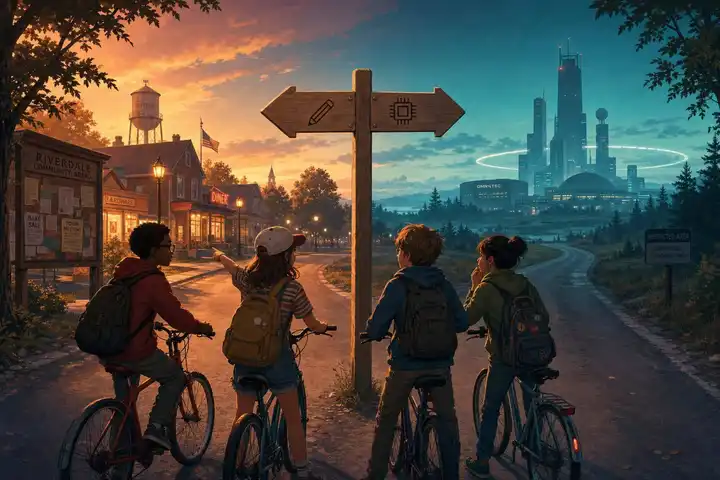
If I had to boil it down to one line: I’d pick Kids on Bikes for group-made towns, loose play, and short runs; I’d pick Tales from the Loop for a fixed 1980s sci-fi world, steadier mystery pacing, and longer campaigns.
Here’s the short answer in plain English:
- Pick Kids on Bikes if you want to make the hometown together, use light rules, and run one-shots or short arcs.
- Pick Tales from the Loop if you want a prebuilt setting, more guided investigation flow, and linked sessions over time.
- The article compares 6 main things: setting, tone, rules, character setup, GM prep, and campaign length.
- There’s also a plain numbers angle: Kids on Bikes gives you 1 sample module in the core book, while Tales from the Loop gives you 4 core scenarios. That alone tells me which game offers more support out of the box.
The core split is simple: freedom vs. structure.
One game asks, “What kind of weird town do we want to make?” The other asks, “Do we want to solve mysteries in an alternate 1980s world with robots and strange machines already built in?”

Kids on Bikes vs. Tales from the Loop: TTRPG Comparison Chart
Kids on Bike vs Tales from the Loop
Quick Comparison
| Criteria | Kids on Bikes | Tales from the Loop |
|---|---|---|
| Best for | Groups that want to build the town | Groups that want a ready-made world |
| Setting | Table-made hometown | Fixed alternate 1980s |
| Tone | Adventure to horror | Quiet, wistful sci-fi mystery |
| Rules feel | Light and loose | Light, but more guided |
| Mystery style | Open-ended clue solving | More structured case flow |
| GM workload | More work after setup | More support from the book |
| Core book scenario support | 1 sample module | 4 linked scenarios |
| Campaign fit | Short arcs, one-shots | Longer campaigns |
So if you want more say over the town, I’d lean Kids on Bikes. If you want more help with pacing and campaign play, I’d lean Tales from the Loop.
Setting and Tone: Build Your Own Town vs. a Fixed Retro Sci-Fi World
Kids on Bikes: Design your own strange hometown
Kids on Bikes Second Edition starts with a blank map and a simple idea: the table builds the hometown together. Players and the GM use town-building prompts to create a place from scratch.
That changes the feel of the game right away. One group might make a cozy small town with bike chases and odd rumors. Another might lean into something darker, where the woods feel wrong and every adult seems to know more than they say. The game clearly points to Stranger Things and Stephen King as touchstones, so it can move from playful adventure to creepy horror without much effort.
This is the better fit for groups that want to invent the town themselves.
Tales from the Loop: Mystery inside an alternate 1980s setting
Tales from the Loop goes the other way. Instead of asking the table to build the whole world, it gives you one from the start. The game takes place in an alternate 1980s, where a huge particle accelerator called the Loop has brought retro-futurist tech and strange anomalies into everyday life.
That means broken robots, gravity anomalies, and odd machines aren't rare sights. They're part of the background of daily life. The tone is also different. Where Kids on Bikes can get loud, messy, and scary, Tales from the Loop tends to feel quieter, more curious, and more wistful.
If your group wants the atmosphere built in from page one, this approach makes a lot of sense.
| Feature | Kids on Bikes (2nd Ed.) | Tales from the Loop |
|---|---|---|
| Default Premise | Everyday people confronting strange and terrifying forces in their backyard | Kids investigating mysteries near a giant physics facility |
| Era | Flexible; often 1980s, '90s, or modern | Fixed alternate 1980s |
| Setting Flexibility | High; players and GM build the town together | Moderate; predefined world, with hometown customization available through supplements |
| Emotional Tone | Lighthearted adventure to creepy horror | Wistful, curious, and melancholy |
| Genre Touchstones | Stranger Things, Stephen King | Simon Stålenhag art, E.T. |
| Sci-Fi Integration | Optional/variable; the weirdness comes from the table | Central; retro-futurism is baked into the world |
That choice of world shapes the next big difference too: how much structure each game gives you in play.
Rules and Characters: Narrative Dice vs. Structured Investigation
Kids on Bikes: Trope-based characters and free-form clue solving
Character creation is quick and easy. Players choose a trope like Popular Kid or Mathlete, then assign attribute dice from d4 to d20. Bigger dice mean better stats. And when you roll the highest number on a die, you reroll and add the new result, which can make outcomes feel wild and unpredictable.
When a roll misses, players get Adversity Tokens. They can cash those in later for bonuses, so failure still gives them something to work with.
That ease comes with a tradeoff: mystery-solving is very open-ended. Since the town gets built at the table, the mystery logic often does too. The GM and players tend to shape the answer as play unfolds. For groups that enjoy improv, that can be a lot of fun. For a GM who wants a more guided case, though, it can feel loose. A lot of the mystery's pacing depends on the GM.
Tales from the Loop: Archetypes, conditions, and mystery phases
Tales from the Loop handles that a bit differently by giving the group more structure from the start. It uses the Year Zero Engine: combine Attribute and Skill dice into a pool of d6s, and any 6 counts as a success.
Characters are built from archetypes like the Bookworm or Troublemaker. But the sheet doesn't stop at mechanics. It also asks for a pride, a problem, a signature item, and relationships such as a crush, a rival, and a friend. That means the sheet leans hard into who the kid is in town, not just what they can do.
Failure works differently too. Instead of giving out reward tokens, it adds Conditions like Upset, Scared, Exhausted, or Injured. That puts pressure on the group without killing characters. Investigations also shift between Everyday Life and Mystery phases, which gives the GM a clear way to pace the story.
| Feature | Kids on Bikes | Tales from the Loop |
|---|---|---|
| Core Mechanic | Die-size attributes (d4–d20) + exploding dice | d6 dice pools (Attribute + Skill); need one 6 to succeed |
| Character Creation | Trope-based; quick to build | Archetype-based; includes social ties and everyday life details |
| Failure Pressure | Low; failure grants Adversity Tokens for future use | Moderate; failure adds Conditions |
| Investigation Support | Free-form; improv-driven | Structured Mystery phases with built-in pacing |
| Learning Curve | Very low; streamlined for fast setup | Low; quick to teach, but the GM has more pacing work |
Both systems are easy to get into, but they shine in different ways. Kids on Bikes leans into improvisation and momentum. Tales from the Loop leans into prep and careful clue pacing.
GM Workload and Campaign Fit: Which Game Is Easier to Run?
Those differences show up most clearly in prep time and how well each game holds up over a longer campaign.
Kids on Bikes: More freedom, more work for the GM
Kids on Bikes gives players and the GM a lot of room to shape the setting together during session zero. That can cut down on early prep, since the town comes out of group play instead of a long planning doc.
But that freedom comes with a tradeoff. After setup, the GM still has to put the mystery together, build the threats, and manage the pacing. The core book includes one sample module set in Point Pleasant, New Jersey. So while Kids on Bikes works well for one-shots and short arcs, longer campaigns often mean the GM has to do more of the heavy lifting to keep things on track.
Tales from the Loop: More built-in structure for longer campaigns
Tales from the Loop leans the other way. It asks for more structure at the start, but that structure can make life easier once play gets going.
The game gives the GM a built-in framework, including four linked scenarios in the core book and a Mystery structure that helps keep the pace steady. It also has support for longer play through Things from the Flood, its sequel. If your group wants regular sessions and a format that feels steady from week to week, that setup is a big plus.
| Feature | Kids on Bikes | Tales from the Loop |
|---|---|---|
| Upfront Prep | Moderate; GM builds on player prompts | Low; structured Mystery framework |
| Built-in Scenarios | 1 sample module in core book | 4 complete scenarios in core book |
| Campaign Length | Best for short arcs and one-shots | Strong for linked campaigns; sequel extends play |
Final Verdict: Which Game Fits Your Group?
Once you get past tone, rules, and GM prep, the choice is pretty simple: freedom or structure. Both games are good at small-town mystery. The better pick is the one that lines up with how your group likes to play.
Pick Kids on Bikes for freedom and fast setup
Go with Kids on Bikes if your group wants to build the town together. The shared worldbuilding tools and light rules make it easy to get started fast. And if your table likes to swing between horror and adventure without much friction, Kids on Bikes gives you that room without pushing back too hard.
Pick Tales from the Loop for atmosphere and clear structure
Go with Tales from the Loop if your group would rather sit down with a world that’s already there. Its fixed alternate-1980s setting brings built-in lore, and the Mystery format helps keep pacing tight across linked sessions. If your group wants coming-of-age drama mixed with weird science, and you want a setup that can carry a longer campaign, this is probably the better fit.
FAQs
Which game is easier for first-time GMs?
Tales from the Loop is often the easier pick for first-time Game Masters, especially if you want the rules to fade into the background and prep to stay light.
Kids on Bikes is beginner-friendly too. It gives you help with making one-of-a-kind creatures and includes a starter module, Point Pleasant, New Jersey. Both games are easy to get into, but Tales from the Loop is usually the simplest to run.
Can Kids on Bikes support a long campaign?
Yes. Kids on Bikes can work well for long campaigns because it leans on shared storytelling, steady character growth, and flexible play that can shift as the story keeps going.
Its rules-light design also makes it easier for groups to keep moving without getting bogged down. That gives the campaign room to change in natural ways over time, while still leaving space for satisfying long-term character arcs.
Which game works better for horror?
Kids on Bikes is the stronger pick for horror. The game is built around ordinary people going up against weird, scary forces they don't fully understand. That setup feels much closer to horror, especially with its clear links to Stranger Things and Stephen King.
Tales from the Loop points in a different direction. Its tone leans more toward nostalgia, wonder, and sci-fi discovery. There can still be tension, of course, but the overall feel is more whimsical and heartfelt than straight-up horror.


