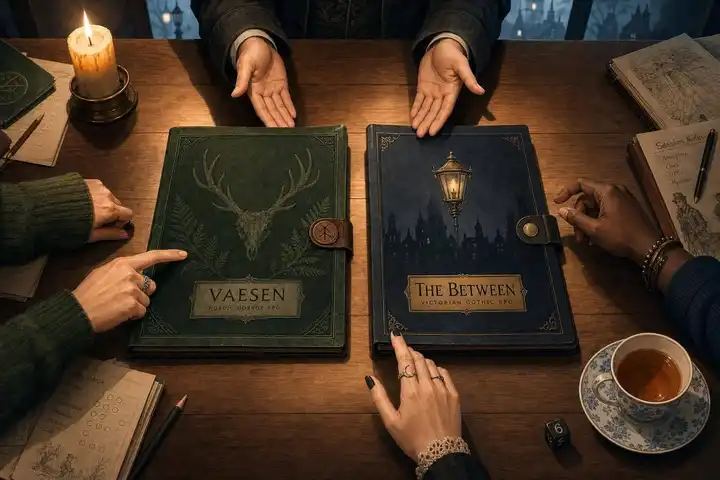
If you want a gothic mystery game for a one-shot or short arc, I’d pick Vaesen. If you want a long campaign built around character drama and shared clue-solving, I’d pick The Between.
Here’s the short version: both games deal in horror, mystery, and investigation, but they solve those things in very different ways. Vaesen gives you a GM-set answer, folklore-driven cases, and a more guided flow. The Between gives you player-shaped answers, linked threats, and a campaign style that grows stronger over time.
In this comparison, I’m looking at 6 main things:
- Setting and tone
- Rules and clue flow
- How mysteries are solved
- How horror feels at the table
- GM prep and improv load
- Best fit for one-shots, mini-series, and campaigns
A big split comes down to mystery control: in Vaesen, the GM knows the truth from the start; in The Between, the table builds that truth during play. That one difference affects almost everything else, from pacing to prep to how much player input changes the case.
My quick take:
- Pick Vaesen for structured cases, Nordic folklore horror, and standalone sessions
- Pick The Between for serialized Victorian horror, playbook drama, and longer campaign payoffs

Vaesen vs. The Between: Gothic Mystery TTRPG Comparison
Quick Comparison
| Criteria | Vaesen | The Between |
|---|---|---|
| Best for | One-shots, short arcs, episodic play | Campaigns, linked sessions, slow-burn drama |
| Setting | 19th-century Scandinavia | Victorian London |
| Tone | Sad, eerie, folkloric | Dark, personal, messy |
| Mystery style | Fixed answer | Table-built answer |
| Rules base | D6 dice pools | 2d6 moves |
| GM load | More prep before play | More improv during play |
| Combat approach | Often a bad idea; focus on balance | More narrative, tied to fallout |
| Player control over solution | Lower | Higher |
That’s the core choice in plain terms: Vaesen is better for case-first play, while The Between is better for character-first play.
Vaesen: Structured Nordic Folklore Horror
Vaesen takes place in the Mythic North, a stylized version of 19th-century Scandinavia where old folk belief collides with industrial change. That setup doesn't just color the setting. It shapes the horror and tells the GM what kind of game this is.
Setting, Tone, and Character Roles
The player characters belong to the Society, a secret group that looks into supernatural disturbances. Its investigators have the Sight, which lets them notice vaesen that other people can't see. So the main question usually isn't "How do we kill the monster?" It's which vaesen is at work, what it wants, and what must happen to restore balance.
The vaesen are pulled straight from Nordic folklore. A myling or troll isn't just an enemy. It's a moral problem. These encounters aren't random fights. They're gothic parables about guilt, broken promises, and what happens when people neglect old duties. The horror has a sad, uneasy feel, much closer to folk horror than splatter or jump scares.
Core Mechanics and Mystery Structure
Vaesen uses the Year Zero Engine. Players roll a pool of d6s based on attributes and skills. One 6 means success, and extra 6s improve the outcome. If a roll fails, players can push it and roll again, but there's a cost. If the push still fails, they risk taking a condition such as Frightened, Exhausted, or Wounded. Those conditions stack penalties and wear characters down as the case goes on.
Each scenario is built around a fixed truth. The GM already knows which vaesen is involved, what caused the disturbance, who is at fault, and what would restore balance. The players piece that truth together by moving through key locations such as a manor, a church, a forest shrine, or a mine. Along the way, they gather clues and talk to NPCs, each holding part of the story. Pressure grows through escalation: hauntings worsen, accidents pile up, and some deadline starts to close in. Combat is usually the wrong answer, and the bestiary puts the focus on each vaesen's motives, taboos, and needs.
That's also why Vaesen is so easy to run as a one-shot or a short arc.
One-Shot and Campaign Use Cases
That fixed-truth setup keeps prep light. A GM usually needs just a few locations, key NPCs, and a clue map. From there, a simple travel-investigate-negotiate loop carries play forward. It's a strong fit for episodic games.
Published collections like A Wicked Secret and Other Mysteries and Seasons of Mystery give GMs ready-to-run scenarios with maps, NPC notes, and event triggers already built in.
For longer play, the Society's headquarters works as a lasting hub that grows between cases. Players can improve it with a library, laboratory, or workshops, while recurring NPCs slowly build a web of relationships. Linked cases can follow a seasonal thread, like industrial expansion or religious reform, which gives the campaign shape without turning it into a full sandbox. It works well for mini-series arcs and for longer campaigns too.
Where Vaesen delivers fixed mysteries and folklore dread, The Between leans into recurring threats and character-driven escalation.
The Between: Character-Driven Victorian Gothic Mystery
The Between shifts away from folklore casework and drops play into Victorian London, where Hargrave House sits at the center of a more serialized gothic story. Hargrave House changes as the campaign moves forward, with new rooms opening up and residents taking on more story and rules weight over time.
Setting, Tone, and Hunter Playbooks
The tone is dark, dramatic, and theatrical. It feels much closer to a Penny Dreadful-style urban gothic tale than to Nordic folk horror. Players pick from 7 archetypal playbooks based on sharp gothic types, like a scandalous bon vivant or a medium who speaks with spirits in risky ways. Each playbook brings its own secrets and unanswered questions, and those threads come out bit by bit during play. In practice, that means the hunters' private lives matter just as much as the monsters they chase.
Moves, Threats, and How Investigations Unfold
The Between uses 2d6+stat moves, and play is divided into a Day Phase for investigation and a Night Phase for things getting worse. During the Night Phase, active Threats move forward on countdown tracks, and when a track fills up, some new horror hits the streets.
Clues don't point to one locked-in answer. Instead, players gather bits and pieces, then use the Theorize move to put those fragments together as a group. So the table shapes the truth of the threat together, rather than digging up a fixed solution hidden by the GM. High rolls can also give Mastermind Clues, which feed into the bigger mystery of how the criminal mastermind plans to destroy the Crown. That setup gives the investigation a shared, table-built feel instead of a scripted one.
Why The Between Works Best as a Series
The game is built for long-form play. Unanswered questions, buried secrets, and shifting relationships are all meant to develop across many sessions. A mini-series can still work, especially if you center it on 1–3 high-impact Threats, push countdowns hard, and use each Night Phase to bring at least one major playbook question into focus. That's the main contrast with Vaesen: The Between is built to stretch character drama and mystery over time, not just move from case to case.
Vaesen vs. The Between: Side-by-Side Comparison
Here’s the straight comparison. If you want the fast version, scan the table first. Then read the notes below to see how those differences tend to play out once the dice hit the table.
| Feature | Vaesen | The Between |
|---|---|---|
| Tone | Melancholic, folkloric, atmospheric | Grotesque, dramatic, intimate |
| Setting | 19th-century rural Scandinavia | 1890s urban London |
| Rules Complexity | Medium (Year Zero Engine, D6 pools) | Light-to-medium (Carved from Brindlewood, 2D6) |
| Investigation | Fixed truth - GM designs the answer | Table-built answers - players shape the solution |
| Conflict Style | Dangerous, last-resort, banishment-focused | Narrative, consequence-driven, emotionally loaded |
| Mystery Control | Lower - players discover a designed mystery | Higher - players co-create the solution |
| GM Prep | Higher upfront scenario design | Lower prep, higher mid-session improvisation |
| One-Shot Fit | Strong | Limited |
| Campaign Fit | Moderate (episodic by default) | Strong |
Tone, Setting, and Horror Style
Once you get past the surface details, the big split is the kind of dread each game leans into. Vaesen feels colder, sadder, and more mournful. The Between feels closer to the skin. It’s messier, sharper, and more likely to turn the pressure inward.
That changes the whole mood at the table. Vaesen often feels like uncovering an old wound in the woods. The Between feels like walking into a room where something has already gone wrong, and now it’s your problem.
Mechanics, Clues, and GM Workload
The biggest mechanical difference is simple: who gets to decide what the answer is.
In Vaesen, the GM starts with a fixed solution and builds the mystery around it. In The Between, the table puts the answer together through play.
That one choice has a huge ripple effect. Vaesen tends to reward careful setup, clue placement, and a mystery that has clear bones before the session starts. The Between asks more from the GM in the moment. You need to react, pivot, and run with the ideas the players put on the table.
So the choice comes down to play style:
- Pick Vaesen if you want a mystery with a set answer and tighter scenario design.
- Pick The Between if you want the case to take shape during play.
One-Shot, Mini-Series, and Long Campaign Fit
Vaesen is the better pick for one-shots and short arcs. It gets to the point well, and its structure holds up nicely when you only have a session or two.
The Between does better over a longer run, with one-shots working best only when the scope is kept tight. Its best parts need room to breathe: Mastermind phases that build over time, playbook secrets that come out slowly, and relationships that get more strained as the sessions stack up.
The final verdict below turns those tradeoffs into a plain, table-ready recommendation.
Final Verdict: Which Gothic Mystery RPG Fits Your Table?
Both games can work well. The better pick comes down to the kind of gothic mystery your table likes most: structured folklore cases or shared Victorian mystery-building.
Vaesen is a better match for tables that want a set answer, a GM-led flow, and sessions that can stand on their own. It’s the safer pick for newer investigation-focused groups or for GMs who’d rather prep ahead than make things up on the fly.
The Between shines when your group wants the mystery to feel more personal and built together at the table. It asks for more improvisation from everyone, but the trade-off is strong character drama and a campaign that keeps pulling you into the next session.
Quick Recommendations by Table Preference
Use the table below for the fastest match.
| Your table wants… | Pick this |
|---|---|
| Structured cases with a fixed answer | Vaesen |
| Emergent mysteries shaped during play | The Between |
| Folkloric atmosphere, Nordic dread | Vaesen |
| Decadent Victorian gothic, psychological horror | The Between |
| Lower GM improvisation pressure | Vaesen |
| Collaborative, reactive storytelling | The Between |
| One-shots or short episodic arcs | Vaesen |
| Serialized campaigns with long-term payoff | The Between |
If your GM wants structure, pick Vaesen. If your table wants shared mystery-building, pick The Between.
FAQs
Which game is easier for new GMs?
Liminal Horror is easier for new Game Masters because it has a simple setup, light rules, and a dedicated Facilitator’s guide. It keeps play direct and puts the focus on fast choices instead of heavy mechanics.
Monster of the Week is also a good pick for beginners, especially for groups that already know Powered by the Apocalypse games. But Liminal Horror has the edge here because its focus is even more stripped down and easy to run.
Can The Between work for a one-shot?
Yes. The Between works well for one-shots because its Carved from Brindlewood framework supports collaborative, emergent mystery-solving instead of pre-planned outcomes.
Its thematic playbooks and streamlined moves make it easy to run a complete, self-contained gothic mystery without a long-term campaign.
Which game has more player-driven mystery solving?
The Between does. Both games support investigation, but The Between makes mystery-solving feel more shared and more tied to the characters. The investigation takes shape as you play, instead of following a set path from the start.
Vaesen is more structured and centers on uncovering mysteries drawn from Nordic folklore. If your group wants more say in where the investigation goes, The Between is the better fit.


