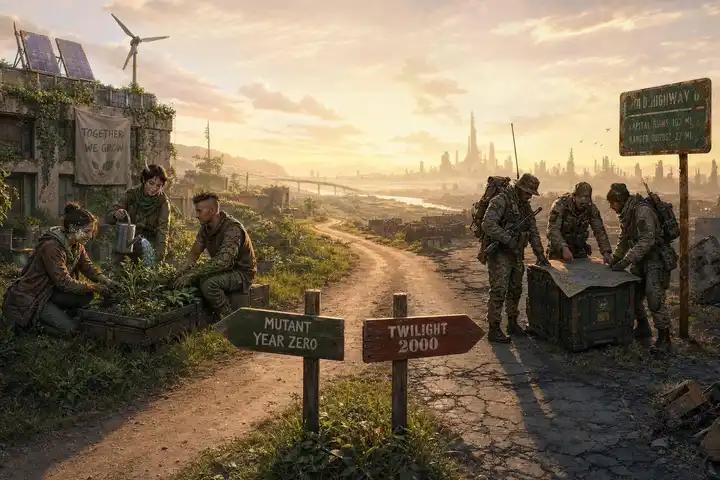
If you want a post-apocalyptic RPG with a home base, mutant powers, and lighter rules overhead, I’d pick Mutant: Year Zero. If you want ammo counts, fuel problems, vehicles, and war-zone combat, I’d pick Twilight: 2000.
Here’s the short version:
- Mutant: Year Zero is built around the Ark, a settlement your group helps shape over time.
- Twilight: 2000 is built around movement, supplies, and survival on the road.
- One game leans toward story, weird ruins, and mutations.
- The other leans toward military survival, travel rules, and hard firefights.
- In Mutant: Year Zero, the group starts the Ark with 12 points split across 4 development stats.
- In Twilight: 2000, even a single bad supply call can leave you low on fuel, food, water, or ammo.
What matters most is simple: Do you want to rebuild a settlement, or do you want to survive a shattered war zone?

Mutant: Year Zero vs. Twilight: 2000 – TTRPG Comparison Guide
A Ranking of (Nearly) EVERY Free League RPG (That Somehow Takes) 3 Hours of (Uncontroversial) Takes!
Quick Comparison
| Criteria | Mutant: Year Zero | Twilight: 2000 |
|---|---|---|
| Core focus | Ark survival and growth | Squad survival in a war-torn region |
| Tone | Weird, grim, and story-led | Serious, harsh, and military-focused |
| Rules style | d6 dice pools with push-your-luck rolls | Step dice with more tracking |
| Combat feel | Fast, lethal, mutation-driven | Lethal, cover-heavy, and more detailed |
| Travel | Zone sector scavenging | Hex travel with fuel and time pressure |
| Party identity | Mutants with set roles | Soldiers and civilians with lifepaths |
| Long campaign hook | Build up the Ark | Stay alive and keep moving |
| Best for | Groups that want base growth and odd discoveries | Groups that want logistics and tactical fights |
I see this matchup as a choice between community pressure and combat attrition. If your table wants short rules loops, strange powers, and settlement growth, Mutant: Year Zero fits better. If your table wants route planning, suppression, vehicles, and every bullet to matter, Twilight: 2000 fits better.
Mutant: Year Zero: Best for Ark Survival, Mutations, and Story-Driven Play
Mutant: Year Zero works best when the Ark matters just as much as the missions.
Setting and Tone: Mutant Enclaves and a Dangerous Zone
The world of Mutant: Year Zero is poisoned, strange, and full of things no one fully understands anymore. Players step into the roles of mutants - changed survivors living under the watch of an aging Elder in a crumbling settlement called the Ark. Beyond its walls sits the Zone, a dangerous wasteland of ruined suburbs, derelict factories, and forgotten military sites, split into 1-mile sectors packed with monsters, scavenged tech, and artifacts from the old world.
The tone is grim but odd in a fun way - more weird science fiction than grounded military drama. Campaigns tend to revolve around power struggles inside the Ark, hard calls about outsiders, trade, and trust, and the slow discovery of what wiped out civilization in the first place. In play, that means Ark politics, scavenging runs, and strange finds in the Zone all feed into each other.
Rules and Play Style: Dice Pools, Pushing Rolls, and Ark Projects
The Year Zero Engine uses d6 dice pools made up of Base, Skill, and Gear dice. A 6 counts as a success, and pushing a failed roll comes with a price: attribute trauma, Mutation Points, or broken gear. That risk-reward loop keeps every trip into the Zone tied back to the Ark's day-to-day survival.
The long campaign arc comes from Ark projects. Players pick group goals like building a palisade, setting up a water purification system, or starting a marketplace. Each one has a Work Point cost that builds across sessions. The Ark also tracks four Development Levels: Food Supply, Culture, Technology, and Warfare. At the start of the campaign, players divide 12 points across those four stats. As projects get finished, those levels go up over time. So progress doesn't just sit on a character sheet - it shows up in the settlement itself.
Combat and Characters: Fast and Lethal with Mutant Powers
Combat runs on the same dice-pool system and moves fast. Attributes can fall to zero, which leaves characters broken and out of the fight until someone heals them. So even a small fight can go bad in a hurry. The game skips detailed tactical subsystems, which keeps combat quick, deadly, and focused on what’s happening in the story.
Characters take on clear archetypal roles. The Stalker guides the group through dangerous Zone sectors. The Enforcer deals with violence and intimidation. The Gearhead fixes and upgrades equipment. The Chronicler influences morale and social dynamics.
Every character also has mutations, fueled by Mutation Points gained through trauma and risky pushed rolls. These powers can change a scene fast - a protective carapace, a brutal attack, sharper senses. Since using them ties back into that same risk loop, the survival pressure never goes away, even when a mutant starts to feel strong.
That gives Mutant: Year Zero a clear edge for campaigns centered on a home base and long-term recovery. Twilight: 2000 pushes that same survival pressure into military logistics and tactical movement.
Twilight: 2000: Best for Military Survival, Logistics, and Tactical Combat
Where Mutant: Year Zero is built around a home base, Twilight: 2000 keeps the group on the move. It works best for groups who want survival to feel like labor, where travel, supplies, and ammo shape almost every session. That makes it a stronger fit for mobile squad campaigns than for settlement-building.
After World War III: A Realistic Survival Sandbox
The setup is bleak and sharply defined: the Cold War turned hot, limited nuclear exchanges followed, and now the world is wrecked. Characters are usually stranded soldiers or civilians trying to stay alive in a broken Poland or Sweden, where supply chains, authority, and trust have all collapsed.
The tone stays serious and down to earth. Campaigns often revolve around hard calls: do you help a group of refugees when your own food is running low, or take the shorter route even though it cuts through militia-held ground? In play, the sandbox builds story from those survival choices.
Rules and Play Style: Step Dice, Travel Procedures, and Resource Tracking
Twilight: 2000 uses a step-die system instead of dice pools. Attributes and skills are rated from d6 to d12, and most tests use one attribute die plus one skill die. A result of 6 or higher counts as a success, while 10 or higher adds a second success. Even small changes in ratings can matter a lot, so differences in ability show up fast.
What sets the game apart, though, is logistics. Food, water, fuel, ammunition, and radiation exposure are all tracked as core parts of play, not as background math. If ammo starts running thin, the group has to decide whether the next fight is worth it or whether it's smarter to slip around trouble. If fuel runs out, a vehicle can become a trap sitting miles from safety. Movement uses hex-based travel procedures, so the trip itself becomes a problem to solve, with planning, detours, and constant course correction built into the game.
Combat and Characters: Tactical Firefights, Vehicles, and Military Roles
Combat in Twilight: 2000 rewards careful play. Cover, suppression, initiative timing, and hit locations all matter, and they push players to think before they fire. One well-placed hit can take a character out, especially if armor is poor and medical help isn't close. Vehicle rules add another layer, too. Trying to manage a truck or armored vehicle under fire is a tactical problem all by itself.
Character creation uses lifepaths tied to military and civilian roles. Players move through careers such as infantry, vehicle crew, medic, engineer, or civilian paths shaped by wartime experience, building characters with clear histories and useful skill sets. A squad might include a combat medic with field surgery experience, a tanker trained on heavy weapons, and a local civilian guide who knows the terrain. Those backgrounds also help create personal goals and shared history, giving the group reasons to stick together when everything else is coming apart. It fits players who want attrition, coordination, and careful battlefield decisions.
That contrast matters most in the direct comparison below.
Direct Comparison: Which Game Fits Your Group
Side-by-Side Overview: Tone, Complexity, Prep, and Campaign Shape
Put these games next to each other, and the split becomes pretty clear.
Mutant: Year Zero puts the pressure on the Ark. Twilight: 2000 puts the pressure on the road, the map, and the supplies that keep you moving.
| Feature | Mutant: Year Zero | Twilight: 2000 |
|---|---|---|
| Setting Style | Mutant enclave survival, weird ruins | Realistic WWIII military collapse |
| Rules Complexity | Medium - d6 dice pools, push mechanic | Higher - step dice, track-heavy logistics |
| Prep Load | Medium; sector tools support improvisation | Detailed; logistics and travel need planning |
| Travel Detail | Zone sector exploration | Procedural travel with fuel and time costs |
| Combat Granularity | Fast, lethal, mutation-powered | Tactical - cover, suppression, battlefield positioning |
| Campaign Goal | Rebuild the Ark, search for answers | Survive and navigate a broken war zone |
That split changes how each one feels behind the screen. In Mutant: Year Zero, prep tends to be lighter because so much of the tension comes from what happens back at the settlement. In Twilight: 2000, prep usually gets heavier because the route itself carries so much weight. Where are they going? How far is it? What will it cost in fuel, time, ammo, and wear on the group?
Survival and Combat: Community Pressure vs. Tactical Attrition
That campaign shape also changes survival and combat in a big way.
Both games are dangerous. But they hurt in different places.
In Mutant: Year Zero, scarcity hits the whole community. If the scavengers come back with nothing, the Ark stalls out. Growth slows. People feel it. Even a single pushed roll can sting: it might give you mutation points, but it can also bring trauma or damage your gear. The danger is personal, but it also spreads outward to the group and the settlement.
In Twilight: 2000, the danger is more practical and immediate. Fuel isn't just a number on a sheet. If it runs low, a vehicle can become dead weight in the wrong place at the worst time. Combat leans toward players who think ahead. Cover matters. Suppression matters. Ammo count matters. If the group waits until bullets are flying to sort that out, they're already behind.
| Survival & Combat Element | Mutant: Year Zero | Twilight: 2000 |
|---|---|---|
| Primary Scarcity | Food, water, bullets, usable artifacts | Fuel, ammunition, spare parts |
| Base-Building | Ark projects - farms, defenses, tech labs | Military camps and logistical staging points |
| Special Mechanics | Unstable mutations, push-your-luck trauma | Suppression, vehicle rules, tactical positioning |
| Lethality | High - trauma and mutation risk are constant | High - tactical attrition, realistic firefights |
Which Game Fits Your Players
If your group likes emergent storytelling, strange discoveries, and a home base that changes over time, Mutant: Year Zero is the better fit.
If your group wants grounded post-war survival where logistics can make or break a session, Twilight: 2000 makes more sense.
Conclusion: Story Tone, Rules Weight, and Survival Style Should Drive Your Choice
Your pick mostly depends on one thing: is your campaign built around a settlement, or a squad moving from place to place?
Mutant: Year Zero is a strong match for groups that want mutant powers, Ark growth, and survival that leans more into story.
Twilight: 2000 is the better match for groups that want grounded military survival, tight resource pressure, and tactical combat.
Here’s the simple rule: choose Mutant: Year Zero if you want mutations, a home base that grows over time, and faster combat. Choose Twilight: 2000 if you want soldiers, vehicles, and more detailed logistics.
If this is your first post-apocalyptic campaign, Mutant: Year Zero is the easier place to begin. If you want a harsher, simulation-heavy war zone, Twilight: 2000 makes more sense - and its free starter booklet gives you a low-risk way to try the system first.
FAQs
Which game is easier for new GMs?
Mutant: Year Zero is usually the easier pick for new GMs. Its rules are more streamlined, and the game leans hard into survival and exploration, which tends to make sessions simpler to prep and run than the heavier, more simulation-focused style of Twilight: 2000.
Twilight: 2000 is a better fit for groups that like detailed tactics and military logistics. That said, all that extra detail can feel like a lot when you're just getting started.
Can either game support a long campaign?
Yes. Both work well for long campaigns, but they do it in different ways.
Twilight: 2000 leans into careful planning, supply tracking, and day-to-day logistics. Over time, those choices add up, so a long campaign feels shaped by what the group did weeks earlier.
Mutant: Year Zero runs on momentum. Survival, resource pressure, and Ark development push the story forward, and the results stick. That gives longer campaigns a sense of change and consequence that helps keep play interesting.
Which game works better for narrative-focused groups?
Mutant: Year Zero is often the better pick for groups that care more about story. Its resource pressure and discovery rules are built to push drama and hard choices, instead of closely modeling military logistics.
The survival side of the game, including settlement management, helps define the feel of the campaign and the story it tells. Compared with Twilight: 2000, it leans more toward character-driven play and exploration, and less toward tactical realism.


