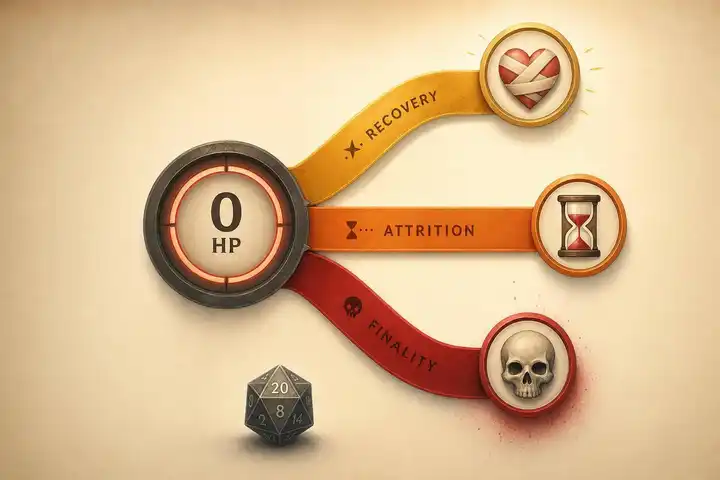
In most TTRPGs, 0 HP does not mean instant death. It usually means you enter a danger state, and what happens next depends on the game. In the six games covered here, death can come from 3 failed death saves, Dying 4, a failed CON roll, critical wounds, a bad Vigor roll, or overflow damage.
If I had to sum it up in one line, it’s this:
- D&D 5e gives you time
- Pathfinder 2e punishes repeat knockdowns
- Call of Cthulhu 7e is harsh from the start
- Warhammer Fantasy Roleplay 4e turns 0 into a death spiral
- Savage Worlds is swingy
- Shadowrun 5e makes damage stack until it kills you
That matters because the same “I’m down” moment can feel very different at the table. In one game, an ally with 1 HP of healing can fix the problem. In another, one failed roll on the next round can end the character.

TTRPG Death Mechanics Compared: 0 HP Across 6 Systems
D&D Made Death a Joke - Here Are Some Alternatives
Quick Comparison
| Game | What happens at 0 HP? | How death happens | Overall risk |
|---|---|---|---|
| D&D 5e | Unconscious, then death saves | 3 failures, extra damage, or instant death from massive damage | Moderate |
| Pathfinder 2e | Unconscious with Dying 1 or more | Death at Dying 4 | Moderate-High |
| Call of Cthulhu 7e | Unconscious or dying if a Major Wound is involved | Failed CON roll or instant death from a huge hit | Very High |
| Warhammer Fantasy Roleplay 4e | 0 Wounds leads to Critical Wounds | Untreated crits, bleeding, or lethal crit results | Very High |
| Savage Worlds | Incapacitated after more than 3 Wounds | Critical failure, then bleed-out rolls | High |
| Shadowrun 5e | Physical track fills, then Overflow starts | Overflow past Body means death | High |
Bottom line: if you want heroic recovery, look at D&D 5e. If you want mounting danger, Pathfinder 2e fits. If you want combat to feel like a bad idea, Call of Cthulhu, Warhammer, and Shadowrun do that well. Savage Worlds sits in the middle, where luck can save you or drop you fast.
Here’s the short version of how each game handles that line between “down” and “dead.”
1. Dungeons & Dragons 5e
In D&D 5e, hitting 0 HP drops a character unconscious. They fall prone, drop whatever they’re holding, and can’t move, speak, or take actions. They can still be targeted, though, which is where things get tense fast.
From there, the character makes a death saving throw at the start of each turn: a d20 roll against DC 10 with no modifiers. A 10 or higher is a success. A 9 or lower is a failure. Three successes mean the character becomes stable at 0 HP, while three failures mean the character dies.
There are two big swing results:
- A natural 20 restores 1 HP and ends the unconscious state.
- A natural 1 counts as two failed death saves.
The part that makes 5e dangerous is damage taken while already at 0 HP. Any damage adds one failed death save. And if the attack is a melee hit from within 5 feet, it becomes an automatic critical hit, which means two failed death saves from that one hit.
There’s also the massive damage rule, which can kill a character on the spot. If the hit that reduces them to 0 HP deals damage equal to or more than their hit point maximum, they die at once and skip death saves entirely. That tends to hit lower-level characters hardest, or anyone caught by a very high-damage attack.
Getting a downed character back up is simple on paper: any healing that restores at least 1 HP ends unconsciousness and wipes out their death save track. An ally can also spend an action to make a DC 10 Wisdom (Medicine) check to stabilize the character without healing. In that case, the character stays at 0 HP and remains unconscious.
That balance between recovery and sudden risk is what makes 5e a solid point of comparison. Pathfinder 2e uses a similar down-but-not-out setup, but each drop carries a steeper cost.
2. Pathfinder 2e
Pathfinder 2e is much less forgiving than D&D 5e when someone drops to 0 HP. In 5e, a character can go down, get picked up, and often jump right back into the fight. In Pathfinder 2e, each trip to the floor leaves a mark.
When a character is reduced to 0 HP by damage, they fall unconscious and gain Dying 1. If the hit was a critical hit, or if the damage came from a critical failure on a save, they start at Dying 2 instead. From there, they make a recovery check at the start of each turn: a flat d20 roll against DC 10 + current Dying.
Here’s how that check works:
- A success lowers Dying by 1.
- A critical success lowers it by 2, restores 1 HP, and wakes the character.
- A failure increases Dying by 1.
- A critical failure increases it by 2.
If a character reaches Dying 4, they die.
The part that makes Pathfinder 2e feel harsher is Wounded. Each time a character loses the dying condition, they gain Wounded 1 or increase their Wounded value by 1. So even if the party saves them, the next drop is more dangerous. A character with Wounded 2 who goes down again starts at Dying 3.
That is brutal in play. At Dying 3, the recovery DC is 13, and one failed recovery check means death. So the game pushes players to think less about “we can heal them after they fall” and more about stopping that second or third knockdown in the first place.
Wounded does not disappear on its own. A character clears it only after a successful Treat Wounds check, or after being restored to full HP and then resting for 10 minutes.
So yes, healing can keep someone alive for the moment. But it does not wipe away the danger that builds after repeat knockdowns. Call of Cthulhu 7e takes that same pressure and turns it up even more, where hitting 0 HP can lead to a much faster collapse.
3. Call of Cthulhu 7e
After Pathfinder 2e’s dying track, Call of Cthulhu strips away most of the safety net. It’s much less forgiving than D&D 5e and Pathfinder 2e: at 0 HP, a character might fall unconscious, start dying, or die on the spot.
A character’s hit points are usually the average of CON and SIZ, rounded up. If a single hit deals at least half of that total, it causes a Major Wound. That’s where things get ugly fast, because once the Major Wound rule comes into play, hitting 0 HP is only the beginning.
Here’s how it works:
- At 0 HP without a Major Wound, the character falls unconscious.
- At 0 HP with a Major Wound, the character becomes dying and makes a CON roll at the end of each following round; failure means death.
There is still a narrow window for help. First Aid, if given within about an hour, stops the CON rolls and restores 1 HP. After that, later treatment can restore more HP over time.
And then there’s the hard cutoff: a single hit that deals damage equal to or greater than maximum HP kills the character outright. No CON roll. No stabilization window.
4. Warhammer Fantasy Roleplay
Like Call of Cthulhu, Warhammer Fantasy Roleplay turns damage past 0 into a countdown. In Warhammer Fantasy Roleplay 4e, 0 Wounds is the closest match to 0 HP. But it’s not a harmless blackout. It’s the start of a death spiral.
Once a character hits 0 Wounds, they fall Prone, and any more damage turns into Critical Wounds. Those Critical Wounds stand for brutal injuries like broken bones and torn arteries. Some results are simply lethal.
If the character stays at 0 Wounds for a number of rounds equal to their Toughness Bonus, they become Unconscious. That’s when things get much worse. If an Unconscious character has more untreated Critical Wounds than their Toughness Bonus, they die at the end of the round unless at least one Critical Wound is healed in time.
Bleeding piles on even more danger. Each Bleeding condition adds a 10% chance of death at the end of each round.
Recovery needs to happen fast. A successful Heal test removes Bleeding, and extra successes clear more of it. Healing magic or prayers that restore Wounds can also remove Bleeding, one condition at a time. Once the character gets back above 0 Wounds, the critical-wound state ends. Even so, any Critical Wounds they already have still need treatment before they’re out of the woods.
In plain terms, a high Toughness Bonus gives you more breathing room. A low-TB character can crash in a hurry.
The next system changes the recovery rules, but the danger still jumps the moment a character drops.
5. Savage Worlds
Savage Worlds skips hit points entirely. Instead, player characters and major NPCs, known as Wild Cards, track Wounds. Most can take up to 3 Wounds before they become Incapacitated. Once that happens, they're out of the fight and in immediate danger of death.
As soon as a character becomes Incapacitated, they make a Vigor roll with their current Wound penalties applied. A critical failure means instant death. A normal failure means the character is Bleeding Out. From there, they must keep making Vigor rolls each round: fail and they die, succeed and they survive for another round, get a raise and they stabilize.
That same roll also decides whether they suffer an Injury Table result. On a failure, the injury lasts as long as the character stays Incapacitated. On a success, it goes away once all Wounds are healed. On a raise, it clears after 24 hours or when all Wounds are healed.
The big safety valve before any of that is the Soak roll. If a hit would cause a Wound, the player can spend a Benny to roll Vigor and try to cut down the damage before the Wounds land. Each success on the Soak roll removes one Wound.
If a character is already Bleeding Out, an ally still has a shot to save them. A successful Healing roll stabilizes the victim right away. Healing can also remove Wounds: 1 on a success and 2 on a raise, as long as the healer reaches them in time. After that, long-term recovery plays out over days.
This makes Savage Worlds feel swingy in play. A Benny and a good Soak roll can wipe away damage in a flash. But once a character is Incapacitated, things can go south fast, and a single bad roll can be the end. Shadowrun takes a different path, but it keeps that same high-stakes pressure.
6. Shadowrun
Shadowrun keeps the same lethal pressure as Savage Worlds, but it handles it in a different way. Instead of hinging on one incapacitation roll, the game tracks harm as damage that builds up over time.
There are no standard HP pools here. Shadowrun uses separate Stun and Physical Condition Monitors. When the Stun track fills up, the character drops unconscious. Any extra Stun then spills over into Physical damage. So even tasers and other Stun-based attacks can turn nasty if enough excess damage crosses that line into Physical.
The Physical track is what decides whether a character is at death’s door. In Shadowrun 5e, the Physical track is 8 + (Body ÷ 2, rounded up) boxes, and the Overflow track equals the character’s Body attribute. Once the Physical track is full, extra damage goes into Overflow. If Overflow goes past Body, the character dies on the spot. If it stays at or below Body, they’re still alive, but they’re in immediate danger.
Here’s what that looks like in play: a runner with Body 4 and 10 Physical boxes who takes 12 Physical damage ends up with 2 Overflow.
At that point, staying alive comes down to fast stabilization. A Trauma Patch, a Biotechnology test, or the Stabilize spell can stop the bleed-out. After that, medicine or magic can heal damage boxes and bring Overflow back down.
Pros and Cons by Play Style
This isn't just about who dies at 0 HP. It's about what hitting 0 HP means at the table. Does it create tension? Does it push players to act with care? Or does it set up a big last-second comeback?
D&D 5e is the most forgiving game here. Death saves give characters a few chances to hang on, and even 1 HP is enough to get someone back into the fight. That makes room for dramatic, movie-style recoveries. The downside is the familiar down-up-down-up loop, where danger can start to feel less sharp than it should. It can still turn hard in a hurry, though. A natural 1 on a death save counts as two failures, so one bad roll can shove a character much closer to death.
Pathfinder 2e feels much tighter. When a character drops to 0 HP, they gain Dying 1, or Dying 2 on a critical hit, and if they get back up, they also pick up Wounded. That means the next fall is more dangerous than the last. Repeated knockdowns are a big deal here. Put simply, it's a harsher, more tactical take on D&D's downed-state cycle.
At the far lethal end, Call of Cthulhu 7e doesn't mess around. A Major Wound can send a character into the dying state, and each failed CON roll can kill them. Warhammer Fantasy Roleplay is just as harsh in its own way. Hitting 0 Wounds starts a steep drop into Critical Wounds, and enough critical injury can mean death by the end of the round. In both games, 0 HP isn't a pause before recovery. It's the start of a countdown. That fits horror and grimdark play very well, but it's rough on groups that want characters to stick around for the long haul.
Savage Worlds lands somewhere in the middle. Bennies and Soak rolls give players a real shot at avoiding a collapse, which helps keep the tone pulpy and cinematic. The catch is balance. Hand out too many Bennies and fights lose their edge. Hand out too few and things get deadly fast. Shadowrun goes in a grittier direction. Damage stacks across Stun and Physical tracks, healing is slow, and overflow rules make direct firefights risky unless the team plans ahead. Both games can be lethal, but they get there in different ways: one through swingy recovery rolls, the other through steady damage that adds up.
The table below shows where each system lands:
| Game | Main Strengths | Main Drawbacks | Best Fit |
|---|---|---|---|
| D&D 5e | Forgiving; dramatic death save moments; clear rules | Down-and-up cycle; swingy outcomes; can undermine tension | Heroic fantasy |
| Pathfinder 2e | Escalating danger; rewards tactics; transparent risk | Heavy bookkeeping; punishing repeated drops | Tactical challenge |
| Call of Cthulhu 7e | High lethality; reinforces horror tone; combat avoidance feels earned | Frequent character turnover; limited in-combat recovery | Horror investigation |
| Warhammer Fantasy Roleplay | Brutal atmosphere; critical wounds matter; grimdark tone | High lethality may frustrate some players | Grimdark survival |
| Savage Worlds | Pulpy resilience; Bennies add player agency; fast-paced | Benny balance is tricky; death can feel toothless or sudden | Cinematic action |
| Shadowrun | Gritty realism; rewards planning; dual damage tracks | Slow healing; complex bookkeeping; high lethality | Cyberpunk black-ops |
So the main choice is pretty simple: do you want 0 HP to feel forgiving, punishing, or almost final?
Conclusion
What matters most is what 0 HP means at your table.
On the forgiving side, D&D 5e treats 0 HP more like a dramatic beat than an ending. Death saves give characters breathing room, healing is easy to find, and spells like Revivify make permanent loss fairly rare in many games. The result is a more cinematic style of play. If your group likes bold heroes, big swings, and the sense that characters can survive dangerous moments, 5e supports that well.
A step harsher, Pathfinder 2e adds more pressure without turning every fight into a death sentence. The dying and wounded conditions make each trip to the ground riskier than the last. That setup works well for groups that want survival to feel earned, not guaranteed.
At the far deadlier end, Call of Cthulhu 7e plays by very different rules. HP totals are low, damage is brutal, and reaching 0 HP is often a disaster. That fragility isn't a flaw. It's part of what makes the horror land.
Warhammer Fantasy Roleplay sits close to that same deadly edge. Hitting 0 Wounds can start a brutal chain of critical injuries and death checks. Savage Worlds lands closer to the middle. Bennies and Soak rolls help keep things cinematic, but one bad Vigor roll can still take a character out. Shadowrun leans gritty, with damage spread across two tracks and overflow damage that can kill fast and without much warning.
Put simply, D&D 5e leans heroic, Pathfinder 2e rewards caution, and Call of Cthulhu 7e is plainly lethal. Savage Worlds, Warhammer Fantasy Roleplay, and Shadowrun all make defeat hurt, just in different ways. The best choice comes down to the kind of tension your group wants: recovery, attrition, or finality.
FAQs
Which game is most forgiving at 0 HP?
There isn’t one game that stands out as the most forgiving at 0 HP.
The Black Hack is often seen as less deadly, but not because 0 HP gets special treatment. The main reason is that low HP tends to make players more careful, which can lead to fewer character deaths.
Phoenix Command sits at the other end of the spectrum. It’s openly brutal, and a single hit can take a character out.
Endure works differently from both. It doesn’t use standard HP, so survival isn’t tied to a usual 0 HP rule at all. Instead, staying alive depends on a different set of mechanics.
Which systems make repeat knockdowns more dangerous?
In Pathfinder 2e, getting knocked down more than once is a lot more dangerous because of the dying and wounded conditions.
When you hit 0 HP, you gain dying. If you stabilize, get back up, and then go down again, you come back with dying plus wounded. That’s the nasty part: wounded adds to your dying value each time you fall, so each repeat knockdown pushes you closer to permanent death.
How should GMs choose a death mechanic for their table?
Start with your group’s comfort level for survival play and resource management. If your players like tracking spell slots, ammunition, and similar details, a more detailed death mechanic can be a good fit. If they’d rather skip the bookkeeping, a simpler system usually works better.
You’ll also want to match the mechanic to your campaign’s tone, your session length, and whether the table leans more toward tactical balance or story-driven drama. Start simple, then tweak it as you go so the tension stays fun instead of turning into a chore.


