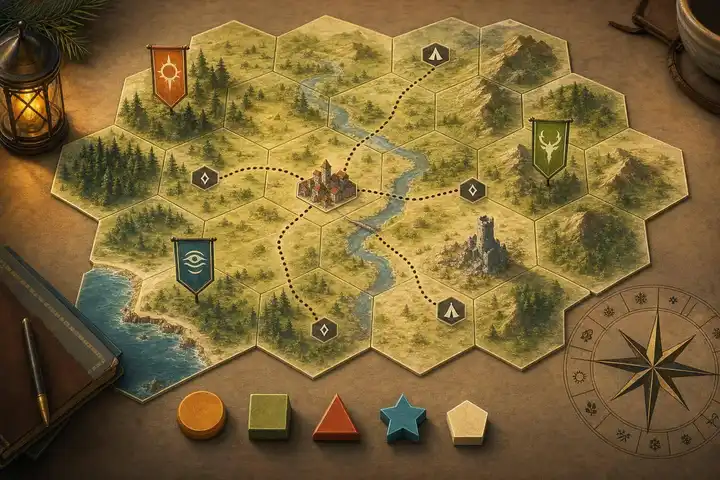
If I had to give the short answer: Old-School Essentials and Worlds Without Number fit the format best out of the box, Forbidden Lands is best if you want travel to feel hard, 5e is easiest to fill seats for, and Dungeon Crawl Classics works best if your group is fine with lots of death.
A West Marches game lives or dies on a few things: travel rules, easy drop-in play, fast replacement characters, a home base, and a world that changes between sessions. In the article, I compare five games - Old-School Essentials, D&D 5e, Worlds Without Number, Forbidden Lands, and Dungeon Crawl Classics - using those exact tests.
Here’s the core takeaway in plain English:
- Old-School Essentials: best for strict expedition play, supply pressure, and easy character replacement
- D&D 5e: best for player familiarity, but the GM has to add more travel and map procedure
- Worlds Without Number: best for sandbox play plus between-session faction movement
- Forbidden Lands: best for hex travel, survival, and a shared base that matters
- Dungeon Crawl Classics: best for tables that want funnels, chaos, and high mortality
The article also looks at hard numbers that shape play, like 24 miles per day in OSE, 18/24/30 miles per day in 5e by pace, OSE’s 1-in-6 to 3-in-6 encounter checks by terrain, and DCC’s 2–4 starting 0-level characters per player.

Best TTRPGs for West Marches Campaigns: System Comparison Guide
West Marches Campaign Guidebook | OSR Sandbox Playstyle Explained! GM Tips, Hex Crawls & Open Table
Quick Comparison
| System | Best use at a West Marches table | Main issue |
|---|---|---|
| Old-School Essentials | Expedition play, attrition, rotating groups | GM must handle faction movement by hand |
| D&D 5e | Easy onboarding and drop-in recruitment | Travel can get handwaved without extra rules |
| Worlds Without Number | Sandbox play and world movement between sessions | More campaign parts to track |
| Forbidden Lands | Survival travel and hex-by-hex journeys | More session-by-session tracking |
| Dungeon Crawl Classics | High-turnover play and lethal expeditions | Hexcrawl frame needs GM work |
If you want a simple way to choose: pick OSE for old-school pressure, WWN for sandbox campaign tools, Forbidden Lands for harsh travel, 5e for easy player buy-in, and DCC for lethal weirdness. That’s the article in one pass.
1. Old-School Essentials
Old-School Essentials (OSE) is one of the cleanest fits for West Marches play. It works well because it leans into self-contained, resource-driven expeditions. The rules handle dungeon travel, wilderness travel, and even stronghold building, which lines up neatly with the open-world structure a West Marches GM needs.
Travel rules do a lot of heavy lifting here. A character with a base movement rate of 120 feet can travel up to 24 miles per day in normal terrain. That drops by 33% in broken lands, deserts, forests, and hills, and by 50% in jungles, mountains, and swamps. Roads increase daily distance by 50%. And after every six days of travel, characters need one full day of rest or they take a –1 penalty to attack and damage rolls until they recover. In plain English: route planning and supply use matter.
Wandering encounters add even more pressure. Checks range from 1-in-6 in clear or settled lands to 2-in-6 in forests and hills, then 3-in-6 in jungles, mountains, and swamps. That risk curve pushes players to think hard about where they go, how far they push, and whether the shortcut is worth it. That's a big part of the West Marches rhythm.
Rotating attendance also fits OSE with very little friction. Characters are quick to make, and the game doesn't demand a fixed party setup. Retainers help cover gaps when the usual mix of players doesn't show up, and because they're recruited in-world, they feel like part of the campaign instead of a patch. Their loyalty checks, rolled on 2d6, also give those relationships some tension. If a character dies, the campaign doesn't need to bend around it. A new character can simply arrive in the home settlement and join the next expedition.
The main weak spot is faction and domain play. OSE gives you reaction rolls, morale, and rules for NPC behavior, but it doesn't include a built-in faction turn or a detailed domain-management system. So if you want between-session faction movement, the GM has to track that on their own. OSE is strong on table procedures, but it leans on the GM for campaign-side bookkeeping.
2. Dungeons & Dragons 5e
Where OSE gives the GM more built-in procedure, 5e leans more on rulings at the table. D&D 5e is also familiar to a big pool of players, which makes drop-in sessions easier to run. The trade-off is pretty clear: 5e leans toward heroic encounters more than procedural wilderness play.
The official pace table splits overland movement into three speeds.
| Pace | Distance per hour | Distance per day | Effect |
|---|---|---|---|
| Fast | 4 miles | 30 miles | −5 penalty to passive Wisdom (Perception) |
| Normal | 3 miles | 24 miles | No special effect |
| Slow | 2 miles | 18 miles | Characters can use stealth |
Difficult terrain cuts those distances in half, and travel beyond 8 hours can lead to exhaustion. So yes, the travel rules work. But they don't quite give you a full West Marches hexcrawl on their own.
That gap matters. 5e doesn't come with a built-in hexcrawl engine, so hex reveals, navigation checks, and supply tracking all land on the GM. In one West Marches setup, the GM used one navigation roll for each four-hour watch outside town, then split the results between encounters and special events.
Faction play has a similar issue. 5e doesn't include a full faction-turn system, which means the GM has to track each faction's goals and actions by hand. A simple way to handle it is to give each faction:
- one active objective
- one obstacle
- one thing it does between expeditions
Then let player choices push those pieces around over time.
Character turnover is 5e's other big strength in this format. It works best with a shared level policy and a fixed home base. Because 5e characters are fairly durable, you need clear rules for joining, missing sessions, and returning later if you want a drop-in/drop-out campaign to stay easy to run.
3. Worlds Without Number
WWN lands in the middle of OSE’s tight old-school procedures and 5e’s looser travel rules. OSE leans hard on resource tracking. 5e leaves more to table rulings. WWN, by contrast, is built for sandbox campaigns that need both step-by-step exploration and world movement between sessions.
That matters for West Marches play. The game supports open-world travel, rotating groups, and low-prep campaign management in ways the other two don’t fully handle out of the box.
One of WWN’s clearest strengths is its faction system. Factions can chase goals, move assets, and change the campaign world between sessions, so the setting doesn’t sit still when different players show up from week to week. The rules also suggest keeping only three or four active factions in focus, which helps keep campaign management under control.
Character creation is also quick enough for a rotating table. Players use rolled stats or a fixed array, then pick a background and class. That makes replacement characters easy to bring in without a long setup process.
WWN also gives you a structured overland travel framework. It covers movement rates, terrain, supplies, shelter, fire fuel, and foraging. For a West Marches campaign, the GM still has to make a few big calls: map scale, navigation checks, encounter frequency, encumbrance, and how to deal with safe return routes and absent characters. If you want to try it before spending money, there’s a free edition.
WWN is a strong fit for procedural exploration, faction movement, and rotating attendance.
| West Marches demand | What WWN provides | What the GM must add |
|---|---|---|
| Hexcrawl exploration | Region procedures, ruins, communities, location tags | Regional map, scale, landmarks, player-facing rumors |
| Travel pressure | Movement rates, terrain, supplies, shelter, foraging | Navigation rules, encounter frequency, encumbrance |
| Character turnover | Fast creation; attributes, backgrounds, skills, classes | Replacement policy, starting level, absent-character handling |
| Faction play | Faction turns; objectives; assets | Which factions matter, goals, player-facing outcomes |
That mix of structure and flexibility makes WWN a useful benchmark before moving to harsher survival-focused systems.
4. Forbidden Lands
Forbidden Lands is a strong fit for a West Marches sandbox because it assumes hex-by-hex wilderness travel instead of a set adventure path. That lines up with three big West Marches needs right away: hexcrawling, survival pressure, and a rotating player group. In practice, that means the travel rules do a lot of the heavy lifting.
Each quarter day, characters pick an activity such as Hike, Lead the Way, Keep Watch, Forage, Hunt, Make Camp, Sleep, or Rest, and the terrain decides how far they can go. Movement is easy to track: two hexes per quarter day in open land, one hex in rough terrain, and more on horseback. That gives every trip a clear rhythm without forcing the GM to do a pile of prep. Exploration stays front and center instead of feeling like dead space between set pieces.
The push-your-luck dice system adds tension to every expedition. Players build a dice pool from attributes, skills, and gear. If a roll fails, they can push it and reroll the failed dice, but any 1s on the pushed roll can damage attributes or equipment. That sting matters in West Marches play because party condition needs to carry from one session to the next. If a group limps home battered, the campaign should remember that. Forbidden Lands does.
The stronghold system helps with that sense of continuity too. It gives rotating players a shared base to return to and a place to spend treasure on upgrades. Different groups can head out, come back, restock, and make plans from the same home base. That shared location ties the campaign together, even when the roster changes from session to session.
| West Marches demand | What Forbidden Lands provides | What the GM must add |
|---|---|---|
| Hexcrawl exploration | Hex movement, terrain rates, travel roles, quarter-day structure | Regional map, landmarks, rumors |
| Travel pressure | Food, water, time, fatigue, weather, encumbrance, push-your-luck rolls, mishaps | Navigation, encounter frequency |
| Character turnover | Dangerous expeditions and a persistent campaign structure | Attendance and replacement rules |
| Faction play | Settlements, ruins, contested territory, stronghold development | Faction sheets and between-session turns |
Where the rules stop is campaign procedure. The GM still needs to decide how to handle absent players, replacement characters, and faction turns between sessions. If your group likes this expedition-first style but wants even more danger, the next system turns that dial up.
5. Dungeon Crawl Classics
Where Forbidden Lands leans on structured survival, DCC puts that same pressure on the table through randomness and fragile characters.
DCC is a natural fit for a West Marches setup because of its 0-level funnel. Each player begins with 2–4 expendable characters, and the ones who live become the campaign roster. Once those survivors earn 10 XP, they move up to 1st level.
That setup solves a common West Marches problem: turnover. Characters die. New ones step in. The campaign keeps moving.
DCC also gives the Judge some basic tools for wilderness expeditions, but it doesn't hand over a full hexcrawl engine. If you want that style of play, the Judge still needs to build the frame around it. That means adding:
- map scale
- keyed hexes
- navigation rules
- terrain modifiers
- encounter cadence
- revisit procedures
You'll also want to track routes, encounters, and explored hexes on a shared map. That's what helps the world feel persistent from one group to the next.
Travel pressure in DCC comes from a different place than it does in systems with tighter overland rules. Here, the danger comes from fragile characters, thin resources, deadly encounters, and swingy magic. In other words, the road feels harsh because the people on it are easy to break. If you're running an open-table game, it also helps to end each session in a secure settlement so the next group knows exactly where the last party stopped.
Faction play has good raw ingredients, too. DCC's alignments, patrons, spirits, and divine aid give the Judge plenty to work with. But those pieces don't turn into faction play on their own. The Judge still needs to build actual groups with names, goals, territory, and actions that happen between sessions.
| West Marches demand | What DCC provides directly | What the Judge must add |
|---|---|---|
| Hexcrawl exploration | Basic wilderness-expedition tools, random generation, modular scenarios | Map scale, keyed hexes, navigation, terrain, encounter cadence |
| Travel pressure | Fragile characters, limited resources, dangerous encounters, swingy magic | Food, water, light, fatigue, camping, rest procedures |
| Character turnover | 0-level funnel, multiple starting characters, high mortality | Replacement policy, reserve roster, mid-session entry rules |
| Faction play | Law, Neutrality, and Chaos alignment, patrons, spirits, divine aid | Named factions, goals, territories, between-session actions |
That tradeoff leads into the cross-system comparison below.
How Each System Handles Key West Marches Demands
No single system nails every part of a West Marches campaign. Each one does some jobs well, misses others, and leaves a few things in the GM’s hands.
The table below breaks that down across the four pressures that matter most in play: exploration, travel, character turnover, and faction fallout.
| System | Exploration & Hexcrawling | Travel, Supplies & Rest | Character Turnover | Factions & Consequences |
|---|---|---|---|---|
| Old-School Essentials | Strong - built-in exploration and attrition rules | Strong - encumbrance, light, and food create real pressure | Strong - simple characters and retainers suit drop-in/drop-out groups | Moderate - persistent change works, but faction tracking falls to the GM |
| D&D 5e | Moderate - travel rules exist, but hexcrawl procedures need GM additions | Moderate - rest and exhaustion rules are present but often go unenforced | Moderate - accessible rules help onboarding, but power gaps need a clear policy | GM-dependent - faction clocks and consequences need added procedures |
| Worlds Without Number | Strong - sandbox generation and exploration tools built for regional play | Mostly strong - flexible travel tools work well when the GM decides how strictly to apply them | Strong - modular objectives and manageable entry points support drop-in/drop-out groups | Strong - built-in faction play and sandbox structure |
| Forbidden Lands | Strong - journey procedures make travel a central activity | Strong - party roles, supplies, and strongholds reinforce attrition | Moderate - replacement characters have a natural place, but continuity tracking matters | Strong - reputation, strongholds, and faction reactions create lasting consequences |
| Dungeon Crawl Classics | Moderate - old-school adventure supports exploration, but the hexcrawl layer needs GM definition | Moderate - lethal play creates pressure, though travel procedures may need additions | Strong - funnels and high mortality make turnover part of the game's identity | Moderate - patrons, cults, and campaign consequences work well but rely on GM design |
The biggest divide here is simple: some systems build pressure into the rules, while others expect the GM to create it through rulings.
Old-School Essentials and Forbidden Lands make attrition part of normal play. Food, light, load, and the trip itself aren’t side notes - they’re part of the game loop. D&D 5e has many of the same parts on paper, but long rests can drain a lot of the tension from an expedition unless the GM puts clear limits on safe recovery.
Worlds Without Number stands out for a different reason. Its built-in faction-turn procedure lets the setting keep moving between sessions, which is a big deal in West Marches play. The world doesn’t just wait around for the party to come back; it changes on its own, without the GM having to invent a separate system for that work.
That’s where the tradeoff starts to show. A system might be easier to learn, but ask for more setup. Another might do more out of the box, but ask the group to buy into harsher pressure from the start.
Pros and Cons for West Marches Play
All five systems can handle West Marches play. The main difference is simpler: what does each one ask the GM to keep track of? That’s the part that changes the feel at the table.
This quick guide boils the earlier comparison down to four big pressure points: exploration, travel, character turnover, and faction fallout.
| System | Biggest Strength | Biggest Weakness | Best For | Watch Out For |
|---|---|---|---|---|
| Old-School Essentials | Lightweight procedures and meaningful risk | Lower accessibility for players used to modern games | OSR groups that want fast, dangerous play | Sudden character death |
| Dungeons & Dragons 5e | Easy recruitment | Light on procedure | Easy drop-in play with mixed-experience groups | Travel becoming handwaved |
| Worlds Without Number | Strong sandbox and faction tools | More subsystems to maintain between sessions | GMs who want a reactive open world | Overbuilding the campaign |
| Forbidden Lands | Journey-first survival play | More tracking each session | Groups that want wilderness travel as the main challenge | Stranded characters between sessions |
| Dungeon Crawl Classics | Funnels make turnover part of play | Less turnkey support for wilderness and campaign administration | Players who want high-risk, strange expeditions | Replacement funnels that require extra scheduling |
In practice, the choice often comes down to your table’s biggest limit. If you want easy onboarding, Dungeons & Dragons 5e has a clear edge. If you want travel and risk to matter every session, Forbidden Lands and Old-School Essentials stand out in different ways. If you want the world to push back between sessions, Worlds Without Number gives the GM more levers to pull. And if your group likes chaos, loss, and weird expedition energy, Dungeon Crawl Classics leans into that from the start.
Conclusion
The best fit comes down to how much structure, danger, and drop-in freedom your table wants.
Old-School Essentials works well for fast, risky play where replacing a dead character is simple. Dungeons & Dragons 5e is the easiest starting point for groups with mixed experience, but the GM will need to bolt on travel rules and faction procedures. Worlds Without Number stands out if you want direct sandbox tools and a world that keeps moving between sessions. Forbidden Lands is the top choice when travel and survival drive each trip into the wild. Dungeon Crawl Classics fits groups that are fine with frequent character death and chaotic, swingy expeditions.
The biggest difference between these games isn't the setting or the dice mechanics. It's how much campaign structure the GM has to provide. In a West Marches game, the ruleset helps, sure - but the table procedures do most of the heavy lifting. That's the real test.
| Procedure | Function |
|---|---|
| Home-base rule | Sessions start and end at the hub |
| Shared map with consistent scale | One canonical map tracks discoveries, routes, and danger markers |
| Party-formation and scheduling rules | Players propose expeditions with a destination and date |
| Absent-character policy | Defines what happens when a player misses a session |
| Expedition reports | Short post-session summaries keep the wider group informed |
| Advancement and treasure policies | Transparent, portable rewards handle irregular attendance |
| World ledger | Tracks faction goals, NPC attitudes, territory changes, and expedition consequences |
Once those basics are set, the system can do its part without much friction. Pick the game that matches your group's taste for lethality, travel, and GM prep. Then put the right procedures around it.
FAQs
Which game is best for a beginner West Marches GM?
For a beginner West Marches GM, Dungeon Crawl Classics is a strong pick. It works well for short, self-contained sessions with very little that needs to carry over from one game to the next. That makes it a good fit for rotating attendance and drop-in play.
The rules are also light, so they tend to fade into the background at the table. You’re not spending the whole session looking things up or managing a pile of edge cases. Instead, the focus stays where it should: on player-led exploration, risk-taking, and the fun of finding out what’s around the next corner.
How much extra prep does each system need?
Based on the TTRPG Games Directory entries, Worlds Without Number, Five Torches Deep, and OSRIC are all marked as low-prep.
Worlds Without Number also stands out for its extensive GM generation tools, which can make session planning a lot easier.
Dungeon Crawl Classics is the outlier. It’s listed as medium prep and has a 5/5 complexity rating.
Old-School Essentials and Forbidden Lands don’t have prep levels listed in the provided results.
What table rules matter most in West Marches play?
In West Marches, the table rules that matter most are the ones that keep play easy to join and easy to leave. That usually means lightweight procedures for drop-in/drop-out scheduling, plus strong travel and exploration rules that make scouting, route planning, and risk calls feel like they matter.
You’ll also want rules that support:
- resource use and encumbrance pressure
- smooth character turnover
- faction play in a shared world that keeps changing
If those pieces are in place, the game starts to do what West Marches does best: players make plans, weigh danger, and live with the results.


