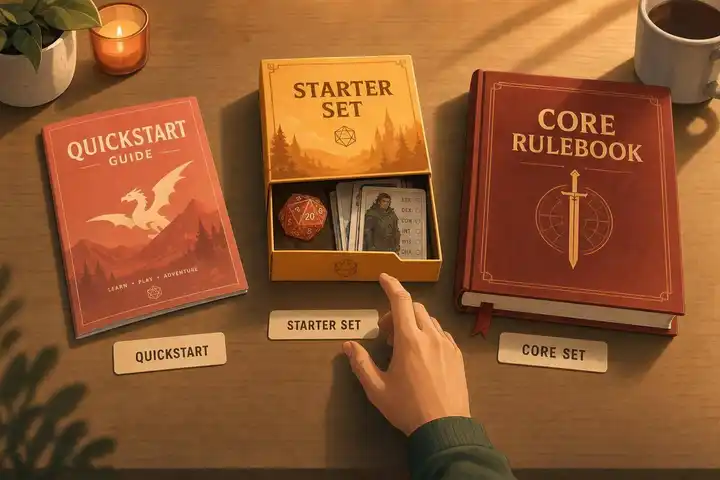
If I want the short answer: most first-time groups should buy a starter set. It usually gives me the best mix of low prep, lower cost, and enough stuff to run my first few sessions. If I only want to test a game, I’d start with a quickstart. If I already know my group plans to play for months, I’d go straight to the core set.
Here’s the simple breakdown:
- Quickstart: best for a cheap test run, often free to $10
- Starter set: best for most new groups, usually $20 to $30
- Core set: best for long campaign play, often $50 to $70+
What I’d check before buying:
- Price
- How much reading I want to do
- Whether my group is likely to stick with it
- Whether I want one session or a full campaign
- What comes in the box or PDF like dice, pregens, and an adventure
A few facts stand out fast:
- Starter sets often include trimmed rules, pregenerated characters, dice, and a short adventure
- Quickstarts often skip physical items and are usually PDFs
- Core sets give me full character options, leveling, GM tools, and long-term play support

Quickstart vs Starter Set vs Core Set: TTRPG Buying Guide
What is a Starter Set, and should you buy one?
Quick Comparison
| Product | Best for | Usual price | What I get | Main tradeoff |
|---|---|---|---|---|
| Quickstart | One-night test | $0–$10 | Short rules, pregens, sample adventure | I may need my own dice and supplies |
| Starter Set | First real game | $20–$30 | Intro rules, adventure, pregens, often dice/maps | I’ll outgrow it if my group keeps playing |
| Core Set | Long campaign | $50–$70+ | Full rules, character building, GM tools | More reading, more prep, more money up front |
My rule of thumb is simple: buy for session one, not for the hobby version I picture later. That keeps cost down, cuts setup work, and helps my group get to the table before rule fatigue sets in.
Starter Set: The Easiest Way to Play Your First Game
If you want the simplest first session, start with a starter set. It’s the fastest way to get a new group to the table with very little prep.
What a Starter Set Usually Includes
Starter sets change from game to game, but most of them include the same core pieces. You’ll usually get a condensed rulebook - often around 30–60 pages - that covers the basics of low-level play, plus a beginner-friendly adventure, pregenerated characters, and at least one set of polyhedral dice.
The classic D&D Starter Set is a good example. It comes with a 32-page rulebook, a 64-page adventure book (Lost Mine of Phandelver), five pregenerated characters, and six polyhedral dice.
The Call of Cthulhu Starter Set takes a different approach. It begins with a solo, choose-your-own-adventure tutorial called Alone Against the Flames. That short story teaches the rules as you play, so you can learn the game before sitting down with a group.
That’s the big draw of a starter set: the adventure usually teaches the rules in context. You’re not trying to memorize a whole book first. Instead, sidebars explain mechanics right when they matter, the GM gets read-aloud text, and the adventure often has natural stopping points that fit a 2–4 hour first session.
Who Should Buy a Starter Set
A starter set makes sense if your group is new, your budget is tight, or you just want to test the game before buying the full rules. It also works well for families, casual friend groups, or anyone who wants to open a box on a Friday night and play, not spend the whole evening reading.
For most major titles, a starter set costs about $20–$30. That’s much less than buying a full set of core books, and it still gives you enough material for more than one session. In plain terms, it’s a low-risk way to see if the game clicks before you spend more on the full books.
If you already know you’ll want more than the intro experience, the next step is deciding whether the full rules make sense for your group.
Core Set: The Right Choice if You Plan to Keep Playing
A core set is the full rules package for people who want to keep going, not just try one intro night. Unlike a starter set, it supports full campaign play. And that changes what you get in the box or book.
What a Core Set Gives You That Others Don't
The biggest difference is simple: more game.
A core set includes full character creation rules, complete advancement paths, and a much larger range of classes, abilities, spells, and equipment. In Pathfinder 2e, for example, the Beginner Box limits advancement to a handful of classes and a few levels, while the Core Rulebook opens up the full roster of ancestries, classes, feats, and leveling rules for long-term campaigns.
It also puts more on the GM's side of the table. Instead of giving you one built-in teaching adventure, core sets tend to give you the tools to run the game over time. That usually means things like:
- monster lists
- encounter-building guidance
- worldbuilding advice
- GM procedures for longer campaigns
Some core sets also include extras like GM screens, reference cards, or digital access.
This is the version to buy when you know you want the complete game, not just a test drive.
When a Core Set Is Worth the Higher Up-Front Cost
A core set costs more up front, but for active groups, that price can make sense fast.
It’s a smart buy when your group already knows it likes the game and wants to keep playing after a short intro campaign. If you’ve finished a starter adventure and everyone is asking, "what's next?" that’s usually the moment to move up.
It also fits best when someone is ready to GM on a regular basis, plan sessions, and build original adventures. For many major titles, the higher up-front cost is usually around $40 to $70, and that can work out well over time for groups that play weekly or monthly because the cost per session drops.
A core set is the right first purchase only if you expect to play more than once or twice.
If you’re not ready for the full rules yet, a quickstart is the cheaper way to test the game first.
Quickstart: The Cheapest Way to Try a Game Before Committing
A quickstart is usually a free or low-cost PDF that gives you enough rules and a short adventure to try a game before buying more. In plain English: it’s the fastest, lowest-cost way to see if a system clicks without picking up the full box or main books. You can use it to test the game first, then decide if it’s worth spending money on a starter set or core set.
What You Get in a Quickstart
Most quickstarts come with condensed rules, pregenerated characters, a short adventure, and a reference sheet - enough for a group to sit down and play that same night.
What’s usually missing? Physical extras. Quickstarts often do not include dice, maps, or miniatures. If the PDF has a map, it’s often a simple diagram you can print at home or pull up on a screen. That’s part of how the cost stays low, but it also means your group needs to bring its own dice and a few basic supplies.
Who Should Start With a Quickstart
A quickstart makes sense if you don’t want to spend much on a game you haven’t tried yet. It works best for a one-night test session, especially when someone at the table already has dice and a bit of TTRPG experience. After that, you can compare your budget, how much time you want to put in, your comfort with the rules, and what kind of play you want before buying more.
How to Choose: What to Check Before You Buy
Now that you know what each product tends to include, the next step is simple: pick the smallest product that gets your first session to the table.
That matters more than most people think. A lot of new buyers shop for the version of the hobby they hope to have six months from now. But your first goal is much smaller than that. You just need enough to run session one without stress.
4 Filters to Help You Decide: Budget, Commitment, Rules Comfort, and Play Goals
Start with budget. This usually narrows the field fast.
- Free or under $10 usually points to a quickstart.
- $20–$30 usually points to a starter set.
- $50–$70+ usually makes sense only if your group already knows it wants to keep going.
Next, think about commitment. If you're not sure your group will stick with the game, it's smart to skip the core set for now. Buying a full rule library before anyone has played can feel a bit like buying a full home gym before your first workout.
After that, check your rules comfort. If reading a full rulebook before session one sounds tiring, don't force it. A starter set or quickstart is often a much easier on-ramp.
Then look at your first-session goals. A one-shot, test night, or casual trial run usually points to a quickstart or starter set. If the group wants a long campaign, you'll likely want the core rules later.
Buying Checklist and Comparison Table
If you're still on the fence, run through this short check before you buy:
- Does it include a ready-to-run adventure?
- Does it include pregenerated characters?
- Does it include dice or other physical components?
- Does it cover the number of sessions you want right now?
| Quickstart | Starter Set | Core Set | |
|---|---|---|---|
| Price range (USD) | $0–$10; often free PDF | $20–$30 | $50–$70+ |
| Rule depth | Condensed demo rules | Intro-level, simplified rules | Full rules system |
| Included components | Short rules summary, brief adventure, pregenerated characters; usually no physical extras | Rulebook, adventure, pregenerated characters, dice, maps/handouts | Core rulebook(s), setting info; accessories vary |
| Prep required | Very low to moderate | Low | High |
| Best fit | One-shot test session, budget-conscious buyers | New GM and players wanting several sessions with minimal prep | Committed group planning a long-term campaign |
Conclusion: Buy for Session One, Not Your Entire Hobby Future
The biggest mistake new buyers make is shopping for the hobby they imagine instead of the session they are actually planning.
A better move: start small, play once, then upgrade if the group sticks. You can always buy the core rules later. Money spent on books that never make it to the table is much harder to get back.
FAQs
Can I start with a starter set and skip the quickstart?
Yes. A starter set is usually an all-in-one intro box that gives you what you need to start playing right away.
That often includes:
- simpler rules
- pre-generated characters
- a ready-to-run adventure
A quickstart is mostly a preview. It helps you test a game before you decide to buy in.
If you already know which system you want, a starter set gives you a full base for your first game without making you pick up anything else.
What if my group wants to keep playing after the starter set ends?
If your group wants to keep going after a starter set, the next step is usually the core rulebook for that system.
That book tends to include the full rules for character creation, long-term progression, and extended storytelling that starter sets often trim down or skip. Once everyone feels comfortable, you can also bring in optional advanced mechanics or homebrewed content.
Do I need to buy extra dice or supplies with a quickstart?
It depends on the game system.
Some quickstarts use standard dice. Others need polyhedral dice. And some skip dice altogether and use tokens or other pieces instead.
Before you buy anything extra, check your quickstart and see what it calls for. If it uses its own system, you may not need standard dice at all.


