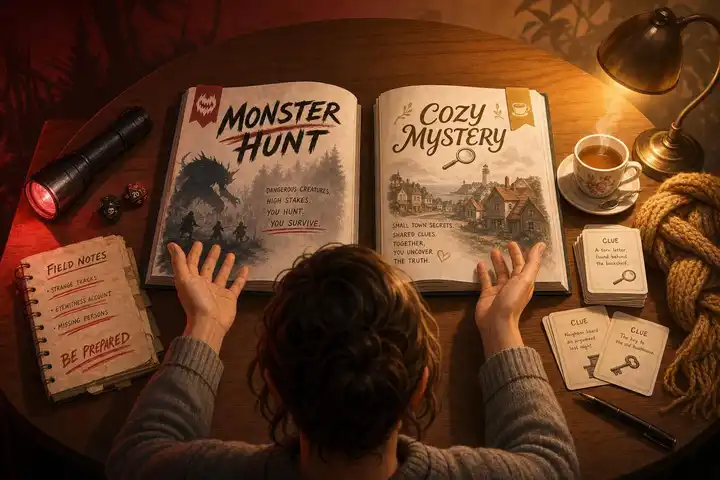
If you want fixed answers, a ticking threat, and fights, I’d pick Monster of the Week. If you want group theory-building, cozy horror, and low-prep case solving, I’d pick Brindlewood Bay.
Here’s the short version:
- Monster of the Week is built around finding one set answer and stopping a monster before the countdown hits.
- Brindlewood Bay is built around gathering clues and deciding as a group what they mean.
- One game leans toward action and urgency.
- The other leans toward talk, mood, and shared solving.
- Session length and campaign shape differ too: Brindlewood Bay often runs 120–180 minutes per session and may wrap a full season in about 7 sessions, while Monster of the Week often closes a case in 1–2 sessions.
If you’re choosing between them, I’d use this rule: pick the game based on how your group wants mysteries to work, not just on theme.

Monster of the Week vs Brindlewood Bay: TTRPG Comparison Chart
HOW TO PLAY: Monster of the Week

Quick Comparison
| Criteria | Monster of the Week | Brindlewood Bay |
|---|---|---|
| Core play loop | Hunt the threat and stop it | Gather clues and build a theory |
| Mystery answer | Set before play | Decided through play |
| Pace | Fast and pressure-driven | Slower and more talk-focused |
| GM prep | Threat, clues, countdown | Suspects, places, clues, no set answer |
| Player role | Investigate, fight, survive | Meddle, discuss, theorize |
| Tone | Supernatural danger | Cozy mystery with occult horror |
| Best for | Groups that want direct answers | Groups that like shared deduction |
In short, I see Monster of the Week as the better fit for groups that want a clear target, while Brindlewood Bay fits groups that want to shape the case together.
Monster of the Week: Fast supernatural investigations built around a hunt-and-stop loop
Monster of the Week runs on a clear structure: the answer is fixed, the clock is ticking, and pressure ramps up fast. That fixed answer, paired with a running clock, keeps sessions moving. In this comparison, that makes Monster of the Week the clearer, faster pick.
Most mysteries are built to wrap up in one or two sessions. Players pick from prebuilt playbooks, so character creation is fast, and new players can often get going in just a few minutes.
How the mystery loop works in Monster of the Week
Each session starts with a hook - a body, a disappearance, a weird broadcast, or a local rumor. From there, hunters use moves like Investigate a Mystery and Read a Bad Situation to gather clues, question witnesses, and spot the monster's pattern. This isn't a shared-deduction setup where the group decides what the answer means. The answer already exists: the hunters are trying to find one specific threat and learn its weakness.
The Keeper tracks escalation with a countdown clock. If the hunters slow down or miss the mark, the situation gets worse as the threat moves forward.
What the GM and players do at the table
The Keeper doesn't need to map out a fixed chain of scenes. Instead, they prep a threat, a countdown, bystanders, locations, and enough clues for the hunters to make real progress. In practice, that keeps prep centered on pressure rather than scene-by-scene scripting.
Players push the action with their playbook moves and core attributes - Charm, Cool, Sharp, Tough, and Weird - to investigate, fight, and deal with complications. They also track limited Luck. Each hunter gets 7 points that do not usually come back, and spending one can turn a roll into a 12 or cut harm to 0. That's a big deal. Once that Luck is gone, the hunter is in serious trouble, and the Keeper is encouraged to make the pressure on that character much harsher.
So the rhythm is pretty direct: hunters chase the threat, the Keeper turns up the heat, and that pressure keeps building until the table drives into a showdown. The game is built for action-first mystery solving, not open-ended theory building.
Brindlewood Bay takes the opposite approach: clues matter just as much, but their meaning is decided at the table.
Brindlewood Bay: Cozy occult cases built on shared clue interpretation
Brindlewood Bay puts players in the shoes of the Murder Mavens, a book club of older women who solve murders in a small seaside town. At first, the mood is cozy: tea, gossip, knitting. Then the game starts to lean into cosmic horror. That mix makes every clue matter, but not in the same way as Monster of the Week.
How the mystery loop works in Brindlewood Bay
Players gather clues through the Meddling move. But unlike Monster of the Week, those clues are meant to be incomplete. A cut brake line doesn't lead to one fixed answer by itself. It's just one piece, and it only starts to mean something when the group talks through what it could point to.
Once the table has enough clues, play shifts to the Theorize move. This is a group discussion where players turn those clue fragments into a shared theory. Then they roll 2d6, add clues, and subtract mystery complexity. On a 10+, the theory is correct. On a 7–9, it's correct, but there’s a complication. On a 6 or lower, the theory is wrong.
So the game doesn't treat clues like puzzle pieces that snap into one hidden answer the Keeper wrote ahead of time. Instead, the group builds the answer together at the table. That's the big split from a hunt-and-stop game: you're not digging up a preset solution. You're shaping the case as you solve it.
What the GM and players do at the table
The GM, called the Keeper, prepares a cast of suspects, a group of locations, and a small set of clues - but no solution. From there, the Keeper improvises suspects, complications, and fallout based on what the players suggest, while also moving the long-term occult mystery forward in the background.
Players aren't just there to investigate. They also use cozy moves like knitting, gardening, and gossiping. These help soften the horror and build relationships between characters. On top of that, they can use Crown moves to turn failures into successes, but at a story cost, like exposing a character's past or pulling them closer to the occult.
Sessions usually last 120–180 minutes, and a full "season" often ends after about 7 sessions, once the group has gathered 15 meta-plot clues. That slower pace gives the game room to breathe. It helps the atmosphere land, gives the mystery time to unfold, and makes Brindlewood Bay feel looser at the table. It also means the game leans more on group trust and improvisation, especially when you stack it up against games with fixed mystery answers.
Direct comparison: Mystery resolution, GM workload, and campaign feel
The biggest split between these games comes down to how a case gets solved.
In Monster of the Week, the mystery has a set answer from the start. The Keeper knows what the monster is, what it wants, and how the hunters can stop it. In Brindlewood Bay, the answer comes out during play. Players gather clues, build a theory, and the game uses the Theorize move to see whether that theory holds.
So you can have the same clue on the table and end up in two very different places. In one game, the clue points to a fixed truth. In the other, it helps the group shape the truth together. That's the heart of the comparison: a fixed hunt versus a table-built theory.
| Feature | Monster of the Week | Brindlewood Bay |
|---|---|---|
| Mystery Solution | Predetermined by the Keeper | Created by players via Theorize move |
| Clue Function | Points toward a specific weakness | Narrative prompts for building a theory |
| GM Prep | Medium (threat, countdown, clues) | Low (locations, open-ended clues) |
| Improv Burden | Medium (consequences, escalation) | Moderate to high (reacting to player theories) |
| Campaign Structure | Episodic hunt-and-stop loop | Season-long meta-mystery |
Which game is easier to run and learn
Monster of the Week is easier to learn at a glance. The loop is familiar and easy to picture: find the monster, learn its weakness, and stop it. If you've seen Supernatural or Buffy the Vampire Slayer, you'll probably get the vibe almost right away.
Brindlewood Bay is lighter on prep in one sense. You don't have to guard a single correct answer like it's a state secret. But that freedom comes with a tradeoff. You need to stay loose, listen hard, and roll with whatever theory the players put together. For some GMs, that's a relief. For others, that's where the sweat starts.
How tone shapes the whole campaign
Tone does more than color the setting. It changes the rhythm of play, the kind of scenes you get, and what the group leans into week after week.
Monster of the Week pushes urgency. People are in danger, the threat is moving, and the hunters usually feel like they're racing the clock. Brindlewood Bay begins cozy, almost gentle, then lets the weirdness creep in bit by bit until things feel off in a way you can't ignore.
That contrast shapes the whole campaign. One game says, "Go stop the thing." The other says, "Let's see what this mystery becomes."
Which mystery TTRPG should you play?
The right pick comes down to how your group wants mysteries to work. If the choice still feels close, use a simple rule of thumb: fixed answers and action point to Monster of the Week. Shared deduction and atmosphere point to Brindlewood Bay.
Here’s the quick split:
| What your group wants | Better choice |
|---|---|
| Fast, action-forward mysteries with a clear threat and direct answers | Monster of the Week |
| Beginner-friendly sessions with an easy on-ramp | Monster of the Week |
| Shared clue interpretation, low prep, and a slow-burn conspiracy that pays off over time | Brindlewood Bay |
| Cozy-horror atmosphere with a roleplay and deduction focus | Brindlewood Bay |
Here’s what that looks like at the table.
Choose Monster of the Week for speed, danger, and direct answers
Pick Monster of the Week if your group wants a fast, action-forward mystery with direct answers and an easy on-ramp. Each session gives players a clear target, and the countdown pressure keeps the game moving toward a sharp finish.
If your group wants a slower, more interpretive style, the other game will likely fit better.
Choose Brindlewood Bay for shared deduction, atmosphere, and long-term mystery
Pick Brindlewood Bay if your group wants shared deduction, low prep, and a slow-burn occult mystery that grows during play. The case comes together at the table, and the larger conspiracy builds toward a payoff the whole group helped shape.
FAQs
Which game is better for first-time GMs?
Both are beginner-friendly, but they fit different GM styles.
Brindlewood Bay works well if you like to improvise and figure out the mystery with the group as you play. It gives you room to riff, follow strange leads, and let the answer take shape at the table.
Monster of the Week is a better pick if you want a clear, simple system and a set mission format that helps guide each session. It’s more direct, which can make running the game feel less like juggling and more like following a solid game plan.
Can Brindlewood Bay work for groups that like combat?
No. Brindlewood Bay is a poor fit for groups that enjoy combat.
The game is built for mystery-first play, not tactical battles or character optimization. That means the fun comes from piecing things together, playing through character-driven scenes, and shaping the story as a group.
It tends to work best for:
- collaborative investigation
- roleplay-heavy scenes
- shared storytelling
If your group wants tactical fights, detailed character builds, or action-focused encounters, a different system will be a better fit.
Which game fits a longer campaign better?
Both can handle longer campaigns, but they get there in different ways.
Monster of the Week links one hunt to the next through a larger arc, like a season-long villain, a conspiracy, or an apocalypse clock. Brindlewood Bay builds its campaign around an occult conspiracy and plays out as a slow burn, moving bit by bit from cozy sleuthing into occult horror.


