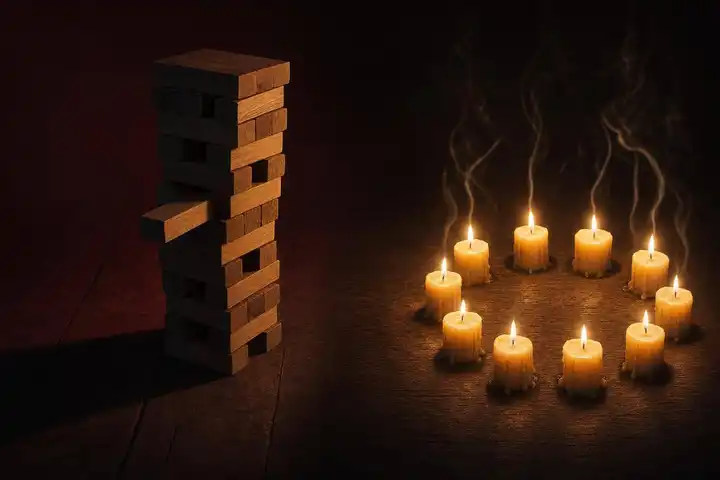
If you want horror with a chance to survive, pick Dread. If you want horror where everyone dies, pick Ten Candles. That’s the short answer.
I’d break it down like this:
- Choose Dread for survival horror, a Jenga tower, and a session where escape still feels possible.
- Choose Ten Candles for doomed horror, shared narration, and a game built around certain death.
- Pick based on setup too: Dread needs a steady table. Ten Candles needs a dark room, 10 tea lights, and a fire-safe space.
- Time matters: Dread usually runs 3 to 5 hours. Ten Candles usually runs 2 to 4 hours.
- Odds matter too: in Ten Candles, success drops from about 84% with 10 dice to 31% with 2 dice.
In other words: these are both horror one-shots, but they push your group in very different ways. One is about nerve and survival. The other is about dread, loss, and the end coming for everyone.

Dread vs Ten Candles: Horror TTRPG Comparison Chart
6 horror RPGs to terrify your players
Quick Comparison
| Criteria | Dread | Ten Candles |
|---|---|---|
| Best fit | Survival horror | Tragic horror |
| Main tool | Jenga tower | Candles + d6 dice |
| Can you survive? | Yes | No |
| Player input on story | Lower | Higher |
| GM prep | More | Less |
| Tone | Tense, uncertain | Bleak, doomed |
| Usual group size | 3–6 | 3–5 |
| Usual session length | 3–5 hours | 2–4 hours |
| Room needs | Stable table | Dark, fire-safe room |
If I were choosing for game night, I’d use one simple rule: Dread for suspense, Ten Candles for tragedy. The rest of the article helps you match that choice to your group, your space, and how much control players want in the story.
How Each Game Works at the Table
Dread: Jenga Tower, Questionnaires, and Survival Horror
Before play begins, the GM gives each player a custom questionnaire with 10 to 13 prompts that shape the character's skills, personality, and fears. In Dread, your character comes from those answers. There usually isn't a stat sheet doing the heavy lifting.
Those answers matter once the story starts. When your character tries something risky, the GM may call for a pull from the Jenga tower in the middle of the table.
If you make the pull, the action works. If the tower falls, that character is removed from play. You can refuse the pull and take the failure instead, which lets you keep your character around a little longer. The GM still handles scene flow and rulings, but the tension comes from that tower. Every bad choice, desperate sprint, or shaky act of courage feels like a physical bet, not just another die roll.
The setup also matters more than you might expect. Dread needs a flat, steady table, so it's best to avoid wobbly furniture or busy spaces where people keep brushing past the game.
Ten Candles: Ritual Play, Shared Narration, and Certain Doom

Ten Candles works in a very different way. It gives more narrative control to everyone at the table, then slowly takes hope off the board as the candles burn out.
Ten Candles begins with ten lit tea lights, a dark room, and a recorded final message from each character that plays after the group dies. That setup tells you exactly what kind of story you're in. No one is getting out.
The main system uses a shrinking dice pool. Players begin with 10 six-sided dice, one for each candle. When a conflict fails or a scene ends, one candle is extinguished, and the dice pool gets smaller too. With 10 dice, players succeed about 84% of the time. With 2 dice, that drops to 31%. You can also burn index cards to reroll dice or get an edge in the moment.
There’s also more shared input in the story itself. At the start of each scene, players and the GM add Truths about the world. During conflicts, rolling a 6 lets the player narrate the outcome, while a failed roll gives that narration to the GM. That shift in who gets to speak into the fiction makes Ten Candles feel more shared than Dread.
A few table details matter here too:
- Ten Candles is built for 3 to 5 players plus one narrator and usually lasts 2 to 4 hours.
- You need a fireproof bowl for burning cards.
- If a candle goes out by accident, you don't relight it, and the scene ends right away.
Dread keeps narrative control mostly with the GM while players take physical risks through the tower. Ten Candles spreads more of that control around the table, even as the game keeps closing in on the group's fate.
Direct Comparison: Mechanics, Tone, and GM Workload
Now that the core loops are clear, the big question is simpler: what kind of pressure does your table want?
Core Mechanics and Table Setup
The clearest split comes from how each game creates stress. Dread uses a physical tower. Ten Candles uses fading light and dice. In Dread, every pull makes the tower less stable, and players can feel that risk in their own hands. In Ten Candles, the pressure comes from darkness and shrinking odds. As candles go out, success gets harder and harder.
| Aspect | Dread | Ten Candles |
|---|---|---|
| Primary Mechanic | Jenga tower | 10 tea light candles + d6 dice pool |
| Conflict Resolution | Pull a block; success if tower stands | Roll d6s; a 6 counts as a success |
| Failure Consequence | Tower falls = character eliminated | Candle extinguished = scene ends |
| Risk Signaling | Physical wobble of the tower | Dimming light and shrinking dice pool |
| Setup Needs | Stable, flat table | Dark room, fireproof bowl, candles |
There’s also a plain logistics issue here. Ten Candles leans hard on real candles, so spaces that ban open flames can make it tougher to run as written. Dread skips that problem, but it still needs a solid, steady table. A shaky card table can wreck the whole thing fast.
Those rules don’t just change play on paper. They shape how the room feels.
Tone, Emotional Impact, and Player Experience
Dread leaves the door open for survival, so each risky move still feels like it might pay off. That gives the game a suspense-heavy edge. You can still make it out. Maybe.
Ten Candles takes that away from the start. Survival is off the table, which shifts the horror from suspense to tragedy. The fear isn’t just about what happens next. It’s also about heading toward an ending everyone already knows is coming.
That changes the mood in a big way. Dread often feels like survival horror with a shot at getting through. Ten Candles leans toward tragic horror, group narration, and the emotional pull of a doomed final act.
Prep Time and GM Demands
Dread asks more from the GM before play starts. Writing custom 10–13 question questionnaires for each player takes time, and those questions have to match both the scenario and the group.
Ten Candles works very differently. It’s marketed as a zero-prep game. Character creation and world-building happen at the table, and modules let you sit down and run a session that same session.
| Category | Dread | Ten Candles |
|---|---|---|
| Scenario Design | Requires pre-written questionnaires | Zero-prep; uses modules |
| Improvisation | High; GM reacts to tower falls | High; shared narration with players |
| Pacing Control | Tied to physical tower stability | Tied to candle duration and failed rolls |
| Emotional Load on GM | Constant tension management | Guiding a bleak ending |
The GM job feels different too. In Dread, you’re managing pressure and momentum almost minute by minute. In Ten Candles, you’re helping the group move through a shared, inevitable loss without letting the mood fall flat.
That gap matters most when you’re picking for your group’s taste in suspense, tragedy, and how much control the table wants to feel moment to moment.
Which Game Fits Your Group
Now that the rules make sense, the bigger question is simple: what kind of horror does your group want to sit inside for a few hours?
Choose Dread for Tense Survival and a Chance to Win
Pick Dread if your group wants survival horror where getting out alive still feels possible. That matters. The fear in Dread comes from pressure, risk, and the fact that one bad pull can change everything.
It works best for groups that like a physical, hands-on challenge. It also slides neatly into slasher, monster-hunt, and psychological-thriller setups.
If your table wants high tension without certain defeat, Dread is the cleaner fit.
Choose Ten Candles for Tragic Horror and Shared Storytelling
Ten Candles is built for groups that want loss to be part of the point. This makes it a strong fit for bleak, emotional horror. The story isn't about making it out. It's about facing the end together.
Groups that are okay with heavier emotional themes usually get the most from it, especially in apocalyptic stories.
If your group wants a doomed story that everyone helps shape, Ten Candles is the stronger choice.
Match the Game to Your Group Size, Time, and Space
| Factor | Dread | Ten Candles |
|---|---|---|
| Ideal Player Count | 5–6, though 3–4 works too | 3–5 |
| Session Length | 3–5 hours | 2–4 hours |
| Environment Needed | Stable table; any lighting | Dark room; fire-safe space |
| Best Venue | Bright public spaces like game stores | Private dark spaces |
Those tradeoffs lead to the last practical check: which game fits your group's size, room setup, and taste for tragedy?
Final Verdict and Next Steps
Both games work well, but they aim at different kinds of horror. Dread is the better pick for groups that want tense survival horror and a real shot at making it through. The Jenga tower is simple to learn, and the physical stress it adds at the table is hard to beat. Dread also picked up major industry awards for its design.
If your group wants doom baked into the story, Ten Candles is the better fit. The game is built so that no character survives. Its candlelit setup and ritual-style play make the session feel more like a ceremony than a standard horror game.
Before game night, make sure you have the right props ready:
- For Dread: a flat, stable surface and a Jenga tower
- For Ten Candles: ten tea lights, a fireproof bowl, and a recorder
FAQs
Which game is easier for first-time horror RPG players?
Both are beginner-friendly because they put storytelling first, not crunchy rules.
Dread may be a bit easier for total newcomers. It has no stats, uses a simple Jenga tower, and can feel more comfortable for players who aren’t sure about more old-school roleplaying. Ten Candles is also easy to get into, with light rules and a short play time.
Can Dread or Ten Candles work well online?
Not especially. Both games are built for in-person play and lean hard on physical props: a Jenga tower in Dread and burning candles in Ten Candles.
You can play them online with major changes. But once you swap those props for digital stand-ins, you usually lose a lot of the raw tension and ritual that make these games hit the way they do.
Which game has better replay value for the same group?
Both are made for one-shots, not long campaign play with the same cast. But they don’t feel the same when you come back to them.
Ten Candles keeps things feeling new because the group builds the world together. That means each session can bring a different story, a different setting, and different threats.
Dread replays in another way. It leans on new GM-prepared scenarios and different horror subgenres, so one game might feel like a slasher while another plays more like a haunted house story.


