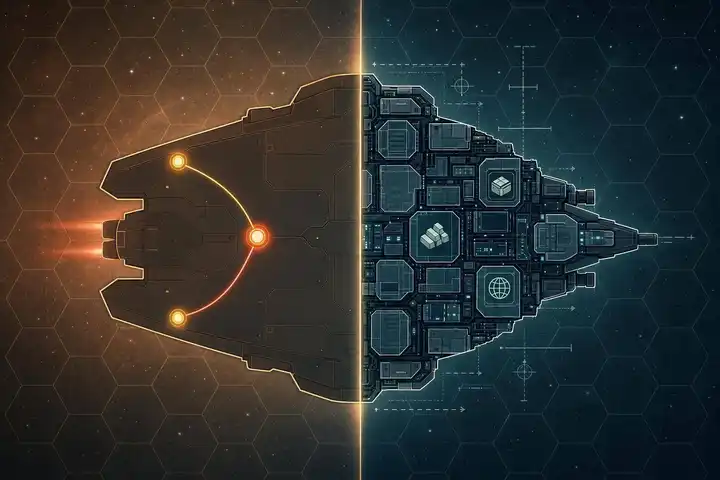
If you want the short answer: I’d pick Stars Without Number for a fast start and lighter GM work, and I’d pick Traveller for trade, ship costs, and a harsher hard-SF feel.
Here’s the whole article in plain English:
- Stars Without Number uses 2 core roll types: 2d6 for skills and 1d20 for combat
- Traveller uses one main 2d6 system with a usual target of 8+
- SWN characters come from 3 main classes plus a mixed option
- Traveller characters come from career lifepaths, so they begin with more history
- SWN pushes a sandbox with world tags and faction turns
- Traveller pushes a sandbox with trade routes, fuel, maintenance, and ship payments
- SWN has a free core PDF
- Traveller usually asks for paid core rules
- SWN characters tend to grow more over time
- Traveller keeps a flatter power curve, so danger stays high for longer
If I boil the comparison down even more, it looks like this:
- Choose SWN if you want to get a campaign running with less prep
- Choose Traveller if you want money, travel, and ship decisions to shape play
- Choose SWN if your group likes D&D-style classes and levels
- Choose Traveller if your group likes lifepaths, gear detail, and route planning

Stars Without Number vs Traveller: Side-by-Side TTRPG Comparison
RPG: Traveller or Stars Without Number?
Quick Comparison
| Criteria | Stars Without Number | Traveller |
|---|---|---|
| Rules feel | Familiar, lighter | More procedural |
| Character creation | Class-based, fast | Career-based, longer |
| Sandbox driver | Factions and world conflict | Trade, jobs, and bills |
| Travel | More abstract | Fuel and route planning matter |
| Trade | Secondary unless expanded | Central to play |
| Combat | Faster, swingy, lethal early | Slower, tactical, lethal throughout |
| GM workload | Lower | Higher |
| Cost to try | $0 for free core PDF | Usually paid entry |
My take: this is less about which game is “better” and more about what kind of pressure your group wants at the table. In SWN, the pressure comes from factions, hooks, and risky fights. In Traveller, it comes from cargo, fuel, debt, and hard choices in space.
Core Mechanics and Character Creation
Stars Without Number: Fast Setup and Flexible Characters
SWN keeps things simple at the table. It uses a two-part system: 2d6 for skill checks and 1d20 for combat. That split does a lot of work. Skill rolls tend to feel steadier, while combat stays swingy and risky. Low-level characters can be very fragile too. An Expert, for example, may start with only 1d6 hit points.
Character creation is quick and easy to grasp. Players pick from three core classes - Expert, Warrior, or Psychic - or mix them through the hybrid Adventurer. After that, background and training packages round out the character. If you've played classic D&D, this will feel familiar fast. That same speed shows up in the game's sandbox tools, which lean toward a quick campaign start instead of deep lifepath detail.
Traveller: Careers, Life Paths, and a Stronger Simulation Feel
Traveller goes in the other direction. Before play even starts, characters move through a randomized lifepath system. Players roll through career stages, events, and injuries, ending up with adults who already have history, debt, and gear built in.
Its rules engine is more uniform too. Traveller uses a unified 2d6 system for almost all tasks, with 8 as the standard target number. It also tracks Effect, which can range from -3 to +3 based on how far the roll lands above or below the target. The upside is a stronger simulation feel. The cost is a steeper learning curve and more procedures to track during play. That same rules depth also runs through its worldbuilding, trade, and travel systems.
Here’s the core tradeoff in one view.
| Feature | Stars Without Number (Revised) | Traveller (Mongoose 2E) |
|---|---|---|
| Core Mechanic | 2d6 for skills / 1d20 for combat | Unified 2d6 for most tasks |
| Character Creation | Fast, class-based, with three core classes plus Adventurer | Lifepath-based, with career stages and rolls |
| Progression | Level-based growth | Skill- and equipment-based, flatter power curve |
| Learning Curve | Lower for D&D players | More rules-driven |
Sandbox Tools and Campaign Building
At the sandbox level, the big split comes down to who creates momentum: the GM, the factions, or the money.
Stars Without Number: Sector Creation, World Tags, and Faction Turns
SWN gives the GM a strong set of tools for building a sandbox campaign. Its World Tags - two-word prompts like "Alien Ruins" or "Eugenics Cult" - create instant hooks and conflict. You can look at a tag and almost immediately see the problem, the people involved, and where a session might go.
SWN also uses the Faction Turn to push the setting forward between sessions. Pirates, rebels, and planetary governments act offscreen, so the sector keeps changing even when the players are somewhere else. That means the sandbox doesn’t sit still waiting for the party to poke it.
Traveller: Structured Worlds, Trade, and Classic Sandbox Procedures
Traveller takes a more coded approach. Instead of prompts, it uses Universal World Profiles (UWP): alphanumeric codes for starport, atmosphere, population, government, law level, and tech level. The GM reads that profile, then turns it into a place with texture and conflict.
Its sandbox engine is less about faction motion and more about economic pressure. Ship mortgages, fuel costs, and maintenance keep the crew moving and taking jobs they might otherwise avoid. Speculative trade adds a clear path for each jump, with its own cost and risk built in.
That split changes how each game keeps play moving from session to session.
| Tool | Stars Without Number | Traveller |
|---|---|---|
| World Generation | World Tags that create immediate adventure hooks | Universal World Profiles that describe a world in code |
| Sandbox Driver | Faction Turns that keep the setting evolving | Speculative trade and ship mortgage pressure |
| Ongoing Campaign Driver | World Tags and Faction Turn | Patrons and trade routes |
| GM Prep | Lower - prompt-based world generation | Higher - UWP codes require more interpretation |
So when you sit down to run them, the feel at the table shifts fast. SWN tends to generate motion from setting conflict, while Traveller tends to generate motion from routes, bills, and jobs. That shapes how exploration, trade, and combat show up in play.
Exploration, Trade, and Combat Feel
Exploration and Discovery at the Table
Once the sandbox is built, the gap between these games shows up at the table. You see it in travel, money, and how danger lands.
SWN keeps exploration loose. Travel is built around fast jumps, light procedure, and a focus on what the crew finds instead of how they chart every step. Spike Drives are abstract enough that the trip usually stays in the background.
Traveller takes the other path. Jump Drives make fuel planning and route choice part of the experience before the ship even leaves port. That works well for groups who want travel decisions to carry weight. But it also means more player choices before the next scene starts.
Trading, Ships, and the Tone of Risk
The same split shows up in trade. In one game, commerce relieves pressure now and then. In the other, it powers the whole campaign.
Traveller is built around financial pressure. Ship mortgages, maintenance costs, and fuel bills keep crews hunting for cargo runs just to stay afloat. One bad trade deal or a damaged component can put the whole operation in trouble. If you want money problems to shape the story, Traveller does that better.
Trade is present in SWN, but it sits in the background unless you layer in deeper merchant rules. For merchant-heavy campaigns, Suns of Gold adds the extra detail needed.
Combat Pace and Consequences
Combat shows the same design split.
SWN starts out lethal, then eases up as characters gain levels. The Warrior class can also ignore one successful hit per combat, which gives frontline characters a bit more staying power.
Traveller keeps the power curve flat. Characters do not level up or become much tougher over time, so they stay at risk across the whole campaign. Combat is slow and tactical, with position and range mattering more than fast combat tricks. That keeps negotiation, stealth, and planning on the table as real options. SWN leans toward quick action. Traveller pays off for groups that move with care.
| Feature | Stars Without Number | Traveller |
|---|---|---|
| Travel Procedure | Abstracted jumps; navigation stays in the background | Jump planning, fuel choice, and route decisions matter |
| Trade Role | Optional; secondary unless expanded | Central; financial pressure drives the campaign |
| Power Curve | Level-based; HP grows over time | Flat; characters stay fragile |
| Lethality | High early, decreases at higher levels | Consistently high throughout the campaign |
| Recovery | Strain limits rapid recovery | Healing stays slow and fragile |
| Combat Feel | Fast, improvisational, D&D-adjacent | Slow and tactical, deliberate |
Those differences point straight at the kind of group each game fits best.
Which Game Fits Your Group Best
Once you get past the rules, tools, and overall table vibe, this choice mostly comes down to one thing: how much structure your group wants.
Choose Stars Without Number for Faster Sandbox Support
Stars Without Number makes more sense for groups that want to get moving fast and keep GM prep light. The free core rules make it easy to try, the class-and-level setup feels familiar, and the sector and faction tools handle a lot of the campaign setup for you.
It also gives players a clearer sense of growth as the campaign moves along.
Choose Traveller for Detailed Sci-Fi Procedures
Traveller is a better fit for groups that want the process itself to matter. If your players like plotting routes, tracking ship costs, and feeling money pressure, Traveller is built for that. Its lifepath character creation also means characters show up with history before session one even begins.
The tradeoff is that character creation takes longer, and the game is more closely tied to the Third Imperium.
Final Takeaway
Neither game wins across the board. Stars Without Number is the pick for speed, lighter prep, and GM support that helps you improvise on the fly. Traveller is the pick for detailed procedures, grounded economics, and danger that sticks around.
Use the table below to line up each game with what your group wants most.
| Stars Without Number | Traveller | |
|---|---|---|
| Best for | Fast-start groups | Groups that want procedural hard SF |
| Entry cost | Free core rules | Paid core rules |
| GM prep | Low - tables and generators do much of the work | Higher - detailed world-coding and procedures |
| Character feel | Growing heroes | Flat power curve |
| Campaign tone | Flexible; adapts to many sci-fi subgenres | Grounded; tramp freighter campaigns with a harder sci-fi feel |
If your group is still on the fence, start with the free SWN PDF. Run a few sessions. If you come away wanting more economic texture and tougher procedures, Traveller will still be there.
FAQs
Which game is easier for first-time GMs?
Stars Without Number is usually the easier pick for first-time GMs. Its familiar d20-based rules make the learning curve less steep, and its GM tools and procedural tables do a lot of the heavy lifting. That makes open-ended sandbox play much simpler to run, even if you’ve done little prep.
Traveller leans more toward a detailed, simulation-focused style. That can be a big draw, but the rules are often more complex and ask for a larger time investment to learn.
Can Traveller work for a low-trade campaign?
Yes. Speculative trade is a big part of Traveller, but you don't have to use it.
You can lean into exploration and sandbox play instead, while keeping trade in the background or skipping it altogether. The game's modular rules still support other styles of play, like diplomacy, investigation, or bounty hunting, without throwing off the core system.
How much sandbox prep does each game need?
Stars Without Number is built for minimal GM prep. It gives you procedural tools for star systems, factions, planets, and adventure hooks, so a busy GM can sketch out a big sandbox without sinking hours into prep.
Traveller goes deeper into the details. Its systems for settings, economics, and character generation are more granular, which can be great if you like that level of detail. The trade-off is simple: its simulation-heavy style usually asks more from the GM.


