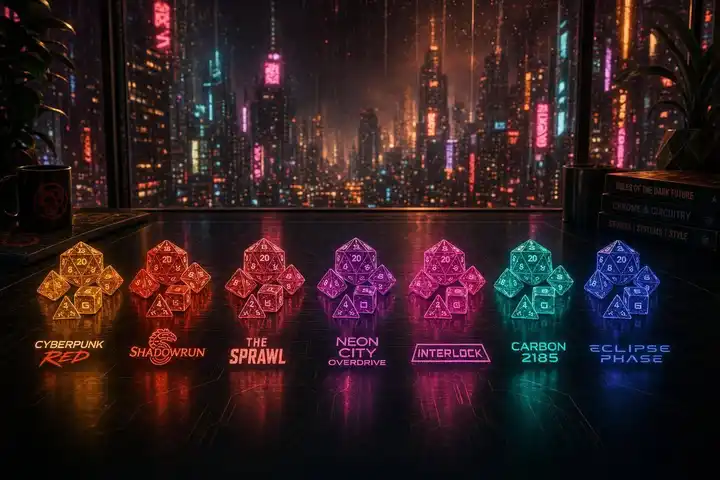
If I had to cut this list down fast, I’d say this: Cyberpunk RED is the best all-around starting point, Shadowrun is for groups that want cyberpunk plus magic, The Sprawl is the best pick for fiction-first jobs, and Carbon 2185 is the easiest jump for 5e players.
This guide looks at 7 cyberpunk TTRPGs and compares them by the stuff that matters most at the table:
- setting and tone
- rules weight
- combat style
- hacking flow
- GM prep
- price
I’d group them like this:
- Best entry point: Cyberpunk RED
- Most rules-heavy: Shadowrun and Cyberpunk 2020
- Best for mission-based play: The Sprawl
- Best for politics and community focus: Hard Wired Island
- Best for system choice: Interface Zero
- Best for 5e players: Carbon 2185
A few fast facts stand out right away:
- Cyberpunk first launched in 1988
- Shadowrun character creation can take 2–3 hours
- The Sprawl sessions often run 120–240 minutes
- Core book prices here range from about $26.39 to $60.44
If you want a blunt way to choose, use this rule:
- pick RED for street-level survival
- pick Shadowrun for cyberpunk fantasy runs
- pick The Sprawl for low-rules heists
- pick 2020 for old-school crunch
- pick Hard Wired Island for anti-corporate, people-first play
- pick Interface Zero for big-scope conflict
- pick Carbon 2185 for a 5e-style rules frame
The short version: tone, rules load, and prep time are what split these games apart.

Best Cyberpunk TTRPGs Compared: Rules Weight, Price & Play Style
Cyberpunk Red is an important RPG if you’re into the cyberpunk genre - RPG Review

Quick Comparison
| Game | Core Hook | Rules Weight | Best For | Starting Price |
|---|---|---|---|---|
| Cyberpunk RED | Street survival in 2045 Night City | Medium | New players, lethal combat, role-based crews | $30 PDF / $60 hardcover |
| Shadowrun | Cyberpunk plus magic | High | Teams that like builds, planning, and layered runs | Not listed in the article |
| The Sprawl | PbtA mission play | Medium-light | Fiction-first jobs and pressure-heavy sessions | Not listed in the article |
| Cyberpunk 2020 | Old-school Night City grit | High | Groups that want harder, rougher rules | Not listed in the article |
| Hard Wired Island | Anti-capitalist cyberpunk in space | Medium | Community-focused play and low-prep missions | $30 PDF / $60 hardcover |
| Interface Zero | Big-scope cyberpunk with system options | Varies by version | Groups that want lore, politics, and system choice | $19.99 PDF / $35.99 print |
| Carbon 2185 | 5e-style cyberpunk | Medium | D&D 5e players who want an easy switch | $26.39 PDF / $60.44 hardcover |
Bottom line: if you know what your group wants - more crunch, less crunch, magic, heists, politics, or 5e familiarity - this list makes the choice much easier.
1. Cyberpunk RED
Cyberpunk RED takes place in 2045, after the 4th Corporate War and the Night City nuclear blast, in the period known as the "Time of the Red". The setting feels battered from the jump: red ash hangs in the sky, supply chains are in pieces, and the NET is shattered. Corporations are still around, but they’re busy chasing recovery and profit. That sense of collapse gives the game its harsh, survival-first feel and makes RED a strong pick for grounded, street-level campaigns.
The tone is blunt and unforgiving: make money fast, stay armed, and assume violence will show up before long.
At the table, the main mechanic is simple. Players roll stat + skill + 1d10 against a GM-set Difficulty Value. You choose from 10 roles, and each role comes with its own special ability. Combat, known as "Friday Night Firefight," is deadly and tactical. Cover matters. Teamwork matters. And one bullet can kill you. The system lands in a nice middle space between older crunch-heavy games and newer rules-light ones. In practice, that means choices at the table matter more than just piling up numbers.
Netrunning is also built to keep hackers with the group instead of splitting them off into their own side scene, which helps everyone stay part of the action during hacks. For GMs, the core book includes "Screamsheets" - two-page mission hooks that can cut down prep time and get a session moving fast.
Pricing is pretty straightforward:
- The core rulebook costs $60 in hardcover or $30 as a PDF
- The Jumpstart Kit costs $30 in print or $10 digitally
This game fits groups that want lethal combat, clear role identity, and rules that have some weight without becoming a slog.
If your table wants more depth in the rules and more of an urban-fantasy slant, Shadowrun pushes the genre in a very different direction.
2. Shadowrun
Shadowrun takes place in the Sixth World, usually sometime in the 2070s or 2080s, where cyberware, megacorps, magic, and myth all exist side by side. In 2011, an event called the Awakening changed humanity, with some people emerging as metahuman forms like elves, dwarves, orks, and trolls. That blend gives the game a clear identity: cyberpunk runs with fantasy-level stakes. It tends to work best for groups that enjoy planning, role-based teamwork, and missions with several moving parts. Compared with Cyberpunk RED, Shadowrun brings more setting depth, more role focus, and heavier rules.
On the rules side, Shadowrun uses a d6 dice-pool system. You roll Attribute + Skill, count 5s and 6s as hits, and try to meet a GM-set threshold, usually from 1 to 4 hits. A glitch happens if half or more of your dice come up 1s. For new GMs, the system is rated 2/5, and new players can spend 2–3 hours on character creation.
A typical crew usually needs these core roles:
- Street Samurai
- Hacker
- Mage
- Rigger
That setup helps the group handle Shadowrun’s three layers of play: the physical world, the Matrix, and the Astral plane, without getting stuck during a mission. Most runs follow a familiar loop: legwork, infiltration, conflict, and extraction. If your group likes dialing in builds, digging through gear options, and playing around with corporate intrigue, Shadowrun gives you plenty to work with.
If you want a game with a similar run-based structure but fewer rules to manage, The Sprawl pushes mission play in a leaner direction.
3. The Sprawl
The Sprawl goes all-in on noir: small crews, giant systems, and no fantasy layer at all. There’s no magic, no fantasy races, just corporations, chrome, and the people stuck under both. Compared with Shadowrun, it keeps the run-based setup but strips out the fantasy side and a lot of the rules weight. It’s leaner than Shadowrun and less sim-heavy than Cyberpunk RED, with a tight focus on mission-based play.
Built on the Powered by the Apocalypse (PbtA) engine, the game swaps long skill lists for Moves and Playbooks. Characters revolve around three stats: Meat for physical action, Mind for mental action, and Synth for tech interfacing. It uses the standard PbtA 2d6 + stat roll:
- 10+: success
- 7–9: success, but with a cost
- 6-: failure
Hacking follows that same fiction-first style through the Synth stat, so it doesn’t break away into a separate mini-game.
The standout piece is the clock system. Each mission has a Legwork phase and an Action phase, and each one gets its own clock. Planning fills the Legwork clock. Mistakes fill the Action clock. Corporations also track their own clocks, which show how they respond to what the crew is doing. The effect is simple: less planning paralysis, more momentum. That makes the game a strong pick for fast, pressure-heavy sessions.
The Sprawl rates 3/5 for complexity and 5/5 for roleplay focus, with sessions usually running 120–240 minutes. It tends to work best for groups that want a gritty, high-pressure mission structure without the rules load of older cyberpunk games. On the flip side, players who want tactical grid combat or a sandbox campaign may feel boxed in by its mission-centered format.
| Feature | The Sprawl |
|---|---|
| System | PbtA (2d6 + Moves) |
| Complexity | 3/5 |
| Roleplay Focus | 5/5 |
| Ideal Group Size | 2–5 players + GM |
| Session Length | 120–240 minutes |
If your table wants mission clocks, fiction-first play, and a no-magic cyberpunk setup, The Sprawl fits. Next is Cyberpunk 2020, the original ruleset that helped define the genre.
4. Cyberpunk 2020
Cyberpunk 2020 drops you back into Night City in 2020, where megacorps run the show and collapse doesn’t feel like a threat so much as the air everyone breathes. If Cyberpunk RED is the newer take, Cyberpunk 2020 is the rough, sharp-edged original. Its tone is "High Tech, Low Life" - gritty, merciless, and cynical. Pondsmith built the game around personal stakes, not abstract revolution.
The game runs on the same Interlock chassis as RED, but it hits harder and gives players less room for mistakes. You pick from role staples like Solo, Netrunner, Fixer, and Rockerboy, and each one comes with abilities that shape their place in the crew. That said, it can be tough for new players and GMs to get into, with combat and netrunning being the biggest hurdles.
If you want a leaner, more current cyberpunk game, Hard Wired Island shifts the tone and pacing.
5. Hard Wired Island
Hard Wired Island drops cyberpunk onto Grand Cross, a high-tech O'Neill cylinder orbiting Earth in an alternate 2020. The game is openly anti-capitalist and runs on heavy 90s anime vibes. Weird Age Games says it best: "Hard Wired Island is about a group of marginalized people using technology to try to change the status quo. They work against their enemies, not for them." Out of all the games in this lineup, this is the one most centered on community and politics. You can feel that in the rules, too. Survival is tied to scarcity, not some big power trip.
Augments use Burden instead of humanity loss, so the cost is financial rather than moral. If your Burden gets too high, you may need to make Economic Shock rolls between missions, which can put your housing or assets at risk. Even the game's Augverts follow that same idea. They're cybernetic upgrades that cost nothing to install, but they come packed with intrusive in-game ads. In practice, that means every mission can feel like a money problem just as much as a story problem.
The main system is simple: roll 2d6 + Ability + Specialty against a target number set by the GM. Social scenes, stealth, hacking, and conflict all run through that same structure, so hacking doesn't split off into its own mini-game. Combat is built as a last resort. It stays active and fluid, but it asks for a different rhythm than old-school tactical combat.
Before a mission, players spend Prep on gear, bonuses, or Flashbacks that let the crew reveal they had already planned for a problem. That's a nice touch for groups that like clever play without getting stuck in long planning sessions. The 400-page core book also comes with 13 pregens and more than 100 NPCs.
Hard Wired Island costs $30.00 for the PDF or $60.00 for the hardcover. It works well for tables that want narrative-first cyberpunk and low-prep missions. If your group wants a more classic cyberpunk toolkit with more room for customization, the next game heads that way.
6. Interface Zero
If the last game leaned into resistance at the community level, Interface Zero pushes cyberpunk onto a much bigger stage. Interface Zero 3.0 takes place in 2095, after climate collapse, nuclear war, and rising seas remake the Reformed United States. Day-to-day life runs through the Tendril Access Processor (TAP), a brain implant that connects citizens to the Global DataNet and an augmented reality layer known as Hyper Reality.
The focus here is less about surviving block by block and more about power, control, and high-level conflict. Players get pulled into surveillance, corporate influence, and mission-driven politics instead of just trying to make it through life in a ruined city.
One thing that sets Interface Zero apart is its support for multiple systems: Savage Worlds Adventure Edition (SWADE), Fate Core, and Pathfinder. Each one pushes play in a different direction. The SWADE version is built for fast tactical action, including drone support. Pathfinder is the crunchiest option, with hacking run through spell-like engrams.
That means your rules choice matters a lot:
- Pick SWADE for faster tactical play
- Pick Fate for narrative freedom
- Pick Pathfinder if your group likes heavier rules
Prep changes by version too. SWADE comes with built-in generators for NPCs, biohorrors, and adventures, plus short pre-written Savage Tales. Pathfinder asks for more system knowledge up front, especially for vehicles and hacking subsystems.
On price, Interface Zero 3.0 costs $35.99 in print or $19.99 for the PDF. The Game Master's Guide to 2095 costs $24.99 in print or $11.99 for the PDF.
This game works best for groups that want cyberpunk with dense lore, political tension, and a scope that goes well beyond street-level play. It also helps if the group is happy to settle on a ruleset before the campaign begins. If that's the kind of game you want, Interface Zero gives you a much broader frame than the usual alleyway-and-neon version of cyberpunk, while still giving you clear mechanical support.
7. Carbon 2185

If your group wants cyberpunk without a big rules jump, Carbon 2185 is the easiest 5e-style pick in this lineup. It takes place in San Francisco in 2185, a city of 12 million people under megacorporate control. The game strips out magic, magical items, and fantasy races, so it stays locked into human-centered cyberpunk. The tone is bleak, grounded, and all about people trying to get by in a corporate-run world.
CarbonRPG is built on the D&D 5e OGL, so it keeps the familiar d20 structure, proficiency, and saving throws. If you already know 5e, you'll read this system fast. A few parts change things up: Wisdom becomes Technology, Charisma becomes People, and characters top out at level 10. Hacking runs through class features called Hacker Exploits. Cyberware is kept in check by Blood Toxicity, with Constitution deciding how much chrome your character can take before it starts to cost them.
Character creation uses a Lifepath system with five-year terms that shape your skills, money, and backstory. Those terms can also leave you injured, which gives the process a bit more bite.
GM prep sits in the middle. If you're used to D&D-style tools, you'll probably settle in fast thanks to random encounter tables, enemy stat blocks, and prebuilt NPC frameworks. The weak index is the main drag, since it slows down rule lookups at the table.
This game fits mission-based crews that want tactical combat, light hacking, and a smooth 5e on-ramp. Put simply, where RED leans into gritty survival, Shadowrun leans into dense system load, and The Sprawl leans into narrative mission play, Carbon 2185 fills the slot for familiar 5e-style cyberpunk. The PDF costs $26.39, and the hardcover costs $60.44.
For a quick side-by-side reference, use the directory below.
Pros, Cons, and Which Game Fits Your Table
If you want the fastest way to pick, use the table below. It lines up common table priorities with the game that fits best.
The big trade-off is pretty simple: some games give you more depth, some move faster, and some ask for more prep from the GM.
| Priority | Best Match | Why It Fits | Watch Outs |
|---|---|---|---|
| Easiest for new players | Cyberpunk RED | Easiest entry; integrated Netrunning | The rules still take one read to settle in |
| Cyberpunk plus magic | Shadowrun | Best if your group wants cyberpunk with fantasy and tactical teamwork | Very High complexity across magic, tech, and hacking subsystems |
| Mission-based runs / heists | The Sprawl | Best for narrative mission play | Players wanting crunchier resolution may miss that style |
| D&D 5e familiarity | Carbon 2185 | Best for groups that want cyberpunk with a familiar 5e engine | May feel too close to standard 5e |
| Deepest mechanical simulation | Cyberpunk 2020 | Best for crunch; hardest on the GM | High GM workload; Netrunning can stall sessions |
| Fast tactical action | Interface Zero | Best in SWADE for fast tactical play | Trades mechanical depth for pace |
Think of it like this: if your group wants to get to the table with less friction, Cyberpunk RED or Carbon 2185 will usually be the safer pick. If your players love systems, gear, and moving parts, Cyberpunk 2020 or Shadowrun may be more their speed. And if your table wants jobs, pressure, and clean mission flow, The Sprawl stands out right away.
Conclusion
Cyberpunk RED is the easiest way into classic street-level play. Shadowrun brings magic into the mix and adds layered mission structure. The Sprawl is built for fast, fiction-first runs. Cyberpunk 2020 leans hardest into crunchy rules. Interface Zero sits in the middle with tactical play and cybernetics. Carbon 2185 works well for groups already used to 5E. Hard Wired Island is the pick for political, anti-capitalist cyberpunk.
That makes the next step pretty simple: narrow your choice by tone, rules weight, and GM prep. Those three filters cut through the noise fast.
After that, put your finalists next to each other and compare them side by side. Start with the top picks here, then check your shortlist in TTRPG Games Directory before your group commits.
FAQs
Which cyberpunk TTRPG is best for beginners?
Cyberpunk RED is the best pick for beginners. Its simpler rules and modern design make it easier to teach and run, which makes it a strong starting point for new players.
Shadowrun can work for newcomers too, but it asks more from the table. Its dice-pool system takes more time to learn, and its mix of fantasy and high-tech adds another layer for players to keep track of.
How crunchy is Shadowrun compared to Cyberpunk RED?
Shadowrun is much crunchier than Cyberpunk RED.
Cyberpunk RED is the cleaner, easier-to-pick-up game of the two. Its d10-based system keeps turns moving and helps the table stay in the flow.
Shadowrun goes in a different direction. It uses a more complex dice-pool system, and its rules for magic, hacking, and rigging go much deeper. That gives the game a denser, more tactical feel.
At the table, the difference is pretty clear:
- Cyberpunk RED makes it easier for players to stay involved in the same scene
- Shadowrun offers more layered rules and more moving parts
So if you want a smoother ride, Cyberpunk RED tends to be easier to run and play. If you want heavier rules with more tactical depth, Shadowrun leans that way.
Which game is best for hacking-focused campaigns?
It comes down to how your group likes to play and how much rules depth you want at the table.
Cyberpunk RED is a strong modern pick because its Netrunning stays tied to the action. That keeps the hacker involved with the rest of the crew instead of spinning off into a separate mini-game.
Shadowrun fits groups that want dense, technical Matrix rules. If your table likes digging into systems and doesn't mind extra crunch, it can be a good match.
For a deeper but slower old-school style, Cyberpunk 2020 is a good fit.


