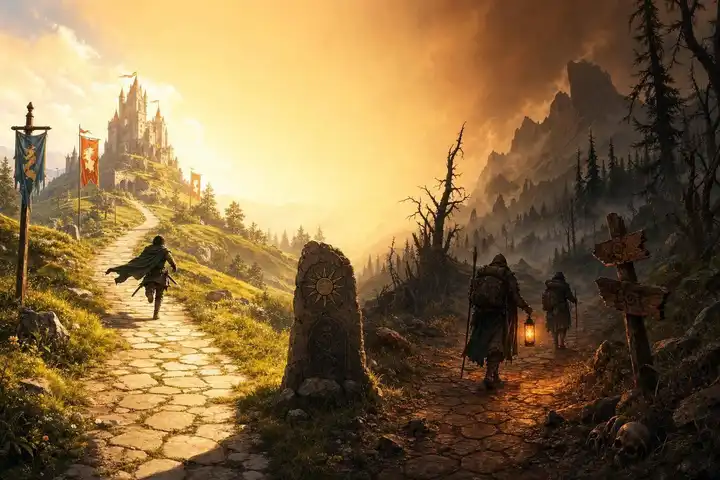
If I had to boil it down to one line: Dragonbane is for fast heroic fantasy; Forbidden Lands is for hard survival sandbox play.
If you want the short answer, here it is:
- Pick Dragonbane if you want low rules load, fast setup, and shorter adventure arcs
- Pick Forbidden Lands if you want resource pressure, hex-map travel, and long campaign play
- Dragonbane uses a d20 roll-under system
- Forbidden Lands uses d6 dice pools with a push-your-luck rule
- Dragonbane character creation takes about 15 minutes
- Dragonbane is rated 2/5 for complexity
- Forbidden Lands puts more weight on food, water, gear, injuries, and travel jobs
- Both core boxes sit in a similar price range, so the main choice is play style, not cost
This comparison looks at the parts that matter most at the table: tone, rules, character creation, combat, travel, advancement, campaign shape, and GM work.

Dragonbane vs. Forbidden Lands: Side-by-Side TTRPG Comparison
4 Fantasy RPGs from Free League Publishing Worth Playing
Quick Comparison
| Criteria | Dragonbane | Forbidden Lands |
|---|---|---|
| Main feel | Heroic fantasy adventure | Dark survival fantasy |
| Best for | New or mixed-experience groups | Groups that want long sandbox campaigns |
| Core system | d20 roll-under | d6 dice pool |
| Combat feel | Fast, sharp, risky in the moment | Slower, harsher over time |
| Travel | Light, mostly between adventure sites | A major part of play |
| Character setup | About 15 minutes | More front-loaded choices |
| Rules weight | 2/5 complexity | Medium rules load |
| GM work | Low prep | More tracking and world upkeep |
My take: if you want a game you can start with little friction, Dragonbane is the safer pick. If you want the road, the map, and survival pressure to matter every session, Forbidden Lands fits better.
That’s the whole article in plain English - now I’d move into the side-by-side breakdown.
Core Identity: Heroic Fantasy vs. Survival Sandbox
That difference shapes everything that comes next, from character creation to the way a whole campaign runs.
Dragonbane: Tone and Ideal Group
Dragonbane leans into light heroic fantasy. It feels like classic adventure: danger is there, but the game keeps moving and failure can still be fun instead of crushing. Its default setting, Misty Vale, is loose and easy to use. A GM gets enough structure for expeditions and trouble on the road without needing to memorize a giant pile of lore.
The game is rated 2 out of 5 for complexity, and characters take about 15 minutes to make. That low-friction setup helps sessions start fast and stay energetic. It fits mixed-experience groups, short-to-medium campaigns, and GMs who want low prep with dangerous, fast-moving play. You can feel that pace in both character creation and combat.
Forbidden Lands: Tone and Ideal Group
Forbidden Lands goes in a very different direction. It’s a sandbox survival roleplaying game about raiders and rogues trying to get by in a cursed, hostile world. Ravenlands is much denser than Misty Vale, and the setting ties directly into play. The blood mist, ruined lands, and faction conflict all shape travel, resource use, and stronghold building at the table.
The tone is bleak. Food matters. Torches matter. Worn-out gear matters. Injuries matter. Travel itself can force a retreat or get people killed. Instead of following a plotted story, the campaign grows out of player choices. And those choices usually come with a price. That pushes the group toward caution, planning, and hard tradeoffs.
This is the better fit if you want long-form exploration, survival pressure, and a group that likes slow, permanent progress in a hostile setting. That same pressure shows up in character building, combat, and the way the campaign develops.
| Dragonbane | Forbidden Lands | |
|---|---|---|
| Tone | Adventurous, room for humor | Dark, bleak, survival-focused |
| Setting | Light, flexible (Misty Vale) | Dense, integrated (Ravenlands) |
| Core Fantasy | Bold quests, heroic feats | Survival, stronghold building |
| Ideal Group | Mixed experience, low-prep tables | Hexcrawl and survival-focused groups |
Rules Comparison: Mechanics, Character Creation, and Combat
That tonal split shows up in the rules, too. The two games share a few ideas, but at the table they feel quite different.
Dragonbane uses a d20 roll-under system. You roll a d20 and try to get a result at or below your skill or attribute. A 1 is a dragon (critical success), and a 20 is a demon (critical failure). Instead of stacking a bunch of small number tweaks, the game uses Boons and Banes, which keeps checks easy to read and fast to run. It’s simple to teach, simple to call, and it keeps turns moving.
Forbidden Lands runs on the Year Zero Engine. You build a pool of d6s from your attribute, skill, and gear, then look for 6s. Each 6 gives you a success. The key choice is whether to push the roll. When you do that, you reroll all dice that aren’t a 1 or a 6 to chase more successes. The catch is nasty: pushed attribute dice can deal attribute damage, which makes later rolls weaker. So the risk doesn’t just sting now. It can follow you into the next scene.
Here’s the side-by-side view:
| Feature | Dragonbane | Forbidden Lands |
|---|---|---|
| Core Resolution | d20 roll under skill/attribute | d6 dice pool; each 6 = 1 success |
| Initiative | Cards 1–10 redrawn each round | Cards 1–10 drawn at combat start and usually kept for the fight |
| Defenses | Active parry/dodge; usually costs your action | Armor dice cancel hits; 1s can degrade gear |
| Monster Attacks | Auto-hit; attack tables determine effects | Dice-pool monster attacks; defense rolls can negate them |
| Character Build Depth | Kin, professions, and one heroic ability at start | Kin, professions, talents, and Willpower-driven progression |
| Complexity | Low; Boon/Bane adjustments | Medium; track attribute damage, gear wear, and resources |
Character Building and Early Choices
Character creation in Dragonbane is quick. You pick a kin, a profession, set your attributes, and add a heroic ability. Professions such as Fighter, Mage, or Thief work more like starting packages than locked class paths. Age also matters, because it affects how many skills you can mark as trained. And trained skills begin at double the base chance, so your strengths show up right away.
Forbidden Lands asks for a bit more thought up front. Kin, profession, attributes, and talents all matter from the start. Talents run on Willpower Points, and you gain those points by pushing risky rolls. In plain English: dangerous play fuels your best tricks. That changes party planning, too. Groups tend to sort out who handles pathfinding, who keeps track of food, and who scouts ahead, because survival jobs have real weight from the first hex.
Those opening choices don’t sit quietly on the sheet. Both games turn them into combat calls almost at once.
Combat Pace, Danger, and Risk Choices
In Dragonbane, you get one action per round, initiative shifts from round to round, and monster attacks hit automatically. That gives combat a sharp, snap-decision feel. If you spend your action badly, you can feel it at once.
In Forbidden Lands, you get two actions, initiative tends to stay put once combat starts, and the push-your-luck system adds pressure in a slower, steadier way. The tension builds through tradeoffs: do you push now, take damage, and risk coming up short later?
Put simply, Dragonbane punishes split-second mistakes. Forbidden Lands punishes attrition.
And that same split carries over into travel, danger, and long-term campaign play.
Campaign Play: Exploration, Progression, and GM Workload
Outside combat, these two games split apart even more. Dragonbane runs on discrete adventures. Forbidden Lands runs on travel, discovery, and the road between places. Once play starts, that difference shapes the whole campaign: Dragonbane jumps from scene to scene, while Forbidden Lands turns the journey itself into part of the session.
Exploration and Adventure Structure
Dragonbane is built around adventure sites. The group gets a hook, heads to a ruin, dungeon, or some other place of interest, and works through that location before moving on. Most of the exploration happens inside the site. Travel between locations exists, but it usually stays in the background instead of becoming a deep overland system. That keeps things moving and keeps prep light, so the GM can get the party to the next ruin, mystery, or problem without much friction.
Forbidden Lands takes the opposite route. It puts players on a hex map from the start. They pick a direction and then work through a set travel procedure: Leading the Way, Making Camp, foraging for food and water, and setting night watches. Those steps call for rolls, supply checks, and more small decisions along the way. In practice, checking out a single hex can mean roughly a dozen rolls. So each hex has weight. Travel is not just how you get somewhere else; it’s one of the main things the session is about.
That difference also changes how growth feels across a campaign.
Advancement and Prep Across Multiple Sessions
Dragonbane uses skill marks and end-of-session rolls for advancement. Players mark skills they used during play, then roll a d20 at the end of the session. If the roll is higher than the current skill value, that skill goes up. Players can also earn extra marks for finding a new location, beating a dangerous enemy, or solving a problem without force. The result is a steady rhythm of small gains tied to what happened at the table.
Forbidden Lands links advancement more tightly to long-term sandbox play, including exploration, survival, and stronghold growth. Characters grow through a campaign built around mapping territory, staying alive on the road, and putting effort into bigger goals. From one session to the next, progress can feel slower. But when the group gets a new talent, better gear, or a stronghold that changes what they can do in the setting, the jump often feels much bigger.
Because the games ask for different kinds of play, they also ask for different kinds of GM work. Dragonbane prep stays local. You pick a site, sketch a few NPCs, and add some rumors. Forbidden Lands needs more upkeep over time: mapping hexes, tracking factions, and updating travel dangers as the world shifts.
| Area | Dragonbane | Forbidden Lands |
|---|---|---|
| Exploration structure | Site-based; adventure-driven quests and discrete locations | Hexcrawl sandbox; map-first travel and discovery |
| Progression style | Skill marks and end-of-session rolls; steady, incremental growth | Survival, exploration, and stronghold milestones; slower, more meaningful |
| Campaign length fit | One-shots, short arcs, episodic play | Long-running sandboxes where the world changes over time |
| Prep demands | Low; one site, a few NPCs, and a few rumors | Higher; hex content, travel complications, factions, and world state |
| Improvisation needs | Moderate; adventure structure carries most of the session | High; GM reacts to player-chosen routes and emergent exploration |
Which Game Fits Your Table
Both core sets cost about the same, so the choice usually comes down to tone, rules weight, and the kind of campaign you want to run. This isn't about which game is "better." It's about what feels right for your group.
Choose Dragonbane for Speed and Classic Fantasy Action
If your group wants to get up and running fast, Dragonbane has the edge. It's easy to learn, easy to teach, and doesn't bury the table in extra rules. The roll-under d20 system is straightforward, combat stays tactical without a lot of bookkeeping, and the overall feel leans heroic fantasy with plenty of energy, even when things get dangerous.
It's a good fit for weekly groups that want momentum and for tables that don't want to spend much time on survival tracking.
Choose Forbidden Lands for Grit and Open-World Exploration
If your group likes pressure, travel, and long sandbox campaigns, Forbidden Lands is the stronger pick. Its d6 dice pools, travel procedures, and survival rules put exploration and resource pressure front and center. That changes the feel of play in a big way.
Players choose where to go next, the map grows as they explore, and strongholds and factions shift through play. If your table likes weighing whether to push forward or camp for the night, picking the next hex to explore, and seeing decisions from several sessions ago come back around, Forbidden Lands does that VERY well.
| Criteria | Dragonbane | Forbidden Lands |
|---|---|---|
| Best for new players | Excellent – easy to learn and fast to start | Better for experienced groups |
| Best for long sandbox campaigns | Better for shorter heroic arcs | Built for open-ended sandbox play |
| Best for tactical simplicity | Strong – quick, clean combat | Good, but more moving parts |
| Best for survival pressure | Light survival elements | Strong focus on food, gear, and travel risk |
| Best for low GM prep | Low prep and easy to run | More upkeep for a living sandbox |
| Best for player-driven exploration | More adventure-site focused | Strong hex-crawl exploration |
| Tone | Heroic, light-hearted fantasy | Dark, gritty survival fantasy |
FAQs
Which game is easier for first-time GMs?
Dragonbane is the better pick for first-time GMs. It’s built to be low-prep and easy to learn, with a clear starting path that helps you get a game on the table fast.
The Core Set gives you a lot of that support right away: teaching materials, pregenerated characters, and linked adventures. That means a new GM can jump in with very little setup or extra work.
Forbidden Lands is a strong sandbox game, no question. But Dragonbane is easier to run, easier to teach, and easier to scale as your group gets more comfortable.
Can Dragonbane support a long campaign?
Yes. Dragonbane works well for both short arcs and long campaigns.
The Core Set is built to support linked adventures, so it’s easy to carry one session into the next without much friction. If you want a longer run, published arcs like Path of Glory push play further and give the campaign more room to grow.
It also stays easy to run over time because character creation is fast, and the system doesn’t lean on heavy optimization. That means if a player needs a new character, or wants to jump in without hours of planning, it’s not a big ordeal.
How much bookkeeping does Forbidden Lands need?
Forbidden Lands leans hard into survival, and that means a lot of bookkeeping. Players usually need to track food, water, rest, and encumbrance. On top of that, they also keep tabs on crafting and foraging.
For some groups, that’s part of the fun. It makes every journey feel a bit heavier and a bit more earned. But let’s be honest: if you handle all of it by hand, the admin can pile up fast.
That’s why many tables use digital tools or apps to manage encumbrance, travel, or exposure timers. It cuts down on the paperwork while keeping the survival pressure in place.


