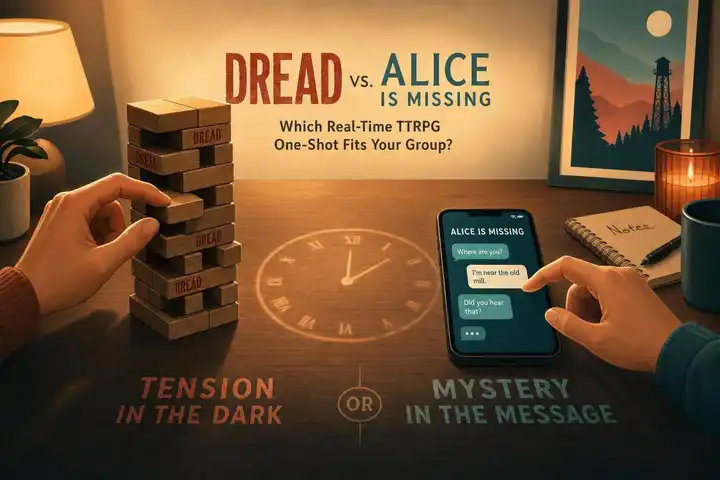
If you want the short answer: pick Dread for spoken horror and a 2–4 hour session, or pick Alice Is Missing for silent texting, emotional play, and a 90-minute story.
I’d break it down like this:
-
Choose Dread if your group wants:
- out-loud roleplay
- a physical Jenga-style tower
- panic, risk, and possible character loss
- a host who steers the session
-
Choose Alice Is Missing if your group wants:
- silent, text-only play
- a fixed 90-minute main session
- grief, secrets, and teen mystery
- a lighter facilitator job during play
Both are built for a one-shot, but they land very differently. One puts pressure in your hands. The other puts it in your phone screen. Dread is louder and more public. Alice Is Missing is quieter and more private.
The main thing I’d look at is how your group likes to communicate. If people want to talk, react, and watch a tower shake, go with Dread. If they like texting in character and sitting with long pauses, go with Alice Is Missing.

Dread vs. Alice Is Missing: TTRPG One-Shot Comparison Guide
Quick Comparison
| What matters | Dread | Alice Is Missing |
|---|---|---|
| Main play style | Spoken table play | Silent text messaging |
| Core system | Jenga-style tower pulls | Timed card reveals |
| Session time | 2–4 hours | 90 minutes play, plus setup/debrief |
| Tone | Survival horror, panic | Sad mystery, grief, secrets |
| GM/facilitator work | More active host role | More structure-based facilitation |
| Character loss | Yes, if the tower falls | No player drops out |
| Best for | Horror-heavy table drama | Quiet, emotional immersion |
If I were choosing for a mixed group with one night free, I’d use tone, talk style, and time as the filter. That usually makes the choice simple.
How each game plays in one session
Here’s how that difference shows up at the table.
Dread: horror decisions through a Jenga tower
In a real-time one-shot, Dread builds pressure through risk. Players say what their characters try to do, and when that risk matters, the Host calls for a tower pull. If the player pulls a block and the tower stays up, the action works. If they refuse, the character fails but stays in play. If the tower falls, that character is out, and the tower resets.
A full session usually runs 2 to 4 hours, with pacing shaped by how fast the tower starts to wobble. You can feel the tension sitting right there on the table. Every pull turns a simple choice into a nerve test. That makes Dread a strong fit for groups that want visible, rising pressure.
Alice Is Missing goes the other way.
Alice Is Missing: a silent mystery told by text
In a real-time one-shot, Alice Is Missing builds pressure through silence and timed reveals. Players spend the main session - about 90 minutes - communicating almost entirely without speaking, sending in-character messages as teenagers connected to Alice Briarwood. A soundtrack video provides the countdown. Players reveal their assigned Clue cards at the indicated times and follow each card’s instructions to introduce discoveries into the conversation.
Players shape the mystery through what they reveal, what they hold back, and when they choose to send each message. Delayed reveals and guarded texts carry much of the emotional weight. Instead of a tower that might fall, the tension comes from pauses, half-answers, and the things left unsaid. That makes it a strong fit for groups that want slow-burn emotional play.
The core difference is simple: Dread is loud, physical, and immediate; Alice Is Missing is quiet and emotionally cumulative. Dread puts tension in your hands. Alice Is Missing puts it in the gaps between messages. That difference shapes everything else: tone, pacing, and table setup.
Key differences that change the table experience
Tone, tension, and emotional pressure
The biggest gap between these games isn't just how they work. It's the kind of pressure they put on people.
Dread pushes a physical kind of horror. You get shaky hands, nervous laughs, and that tight feeling of trying not to mess up. Most scenarios frame the characters like slasher-movie survivors, which usually means not everyone is making it out alive. That setup keeps the stakes close, sharp, and bodily.
Alice Is Missing hits from a different angle. Its mystery is quiet, sad, and heavy. The tension comes from not knowing, from buried secrets between people, and from the pain of looking for someone who matters to you. Players are more likely to feel sadness, dread, and heartbreak than fear of dying. Dread turns fear into something physical. Alice Is Missing turns it inward.
Interaction, pacing, and facilitator load
The way people interact at the table changes everything.
In Dread, play is spoken out loud. That gives the game a loud, group-energy kind of tension: gasps when the tower shifts, laughter when someone barely saves a pull, and instant reactions from everyone watching.
Alice Is Missing does the opposite. It's silent and text-based, so the mood feels private and broken into pieces. Conversations split into different threads. Secrets move through direct messages. Even when everyone is sitting in the same room, it can feel like each player is alone with their phone and their feelings.
Pacing also breaks in two very different directions. Dread builds pressure on its own as the tower gets less stable. Alice Is Missing runs on a fixed timer, with card reveals happening at set moments. That gives facilitators a clear emotional path and an ending that lands on time.
That split carries over to facilitator work. Dread is host-led. The facilitator pushes scenes forward, calls for pulls, and deals with character loss. Alice Is Missing sits much closer to GM-less play. The facilitator runs the timer, prompts card reveals, and protects the mood more than they invent plot. Put simply, Dread wants a host who can steer. Alice Is Missing wants someone who can hold the frame.
| Feature | Dread | Alice Is Missing |
|---|---|---|
| Communication | Spoken table play | Silent, text-only messaging |
| Core mechanic | Jenga tower pulls | Timed card reveals |
| Pacing | Organic, tower-driven escalation | Fixed real-time countdown |
| Facilitator role | Host-led; manages story and pulls | Structure and tone keeper |
| Player exit | Character elimination possible | All players stay engaged to the end |
| Primary emotion | Panic, physical stress, survival risk | Dread, grief, emotional mystery |
| Session shape | Variable; depends on tower stability | Predictable, time-scripted arc |
Setup needs and practical logistics
Dread is pretty simple on the gear side, but it does need the right table setup. You need a stable surface and a 54-block tumbling tower that everyone can reach without leaning across the whole table. It's smart to keep drinks and clutter far from the tower so a random bump doesn't change the game. The host also needs printed or digital scenario notes and questionnaires.
Alice Is Missing asks for a different kind of prep. Every player needs a phone or another internet-connected device, plus a messaging app that supports both group chat and private messages. You also need steady internet and enough battery life to last the whole session. The room should stay quiet, because side chatter or interruptions can break the mood fast. The bigger issue, though, is buy-in. If a group doesn't like the idea of phones sitting at the center of play, this game can fall flat before it even starts.
That makes the next choice pretty clear: horror-heavy table drama or quiet, text-driven immersion.
Best fit by group type
If you already know how each game works, the next step is simple: figure out what kind of night your group wants.
Pick Dread for horror-heavy table drama
Dread works best when your group wants to feel the horror at the table, not just describe it. If your players love slasher movies, survival horror games, and those messy moments where everyone starts talking over each other because things have gone off the rails, the Jenga tower is a strong match.
That tower puts risk right out in the open. Every pull is public. Every wobble gets a reaction. It also asks a lot from the host, who needs to press scenes hard and keep the tension climbing. So if your group wants horror that feels loud, tense, and immediate, Dread is probably the better fit.
Pick Alice Is Missing for text-only immersion
Pick Alice Is Missing if your group wants emotional roleplay through text. It fits players who like journaling, in-character texting, and messy relationship drama. This game leans into secrets, guilt, and emotional strain more than physical horror.
Its text-only format also clicks with groups that already spend time in Discord or group chats. Instead of spectacle, it goes for closeness. That makes Alice Is Missing a strong pick for groups that want something quieter, more personal, and more inward-looking.
Which game works better for first-timers and low-prep nights
For low-prep nights, the main issue usually isn't rules. It's comfort.
Both games are easy to learn, but they teach players in different ways. Dread has a simple hook: pull a block, risk a collapse, and something bad happens. That's easy to explain, which makes it a good pitch for people who've never played an RPG before. At the same time, those stakes can feel rough on new players.
Alice Is Missing is often the smoother starting point for mixed-experience groups. Its 90-minute countdown and timed card prompts do a lot of the heavy lifting, so the facilitator doesn't have to build a complicated plot on the fly. New players can settle in fast, and the silent format takes away some of the pressure to perform in front of the group.
For most mixed-experience groups, Alice Is Missing is the easier low-prep choice. Dread is the better intro when the table wants horror you can see, feel, and risk in the moment.
Final choice: match the game to your session goal
Choose the one-shot your group will actually enjoy
Once you've weighed tone, pacing, and setup, pick the game that fits the session you want to run. The easiest way to do that is to filter by three things: tension, how your group communicates, and how you want people to feel after the game. Then make the call and go with the one that fits your table best.
If your group wants cinematic horror escalation, go with Dread. Plan for about 2–4 hours. The night will likely end with adrenaline, nervous laughter, and that charged postgame buzz people keep talking about on the drive home.
If your group wants a silent, emotional mystery, go with Alice Is Missing. Plan for around 45 minutes of setup, 90 minutes of play, and 10–15 minutes of debrief.
These games aim at different table experiences. Match the game to the feeling you want in the room, and the choice gets pretty simple.
FAQs
Which game is easier to run online?
Alice Is Missing is much easier to run online.
That makes sense when you look at how the game works: it’s built as a text-based roleplaying experience. Players communicate through messages, so moving the game to a digital setup feels natural instead of forced.
Dread, on the other hand, is a poor fit for remote play.
The big issue is the tower. A lot of the game’s tension comes from everyone sitting together and watching that shared physical stack wobble in real time. Once that piece is gone, the mood takes a hit. Online substitutes tend to feel awkward, and in most cases, they make the experience weaker than playing in person.
How many players work best for each game?
Both Dread and Alice Is Missing work best with small groups.
Dread is designed for 2 to 5 players plus a Game Master. That smaller setup matters. It keeps the tension sharp and gives each player room to shape the story.
Alice Is Missing also fits best with a close, intimate group. With too many people, the text-based format can get hard to follow, and the emotional focus can start to drift. In a 3 to 5 player group, the pacing stays smooth and the mechanics have room to do their job.
Which one is better for players who dislike intense horror?
Neither. Both Dread and Alice Is Missing are built to feel intense and unsettling, so they aren't a good fit for players who don't enjoy horror.
Dread keeps the pressure on with its physical tower and leans hard into suspense, slasher movie beats, and permanent character loss. If your group wants to steer clear of heavy horror, neither game is a good choice.
Compare the catalog profiles for Dread and Alice Is Missing, or explore more one-shot-friendly TTRPGs and horror TTRPGs.
Session reference: Renegade’s Alice Is Missing description specifies 3–5 players and a full session of 2–3 hours, including preparation and the 90-minute play phase.


