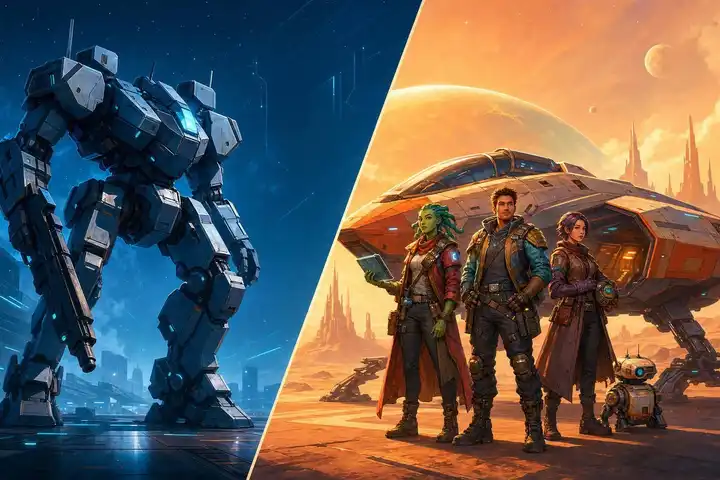
If you want mechs to drive most sessions, pick Lancer. If you want a sci-fi campaign with fights, travel, social scenes, and on-foot play, pick Starfinder Second Edition. That’s the short answer.
I’d break the choice down like this:
- Choose Lancer if your group wants grid-based mech battles, mission goals, squad teamwork, and build planning around 30+ frames
- Choose Starfinder Second Edition if your group wants a mix of combat and story scenes, plus long-term character growth with 6 classes, 10 ancestries, and 50 heritages in the playtest
- Pick by session focus: Lancer is mostly briefing → fight → repair → debrief, while Starfinder shifts between combat, travel, investigation, and faction scenes
- Pick by rules focus: Lancer puts more rules weight into mech fights; Starfinder spreads rules across the whole campaign
- Pick by GM prep style: Lancer asks for maps, sitreps, and enemy setup almost every time; Starfinder asks for more scene variety and more improv
If I had to put it in one line: Lancer is for teams that want the fight to be the event. Starfinder Second Edition is for groups that want the fight to be one part of the trip.

Starfinder 2E vs. Lancer: Tactical Sci-Fi TTRPG Comparison
Quick Comparison
| Criteria | Starfinder Second Edition | Lancer |
|---|---|---|
| Main focus | Full sci-fi campaign | Mech mission play |
| Combat style | Tactical fights inside a mixed session | Tactical grid combat at the center |
| On-foot play | High | Low to medium |
| Character building | Class, ancestry, feats, gear | Frame, licenses, weapons, systems |
| Rules load | Spread across many scene types | Packed into mech combat |
| GM prep | Many kinds of scenes | Fight and map setup |
| Best for | Groups that want variety | Groups that want mech depth |
Bottom line: if your table wants more than combat in most sessions, I’d lean toward Starfinder Second Edition. If your players want tight mech tactics first, I’d lean toward Lancer.
Starfinder Second Edition vs. Lancer: Quick Side-by-Side
Start with a simple choice: does your group want mechs at the center of the campaign, or part of a bigger sci-fi story? Starfinder Second Edition spreads play across a full campaign with combat, travel, exploration, and social scenes. Lancer keeps a much tighter lens on mission-based mech fights. That difference shows up most in scope, combat, and where characters spend their time.
| Category | Starfinder Second Edition | Lancer |
|---|---|---|
| Best use case | Long-term sci-fi campaigns mixing combat, exploration, and social play | Mission-driven campaigns centered on mech combat and squad tactics |
| Combat focus | Tactical firefights and starship missions as part of a broader session | Grid-based mech engagements built around objectives, positioning, and team synergy |
| On-foot relevance | High - on-foot scenes matter as much as combat | Low to moderate - pilot scenes are lightweight and narrative-driven; mechs dominate |
| Campaign scope | Broad, multi-planet campaign | Focused mission loop |
| Ideal group type | Groups wanting a wider campaign beyond combat | Groups wanting mech combat as the centerpiece, with tactical depth |
Starfinder Second Edition: Tactical Combat Across a Full Campaign
Starfinder Second Edition uses the Pathfinder Second Edition engine, including the three-action economy, which keeps turns moving while still leaving room for tactical choices. A single session might jump from a starship boarding action to a spaceport negotiation, then straight into a firefight. That range is a big part of the game's appeal.
Character growth also stretches across many parts of play. Weapons, armor, augmentations, and starship systems all feed into long-term progression. The playtest rulebook lists 6 classes, 10 ancestries, and 50 heritages, which gives players a lot of space to shape a character over time.
The tone leans science-fantasy, so magic, strange cosmologies, and pulpy adventure hooks fit right alongside tactical combat. If your table wants a game where shooting, talking, traveling, and weird space drama all matter, that's where Starfinder Second Edition plants its flag.
Lancer: Squad Tactics and Mech Missions
Lancer divides play into two layers: lightweight pilot scenes and tactical mech combat. Pilot scenes stay light and narrative-driven. The main event is mech combat, which plays out on a grid where movement, cover, lines of fire, and range all matter. Because of that, a battle map is strongly recommended.
Mechs are built from frames plus weapons and systems unlocked through license levels, with 30+ frames available. Most of the fun comes from how a squad works together. One frame might lock enemies down, another pounds them from range, and a support mech helps manage heat and repairs structure. It feels a bit like a tactics game in tabletop form, so groups that already like that style often click with it fast.
That split tells you a lot about what Lancer wants to do. Pilots give the campaign a story frame. Mechs carry the weight of the tactical game. Compared with Starfinder Second Edition, the build path is narrower in overall campaign scope, but each choice can hit much harder once combat starts.
Rules Complexity and Character Build Depth
Both games reward players who like learning a system, but they do it in different ways. Starfinder spreads its rules across combat, exploration, social scenes, and equipment. Lancer puts most of that weight into mech combat and build planning. If your group is choosing between broad play and dense tactical fights, that's the big split.
You can feel that split right away in onboarding, character creation, and GM workload.
| Category | Starfinder Second Edition | Lancer |
|---|---|---|
| Onboarding difficulty | Moderate, easier to learn for players already comfortable with d20 systems | Moderate to high, with licenses, frames, and mech systems to learn |
| Tactical complexity | Medium to high, with feats, positioning, and conditions adding depth over time | High, with dense mechanics, heat management, and squad synergies from the start |
| Character creation complexity | Moderate, with ancestry, background, and class choices plus many feat options | Moderate to high, with frames, licenses, weapons, and systems to configure |
| Advancement structure | Level-based and class-driven, with steady feat and gear upgrades | Modular and license-based, with frames and manufacturers defining unlock paths |
| GM rules overhead | Broad but consistent, with d20 encounters, conditions, skills, and non-combat scenes | Focused but dense, with mech combat tracking for heat, structure damage, statuses, and terrain |
Which Game Is Easier to Start Playing
Groups with d20 experience will usually pick up Starfinder fast. Its three-action economy makes turns easier to follow, and most checks use a pattern that feels familiar. That gives new players a way to jump in and help even before they know every corner of the rules.
Lancer usually needs a little more table time before players feel smooth with it. The mech rules ask a lot from the start: heat, structure, statuses, weapon ranges, and squad synergies are all live on mission one.
Classes, Ancestries, Licenses, and Frames
In Starfinder Second Edition, character identity is built layer by layer. Ancestry sets baseline HP and senses, heritage adds flavor, background gives skill proficiencies, and class shapes your combat role and feat progression. Then the game keeps stacking choices on top. Additional ancestry feats come at levels 5, 9, 13, and 17, adding more ways to shape a character alongside class feats and general feats.
Those choices don't stay locked inside combat, either. Starfinder expects skills and gear to matter in the story, so character building has effects across the whole campaign.
Lancer takes a different path. Players choose a frame, then spend license levels across manufacturers to unlock weapons and systems. Each license rank gives access to two new items, and the frame itself is usually unlocked at rank II. Since unlocked gear can be mixed across frames, as long as mount and system point limits are followed, build options open up fast.
That means a player can take a frame's main strengths and mix in tools from other manufacturers to lean into area control, grappling, or long-range fire support. It's a bit like building a kit from several toolboxes instead of sticking with one set. The upside is a lot of room to tune a mech for the next mission. The downside is that new players can hit option overload, so sample loadouts or GM help often make the first few choices much easier.
| Build Element | Starfinder Second Edition | Lancer |
|---|---|---|
| Core identity | Ancestry + heritage + background + class | Frame choice + license tree selection |
| Customization levers | Class feats, general feats, ancestry feats, gear, augmentations | License levels, weapons, systems, mounts, system points |
| Long-term planning | Plan feat milestones and gear upgrades across 20 levels | Plan license levels across missions to hit key unlocks |
| Build variety source | Multi-axis feat and gear combinations | Cross-manufacturer license mixing within mount and SP limits |
| Best for | Players who enjoy steady, incremental character growth | Players who enjoy buildcraft and mission-to-mission loadout tuning |
The contrast becomes clearest once combat starts. Starfinder spreads its rules load across the whole campaign. Lancer packs much more of it into the fight itself.
Combat Style, On-Foot Play, and Campaign Tone
Build depth matters most once play starts. You feel the split right away at the table: Lancer is built around mech missions, while Starfinder Second Edition blends combat with exploration, negotiation, and travel.
| Category | Starfinder Second Edition | Lancer |
|---|---|---|
| On-foot depth | Strong - exploration, social scenes, and foot combat all have full rules support | Light - pilot-side play is deliberately rules-light and narrative-driven |
| Session structure | Mixes combat, exploration, and social scenes | Centers mission objectives and extraction |
| Tone | Science-fantasy adventure - weird worlds, personal heroics, and varied campaign styles | Military sci-fi - squad deployment, operational briefings, and tactical sorties |
You can see that split most clearly in encounter design.
Battlefield Tactics: Positioning, Teamwork, and Encounter Design
Lancer treats each fight like a mission with a job to do. The game uses objective missions, or sitreps - templates built around goals like holding zones, escorting payloads, hacking data nodes, or surviving against a timer. That means a squad usually can't win by just burning down every enemy. They need to work together. One mech locks enemies in place, another jams systems from a distance, and a third makes a push for the objective while the team juggles heat and structure damage.
Starfinder Second Edition is tactical too, but combat doesn't define the whole session. Cover rules, vertical terrain, and hazard-heavy maps help fights feel active and worth thinking through. At the same time, those fights sit beside exploration, social scenes, and travel rather than taking over the full shape of play.
How Well Each Game Supports Non-Combat Play
Lancer keeps pilot scenes light so mech combat stays at center stage, while Starfinder Second Edition gives exploration, diplomacy, and investigation real mechanical weight. In Starfinder, skills matter outside of combat, and the game expects groups to spend real table time on what happens between battles.
In Lancer, pilot-side play works more like connective tissue. A scene may come down to a few skill checks, with no initiative tracking, and much of the story lives in briefings and downtime.
That split affects GM prep, encounter pacing, and how much happens between sessions.
GM Workload and Recommendations by Group Type
Starfinder spreads prep across a lot of different scene types. Lancer puts most of that work into mission and encounter design. That difference changes how a GM plans sessions, where pacing comes from, and when they need to improvise.
| Category | Starfinder Second Edition | Lancer |
|---|---|---|
| Prep focus | Many scene types each session | One mission-built encounter |
| Encounter preparation | Story arcs, NPCs, varied maps, and tactical combats. | Sitreps, terrain, enemy roles, and reinforcement waves. |
| Tactical management | Tactical combat is important, but it sits inside a wider mixed-genre workload. | Demanding tactical management is central every session. |
| Improvisation demands | More improvisation across dialogue, exploration, and unexpected detours. | Less improvisation outside combat; mid-fight adjustments are the main flex point. |
| Long-term campaign support | Strong official support: GM Core, published adventures, and encounter guidance. | Strong community resources and repeatable mission-design patterns. |
Put simply: Starfinder asks for more variety across scenes, while Lancer asks for more depth inside each fight.
Lancer GM guides from the community often suggest aiming for enemy structure equal to 1.5x to 2x the player count and keeping enemy activations at about 1.5x the number of PCs to keep fights balanced.
At that point, the choice often comes down to prep style. Starfinder leans toward broad scene coverage. Lancer leans toward focused mission design.
Choose Starfinder Second Edition for Broader Sci-Fi Play
Starfinder Second Edition fits groups that want a campaign with built-in variety. It moves between combat, exploration, and social scenes, so the GM has to juggle more kinds of play from session to session.
That sounds like more work on paper, but the official support helps a lot. GM Core and published adventures include maps, stat blocks, and encounter guidance, which can cut down prep over a long campaign. If your GM likes to riff during play and shift smoothly between scene types, Starfinder gives them enough structure to keep things moving without feeling buried in prep.
Choose Lancer for Mech Combat as the Main Event
Lancer makes the most sense if your group wants mission-based mech combat to be the center of play. Here, encounter design matters more than scene variety, because the fight is usually the event everyone showed up for.
The game’s structure - Briefing → Deployment → Combat → Repair → Debriefing - gives each session a clear frame as a self-contained operation. The GM starts with the objective, then builds the sitrep, map, and enemy mix around that goal.
That loop is repeatable, and for the right GM, it’s a lot of fun. But there’s a catch: you’ll usually need a detailed battle map for almost every session, whether you build it yourself or pull it from another source. Groups that love mech builds, squad teamwork, and tightly tuned tactical fights will get the most out of it. The same goes for GMs who’d rather fine-tune encounters than run open-ended exploration.
FAQs
Which game works better for short campaigns?
Lancer is often the better pick for short campaigns. It leans hard into high-stakes mech combat, which makes it a strong match for punchy, mission-based sessions. You can get big moments on the table without as much prep or long-term build management.
Starfinder Second Edition gives you a broader sci-fi adventure space and stronger long-term character growth. But there’s a tradeoff: the rules are more complex, and prep tends to take more work. For a short campaign, that can make it feel like a heavier lift.
Can Lancer still work if our group cares about roleplay?
Yes. Lancer can work well for roleplay-focused groups if you keep the game pointed at story-first goals and don’t let combat eat the whole session.
The big shift is how you frame fights. Instead of treating grid combat like a standalone puzzle, make each battle matter in the fiction. A rescue mission hits differently than “roll initiative and win.” Defending a location, holding a choke point, or taking control of a key area gives players something to care about beyond movement and range.
It also helps to be upfront about session balance. Set clear expectations for how much time will go to tactical play versus character scenes, dialogue, and moment-to-moment roleplay. That way, everyone comes in on the same page, and combat feels like one part of the story instead of the whole thing.
Which game is easier for first-time GMs?
For first-time GMs, the easier pick is the game with smoother onboarding, cleaner mechanics, and less rules overhead.
Since both Starfinder Second Edition and Lancer support tactical play, the better fit for new GMs is the one with lighter encounter prep and simpler session procedures. If not, you can end up spending more time learning the system than actually running the game.


