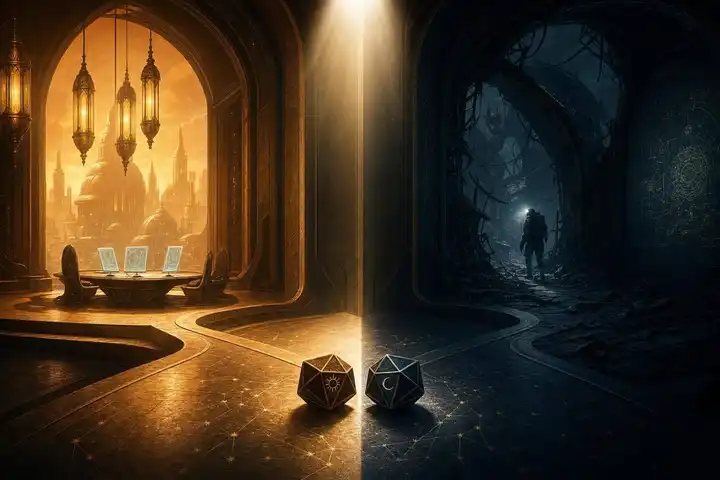
If you want politics, faith, and crew drama, I’d pick The Third Horizon. If you want ruin runs, survival pressure, and a lower GM load, I’d pick The Great Dark.
Here’s the short version:
- The Third Horizon is built for space opera across 36 systems
- The Great Dark is a standalone sequel set about 200 years later
- One game leans on factions, religion, and social tension
- The other leans on expeditions, supplies, gear damage, and the Blight
- New GMs will often have an easier time with The Great Dark
- Long campaign groups that like lore and NPC ties may fit The Third Horizon better
You’re not choosing between an old game and a new version. You’re choosing between two different campaign engines.

Coriolis: The Third Horizon vs. The Great Dark – Full Comparison
Coriolis – The Third Horizon Core Rulebook Review | Sci-Fi RPG Deep Dive & Verdict
Quick Comparison
| Criteria | The Third Horizon | The Great Dark |
|---|---|---|
| Best for | Politics, faith, crew stories | Survival, ruins, frontier trips |
| Setting scope | 36 portal-linked systems | About 11 charted systems |
| Time period | Earlier era | About 200 years later |
| Home base | Coriolis station or ship | Ship City |
| Core danger | Factions, cosmic dread, social fallout | Blight, Supply drain, gear wear |
| Reroll cost | GM gains Darkness Points | You lose Hope or damage gear |
| Session shape | Jobs, talks, travel, mystery | Prep, travel, delve, return |
| New GM fit | Lower | Higher |
| One-shot fit | Lower | Higher |
| Long campaign fit | Very strong | Strong |
My read is simple: if your group likes talking through tense deals and getting pulled into setting lore, go with The Third Horizon. If your group wants clear goals, hard choices, and pressure on every trip, go with The Great Dark.
That’s the whole choice in plain English. The rest comes down to what kind of stress your table enjoys most.
Setting and Campaign Focus: Political Space Opera vs. Frontier Expedition Sci-Fi
The split between these two games starts with location, but it doesn't stop there. Each one puts the crew under a different kind of pressure and pushes the campaign in a different direction.
Coriolis: The Third Horizon - Setting and Campaign Style
Coriolis station sits at the heart of a setting shaped by trade, faith, and faction politics. Its culture, religion, and politics carry a strong Middle Eastern–influenced identity.
That station is more than a backdrop. Built from the hull of the Zenith generation ship, Coriolis serves as a center for trade, diplomacy, and the Council of Factions. The setting also turns on the tension between the Firstcome, who revere the Icons, and the Zenithians, whose later arrival gave them major influence over commerce and military power.
That setup naturally pushes campaigns toward political intrigue, trade disputes, religious strain, and cosmic mystery. One session might start with a contract dispute between the Consortium and the Free League. The next could send the crew after a lead tied to the Emissaries or into the middle of a heresy inside the Church of the Icons. And then there's the Dark between the Stars, which adds a grim, metaphysical edge that makes even quiet social conflict feel unsafe.
The Great Dark trades that station-centered pressure for something more outward-facing: frontier travel, hard choices, and recovery work.
Coriolis: The Great Dark - Setting and Campaign Style
The Great Dark takes place in a frontier settled by refugees from the Third Horizon. They followed a signal to the Jumuah system and built Ship City, an asteroid home base, as the center of operations.
From there, crews head out through Slipstreams, dangerous currents that call for skilled pilots and Greatships. Those routes open into the Charted Sphere, where outposts and Builder ruins make each expedition a mix of discovery and danger. Push farther out, and the Blight shifts the mood from discovery to plain survival.
The default campaign frame places the characters in the Explorer's Guild. That means planning expeditions, lining up funding, recovering artifacts, and dealing with the mess that comes with returning from the frontier. Ship City handles the in-between work: planning, repairs, and fallout after each run.
Those setting choices affect almost every part of play, from where sessions open to what counts as success by the end of the night.
Side-by-Side Table: Where Stories Start and Where They Go
| Feature | Coriolis: The Third Horizon | Coriolis: The Great Dark |
|---|---|---|
| Setting Scope | Portal-linked cluster of about 36 star systems near Aldebaran | The Lost Horizon, with Ship City and roughly 11 charted systems |
| Home Base | Coriolis station or the crew's ship | Ship City |
| Major Threats | Faction politics, the Dark between the Stars, Emissaries | The Blight, Slipstream hazards, Builder ruins |
| Typical Loop | Jobs, trade runs, faction diplomacy, mysteries | Guild expeditions, ruin delves, resource recovery |
| Core Tone | Space opera with faith and intrigue | Frontier survival and exploration sci-fi |
Rules and Session Feel: How Each Game Plays at the Table
Both games run on the Year Zero Engine d6 pool, but they build tension in very different places. The Third Horizon keeps resolution lean and shifts pressure to the GM. The Great Dark puts that pressure on the players’ supplies, gear, and staying power.
You feel that split almost right away at the table. The reroll rules are different. The cost of failure is different. Even the pace of a session changes with it.
The Third Horizon: Mechanics and Table Rhythm
The Third Horizon keeps the basic roll easy to grasp, then layers risk through prayer and Darkness Points.
Players can pray to the Icons once per roll to reroll, but each prayer gives the GM a Darkness Point they can spend on complications such as misfires, ship breakdowns, environmental hazards, or enemy abilities. That tradeoff is simple, and it gives every reroll a little sting. You get another shot, but the GM gets ammo.
At the table, that leads to sessions that can shift fast between social negotiation, investigation, ship operations, and sudden danger. The GM can spend Darkness Points to turn up the heat without dragging out the scene, which helps play stay brisk, especially for new players.
The Great Dark: Mechanics and Table Rhythm
The Great Dark turns every push roll into a resource call.
When players push a roll, they reroll non-1, non-6 dice once; each 1 on a Base Die costs Hope, and each 1 on a Gear Die damages that item until it breaks or loses its bonus. So the question isn’t just “Do I need this reroll?” It’s also “What am I willing to spend to get it?”
That choice shapes the whole session. Play follows a clean expedition loop: prepare, travel, delve, recover. Inside a Delve, Blight keeps the pressure on: leftover Blight deals Heart damage each round, and Supply drains with depth, combat, strenuous activity, and rest. In plain terms, almost every hard move has a cost attached to it.
Side-by-Side Table: Mechanics, Tension, and Typical Session Structure
Here’s the practical difference at the table.
| Feature | Coriolis: The Third Horizon | Coriolis: The Great Dark |
|---|---|---|
| Core Dice System | d6 pool; each 6 = success | d6 pool; each 6 = success |
| Reroll Mechanic | Pray to the Icons (GM gains a Darkness Point) | Push the roll (Hope loss / gear wear on 1s) |
| Where Tension Lives | GM's Darkness Point budget | Player resources: Hope, gear condition, Supply |
| Combat Feel | Sudden and dangerous | Risk-managed, tied to Delve hazards and survival |
| Exploration Support | Interstellar travel and ancient mysteries | Structured Delve loop with Blight tracking |
| Session Structure | Fluid: social scenes, investigation, ship ops | Procedural: Prep → Travel → Explore → Return |
| Typical Session Feel | Balancing a job's social cost against cosmic dread | Executing a high-stakes expedition into the unknown |
Characters, GM Workload, and Long Campaign Support
Once the tone and rules are clear, the next big split is simple: how much work the players and GM need to carry over time.
Character Options, Roles, and Advancement in Both Games
The Third Horizon begins with a shared group concept - traders, mercenaries, explorers, faction agents, or pilgrims - then builds each character through Origin, Upbringing, and role. Roles include options like Pilot, Negotiator, Soldier, or Preacher. Optional paths such as mystics, Humanites, and faction operatives keep faith and politics close to the center of play.
Each character also follows an Icon, which brings both mechanical bonuses and religious meaning. Over time, advancement leans into reputation and faction ties, with social, investigative, mystic, and ship-related talents shaping how a character grows. So characters don’t just get better at tasks. They get pulled deeper into the setting.
The Great Dark takes a leaner route. It removes skills and uses six attributes plus Talents, which makes characters feel narrower but more sharply defined. That gives the game a more focused, expedition-ready feel. Advancement stays tied to Talents and gear.
GM Demands: Managing Intrigue vs. Managing Expeditions
Those character systems spill straight into GM prep. One game asks you to manage a web of people and power. The other asks you to run dangerous journeys.
Running The Third Horizon means keeping tabs on factions, patron networks, and Darkness Points across a dense campaign structure. GMs need to watch who holds influence, how the crew changes those relationships, and how personal character hooks connect to larger story lines. Knowing when to spend Darkness Points for the most dramatic effect takes some table sense and a bit of reps.
That helps explain why the game scores a 2/5 for new GM fit even with a 5/5 for campaign depth. A smart way in is to start small: one station, one patron network, and room to grow.
The Great Dark swaps that political tracking for expedition management. The GM’s attention shifts to hazard design, route planning, and resource drain. Prep stays more contained because the scale is smaller. In play, the pressure comes from pacing the delve loop and tracking how repeated expeditions grind down the crew’s Hope, gear, and health.
Side-by-Side Table: Player Commitment, Prep Load, and Campaign Longevity
Here’s the practical split in player buy-in, prep load, and how well each game holds up over a long run.
| Feature | Coriolis: The Third Horizon | Coriolis: The Great Dark |
|---|---|---|
| Ease for New Players | Moderate - group concept helps, but the lore is dense | Higher - survival stakes are immediately legible |
| Ease for New GMs | Lower (2/5) - faction tracking and Darkness Point pacing take practice | Higher - smaller setting scale and procedural exploration make prep more contained |
| Prep Style | Lore-heavy: factions, NPCs, religious tone, political consequences | Hazard-heavy: expedition routes, resource scarcity, ruin design |
| Long Campaign Support | Very strong - published campaign material supports a multi-year arc | Strong - Ship City survival and repeated expeditions can sustain ongoing play |
| One-Shot Flexibility | Lower - setting investment pays off over time | Higher - strong for short, self-contained delves |
| Group Chemistry It Rewards | Players who enjoy political maneuvering, roleplay-heavy scenes, and shared lore investment | Players who enjoy problem-solving under pressure, resource decisions, and tight crew dynamics |
Final Verdict: Which Coriolis Game Is Right for Your Group
Both games run on the Year Zero Engine, but they aim at different kinds of fun. The simplest way to decide is this: pick the one that matches the main tension your group likes most.
Choose The Third Horizon for Politics, Faith, and Space Opera
Go with The Third Horizon if your table lights up around tense deals, crew conflict, and faction maneuvering. It works well for long-running campaigns built around politics, faith, and life aboard a shared ship. If your players like recurring NPCs with messy loyalties, hard choices tied to belief and ideology, and a vessel that starts to feel like home, this one will likely click.
Choose The Great Dark for Ruins, Survival, and Discovery
Pick The Great Dark if your group wants direct goals and constant danger. It centers on expeditions, ruin delves, and survival when things start going sideways. The Blight connects discovery to risk, so every push deeper into a ruin can cost you. Sessions often feel like a mix of sci-fi dungeon crawl and survival horror, which fits tables that enjoy resource tracking and snap calls under pressure. It's also easier for new GMs to run.
If your group leans toward politics and crew drama, choose The Third Horizon. If they want ruins, survival, and discovery, choose The Great Dark.
FAQs
Which Coriolis game is easier for beginners?
The available information doesn’t clearly show that one Coriolis game is easier for beginners.
Coriolis: The Third Horizon has a 4/5 complexity rating, needs medium prep, and uses the Year Zero Engine. Coriolis: The Great Dark is presented as a standalone, expedition-focused TTRPG, but there’s no clear complexity score or beginner-focused rating attached to it.
So, in plain English: there isn’t enough solid data to say one is the easier starting point. A better way to choose is by theme and play style:
- Pick Coriolis: The Third Horizon if your group likes interstellar politics, faction play, and a setting with more moving parts.
- Pick Coriolis: The Great Dark if survival-driven expeditions and self-contained adventures sound like more fun.
That framing will probably help your group more than trying to force a clear “beginner” label where the info just doesn’t give one.
Can I play The Great Dark without knowing The Third Horizon?
Yes. Coriolis: The Great Dark is a standalone tabletop roleplaying game.
It’s built as a self-contained, expedition-focused experience, so you don’t need any prior knowledge of The Third Horizon to play it.
Which game is better for one-shots versus long campaigns?
Coriolis: The Third Horizon is built more for long-form campaigns, especially when exploration, ship management, and deep lore sit at the center of play.
It’s less suited to simple one-shots or fast, action-heavy sessions because it asks more from the group in terms of setting buy-in and rules learning. As for The Great Dark, the information available here doesn’t clearly say.


