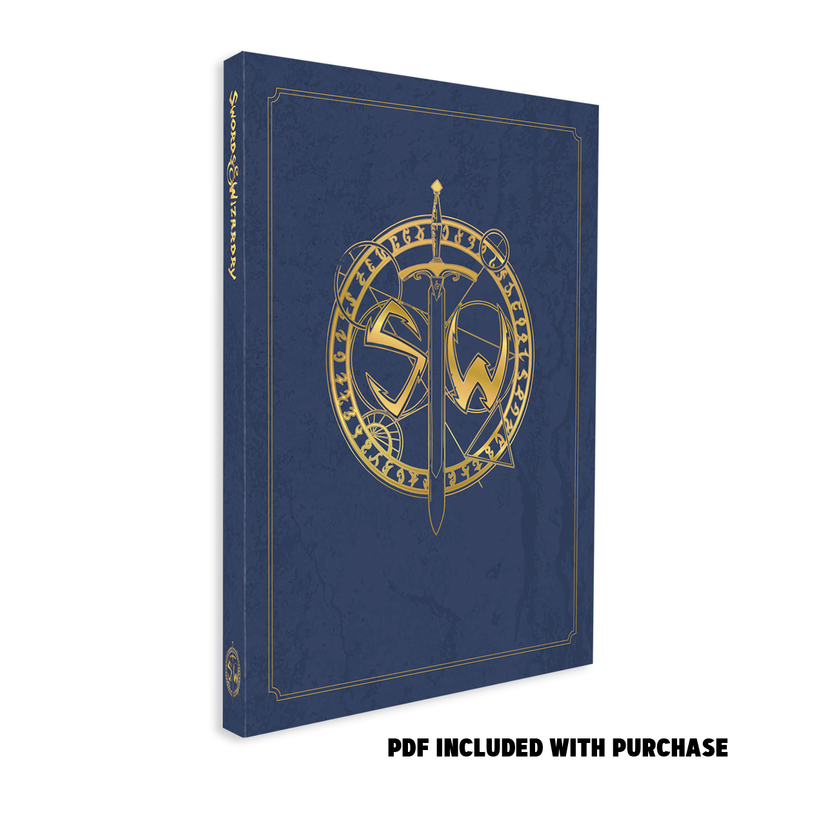
Sword & Wizardry

Sword & Wizardry is the ENNIE award-winning retroclone of Original Dungeons & Dragons (1974-1978), commonly called OD&D or 0e. Created by Matt Finch and published by Mythmere Games, it consolidates the original box set plus the Greyhawk, Blackmoor, and Eldritch Wizardry supplements into a single, coherent 144-page rulebook. The result plays like a simplified AD&D (1979) with modern usability enhancements.

Theme and Setting

Sword & Wizardry embraces classic fantasy roleplaying without prescribing a specific campaign setting. The implied world draws from early Dungeons & Dragons: treasure-seeking adventurers explore dangerous dungeons, face high lethality, and rely on player skill over character abilities. The game supports any traditional fantasy setting and maintains compatibility with material published for D&D and AD&D prior to 3rd edition. The three-fold alignment system (Lawful, Neutral, Chaotic) reinforces the moral ambiguity of sword and sorcery literature.

Core Mechanics and Rules

The game uses d20-based mechanics with optional ascending or descending Armor Class. The ascending system (higher is better) eliminates THAC0 calculations while preserving compatibility with older material. A unified saving throw replaces the traditional category-based system (death rays, wands, etc.), though the classic approach remains available as an option.

Character creation offers seven classes: Cleric, Fighter, Magic-User, Thief, Assassin, Monk, and Ranger. Nine races include Human, Elf, Dwarf, Halfling, Half-Elf, and Half-Orc. Demi-human characters face level limits, though optional rules allow advancement beyond these caps with experience penalties. Hit dice follow OD&D standards (Fighter d8, Cleric d6, Magic-User d4), creating lower-powered campaigns than later editions.

Combat rounds last one minute, with movement rates of 90-120 feet. The rules include four initiative options, morale checks, and two-weapon fighting. Spellcasting follows the Vancian system, with Magic-Users preparing spells into memory slots. The complete spell list covers all classic options from the original supplements.

What Makes It Unique

Sword & Wizardry distinguishes itself through thoughtful modernization of OD&D without losing the original spirit. The ascending AC option and unified saving throw reduce bookkeeping while maintaining the same mathematical outcomes. The Complete version includes everything needed to play—character creation, equipment, spells, monsters, magic items, and encounter tables—eliminating the need for multiple books.

Unlike B/X-based retroclones that limit classes through race-as-class mechanics, Sword & Wizardry preserves the full class and race separation from the original supplements. Players can create Elf Fighters, Dwarf Clerics, or Half-Orc Thieves without restriction. The 144-page hardcover format makes it one of the most compact complete fantasy RPGs available, significantly more affordable than multi-volume alternatives.

Target Audience and Player Experience

Sword & Wizardry serves groups seeking an authentic early D&D experience without the organizational chaos of the original pamphlets. The Revised Edition (2023) features improved layout by Suzy Moseby and art including covers by Erol Otus. New players find the unified mechanics approachable, while veterans appreciate the faithful recreation of their earliest gaming memories.

The game excels at dungeon-focused campaigns with high lethality and resource management. The lower power curve compared to modern editions emphasizes careful planning and creative problem-solving. With nearly fifty years of compatible adventures, supplements, and bestiaries available, referees have endless content to draw from. Groups wanting the scope of AD&D with the simplicity of early D&D will find Sword & Wizardry an ideal foundation.


Rules Lite;Fantasy;Old-School Renaissance (OSR);Class-based
Sword & Wizardry cover image
Emoji icon 1f929.svg

What do players think?

The ENNIE award-winning retroclone receives consistent praise for organizing Original D&D into a coherent, playable format. Reviewers highlight the ascending AC option, unified saving throws, and comprehensive coverage of classes and races from the early supplements. The 144-page hardcover format offers exceptional value compared to multi-volume alternatives, with the 2023 Revised Edition earning particular acclaim for improved layout and presentation.

Related TTRPG Games

Compare Sword & Wizardry with other great ttrpg games.

Old-School Essentials logo

Old-School Essentials

Both are definitive modern presentations of early D&D rules. Old-School Essentials uses the B/X (1981) chassis with race-as-class mechanics and meticulous organization, while Sword & Wizardry draws from the original 1974-1978 supplements with separate race and class options. OSE offers modular formatting; S&W provides ascending AC and unified saves as standard features. Both maintain excellent compatibility with classic modules.

The Black Hack logo

The Black Hack

Two approaches to streamlined OSR gaming. The Black Hack distills old-school play to its absolute minimum with usage dice and player-facing rolls. Sword & Wizardry preserves more of the original D&D structure—classes, levels, and Vancian magic—while adding modern usability. Black Hack suits ultra-light one-shots; S&W supports long campaigns with full character progression and the complete classic spell list.

Basic Fantasy RPG logo

Basic Fantasy RPG

Both are free or low-cost retroclones welcoming newcomers to OSR play. Basic Fantasy RPG uses a d20 chassis similar to early 3rd edition with ascending AC as standard. Sword & Wizardry stays closer to Original D&D mechanics with more class and race options. BFRPG emphasizes community-created content and free availability; S&W offers polished commercial production with the ENNIE-winning Complete Revised edition.

Join Our Mailing List

Every week we send out a newsletter with last week's 10 best ttrpg games that have been added to the directory.

Error. Your form has not been submittedEmoji
This is what the server says:
There must be an @ at the beginning.
I will retry
Reply
We respect your privacy and take protecting it seriously.
Built on Unicorn Platform