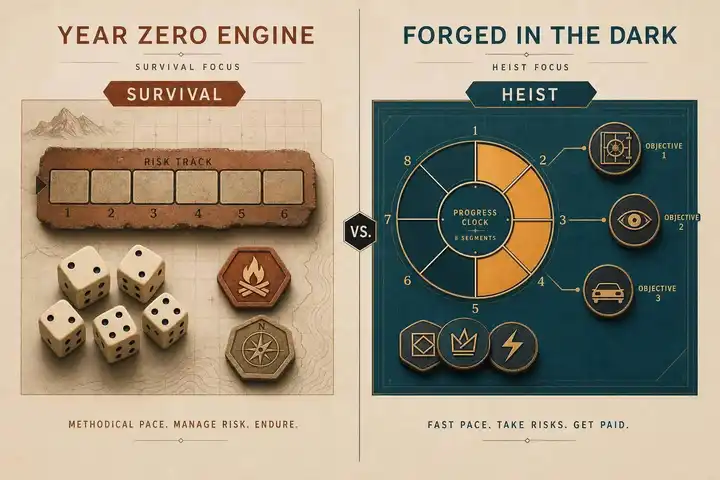
If you want a short answer: pick Year Zero Engine for survival, travel, and supply pressure. Pick Forged in the Dark for heists, crew play, and jobs that move fast.
I’d break the choice down to 5 things: risk timing, failure style, campaign loop, GM workload, and group focus. In plain terms, YZE asks, “Do you push after a bad roll?” while FitD asks, “How risky is this before you roll?” That one split changes almost everything at the table.
Here’s the article in one quick pass:
- Year Zero Engine fits groups that want survival tension, travel, resource drain, and harsh combat
- Forged in the Dark fits groups that want scores, downtime, crew sheets, and mixed success on many rolls
- YZE often puts more work into maps, routes, threats, and supplies
- FitD often puts more work into live rulings, consequences, clocks, and scene flow
- Tales from the Loop is one of the easier entry points
- Band of Blades is one of the heavier games in this comparison
- Campaign shape also shifts a lot: 3–5 session arcs for some Alien play, 8–20 session arcs for games like Scum and Villainy, and long sandbox play for Forbidden Lands
Bottom line: if your table wants slow pressure and survival, I’d lean YZE. If your table wants job-based play and player-led scene control, I’d lean FitD.

Year Zero Engine vs. Forged in the Dark: TTRPG System Comparison
My Top 5 Year Zero Engine Roleplaying Games

Quick Comparison
| Criteria | Year Zero Engine | Forged in the Dark |
|---|---|---|
| Core feel | Survival and travel pressure | Jobs, crews, and downtime |
| Dice read | Count 6s | Read the highest die |
| Failure style | Push after the roll for another shot | 4–5 often means success with a cost |
| Risk timing | Risk often sharpens after the roll | Risk is set before the roll |
| Pressure tools | Stress, panic, conditions, supply loss | Stress, resistance, flashbacks, clocks |
| Campaign loop | Travel, scenes, attrition, recovery | Score, fallout, downtime, repeat |
| GM load | More front-loaded setup in many games | More in-the-moment calls during play |
| Group focus | Often character survival first | Often crew or unit first |
| Good fits | Alien, Tales from the Loop, Forbidden Lands | Blades in the Dark, Scum and Villainy, Band of Blades |
If you’re choosing between the two, I’d start with one simple question: Do you want to survive the world, or run jobs inside it?
How Year Zero Engine and Forged in the Dark Work

Year Zero Engine: Push Rolls, Stress, and Survival Pressure
YZE turns risk into pressure. The more you push, the more the cost starts to bite at the table.
In Year Zero Engine, you build a dice pool by combining an Attribute and a Skill, then roll all those D6s at once. Any die showing a 6 is a success. One 6 is enough to pull it off, and extra 6s add bonus effects called stunts.
What gives YZE its own feel is the push mechanic. If you want another shot, you can reroll all dice that didn't show a 6 or a 1, but you pay for it. In Alien, pushing adds Stress dice and can trigger Panic. In Tales from the Loop, failure usually leads to Conditions instead of death. In Forbidden Lands, resource dice step down as supplies get used up. That slow drain is where a lot of the tension comes from.
Time in YZE is split into 6-hour blocks, which keeps travel and exploration tied to the world in a grounded way. Hex-crawling in Forbidden Lands means tracking food, water, and rest across those shifts. Combat is fast and brutal. Characters can break in a hurry, and injuries tend to stick.
Forged in the Dark: Action Rolls, Position and Effect, and Clocks
FitD handles risk in a different way. The table sets the stakes before the roll, then deals with the fallout through position, effect, and clocks.
Forged in the Dark also uses D6 pools, but the roll reads differently. Your pool comes from an Action rating, and you only look at the highest die. A 6 is a full success. A 4 or 5 is a success with a cost. A 1–3 is a failure. That middle result shows up a lot, and that's a big part of why FitD keeps complications moving at a steady clip.
Before any roll, the GM and player work out Position and Effect. Position shows how much danger you're in: Controlled, Risky, or Desperate. Effect shows how much the action can get done: Limited, Standard, or Great. So before the dice even land, everyone knows what success and failure are likely to mean.
Stress gives players room to push back. It lets them add dice, resist consequences, or trigger flashbacks. Clocks track progress on goals and threats. The system is built around group plans instead of one-off scenes. Blades in the Dark uses this setup for criminal scores. Scum and Villainy applies it to spaceship heists. Band of Blades uses it for a retreating military campaign with high lethality and tight resource management between missions.
| Mechanic | Year Zero Engine | Forged in the Dark |
|---|---|---|
| Dice Pool | Attribute + Skill | Action Rating |
| Success Tiers | 6s = success; extra 6s add stunts | 6 = full, 4–5 = partial, 1–3 = failure |
| Risk | Push after the roll | Set risk before the roll |
| Stress | Costs stress; can trigger panic | Adds dice, resists consequences, enables flashbacks |
| Structure | Shifts and exploration | Scores and downtime |
Those differences shape pacing, player agency, and campaign structure in very different ways.
Core Differences at the Table
Resolution and Risk: Push Your Luck vs. Built-In Complications
The biggest difference comes down to when risk gets locked in.
In Year Zero Engine, you roll first and decide later whether to push. You get to see the result, then choose: keep it, or take on more danger to try for something better.
In Forged in the Dark, that choice happens earlier. The GM and player set Position and Effect before the roll, so the danger and likely payoff are clear up front. Then the roll lands, and that common middle result, a 4–5, keeps complications in motion.
So the feel at the table shifts in a pretty clear way. YZE makes risk a post-roll choice: push for a stronger result, or live with the miss. FitD puts risk on the table before the dice hit, then uses partial success to keep the fiction moving.
Pacing and Player Agency: Exploration Loops vs. Score-Downtime Cycles
Once risk is set, the next split is pacing.
YZE leans toward slower exploration, attrition, and resource pressure. FitD is built to move faster. The Engagement Roll drops the group into the action and cuts planning down to a single step. Flashbacks and Resistance rolls let players shape events in the middle of a scene by spending Stress. Clocks make pressure and progress easy to track at a glance.
That difference also changes how campaigns take shape and how much prep the GM tends to do.
At the table, it usually looks like this:
| Feature | Year Zero Engine | Forged in the Dark |
|---|---|---|
| Risk | After the roll; players choose whether to push | Before the roll; stakes are set through Position & Effect |
| Complications | Tied to pushing and game-specific stress or panic effects | Built into partial success and mixed outcomes |
| Pacing | Gradual exploration and survival loops | Score-Downtime cycle; Engagement Rolls jump straight into the action |
| Agency | Reactive; manage resources and decide when to push | Proactive; use Flashbacks, Resistance rolls, and pre-roll negotiation |
| Pressure Tracking | Resource scarcity like ammo, air, food, and mental stability | Visible Progress and Danger Clocks |
Campaign Fit and GM Workload
Those rule differences don’t just shape play at the table. They also change how much work the GM does before a session versus in the middle of one.
Year Zero Engine Campaigns: Horror, Mystery, and Sandbox Survival
Year Zero Engine tends to put more work before play starts. For Forbidden Lands, that usually means maps, travel routes, threats, and pressure on food, gear, and other supplies. For Alien, it means building agendas and locations. For Tales from the Loop, it means setting up mystery hooks. Once play begins, though, the rules stay pretty simple across all three.
Tales from the Loop is the lightest of the group at 1/5 complexity, and characters can’t die. Alien lands at 3/5 and works well for tight 3–5 session Cinematic arcs with high lethality. Forbidden Lands is the heaviest at 4/5, and it’s built for long-term open-world sandbox play.
So in plain terms, YZE fits groups that want more structured prep, grounded danger, and long-form survival play.
Forged in the Dark Campaigns: Crews, Missions, and Ongoing Operations
Forged in the Dark goes the other way. It cuts down pre-session prep, but moves more of the work into live rulings at the table through Position, Effect, Clocks, and consequences. The GM improvises more during play and does less bookkeeping ahead of time.
Blades in the Dark and Scum and Villainy both work well for medium-length campaigns, often 8–20 sessions, with the Crew or Ship Sheet handling group advancement alongside faction reputation and Heat. Scum and Villainy has a 4/5 complexity rating tied to its job-based structure. Band of Blades adds military logistics and a retreat campaign on top of the FitD chassis, which makes it the most demanding FitD example here.
That makes FitD a better match for groups that want lighter prep, faster scene entry, and campaign structure built around the crew.
| Game | System | Prep Demand | In-Session Complexity | Campaign Structure |
|---|---|---|---|---|
| Alien | YZE | Moderate | 3/5 | Cinematic (3–5 sessions) or frontier sandbox |
| Tales from the Loop | YZE | Low | 1/5 | Episodic mysteries |
| Forbidden Lands | YZE | High | 4/5 | Open-world sandbox |
| Blades in the Dark | FitD | Low | 4/5 | Score-Downtime cycle |
| Scum and Villainy | FitD | Low | 4/5 | 8–20 session arcs |
| Band of Blades | FitD | High | 5/5 | Linear military retreat |
Which System Fits Your Group
Matching Your Goals to the Right System: Survival, Exploration, Heists, or Crew Play
Once mechanics, pacing, and GM load are clear, the last step is pretty simple: what kind of table are you running?
Choose Year Zero Engine for survival pressure and exploration. Choose Forged in the Dark for heists, crew play, and fast-moving jobs. That split comes back to the same three factors this article has followed the whole way through: risk, pacing, and campaign shape.
Here’s a quick map to line up group preference with the right system family:
| Group Preference | Best-Fit System | Example Games |
|---|---|---|
| Survival horror and stress | Year Zero Engine | Alien RPG |
| Emotional mystery | Year Zero Engine | Tales from the Loop |
| Harsh exploration | Year Zero Engine | Forbidden Lands |
| Heists and criminal crews | Forged in the Dark | Blades in the Dark, Scum and Villainy |
| Military campaigns | Forged in the Dark | Band of Blades |
Experience level matters too. Tales from the Loop is one of the easier entry points in either family, while FitD games like Scum and Villainy ask for more table coordination. New GMs often find YZE easier to run because games like Alien and Tales from the Loop rely on more direct procedures.
If your table likes methodical survival play, YZE’s exploration loops will probably feel like a better fit. If your group likes to improvise around consequences, FitD’s flashbacks and score structure keep things moving. So the final choice usually comes down to this: survival tension and sandbox exploration, or heists and crew-driven play.
Using TTRPG Games Directory to Research Games Before Your Next Campaign

If the choice feels close, it helps to compare specific games by complexity and campaign structure. TTRPG Games Directory lets you browse detailed game descriptions, filter by genre, and compare mechanics across both families - all at no cost.
Its complexity ratings and genre tags give you a concrete starting point based on the same criteria covered here: risk profile, pacing structure, and campaign fit. That side-by-side research can save your group from sinking time into a system that doesn’t match how you actually want to play.
FAQs
Which system is easier for new GMs?
Year Zero Engine games are usually easier for new GMs to run. They’re often less complex than many fantasy RPGs, with abstracted skills and a simple dice-pool system that’s easy to pick up.
Forged in the Dark, on the other hand, puts more on the GM’s plate. You need to improvise consequences all the time and keep track of systems like clocks, flashbacks, and downtime. That can be a lot to handle, even for experienced GMs.
Can Year Zero Engine handle heists or crew play well?
Year Zero Engine can run missions with heist or crew angles, but that’s not what it was mainly built for.
At its core, it leans toward procedural survival, exploration, and cinematic tension.
It also doesn’t have the same built-in support for crew dynamics, downtime projects, or heist-focused tools that Forged in the Dark offers. Instead, Year Zero pushes play forward with stress, panic, and resource management.
Which style works better for long campaigns?
Both can handle long campaigns, but they move in different ways.
Forged in the Dark tends to shine in long, crew-focused play. Progress doesn’t sit only on one character sheet. It also lives in the crew, ship, or brigade, so the campaign can keep moving even if characters die or retire.
Year Zero Engine often leans more toward emergent, player-driven exploration. Games like Forbidden Lands and Twilight: 2000 support longer campaigns through hex-crawling, base-building, and long-term goals.


