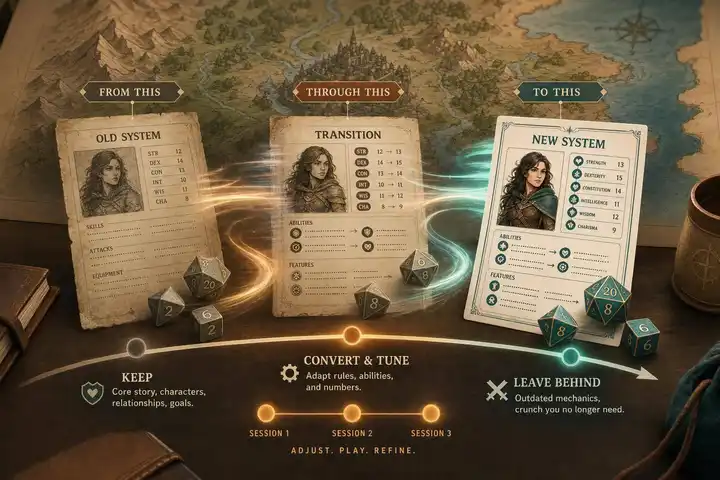
Yes, I can switch systems mid-campaign without throwing out my story. The short version is simple: I keep the fiction, convert only the rules that matter, and drop the parts that no longer fit. That means I protect character relationships, unfinished plot lines, NPC goals, faction conflict, tone, and each PC’s core idea first.
Here’s the whole article in one fast view:
- Why groups switch: the rules stop matching the kind of game the table wants
- When to switch: after a major arc, during a break, or at another clean story pause
- What I keep: story arcs, setting facts, NPCs, factions, tone, and PC relationships
- What I convert: character concept, party role, signature moves, plot-heavy gear, villains, and current power level
- What I leave behind: niche subsystems, stacked modifiers, over-detailed skill math, and builds the new game cannot support
- What helps most: a reset session, a short rule-gap sheet, and a low-risk test run before the full relaunch
A few points matter most. First, the fiction belongs to the group, not the old ruleset. Second, I should rebuild characters from concept, not from feat-by-feat math. Third, I need to warn the table about rule shifts that change play fast - especially action economy, resource recovery, and success tiers.
Studies and table advice in the article point to one smart habit: give players 2–3 sessions to tweak rebuilt characters after the switch. That small buffer can cut frustration early and help the campaign settle into the new system without turning the first session into damage control.
If I treat the move as keep, convert, or drop, the campaign still feels like the same story - even when the character sheets look different.
| Bucket | What goes in it | What I do |
|---|---|---|
| Keep | Story arcs, NPC goals, factions, relationships, tone, setting truths | Leave as-is |
| Convert | PCs, villains, artifacts, advancement, signature abilities | Rebuild by feel and function |
| Leave Behind | Extra subsystems, unsupported builds, stacked bonuses, fine-grain skill rules | Cut or retcon |
That’s the full playbook in plain English: save the heart of the campaign, rebuild the rules around it, and don’t drag old mechanics into a game that doesn’t want them.

How to Switch TTRPG Systems Mid-Campaign: Keep, Convert, Drop
Changing systems? Convert your fav adventures | DM Tips
Step 1: Keep the Fiction First
This step protects the heart of the campaign before you touch the rules. Split the story from the mechanics. The fiction - the setting, the relationships, and the loose plot threads - belongs to your group, not to any one system.
Keep Story Arcs, NPCs, Factions, and Character Relationships
The emotional center of a campaign usually lives in what hasn’t been settled yet: the villain who got away, the faction fight heating up in the capital, the tension between two party members that still hangs in the air. Keep all of that in place.
Before you start the conversion, write down every active story thread. Note the major NPCs by their goals and personalities, not by their stat blocks. Mark which faction deals look shaky, which mysteries are still open, and which character bonds matter at the table. That list becomes your anchor.
For NPCs and monsters, reuse a similar stat block and reskin the fiction. Keep the story. Change the numbers.
Once the fiction is set, convert only the rules needed to hold it up.
Preserve Character Concept Over Build Details
A common mistake is trying to carry over every feat, subclass feature, or skill percentage into the new game. That kind of one-to-one conversion can leave characters awkward, weak, or hard to play.
A better move is to have each player describe their character in plain English before they open a new sheet. What do they do for the party? What’s their signature move? What scares them? What do they want? That description is the target for the conversion, not the old stat block.
Treat the character concept as the target:
- role in the party
- personality
- history
- relationships
If those pieces stay intact, the character will still feel like the same person, even if the mechanics work a bit differently.
Run a Session-Zero Reset to Set Tone and Expectations
Use the reset session to pin down what the new system needs to do. Ask the big questions directly. How deadly should combat feel? How fast should the game move? Does the group want investigation, tactics, or roleplay? Should the tone stay heroic, or lean more gritty?
Fit the campaign to the table, not the rulebook. If the new system pushes a harsher style but your group wants something lighter, make that call up front.
It also helps to build in a grace period. Let players tweak their rebuilt characters during the first 2–3 sessions. Sometimes a build looks fine on paper and feels off once play starts. A little room to adjust early can save a lot of frustration later.
Keep familiar setting details the same where you can.
With tone and expectations in place, you can move on to the mechanics that actually need conversion.
Step 2: Convert Only the Mechanics That Matter
Once the fiction is set, convert only the mechanics that still help tell that story. This is not about making a perfect one-to-one port. It’s about building something that still feels like the same campaign. After that, rebuild the characters, then sort out pacing and encounter math.
Rebuild Characters From Concept, Role, and Signature Abilities
The best move is to rebuild each character from scratch using the new system’s rules. Start with the player’s short description of who the character is. Then find the closest class, archetype, or playbook in the new game and build from there.
What should carry over? The character’s signature moves - the two or three core tactics that shape how they play at the table.
- An archer built around accuracy
- A face who talks their way out of trouble
- A tank who absorbs damage for the party
Find the closest match in the new system for those specific things. Everything else can be rebuilt from the ground up.
A simple checklist helps:
- concept
- party role
- must-keep abilities
- plot-critical gear
- current advancement
If the rebuild works, the sheet should still feel like the same character when play starts.
Adjust Levels, Advancement, and Encounter Math
Rebuild characters at the new system’s current power level, then level them using that system’s own rules. The goal is to match the campaign’s current point so the party doesn’t feel too weak or weirdly overbuilt.
Do the same for recurring monsters and villains. Rebuild them with the new system’s encounter tools, or reskin close matches. That gives everyone a shared sense of what changed before the first full session.
Build a Rule-Gap Comparison Sheet Before the First Full Session
Use a comparison sheet before session one to catch rule gaps early. That cuts down on nasty surprises in combat, recovery, and skill use.
| Mechanic | Old System Assumption | New System Assumption |
|---|---|---|
| Action Economy | Complex (Standard, Move, Swift, Immediate) | Streamlined (Action, Move, Bonus OR 3-Action Economy) |
| Success Tiers | Binary (pass/fail) | Degrees of success (Critical Success/Failure at ±10) |
| Resource Recovery | Long rest / Vancian spell slots | Short rest / Encounter powers / Focus Points |
Pay close attention to action economy and resource recovery. Those two areas change how combat moves and how fast the party burns through resources. If you spot that gap before the first live session, the GM can tune encounters ahead of time instead of trying to explain, on the fly, why everything suddenly feels harder or easier.
Once the table covers the biggest rule gaps, sort what’s left into three buckets: what stays, what converts, and what gets dropped.
Step 3: Decide What to Keep, Convert, and Leave Behind
Put each campaign element into one of three buckets: keep, convert, or drop. That gives you a clean way to decide what stays the same, what needs a rebuild, and what no longer makes the trip.
What to Keep As-Is
Keep the parts of the campaign that make it feel like the same story: unresolved arcs, faction goals, NPC relationships, setting truths, and tone. If the group still cares about the same conflicts and mysteries, the campaign will still feel connected.
Once the fiction is steady, you can turn to the rules that need work.
What to Actively Convert
| Old Element | New Fit | No Match | GM Call |
|---|---|---|---|
| PC class/subclass | Closest class or archetype in the new system | - | Rebuild from concept, not math |
| Signature ability (e.g., Sneak Attack) | Nearest thematic power or at-will | - | Respec to match the original feel |
| Recurring villain stat block | Reskinned monster from the new bestiary | - | Match threat and role |
| Major artifact | New system item with a similar power level | - | Keep the fiction, rewrite the mechanics |
| Advancement/XP total | Starting level that reflects past deeds | - | Lock in once, then advance normally |
If something doesn't land in one of those rows, it likely belongs in the drop-or-retcon bucket.
What to Drop or Retcon
If a rule doesn't fit the new system cleanly, don't jam it in. Leave behind niche subsystems, skill granularities, stacked bonuses, and builds the new system can't support. Sometimes that's the hard part, but it's better than dragging dead weight into a new ruleset.
If a character's core identity depends on a mechanic the new rules don't support, replace it with a standard item from the new system's core book and keep going. Drop mechanics the new system can't handle, and retire any character whose identity depends on them.
Step 4: Test the New System and Complete the Transition
Run a Low-Risk Trial Before the Full Relaunch
Before you jump back into the main campaign, run a small test. Keep the stakes low. Once the rebuild is finished, put the new system on the table and see how it feels in actual play.
A short side mission or one-shot works well here. Use prebuilt characters first instead of asking players to convert their own right away. That gives everyone room to learn the rules without worrying about whether their main character was rebuilt “correctly.”
If the trial shows deeper mismatches, take that as useful feedback. It’s better to spot friction now than after the full relaunch. Use what you learn to decide whether the new system fits before you move the campaign back into the main story.
Use TTRPG Games Directory to Find a Better-Fit System

If the trial makes the mismatch plain, compare other options before you lock anything in. TTRPG Games Directory is a fast way to review systems side by side.
You can shortlist games by:
- Tone
- Genre
- Complexity
That makes it easier to avoid picking a ruleset that pushes against the campaign’s established feel.
Conclusion: Protect the Campaign's Heart, Not Every Old Rule
A mid-campaign system switch works best when the group treats it like a clear choice, not a panic move. Hold on to the campaign’s story, character relationships, and unresolved tension. Then rebuild the rules around those parts that matter most.
FAQs
How do I know if my campaign should switch systems at all?
Treat a mid-campaign system switch as a last resort. It only makes sense when the whole group is frustrated by the current system’s limits and everyone still wants to keep the same story going together.
Before you commit, check that your players are up for learning a new set of mechanics. If a few simple house rules can solve the problem, or if the issue only shows up in a certain genre, you’re often better off staying the course.
What if the new system can’t support my character’s main gimmick?
Put the character’s core idea first, not a one-to-one rules match. Build them in the new system around the elevator pitch of who they are, instead of trying to drag over every old stat.
If one ability just doesn’t slot in, handle it with a house rule or a bit of table-side improv. And if the character still feels flat or stripped down, it may be better to retire them and make someone new for the new ruleset - while keeping the original personality, voice, and vibe that made them fun in the first place.
How long should the adjustment period last after the switch?
A grace period should usually cover the first few sessions. During that stretch, let players respec unused abilities or make small tweaks to their character builds.
That gives people room to settle in without feeling like their characters have been trimmed down into weaker versions of the ones they meant to play. For a lot of groups, the learning curve eases up after a few sessions.


