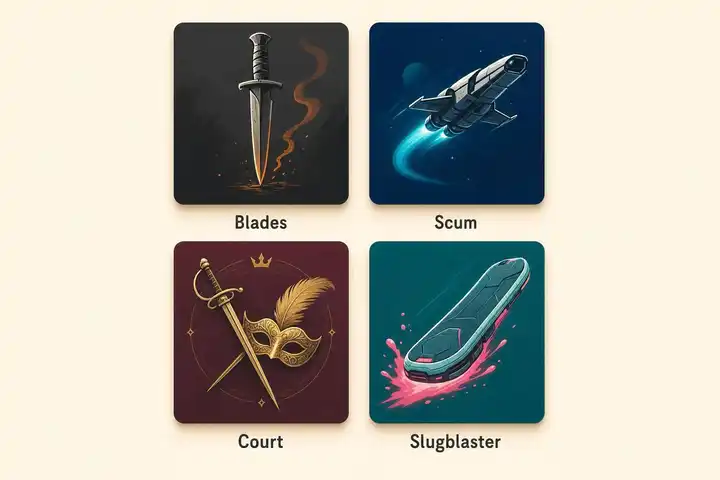
If you want the short answer: pick Blades in the Dark for grim heists, Scum and Villainy for space jobs, Court of Blades for noble politics, and Slugblaster for teen runs with lighter stakes.
I’d boil the whole choice down to 4 things:
- Tone: dark, cinematic, political, or playful
- Main activity: heists, ship jobs, court drama, or dimensional runs
- Pressure level: harsh and tight vs. looser and lower-stakes
- Campaign length: long campaign, mid-length arc, season play, or short bursts
All 4 games use the same basic FitD frame: d6 dice pools, Position and Effect, Stress, Trauma, Flashbacks, and Clocks. But the play feel changes a lot from one game to the next. In one, trouble keeps closing in on you. In another, you can leave and take the next job somewhere else. In another, a rumor can hurt more than a knife. And in another, style and feelings matter as much as the run itself.

Forged in the Dark TTRPGs Compared: Blades, Scum, Court & Slugblaster
How to Play Blades in the Dark (and Forged in the Dark)

Quick Comparison
| Game | Best fit for | Main focus | Tone | Campaign shape |
|---|---|---|---|---|
| Blades in the Dark | Groups who want pressure and crime | Heists, turf, faction play | Dark and gritty | Long-running |
| Scum and Villainy | Groups who want travel and jobs | Space missions, ship play, crew arcs | Cinematic and adventurous | Mid-length |
| Court of Blades | Groups who want talk-heavy conflict | Alliances, scandal, house politics | Romantic and political | Season-based |
| Slugblaster | Groups who want easy pickup play | Runs, tricks, teen drama | Light and playful | Short and episodic |
My rule of thumb: if your group likes mounting pressure, go with Blades or Court. If your group wants more motion and less weight, go with Scum or Slugblaster.
That’s the core pick. From there, the rest is just matching the game to how you want your table to feel.
Side-by-Side Comparison: Tone, Mechanics, and Campaign Style
The table below shows how the same FitD engine can lead to four very different kinds of play. The quickest way to separate them is by looking at tone, what players spend most of their time doing, and how the campaign tends to unfold. This isn’t just a feature check. It’s a way to match each game to the kind of table you have.
Comparison Table: Blades vs. Scum and Villainy vs. Court of Blades vs. Slugblaster

| Blades in the Dark | Scum and Villainy | Court of Blades | Slugblaster | |
|---|---|---|---|---|
| Core Premise | Criminal crew in Doskvol | Starship crew in the Procyon Sector | Retainers of a Great House | Teens on hoverboards doing dimensional runs |
| Tone | Dark, gritty | Cinematic, space-western | Intrigue, romance | Lighter, teen drama |
| Main Activities | Heists, territory grabs, faction politics | Smuggling, bounty hunting, ship maintenance | Social maneuvering, scandals, influence building | Dimensional runs, cool tricks, dodging parents and other real-world complications |
| Signature Mechanics | Stress, Flashbacks, Faction Game, Heat | Gambits, the ship has its own stats and upgrades, Heat rules | Scandal-based mechanics, social seasons | The lightest rules load in this lineup |
| Campaign Structure | Long-running heists building toward a criminal empire | Mid-length campaigns with a clear arc | Social seasons with political arcs | Short, fast runs |
Scum and Villainy caps Action Ratings at 3, while Blades can push higher through crew upgrades; Scum also uses a longer healing clock.
Which Game Fits Your Group's Play Style
A simple way to narrow your pick is to look at tone and campaign shape first. Those two things usually tell you more than a rules summary ever will.
If your group likes dark settings, mounting pressure, and campaigns that build over many sessions, Blades in the Dark is the clear match. Its faction game and rising Heat push players to think long-term. You’re not just pulling jobs. You’re trying to carve out power and hold onto it.
If your table leans toward adventure, mobility, and a more episodic rhythm, Scum and Villainy often lands better. Moving from system to system gives the game a TV-season feel. That makes it feel very different from Doskvol’s boxed-in tension.
If your group cares most about relationships, alliances, and political risk, Court of Blades stands out. Here, scandal and social pressure do the heavy lifting. Combat matters less than who trusts you, who’s offended, and what rumors start spreading.
If you want the easiest on-ramp into FitD, Slugblaster is the easy pick. It keeps the core engine in place, but the campaigns are shorter, lighter, and easier to jump into without a long rules ramp-up.
If your group is stuck between two options, the next sections compare those matchups head-to-head. If the debate is mostly Blades in the Dark versus Scum and Villainy, the next section digs into that split.
Blades in the Dark vs. Scum and Villainy
These two games share the same core frame, but they feel different at the table. The big split comes down to containment vs. mobility. Do you want a crew trapped in one pressure cooker of a setting, or one that can move from place to place when things get hot?
Blades in the Dark: Heists, Stress, and Life in Doskvol
Doskvol is one haunted industrial city, and that closed-in setup does a lot of the work. You can't just leave town and let your problems fade. Heat builds across the city, and it stays with you. That keeps pressure on the crew from all sides.
The Faction Game also points play in a very specific direction. You're not just taking jobs. You're thinking about turf, rivals, and long-term power. As your crew advances, you claim physical territory and improve your Lair. You can see your place in the underworld taking shape.
Stress and trauma sit at the center of the game. That's a big part of its identity. Blades in the Dark is about scraping by, taking hits, and living with the cost. It's not about glamour.
That constant pressure is the part that Scum and Villainy eases up on.
Scum and Villainy: Ship Crews, Gambits, and Space-Opera Jobs
Where Blades in the Dark locks play into one city, Scum and Villainy opens things up across a sector. Your crew can jump between systems, let Heat cool off by moving on, and work out of a ship that has its own stats and upgrades.
The game also shifts some of the core terms and tools. Gambits give the group a shared bonus-dice pool. Coin and Rep become Cred. Those changes nudge play toward a lighter, more fast-moving rhythm.
The playbooks lean into a Firefly-style crew fantasy, which says a lot about the tone the game is aiming for.
How to Choose Between These Two
Pick Blades in the Dark if you want a grim turf war that keeps tightening the screws over time.
Pick Scum and Villainy if you want a mobile, more episodic space-opera campaign with a clear endgame.
Court of Blades vs. Slugblaster
If Blades vs. Scum came down to pressure versus mobility, this matchup is more about intrigue versus momentum. These games sit on very different ends of the Forged in the Dark range. One is built around noble power plays. The other is about teenagers on hoverboards doing wild dimensional runs. Both are great at what they do, but they serve very different groups.
Court of Blades: Noble Houses, Social Seasons, and Political Scheming
In Court of Blades, your group plays retainers serving a major house in the city of Ilrien. You're dropped into a web of Great Houses, each fighting for influence. Court politics isn't just flavor here. It's the main event. Reputations, favors, rival families, and social disasters fill the same role that heat, clocks, and fallout fill in other Forged in the Dark games.
The Social Season structure gives each year only three major tasks, so your house can't do everything. You have to choose where to spend influence, and those choices matter. The Romance Clock adds another layer by letting you court NPCs for resources, which keeps conversation, relationships, and social maneuvering right at the center of play.
This is the game for tables that love a tense dinner scene as much as a duel. Maybe more.
Slugblaster: Teen Drama, Hoverboards, and Dimensional Runs
Slugblaster goes in the opposite direction. Instead of heists, you get dimensional runs: teenagers on hoverboards jumping into strange dimensions for style, status, and bragging rights.
That setup gives the game a loose, fast-moving feel. The stakes still matter, but they land in a different place. Social standing, rivalries, and friendships matter just as much as whether the run blows up in your face. The game also dials back lethality on purpose, which makes it a strong fit for shorter, self-contained sessions.
It feels less like a grim job gone bad and more like a messy, high-speed coming-of-age story with bruises, bad choices, and a lot of attitude.
How to Choose Between These Two
This choice comes down to the kind of conflict your group likes most.
Court of Blades works best for groups that enjoy:
- conversations that can wreck a plan
- rumors spreading through a ballroom
- rival houses making quiet moves behind the scenes
Slugblaster fits groups that want:
- fast scenes and quick turns
- messy feelings between characters
- a lighter, more playful tone
Use that split as your filter. If your table wants sustained political pressure, go with Court of Blades. If your group wants fast, lower-pressure play with social chaos and motion, Slugblaster is probably the better fit.
| Court of Blades | Slugblaster | |
|---|---|---|
| Setting | Renaissance city-state (Ilrien) | Sci-fi / dimensional runs |
| Player roles | Noble retainers | Teenagers / hoverboarders |
| Primary stakes | Reputation and house standing | Style, status, and emotional bonds |
| Conflict type | Conversation-driven, social | Kinetic action, emotional drama |
Pick Court of Blades if your group wants scheming, scandal, and a living political web where every relationship is a resource. Pick Slugblaster if your group wants kinetic energy, friendship drama, and a Forged in the Dark game that feels more playful than pressured. That split sets up the final verdict below.
Final Verdict: Which Forged in the Dark Game Should You Play?
Pick Based on Tone, Focus, and Campaign Length
The easiest way to make the call is to look at tone, focus, and how long you want the campaign to run.
| Game | Best For | Campaign Length | Tone |
|---|---|---|---|
| Blades in the Dark | Grim heists and turf control | Long-running | Dark, gritty, high-pressure |
| Scum and Villainy | Ship-crew space-opera jobs | Mid-length | Cinematic, adventurous |
| Court of Blades | Noble house political drama | Season-based | Intrigue-heavy |
| Slugblaster | Teen chaos and dimensional runs | Episodic | Playful teen drama |
If you're stuck between two, go with the one that matches your group's pressure level.
Short version: pick Blades in the Dark for grim heists, Scum and Villainy for mobile space jobs, Court of Blades for political intrigue, and Slugblaster for playful teen runs.
FAQs
Which Forged in the Dark game is best for beginners?
Scum and Villainy is often seen as the easiest way into Forged in the Dark. It runs on the same core system as Blades in the Dark, but a lot of players find it simpler to pick up and play.
If you enjoy space opera, quick-moving action, and less time spent planning every detail, it’s a warm entry point. And once you learn it, you’ll have a solid base for the other games in the family.
How much do the rules differ between these four games?
They all use the same Forged in the Dark core: dice pools, position and effect, stress, and clocks. If you know Blades in the Dark, you already know how the system works.
Where things start to change is theme. Scum and Villainy brings in spaceship rules and Gambits. Court of Blades and Slugblaster each tweak the system to fit what they’re trying to do, and Slugblaster pushes it the furthest.
Which game works best for a short campaign?
Scum and Villainy works especially well for a shorter campaign. One big reason is that it includes dedicated campaign endgame rules, which the other Forged in the Dark games mentioned here don’t.
With its Final Campaign Missions rules, a crew can retire once they hit +3 status with a faction. That gives the campaign a clean finish: one big, high-impact mission that feels like a proper send-off instead of the story just drifting to a stop.


