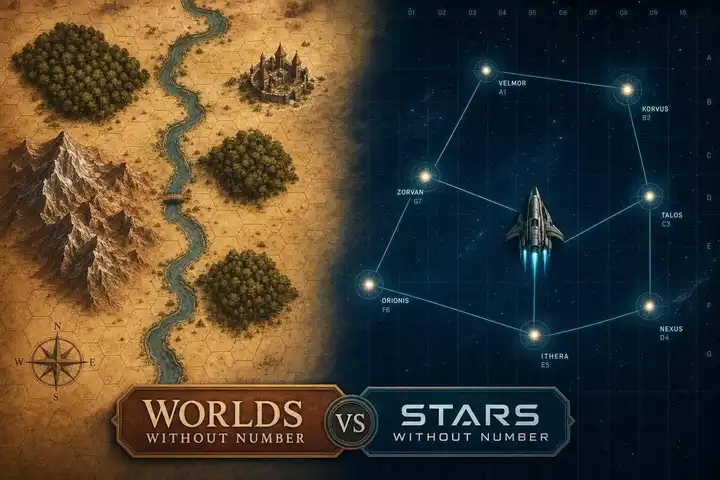
If I had to give the short answer, it’s this: pick Worlds Without Number if I want fantasy travel, ruins, and realm play. Pick Stars Without Number if I want starships, sector maps, and faction politics.
Both games share much of the same rules frame: d20 combat, 2d6 skills, and level 1 to 10 growth. Both are also lethal at low levels, with some starting characters sitting at 2 HP. But they point play in different directions:
- WWN = fantasy, wilderness, ruins, Renown, Major Projects, and Legates
- SWN = sci-fi, sector travel, faction turns, starships, psychics, and AI/transhuman play
- WWN leans on magic-first problem solving
- SWN leans on tech-first problem solving
- WWN fits hexcrawls and kingdom-scale growth
- SWN fits planet-hopping crews and shifting sector power struggles
If you’re trying to match system to campaign, that’s the main call. About 90% of the decision comes down to genre and campaign structure, not rules difficulty, because the engine is so close across both games.
What I’d keep in mind:
-
Choose WWN for:
- wilderness treks
- ancient ruins
- gritty melee pressure
- settlement and realm change
- sword-and-sorcery campaigns
-
Choose SWN for:
- starship crews
- interstellar jobs
- faction conflict
- sector map play
- science-fantasy with tech at the center

Worlds Without Number vs Stars Without Number: Side-by-Side Comparison
Why You Should Play Worlds Without Number (Worlds Without Number Review/Analysis)

Quick Comparison
| Criteria | Worlds Without Number | Stars Without Number |
|---|---|---|
| Genre | Fantasy / sword & sorcery | Science fiction / space opera |
| Core play loop | Travel, ruins, frontier play | Travel, jobs, planets, sector play |
| Main setting frame | Latter Earth | Interstellar sector |
| Main specialist class | Mage | Psychic |
| Main problem-solving tools | Spells, martial skill, Renown | Gear, hacking, drones, ship systems |
| Low-level feel | Harsh, melee-heavy, travel pressure | Harsh, gear-heavy, mission pressure |
| Long-game systems | Renown, Major Projects, Legates | Faction turns, assets, AI/transhuman paths |
| Best campaign fit | Hexcrawl, realm-building, ruined fantasy | Starship campaign, sector politics, faction play |
Bottom line: if I want the party to change a kingdom, I’d lean WWN. If I want them to change a sector, I’d lean SWN.
Genre Focus and the Kind of Campaign Each Game Supports
Worlds Without Number: Heroic Fantasy, Wilderness Travel, and Realm-Scale Play
Worlds Without Number is built for campaigns where the wild is more than scenery. It’s the problem in front of the party. Its setting, Latter Earth, treats ancient tech as the Legacy, which pushes play toward ruins, frontier travel, and discovery. The Renown and Major Projects rules also give players a way to change settlements, institutions, and local law.
Characters top out at level 10, then can ascend as Legates, mythic endgame heroes. That gives the game a clear arc, from scrappy adventurers to world-shaping figures. You can feel that same scale in the rules. Magic, travel, and realm-building all point in the same direction.
Stars Without Number: Sector Exploration, Space Travel, and Faction-Driven Adventure

Stars Without Number takes that sense of scale and pushes it into space. SWN is set after the Silence, when the Jump Gate network collapsed and human worlds were scattered across the stars. Instead of crossing one dangerous wilderness, players jump between star systems, pick up risky jobs, and deal with rival factions.
The Faction System is SWN’s signature GM tool. Between sessions, factions act on their own, which means the setting keeps moving whether the players step in or not. That can make the sector feel alive in a very direct way. Starship roles help too, since they keep the whole group involved during travel and combat instead of leaving one player to do all the fun ship stuff. That sector-scale focus also shapes character options, gear, and advancement.
How Each Game Handles Science-Fantasy or Mixed-Tone Campaigns
The biggest split comes down to where the “magic” sits. WWN is magic-first: spells, elementalism, and necromancy sit at the center, while technology shows up as rare and powerful relics from a lost age. SWN turns that around. Tech is the default, and optional Deluxe-edition rules make it simple to push the game toward a more science-fantasy tone.
The good news is that the two systems share enough structure that crossover is pretty easy. WWN fits ruined-future fantasy where lost tech feels like sorcery. SWN fits science-fantasy where starships, factions, and psychic powers all matter at once. And that choice isn’t just about mood. It changes how each game approaches classes, gear, and long-term progression.
Rules, Character Options, and Party Progression
Shared Rules Foundation and How Play Feels at the Table
Both games run on the same basic frame: six ability scores, level-based growth capped at 10, hit points, d20 combat, 2d6 skills, and ascending Armor Class. Because that core is so similar, the differences in class design and campaign support are easier to feel at the table.
Each game takes that same engine and puts its weight in a different place. The rules underneath may look familiar, but the play experience doesn't land the same way.
Low levels are dangerous in both. A level 1 character can start with as few as 2 hit points and drop from a single hit. That's not a bug. It's there on purpose, pushing players to think ahead, avoid bad fights, and use the world around them instead of charging in.
That shared frame also matters for another reason: each game's classes, gear, and support systems push players toward different ways of handling trouble.
Magic, Tech, and How Characters Solve Problems
Both games offer Warrior, Expert, and a third main class: Mage in WWN, Psychic in SWN. Both also have the Adventurer, which lets a character combine two partial classes from level 1.
WWN's Mage leans on prepared spells and Arts for tight, focused magical options. SWN's Psychic uses Effort for stronger powers, but pushing too hard can lead to permanent stat loss. So while both games reward careful use of resources, they do it with a different kind of pressure.
The toolkits split in a pretty clear way. In WWN, characters often solve problems with spells, martial skill, and Renown that helps them change the setting around them. In SWN, they turn to hacking gear, drones, starship upgrades, and other tech-based tools. Same basic idea - find a way through the problem - but the game asks you to think in very different terms.
Advancement, Survivability, and Long-Term Campaign Growth
WWN adds two rules that strongly shape the campaign arc. First, Shock lets melee weapons deal damage even on a miss unless the target has high AC or a shield. That makes close combat feel harsher and less forgiving. Second, System Strain limits how often a character can be healed before they need real rest in a safe place, with that cap set by Constitution. Put those together, and survival pressure becomes part of the setting's identity. Travel, recovery, and building power all come with a cost.
At the top end, WWN characters who reach level 10 can ascend as Legates, gaining superhuman abilities tied to realm-building and Renown. SWN points its late-game arc in another direction, with paths that can lead toward transhuman or AI-style end states.
Both Deluxe editions also include optional Heroic PC rules for groups that want to soften the lethality and lean more into a higher-fantasy or space-opera tone.
That split in mechanics has a direct effect on the kind of sandbox each game rewards, and that's where the GM tools start to part ways the most.
| Feature | Worlds Without Number | Stars Without Number |
|---|---|---|
| Combat Resolution | d20 combat, plus Shock on a miss | d20 combat with tech-based gear |
| Healing Limit | System Strain, capped by Constitution | Psychic Effort or tech |
| Specialist Class | Mage (prepared spells + Arts) | Psychic (Effort-based disciplines) |
| End-Game Path | Legates (superhuman power) | Transhuman or AI-style end states |
| Campaign Payoff | Realm-building | Faction play |
GM Tools and Sandbox Support
If genre sets the world, GM tools shape how you prep for it.
Fantasy Worldbuilding Tools in Worlds Without Number
WWN gives GMs a fast way to build a fantasy sandbox. It comes with 200 fantasy tags for courts, communities, ruins, and wilderness locations. Each tag adds hooks and place details, so session prep moves along without a ton of heavy lifting.
WWN also includes Major Project rules. These let players track big changes in the world through game mechanics, like founding a university, building a city wall, or setting up a trade route. When you pair that with the Renown system, the setting has a built-in way to react to what the party does over time.
Sector Design and Faction Play in Stars Without Number
SWN handles prep through sector design. The game gives you tools to build interstellar maps, assign planetary tags, and sketch out how worlds connect. Those tags do a lot of work fast. They help define a planet’s themes, NPCs, and conflicts.
Faction Turns power the long game. During the between-session Faction Turn, factions spend Assets to attack rivals, expand influence, or create crises. In plain terms, the sector keeps moving between sessions. Even if the players stay put, the setting doesn’t.
That makes SWN a better fit when you want the world to keep shifting in the background.
Comparison Table: GM Toolkit by Prep Style
| Feature | Worlds Without Number | Stars Without Number |
|---|---|---|
| Primary Generator | Setting creation: regions, wilderness, ruins | Sector creation: interstellar maps and planetary tags |
| Random Tags | 200 fantasy tags (courts, ruins, communities) | 40+ world tags (planetary traits) |
| Long-Term Pressure | Renown and Major Projects | Faction Turns and Assets |
| Exploration Focus | Hexcrawls, wilderness travel, and ruins | Sector navigation and planetary exploration |
| Best-Fit GM Use Case | Frontier kingdoms and domain-level play | Interstellar campaigns and faction-driven sandboxes |
That difference is what the final decision guide turns into campaign choices.
Final Decision Guide: Which Game Fits Your Campaign
Both games run on the same core engine, and both can handle sandbox play. The main split is simple: fantasy frontier adventure versus interstellar sector adventure.
Choose Worlds Without Number for Fantasy Exploration and Realm-Building
Pick Worlds Without Number if you want wilderness travel, ruined places, and fantasy realm-building. The Renown and Major Projects systems give players a clear, mechanical way to change the setting in lasting ways. If your campaign starts as a hexcrawl and later grows into domain-level play, WWN is built for that path. It also works well for groups that like gritty, resource-tight fantasy but still want modern character options through Foci.
Choose Stars Without Number for Starship Travel and Sector Exploration
Pick Stars Without Number if you want starship travel, sector exploration, and politics driven by factions. If your long-term plans involve running a mercenary company, managing a spy agency, or dealing with interstellar power struggles, SWN’s faction rules are set up to support that. The Deluxe Edition also adds rules for AI and transhuman play, which opens the door to those kinds of campaigns.
Quick Comparison Table: Campaign Goal to Best System Match
| Campaign Goal | Best Fit |
|---|---|
| Hexcrawl through wilderness and ancient ruins | Worlds Without Number |
| Kingdom-building and domain rulership | Worlds Without Number |
| Swords-and-sorcery with gritty, lethal combat | Worlds Without Number |
| Science-fantasy with low-tech worlds and ancient relics | Worlds Without Number |
| Starship crew and planet-hopping adventure | Stars Without Number |
| Faction-driven space opera and sector politics | Stars Without Number |
| Science-fantasy with frequent travel between high-tech and low-tech worlds | Stars Without Number |
FAQs
Can I mix material between WWN and SWN?
Yes. Worlds Without Number and Stars Without Number use the same old-school-style core system, including 2d6 skill checks, attribute-based modifiers, and d20 combat.
That shared framework makes it pretty easy to move material between them. You can bring over character options, GM tools, and adventure content without much trouble.
A few parts may need small adjustments, though. Psychic powers and some armor rules can work a bit differently, mostly because each game is built for a different genre.
Which game is easier for a first-time GM to run?
Neither one is plainly easier to run. Worlds Without Number and Stars Without Number use much of the same core design, and both are built for sandbox play with low-prep tools like random tables, faction systems, and modular GM aids.
So the better pick usually comes down to genre more than difficulty: fantasy or science fiction. Both games also have free versions, which makes it easy to test the setting and tools that feel more natural at your table.
How lethal are starting characters in each game?
In both Worlds Without Number and Stars Without Number, starting characters are fragile, and combat can turn deadly fast.
In Worlds Without Number, a level 1 character might go down from a single hit. That changes how people play right away. Instead of charging in, they tend to avoid fights or pick them with care.
Stars Without Number works much the same way. Low hit points, dangerous weapons, and hostile environments mean early encounters can go bad in a hurry.
In both games, combat moves fast and rewards decisive action.


