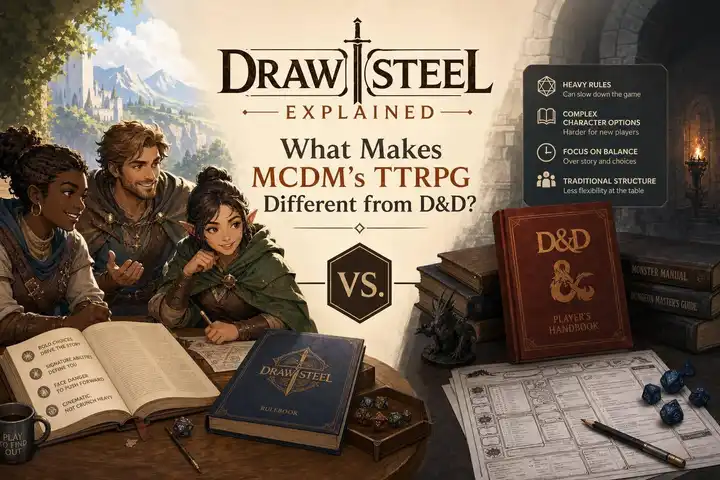
If I had to sum it up in one line: Draw Steel is built for tactical fights where every turn changes the board, while D&D is built for a broader campaign mix.
If you play D&D and want fewer dead turns, Draw Steel stands out for three big reasons:
- Every roll does something with a 3-tier 2d10 system
- Power builds during combat, instead of starting full and spending down
- Positioning matters more, with pushes, slides, and map-based effects
D&D still has its own pull. It uses a 1d20 pass/fail system, supports combat, social scenes, and travel in one campaign loop, and gives players things like multiclassing and a familiar rules shape.
So when I compare these games, I look at five areas:
- Core rules
- Combat flow
- Character building
- GM tools
- Table feel
In plain terms, Draw Steel trades swingy hit-or-miss turns for steady combat momentum. Its key roll tiers are 11 or lower, 12–16, and 17+. That means your turn usually still has an effect, even on a low result. D&D, by contrast, keeps the sharper hit or miss tension many groups already know.

Draw Steel vs D&D: Side-by-Side TTRPG Comparison
Combat in Draw Steel Crushes D&D (Except for This One Thing)
Quick Comparison
| Area | Draw Steel | D&D |
|---|---|---|
| Core roll | 2d10 + modifier | 1d20 + modifier |
| Result style | 3 outcome tiers | Pass/fail |
| Attacks | No empty misses | Hit or miss vs. AC |
| Combat rhythm | Builds up over the fight | Starts full, then spends down |
| Initiative | Side-based team order | Individual turn order |
| Character setup | Ancestry, Culture, Career, Class | Race, Background, Class/Subclass |
| Build rules | No multiclassing | Multiclassing supported |
| GM focus | Set-piece tactical fights | Combat + social + travel |
| Fight pressure | Can go up as enemies fall | Often drops as enemies fall |
| Best fit | Groups that want map-first combat | Groups that want a broader campaign style |
My short take: if you want combat-first play, team combos, and a board state that keeps shifting, Draw Steel may fit better. If you want a game that puts more weight on the full campaign loop, D&D is still the easier match.
Below, I break down where those differences show up at the table.
Core Rules: Draw Steel's Power Rolls vs D&D's d20 System
D&D uses a binary d20 check. Draw Steel uses 2d10 Power Rolls with graded results.
In D&D, you roll one 20-sided die, add your modifier, and compare that total to a target number like AC or DC. In Draw Steel, you roll 2d10, add a characteristic modifier - Might, Agility, Reason, Intuition, or Presence - and then match the total to a three-tier result chart.
Those tiers stay the same:
- Tier 1: 11 or lower, which gives a minimal effect
- Tier 2: 12–16, which gives a standard success
- Tier 3: 17+, which gives an exceptional result
There’s no AC gate in the middle of the process. Every roll leads to some result.
The big mechanical shift is the dice curve. With 2d10, middle results show up more often and extreme highs or lows show up less often. A d20 is flatter, so each number has the same chance to appear.
| Feature | Draw Steel (Power Rolls) | D&D (d20 System) |
|---|---|---|
| Dice System | 2d10 + Modifier | 1d20 + Modifier |
| Success Structure | 3-tiered graded outcomes | Binary pass/fail |
| Attack Resolution | No misses; all attacks have an effect | Hit or miss against Armor Class |
| Swinginess | Low (bell curve distribution) | Higher (flat distribution) |
| Pacing Effect | Constant forward momentum | Can stall on failed rolls |
How Tiered Outcomes Change Player Decisions
That changes how players think on their turn.
In D&D, the main question is often simple: Can I hit this target? In Draw Steel, the question shifts. You’re not only thinking about whether an action works. You’re thinking about which tier result matters most in that moment.
Because even low rolls still do something, players can focus more on impact than on raw hit chance. That’s a pretty big change in feel. A Tier 1 result might deal light damage or apply a short effect, while a Tier 3 result might bring more damage, longer effects, or extra perks.
So even a weak roll still pushes the scene ahead.
What D&D's Hit-or-Miss Model Feels Like at the Table
D&D’s binary system creates real tension. A roll can land cleanly or fail outright, and that sharp split is part of the drama.
But there’s a tradeoff. A bad roll can leave your turn with no mechanical effect at all. In a long combat, that can sting a bit.
Draw Steel is built to cut out those dead turns. Its tier system makes sure that even a low roll still changes the board in some way, which keeps combat moving.
That matters most in a fight, where each turn adds to the action instead of stopping it cold.
Combat and Character Design: Why Draw Steel Plays More Tactically
Once every roll still matters, positioning becomes the next big split. Draw Steel uses a battle map. Characters and monsters get pushed, thrown, and slid around the field, and forced movement into obstacles deals damage to both. So each turn feels more physical and more tied to where everyone stands than a usual D&D fight.
Combat Flow, Resources, and Escalation
Draw Steel ramps up during the fight instead of dumping most of its power at the start. Heroic Resources begin at zero and build as combat goes on, with each class handling that build in its own way - the Fury gains Ferocity, for example. In plain English: the flashiest turns tend to happen later in the battle.
Initiative changes the feel of a round too. Instead of every player rolling on their own, Draw Steel uses side-based initiative: the Director picks which side goes first, then the players choose their order inside that side. That gives the group room to link abilities and set up combos on the fly.
Here’s the short version of how the combat loop differs.
| Feature | D&D (5E) | Draw Steel |
|---|---|---|
| Action Reliability | Binary hit or miss against Armor Class | Tiered outcomes; every roll does something |
| Resources | Start full; spend down across the day | Start at zero; build during combat, reset after |
| Class Identity | Class + Subclass + Feats | Class + Kit + unique Heroic Resource |
| Movement | Often static; opportunity attacks limit repositioning | Highly kinetic; forced movement into terrain deals damage |
Character Building: Ancestry, Culture, Career, and Class vs Race, Background, and Subclass
That tactical bent starts at character creation, not just once combat begins. D&D builds a character from race, class, and background. Draw Steel splits identity into four layers - Ancestry, Culture, Career, and Class - so each part of a character’s past has its own job.
Ancestry covers biology and uses a point-buy trait system. Culture deals with how a character was raised. Career covers what they did before adventuring. Put those together, and they shape non-combat skills and combat perks, which means two heroes can share the same ancestry and still play very differently.
Draw Steel also handles gear in a more all-in-one way. Instead of tracking each weapon with its own stat line, it uses Kits - named combat loadouts like Shining Armor or Ranger that set your bonuses, armor, and signature moves at the same time. There’s no multiclassing, so each class keeps its own identity. The end result is simple: level 1 characters already feel complete, and each class’s Heroic Resource starts shaping play from session one.
Running the Game: Director Tools in Draw Steel vs DM Tools in D&D
Draw Steel uses a Director, not a Dungeon Master. That job is more narrow. Its tools are aimed at tactical combat, while D&D asks the DM to split attention across combat, exploration, and social scenes. Since Draw Steel already leans hard into positioning and escalation, its GM tools stick to that same lane.
Malice and Mid-Fight Escalation
You can see that combat-first focus on the Director side too. Malice is a fight-long resource the Director spends to trigger or boost villain abilities. It goes up as enemies fall, which means the last enemy standing is often the most dangerous one on the field.
D&D takes a different path. A monster’s power is mostly set when the fight starts. Legendary Actions give DMs some room to move, but those actions are still built into the stat block instead of being gained during the battle. So when enemies drop in D&D, the fight usually gets easier. In Draw Steel, the pressure can climb instead.
| Feature | Draw Steel (Director) | D&D (Dungeon Master) |
|---|---|---|
| Encounter Building | Tactical set-piece fights | CR/XP-based encounter math |
| Enemy Escalation | Malice rises as enemies fall; villains get deadlier | Fixed stat blocks; danger typically decreases as enemies die |
| Environmental Support | Core rules for terrain-based tactics | Largely optional; terrain effects depend on DM judgment or supplements |
| Prep Style | Focused on tactical set-pieces | Broad support for combat, exploration, and social pillars |
Which GM Style Each Game Supports Best
Draw Steel is built for Directors who like set-piece battles: fights where the map matters, tension builds, and the action ramps up.
"We're trying to empower the people running the game so that prep is fun and running the game is the most fun you can have." - James Introcaso, Lead Game Designer, MCDM Productions
D&D, on the other hand, gives the DM a much broader set of tools. It’s made to support a full campaign loop that moves between combat, exploration, and social scenes. That works well for groups that want variety from session to session, not just more depth in combat.
That gap is the clearest dividing line here: Draw Steel suits groups that want combat-first prep, while D&D fits groups looking for a broader campaign toolkit.
Which Game Fits Your Group Better
Once you get past the rules and GM support, the last piece is pretty simple: what kind of table are you running? These two games aim at different play habits. Draw Steel leans hard into tactical combat. D&D covers a broader mix of combat, exploration, and social play across a full campaign.
Best Fit for Tactical Combat Groups
If your group wants every turn to count, Draw Steel goes straight at that. Heroic Resources build during combat, which helps fights keep their momentum instead of feeling flat. And level 1 characters in Draw Steel already feel ready to go from the start.
If your table loves grid positioning, sharp movement, and tension that builds as a fight goes on, Draw Steel is the stronger pick.
There is a tradeoff, though. Draw Steel puts most of its focus on combat, while D&D spreads its support across the whole campaign.
Best Fit for Long-Form Fantasy Campaign Groups
D&D has the edge for groups that want more variety over time. Its three-pillar structure - combat, exploration, and social interaction - gives the DM room to shift gears from a dungeon crawl in one session to political intrigue in the next.
If your group wants a broader campaign mix, familiar d20 play, plus multiclassing and more build options, D&D is the better fit.
FAQs
Is Draw Steel easier to learn if I already know D&D?
It depends. Draw Steel uses some familiar pieces - classes, ancestries, and a game master - but under the hood, it’s a different kind of game.
If you know D&D, that will help with the broad idea of how play works. You’ll still sit down with a character, work with a GM, and move through scenes, fights, and choices as a group.
That said, some habits may need to go. Draw Steel runs on 2d10, not the d20 system. It also drops D&D’s attrition-based resource model in favor of growing combat momentum. So if you’ve played D&D for years, there’s often a small adjustment period.
Does Draw Steel work well for roleplay-heavy campaigns?
Yes. Draw Steel leans hard into cinematic tactical combat, but it doesn’t treat everything outside a fight like filler.
The game gives non-combat scenes clear mechanical weight. That includes defined rules for key social encounters, like structured negotiation, plus montage tests for other non-combat challenges.
That matters because roleplay, downtime, and diplomacy don’t get pushed to the sidelines. They stay engaging and carry stakes right alongside the game’s heroic action.
What kind of group will enjoy Draw Steel most?
Draw Steel works best for groups that enjoy tactical, cinematic, heroic fantasy combat. It’s a strong fit for players who want deep character customization, teamwork-based combat synergies, and grid-based battles where movement and positioning can change the whole fight.
It also fits groups that want to feel powerful right away. The game leans into an action-first style that rewards bold play, pushing ahead, and making things happen instead of holding back resources for the long haul.


