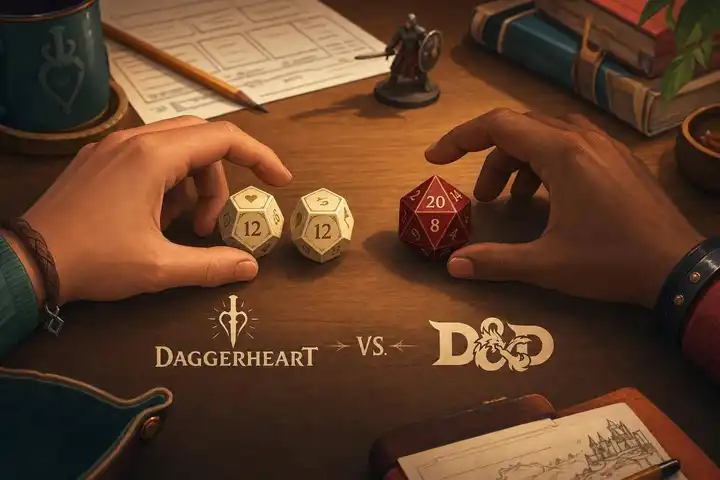
Choose Daggerheart if your table wants fiction-first fantasy, shared improvisation, and consequences shaped by Hope and Fear. Choose Dungeons & Dragons 2024 if you want structured tactical turns, detailed long-term builds, and the deepest pool of adventures and players.
These games can both deliver a party of heroes, dangerous monsters, and a long-running fantasy campaign. The decision is about how your group wants scenes to move. Daggerheart makes the emotional stakes of a roll visible and invites the table to build outward from the fiction. D&D makes turn order, class features, resource choices, and tactical cooperation central to the game loop.
Quick choice: Daggerheart or D&D?
- Pick Daggerheart for a responsive, collaborative game where a roll can push the story forward even when it brings trouble.
- Pick D&D for combat built around initiative, positioning, spells, and class abilities, plus a very large library of ready-to-run material.
- Choose based on your GM. Daggerheart rewards a GM comfortable inventing consequences in the moment; D&D rewards a GM who likes building or running structured encounters.
| Table priority | Daggerheart | D&D 2024 |
|---|---|---|
| Core roll | Two d12 Duality Dice; Hope and Fear shape the result and its fallout. | d20 plus modifiers against a Difficulty Class, with advantage and disadvantage. |
| Scene pacing | Fluid action order driven by fiction, rolls, and GM consequences. | Initiative order gives each player a defined tactical turn. |
| Character expression | Experiences, cards, and narrative identity stay close to the fiction. | Classes, subclasses, spells, feats, and multiclassing support mechanical build planning. |
| GM preparation | Less encounter scripting; more real-time judgment and consequence design. | Strong published-adventure support, with more tactical details to track in a fight. |
| Maps and minis | Comfortable without a grid or miniature-based positioning. | Not required, but especially useful when positioning and ranges matter. |
How a roll changes the story
Daggerheart: Hope and Fear make consequences visible
Daggerheart’s signature roll uses two twelve-sided dice, one for Hope and one for Fear. The total still matters, but which die is higher also matters. A result with Hope can give the player a resource to spend later; a result with Fear gives the GM a resource and signals that the situation can become more complicated. The important point is not that Daggerheart is consequence-free. It is that a successful action can still move the fiction into a more dangerous or interesting place.
That makes Daggerheart a strong fit for players who like to describe bold actions, follow the emotional logic of a scene, and accept unexpected turns as part of the fun. It works best when everyone is willing to contribute details and treat a setback as fuel for the next beat of the story.
D&D: clear tactical turns and familiar d20 stakes
D&D centers its core play on the d20. Players roll, add the relevant modifiers, and compare the result to a target number. Advantage and disadvantage handle many situational factors without adding another subsystem. In combat, initiative gives everyone a predictable turn order, so actions, movement, reactions, spell slots, and conditions become a shared tactical puzzle.
That structure is a feature, not a limitation, for the right group. It lets players plan around each other, build toward reliable tricks, and understand what a character can do before a scene starts. A D&D GM may still improvise constantly, but the system gives more of the scene a conventional tactical frame.
Character identity and long-term growth
Daggerheart puts a character’s story-facing identity close to the surface. Experiences describe the parts of a hero’s history or personality that matter in play, while cards and class choices give that identity mechanical weight. That can make a new character feel specific quickly without asking a player to study a long tree of optimization choices.
D&D’s character building is more granular. Species, class, background, subclass, spells, feats, equipment, and optional multiclassing give players many ways to plan a role over a campaign. Choose D&D when build synergy and level-by-level growth are part of why your group enjoys fantasy TTRPGs. Choose Daggerheart when you want mechanics to support who the hero is and what matters to them in the fiction first.
For more about its table fit, read our Daggerheart profile and browse narrative-driven TTRPGs.
Combat flow, maps, and GM workload
Daggerheart does not organize a fight around a fixed initiative loop. Players act as the fiction develops, and action rolls create openings for the GM to respond. That can make combat feel fast and cinematic, particularly for tables that dislike waiting through a long round. The tradeoff is that the GM must be ready to judge when the spotlight shifts and what consequence follows.
D&D’s initiative order makes the shape of a fight easier to see. Positioning, movement, action economy, concentration, and resource use provide satisfying decisions for players who enjoy a battle map. That clarity also creates more things to track. A D&D GM can lean on established encounter patterns and published monsters, but tactical preparation still takes time.
Neither game requires maps or miniatures. Daggerheart naturally supports theater of the mind. D&D works without them too, but a grid is useful when the group wants positioning to be a major part of the challenge. See more systems built around combat choices in our tactical-combat category.
Campaign support and the practical decision
D&D is the easier choice when practical access is decisive. It has an enormous official and third-party adventure library, a huge player base, and many local or online groups. That does not guarantee the best experience, but it can remove the friction of finding a party, a one-shot, or a campaign framework.
Daggerheart is a newer line with a smaller ecosystem. Its advantage is a more focused invitation: build a fantasy story together, let rolls change its direction, and do not force every important moment into a tactical turn cycle. It can absolutely support a campaign, but it suits a group willing to make more of the setting and consequences its own.
Final verdict
Play Daggerheart if your group wants collaborative storytelling, fluid scenes, and a rules engine where Hope and Fear keep consequences in motion. It is especially appealing for tables that prefer theater of the mind and a GM who enjoys responding to player ideas.
Play D&D 2024 if your group wants tactical combat, robust build planning, established adventures, or simply the confidence of a huge existing community. It is the stronger choice when structured encounters and long-term system mastery are a feature of the campaign.
If your group is weighing several alternatives to 5e rather than only Daggerheart, start with our games like D&D guide.
Frequently asked questions
Is Daggerheart easier for beginners than D&D?
Daggerheart can be easier for beginners who are comfortable improvising and describing what their characters attempt. D&D can be easier for beginners who prefer a predictable turn structure and familiar fantasy language. In either case, a welcoming GM matters more than the rulebook’s reputation.
Can Daggerheart run a long campaign?
Yes. Daggerheart supports character growth and ongoing story arcs. Choose it for a long campaign when your group wants relationships, consequences, and collaborative worldbuilding to drive that arc; choose D&D when the group wants a large stock of published campaign material and tactical progression.
Which game is better without maps or miniatures?
Daggerheart is the more natural choice for a table that wants to play entirely in theater of the mind. D&D can work without maps, but its tactical combat becomes easier to communicate when everyone can see positions and ranges.
Is Daggerheart a replacement for D&D?
No. They prioritize different pleasures. Daggerheart is a good alternative for a group seeking fluid, fiction-led fantasy play; D&D remains a strong choice for groups that want familiar structure, tactical combat, and a massive adventure ecosystem.


