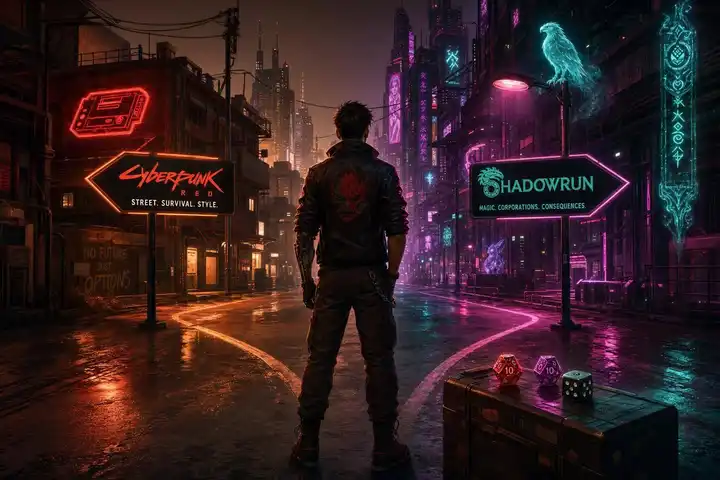
If you want pure cyberpunk with less rules strain, I’d pick Cyberpunk RED. If you want magic, fantasy races, and heavier system load, I’d pick Shadowrun.
Here’s the short version:
-
Cyberpunk RED fits groups that want:
- street-level play
- simpler character setup
- faster combat
- hacking that stays with the group
- lower GM workload
-
Shadowrun fits groups that want:
- cyberpunk plus magic
- deeper build options
- more tactical choices
- matrix, magic, drones, and spirits in one campaign
- a GM and players who are fine with more rules
A few table-fit facts stand out right away:
- RED centers on 10 Roles and a Lifepath system
- RED uses 1d10 plus stat and skill
- Shadowrun uses d6 dice pools
- Shadowrun is rated 4/5 for complexity in the source cited in the article
- RED has 0 magic systems, while Shadowrun adds spellcasting, spirits, and astral play
My simple take: if your group is new, or you want to start playing with less setup, go with Cyberpunk RED. If your table likes heavier rules and wants elves, trolls, mages, riggers, and deckers on the same job, go with Shadowrun.
Quick Comparison
| Criteria | Cyberpunk RED | Shadowrun |
|---|---|---|
| Tone | Grounded cyberpunk | Cyberpunk + fantasy |
| Rules weight | Lighter | Heavier |
| Character builds | More focused | More build depth |
| Combat pace | Faster | Slower, more tactical |
| Hacking | On-site netrunning | Matrix, local or remote |
| Magic | None | Full magic system |
| GM prep | Lower | Higher |
| New player entry | Easier | Harder |
So before session zero, I’d ask two things: How many rules does your group want? And does magic belong in your cyberpunk?

Cyberpunk RED vs Shadowrun: Side-by-Side TTRPG Comparison
Cyberpunk RED: Grounded Tone and Streamlined Play

Setting Tone, Roles, and Character Creation
Cyberpunk RED takes place in 2045, during the "Time of the Red" - a name tied to the polluted sky left behind after the 4th Corporate War. The global supply chain has fallen apart, and Night City feels damaged, scarce, and dangerous. You’re not playing larger-than-life heroes here. You’re playing Edgerunners: mercs and specialists trying to get through the next job, stay ahead of debt, and decide how much of themselves they’re willing to trade for chrome.
That choice matters. Installing cyberware costs Humanity. Hit zero, and the character falls into Cyberpsychosis and becomes an NPC.
Character creation leans hard into story with a Lifepath system. You can roll on tables or pick details by hand, building out family history, past events, and personal enemies. Paired with 10 distinct Roles like Solo, Netrunner, and Rockerboy, characters start with a strong identity and built-in hooks for the GM to use. That street-level feel runs straight into RED’s combat style too.
Combat and Netrunning in Actual Play
RED uses the Interlock system: roll one d10, add a stat and skill, and beat a target number. It’s easy to grasp, which helps the game move. Combat gets dangerous fast because armor wears down instead of sitting there like a static shield.
When an attack gets through armor, that armor’s rating drops by one point for good. So even if a character survives the first hit, the next one can hurt a lot more. You don’t need giant hit point totals to make fights tense. The game gets there by making each hit matter.
Netrunning also handles a common cyberpunk problem in a smart way. Since the old NET is gone, Netrunners need to be physically at the site they’re hacking. That means the hacker stays in the same place as the rest of the crew instead of vanishing into a side scene. Because hacking stays on-site, the game does not split the group into separate scenes. In plain English: everyone stays involved, and play keeps moving.
Strengths, Limitations, and Best Fit
RED’s big strength is focus. It knows what kind of game it wants to be, and the rules point in that same direction. A new GM doesn’t have to juggle a pile of separate systems just to get through a session.
The flip side is pretty clear too. The setting has firm boundaries. There’s no magic, no metahuman species, and fewer build paths than Shadowrun. For some groups, that’s the whole appeal. For others, it may feel a bit tighter by design.
| Cyberpunk RED | |
|---|---|
| Strengths | Fast combat, unified rules, on-site hacking, low GM prep |
| Limitations | No magic, no fantasy races, fewer build paths |
| Best Fit | New GMs, groups wanting pure cyberpunk, tables that prefer faster sessions over deep tactical planning |
That simplicity is RED’s clearest contrast with Shadowrun’s denser rules.
Shadowrun: Cyberpunk-Fantasy Hybrid with Deeper Rules

Setting Tone, Fantasy Elements, and Character Builds
Cyberpunk RED sticks close to street-level cyberpunk. Shadowrun goes much bigger. In the Sixth World, megacorp dystopia sits right next to cyberware, hacking, magic, spirits, dragons, and fantasy ancestries like elves, orks, dwarves, and trolls.
That mix changes the feel of the game right away. One crew can include a troll street samurai, an elven mage, and a human decker, all taking the same job. Players pick an ancestry and then build from qualities, skills, gear, magic access, and cyberware. The game also opens the door to archetypes that RED doesn’t support, including adepts, technomancers, and riggers.
That range is a big draw. It also means there’s more to sort through before play starts. For new players, guided builds or pregenerated characters are usually the smoothest way in.
Combat, Matrix Play, and Magic Subsystems
You can feel that bigger scope in the rules. Shadowrun uses d6 dice pools: you add dice from stats, skills, gear, and modifiers, then count hits. In a single run, the table may bounce between physical combat, Matrix hacking, and astral magic.
That can be a blast, but it asks more from the group. Unlike RED’s local netrunning, Matrix play in Shadowrun can happen remotely, so one character might work from a distance while everyone else deals with a firefight on-site. Magic adds another lane at the same time.
For some groups, that layered play is the whole point. It gives each run more moving parts and more tactical choices. But it also puts pressure on the GM to juggle those threads well, so players who aren’t hacking or casting don’t end up just watching.
Strengths, Limitations, and Best Fit
Shadowrun stands out because of its sheer range. You can mix cyberware, spellcasting, spirits, metahuman politics, and corporate power in one campaign. If your group wants runs where all of that crashes together, Shadowrun gives you a lot to work with.
The catch is crunch. Shadowrun is rated 4/5 for complexity and very low for new GMs, and the current Sixth World edition has drawn criticism for editing problems and dense subsystem rules. So this game tends to land best with experienced GMs and groups that like detailed rules, careful planning, and layered character builds.
If your table is newer, the Shadowrun: Sixth World Beginner Box is a much easier place to start.
| Shadowrun | |
|---|---|
| Strengths | Unmatched setting scope, build customization, magic/tech hybrid play |
| Limitations | High GM prep, layered subsystems, steep learning curve, editing issues in the current edition |
| Best Fit | Experienced GMs, groups that enjoy heavy crunch, tables that want cyberpunk-fantasy and don't mind slower session pacing |
Those tradeoffs get easier to spot when you look at pace, GM workload, and new-player access side by side.
Cyberpunk RED vs Shadowrun: Side-by-Side Decision Points
Tone, Rules Complexity, and Combat Pace
Here’s the clean split. Cyberpunk RED is faster and more grounded in straight cyberpunk. Shadowrun goes deeper and mixes magic, spirits, and fantasy races into the same dystopian mess.
That difference shows up right away in the rules. RED uses a single d10 roll, so turns keep moving. Shadowrun leans on big d6 dice pools, with more tactical, rules-heavy combat. RED also stays lethal because armor degrades when it gets hit.
Hacking, Magic, GM Workload, and New-Player Access
You feel the rules gap most in hacking, magic, and prep.
In RED, the hacker stays in the same scene as the rest of the crew. No remote play. No splitting the table in half while one person does their own thing. In Shadowrun, Matrix play can happen remotely, which can turn into a private minigame for one player while everyone else is stuck in the firefight.
Magic is the other big dividing line. RED has none. Shadowrun gives you mages, shamans, spirits, and an astral plane, which means one more system for players and the GM to juggle. That’s a big reason RED is easier for new GMs, while Shadowrun asks for more prep.
Use the table below to line each game up with what your group wants most.
Quick Comparison Table: Choosing the Right Game
| Feature | Cyberpunk RED | Shadowrun (Sixth World) |
|---|---|---|
| Setting Tone | Grounded street-level cyberpunk | Cyberpunk-fantasy hybrid with magic and fantasy races |
| Character Creation and Build Depth | Role-based with a Lifepath system | Deep customization across cyberware, magic, and skills |
| Combat Speed | Fast; armor degrades when hit | Tactical and rules-heavy; Edge gives players small tactical boosts that keep turns moving |
| Hacking | Netrunning; physical proximity required | Matrix play; can be remote or local, and is more complex |
| Magic | None | Full system: mages, shamans, spirits, astral plane |
| GM Prep | Lower; easier for new GMs | Higher; demands more prep |
| Ease for New Players | Good; Easy Mode available | Poor for new GMs; Beginner Box recommended |
Which Game Should You Play? Final Recommendation
Choose Cyberpunk RED for Faster Onboarding and Pure Cyberpunk
The earlier comparison points in one direction: Cyberpunk RED is the better pick if your group wants to get to the table fast and play in a current Night City campaign without a big rules load.
It also makes life easier for the GM. RED trims down side systems and keeps Netrunning on-site, which means less juggling during play and less prep before game night. If you want a simple starting point before buying into the full core rulebook, Cyberpunk RED: Easy Mode is the intro booklet to grab.
Choose Shadowrun for Heavy Crunch and Cyberpunk-Fantasy Hybrid
Shadowrun goes the other way, and that’s the whole appeal. If your group likes crunch, layered character builds, and lots of systems interacting at once, it can be a great fit.
Shadowrun justifies its complexity when the whole table wants that depth. Deep character builds, faction play, magic, drones, and the Matrix give groups a lot to work with. It’s usually a better match for long campaigns than one-shots, since money, social ties, and character growth build up over time.
If you’re new to running it, start small. The Shadowrun: Sixth World Beginner Box or pregenerated characters can help you learn the game before diving into the full core rulebooks.
Key Takeaways Before Session Zero
This choice mostly comes down to two things:
- How much rules weight your group wants
- Whether magic belongs in your cyberpunk setting
Pick RED if you want a smoother start and straight cyberpunk. Pick Shadowrun if your table wants deeper mechanics and a cyberpunk-fantasy world with magic.
Tales from the Archive: Shadowrun v Cyberpunk
FAQs
Which game is better for one-shots?
Cyberpunk RED is usually the better pick for one-shots. The rules are easier to get into, the character roles are more approachable, and the free Easy Mode starter set helps new players get to the table fast. That makes it much simpler to start playing and wrap up a full session in one sitting.
Shadowrun, by contrast, is heavier on rules. Its tactical combat and dice pool system take more time to learn and run, so it tends to work better for long-form campaigns than for quick one-off sessions.
Can I run Shadowrun without using magic?
Yes, but it takes a lot of homebrewing.
Shadowrun is built on a blend of cyberpunk tech and urban fantasy, so magic sits at the center of both the setting and the rules.
If you strip magic out, you’re not making a small tweak. You’re cutting out major character archetypes, enemy types, and a big chunk of what makes the game work the way it does.
If you want a more grounded, tech-first cyberpunk game without fantasy elements, Cyberpunk RED is the better fit.
How hard is it to switch from RED to Shadowrun later?
It’s a pretty big step up in complexity.
Cyberpunk RED uses a cleaner d10-based system, which makes play easier to pick up and run. Shadowrun, by contrast, uses a more detailed d6 dice-pool system with more moving parts tied to attributes and skills.
Shadowrun also brings in more rules overall. On top of cyberpunk gear and combat, it adds magic and mythical creatures. That means players usually have more to track across combat, hacking, and spellcasting than they do in RED.


