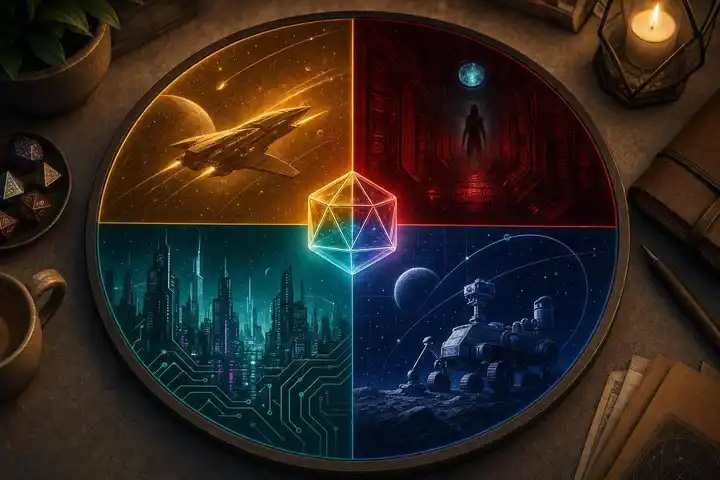
If you want the short answer: pick the game by mood first, not brand name. I’d point most groups to Stars Without Number for open galaxy play, Mothership for horror, Cyberpunk RED for street-level dystopia, and Traveller for grounded ship-and-trade campaigns.
Here’s the whole article in one pass:
- Stars Without Number fits sandbox space adventure and faction play
- Mothership fits fear, stress, and short survival stories
- Cyberpunk RED fits urban jobs, cyberware, and tactical fights
- Traveller fits trade routes, fuel costs, and hard-SF limits
- 2 games have free entry PDFs: Stars Without Number and Mothership
- The article also points to a directory with 205+ systems to filter by genre, rules weight, and campaign style
If I were choosing fast, I’d use three filters:
- Tone - space adventure, horror, cyberpunk, or grounded SF
- Rules load - light, medium, or heavy
- Campaign length - one-shot, short arc, or long sandbox
That’s the core point of the article. A group that wants dread won’t have much fun in a game built for big heroic action, and a group that wants trade routes and ship debt may not want panic tables or neon street warfare.
Quick Comparison
| Game | Best Match | Rules Style | Campaign Shape | Risk Level | Entry Cost |
|---|---|---|---|---|---|
| Stars Without Number | Space opera sandbox | d20 combat, 2d6 skills | Long open campaign | High early | Free PDF / about $39.99 print |
| Mothership | Sci-fi horror | d100 roll-under | One-shots, short arcs | Very high | Free PDF / $59.00 core set |
| Cyberpunk RED | Cyberpunk missions | d10 + stat + skill | Short or long campaign | Medium to high | Paid |
| Traveller | Hard SF trade and travel | 2d6 skill system | Long open campaign | Medium to high | Paid |
I’d sum up the article like this: pick Stars Without Number for freedom, Mothership for pressure, Cyberpunk RED for edge, and Traveller for grounded space life. If none of those line up with your table, the directory is there to help narrow the field without guessing.

Best Sci-Fi TTRPGs Compared: Tone, Rules & Campaign Style
1. Stars Without Number

Genre fit
Stars Without Number mixes hard-SF grit with big space-opera scope. Its default setting takes place in a post-collapse galaxy scarred by the psychic disaster known as the Scream, which cut human worlds off from each other for centuries. That setup gives you a lot to work with: exploration, power struggles, and the slow job of rebuilding from the ruins. You can run it grim, hopeful, or somewhere in the middle. The Deluxe Edition also adds Heroic PC rules if you want a more cinematic feel.
Rules crunch
SWN sits in the medium-crunch range, with d20 combat and 2d6 skill checks. Character creation is fast, and the Revised Edition includes a quick generator that can make a character in about six rolls. If your group likes extra systems to tinker with, there are optional rules for starships, hacking, drones, and mechs.
Campaign style
This game is built for sandbox play. The GM gets a strong set of tools, including World Tags and the Faction Turn system, which lets governments, cults, and corporations push their own agendas between sessions. That means the setting keeps moving even when the players look the other way. The Revised Edition core book runs 325 pages and packs in 100 pre-generated adventure seeds.
One thing to know up front: early combat can be brutal. If your group wants a softer landing in fights, SWN may feel too lethal.
Best for
SWN works well for GMs who want a galaxy that feels alive without having to write every planet, faction, and problem from scratch. It also fits players who like exploration and faction-driven play. And if your table is coming from D&D, the d20 combat will feel familiar enough to ease the shift.
A big plus is the free PDF, which includes the full core rules, the faction system, and sector-generation tools. If you want print, the Core Edition costs about $39.99.
For a darker, tighter survival experience, the next pick shifts from open-ended sandbox play to claustrophobic horror.
2. Mothership

Genre fit
If Stars Without Number gives you room to roam, Mothership pushes you into a tighter, meaner kind of sci-fi. This is blue-collar horror in space: part job site, part grave, part legal problem waiting to happen. Think Alien or Event Horizon. Your characters aren’t bold heroes heading into the unknown. They’re workers, contractors, and unlucky people caught in something way past their pay grade.
Its pitch says everything you need to know:
"Survive. Solve. Save. Pick One."
Rules crunch
Mothership uses a d100 roll-under system that moves fast. The character sheet does a lot of the heavy lifting, so new players can usually get set up in under 15 minutes. That makes it easy to bring to the table, especially for a one-shot.
The game also handles damage in a harsher way than many RPGs. Instead of hit points, it uses a Wounds system built around direct injuries. Stress matters just as much. The Panic Die turns pressure into mistakes, tunnel vision, or full-on breakdowns, and the Panic Table can either sharpen a character for a moment or send them spiraling when stress gets too high. That lower success rate isn’t a flaw. It’s the point. Characters begin the game already outmatched.
Campaign style
Mothership shines in one-shots and short arcs, usually around three to four sessions, where the stress, injuries, and close calls pile up until every small win feels hard-earned. It’s built for that kind of pressure-cooker pacing.
The Warden's Operations Manual gives GMs a five-act horror structure called TOMBS - Transgression, Omens, Manifestation, Banishment, Slumber - to help shape an arc without locking it into a rigid script. That’s a smart fit for horror. You want structure, but you also want room for things to go sideways.
Progress here isn’t about leveling into bigger and better heroes. Mothership rewards staying alive. And that’s no small thing when the average character lasts about four sessions.
Best for
Mothership is a strong fit for groups that want high stakes, fragile characters, and very little protection from bad outcomes. It works well for:
- horror fans
- one-shot game nights
- groups that want a full story in just a few sessions
If your table wants steady protagonists, long arcs, or a slow climb in power, this probably isn’t the right game.
The Player's Survival Guide PDF is free, and the Core Set costs $59.00.
For a different kind of pressure - neon, debt, and street-level violence - Cyberpunk RED shifts the mood from horror to dystopia.
3. Cyberpunk RED

Genre fit
Cyberpunk RED is one of the main cyberpunk RPGs for street-level survival under corporate pressure. It takes place in 2045, in the Time of the Red, where people are trying to rebuild after the Fourth Corporate War. The game leans hard into style, attitude, danger, and breaking the rules. That mood runs through the whole system. You get tense fights, lots of ways to build your character, and consequences that hit back.
Rules crunch
This is a medium-to-high crunch game. The main rule is simple on paper: Stat + Skill + 1d10 against a Difficulty Value. But around that, there’s a thick rules system for combat, cyberware, gear, and hacking. The core book includes 10 roles and 86 skills.
Combat uses the Friday Night Firefight system. It’s tactical and lethal, with rules for cover, critical injuries, hit locations, and weapon-specific fire modes. In plain English: fights can go bad fast.
Netrunning also got a smart rework. The hacker stays on-site with the rest of the crew instead of vanishing into a separate mini-game. That change keeps the table together, which matters a lot in play.
Cyberware gives your character more power, but there’s a cost. It wears down your Humanity stat, and if you push too far, cyberpsychosis becomes a game effect, not just story flavor. Put all of that together, and Cyberpunk RED feels sharp, risky, and built for campaigns where every choice can sting.
Campaign style
Cyberpunk RED works for both one-shots and longer crew-based campaigns. Screamsheets make one-shot prep easier by giving you ready-to-run hooks and job ideas. At the same time, money, repairs, and upgrades stay tight, which keeps the game rooted in survival.
That pressure is a big part of the appeal. Your crew is often one bad job away from trouble, and even small gear choices can matter.
Best for
This game fits groups that want tactical combat, deep character options, and a setting that pushes back. If your group doesn’t enjoy dense rules, it may feel heavier than it first appears.
If you want sci-fi that feels less neon and more grounded, Traveller moves the focus toward ships, trade, and hard SF limits.
4. Traveller

Genre fit
Of the games on this list, Traveller is the most grounded hard SF pick. It puts trade, distance, fuel, economics, and ship costs ahead of cinematic heroics. There’s no faster-than-light communication, which changes everything: news moves only as fast as ships, and space feels huge, slow, and cut off. The default setting, the Third Imperium, is a feudal interstellar empire where local nobles hold real power because the center can’t react fast enough. That sense of realism runs through the whole game.
Rules crunch
The core mechanic is simple: roll 2d6, add your attribute and skill modifiers, and beat an 8. Easy enough on its own. The added weight comes from the way the game’s systems connect to each other.
Character creation uses a lifepath system. You roll through career terms, life events, and mishaps before play even begins, and in older editions your character could even die during that process. It can be swingy, but it also gives you a backstory with very little effort. The Mongoose Traveller 2E Core Rulebook is 264 pages long and packs in detailed systems for trading, ship design, and world generation.
Combat is fast and lethal. Damage goes straight to your physical attributes - Strength, Dexterity, and Endurance - so getting hurt makes you worse at things right away. In plain terms: if you can avoid a fight, you probably should.
Campaign style
Traveller is built for open-ended trade and travel campaigns. The usual setup is a small crew trying to keep a trade ship running, juggling expenses, income, and odd jobs from port to port. Ship repairs cost a lot, so money problems are never far away.
The game also works well for mercenary crews, Scout Service explorers, and other groups out on the frontier. No matter the setup, the tone stays grounded: capable people trying to get by in a universe that doesn’t care much about them. It’s less heroic and more procedural.
Best for
Traveller works best for groups that like logistics, emergent storytelling, and grounded consequences. If your table wants a Firefly-style vibe - scraping by, making hard calls, and carving out a life on the edges of a big empire - it does that very well.
It’s a tougher fit for groups that want fast advancement or a tight story structure. Character growth tends to come through money and gear, not skill points or levels. And the rulebook’s layout can slow down new referees. For some groups, that friction is part of the draw. If you want more sci-fi picks after these four, the directory below helps narrow things down by tone and rules weight.
Genre fit
The TTRPG Games Directory helps you cut through the noise and find sci-fi games that match your group. You can sort by subgenre, rules weight, and the kind of campaign you want to run. So if you're after Space Opera, Cosmic Horror, Cyberpunk, or Hard SF, you can narrow the list fast instead of digging through game after game.
Rules crunch
Each game entry scores Complexity, Tactical Depth, Combat Focus, and Roleplay Focus on a 1–5 scale. It also shows Campaign Depth and Structure, which makes it easier to tell whether a game leans open-ended or more guided.
Here's a compact comparison of the games in this guide:
| Game | Complexity | Tactical Depth | Campaign Depth | Structure |
|---|---|---|---|---|
| Stars Without Number | 5/5 | 4/5 | 5/5 | Open/Sandbox |
| Mothership | 3/5 | 2/5 | 3/5 | Open |
| Cyberpunk RED | 4/5 | 4/5 | 4/5 | Open |
| Traveller | 4/5 | 2/5 | 5/5 | Open |
It also includes character build time, which is handy when your group wants to get started without a long setup. Traveller takes about 45 minutes, while Mothership is much faster and can often be done in seconds with the app.
Best for
This directory is a good fit for GMs and groups that want to choose with their eyes open before they commit. The "Avoid if" notes call out things like high lethality, heavy prep, and linear structure right away, so there are fewer surprises later.
It also shows entry cost. The Mothership Player's Survival Guide is a free PDF, while Traveller is listed as paid.
"Traveller is the classic science-fiction TTRPG for groups that want a starship, a crew, a subsector map, uncertain jobs, hard choices, and practical costs." - TTRPG Games Directory
Related Items make side-by-side comparison easier, especially when you're torn between games that scratch a similar itch.
22 Stellar Science Fiction TTRPGs Deserving Your Attention (And They Have Nothing to Do with D&D)
How They Compare: Tone, Mechanics, and Table Fit
Taken together, these four picks split apart most on tone, rules weight, and how much control the GM wants between sessions. In plain English: pick the game that fits the kind of night you want at the table, not the one with the biggest name.
The table below gives the fastest side-by-side read.
| Game | Core Niche | Core Mechanic | Campaign Style | Lethality | Best For |
|---|---|---|---|---|---|
| Stars Without Number | Sandbox / Space Opera | d20 combat / 2d6 skills | Sandbox campaigns | Very high early on | GMs who want a living sector with low prep |
| Mothership | Sci-Fi Horror | d100 roll-under | One-shots and short arcs | Very high | Horror fans; fast, fragile-character play |
| Cyberpunk RED | Dystopian Cyberpunk | d10 + Stat + Skill | Mission-based or long campaigns | Moderate | Action- and roleplay-focused groups |
| Traveller | Hard SF / Space Opera | 2d6 skill system | Sandbox campaigns | Moderate to high | Detail-heavy, lore-rich campaigns |
Mothership is the bleakest and most stressful. Cyberpunk RED is the most stylish and rebellious. Stars Without Number gives you the biggest sandbox. Traveller feels the most grounded and procedural.
On the rules side, Mothership is the easiest to teach. Stars Without Number mixes familiar d20 combat with OSR danger. Cyberpunk RED cuts some rules bulk to keep sessions moving. Traveller stays clean in its design, but it asks more from the table moment to moment.
Your campaign goal is the fastest way to decide.
- If your group wants to roam a galaxy it built for itself, go with Stars Without Number.
- If your group wants fear, stress, and psychological pressure, pick Mothership.
- If your crew wants a starship, a subsector map, and tough calls about fuel and cargo, Traveller is the fit.
- If you want neon-soaked street action under corporate pressure, Cyberpunk RED works best.
The next section breaks down where each game shines and where each one can slow a table down.
Pros and Cons
Each of these four games has a clear sweet spot and a point where it can fall apart. If you know both before game night, it’s much easier to pick the right fit for your group.
| Game | Pros | Cons | Ideal Group |
|---|---|---|---|
| Stars Without Number | Free core rules; excellent sandbox and faction tools; familiar d20 combat | High early-game lethality; sandbox can feel directionless without a strong GM | GMs who love world-building; groups wanting a long-term "living galaxy" campaign |
| Mothership | Fast to learn and run; free entry point; strong horror pacing | High turnover; little long-term advancement; starts with light built-in lore | Horror fans; one-shot groups; anyone who loves Alien or Dead Space |
| Cyberpunk RED | Rich setting; more forgiving damage system than OSR-style games; strong street-level tone | Some subsystems can split the table's attention | Genre fans who want style, street action, and a rich corporate dystopia |
| Traveller | Rich lifepaths; grounded hard SF; deep trade and travel systems | Steep learning curve; between-session bookkeeping; character death during creation | Simulationists who enjoy logistics, realistic physics, and long-haul campaigns |
The tradeoffs here are pretty straightforward: match the game’s tone, rules load, and campaign shape to what your table wants most.
Mothership is built around immediate survival. Traveller leans toward long-haul planning, travel, and cost management. Stars Without Number asks for more prep up front, then pays that back with World Tags and the Faction Turn, which help the sector keep moving between sessions. Cyberpunk RED is the least lethal option for D&D groups, but it asks you to deal with heavier subsystem load, especially in Netrunning.
The conclusion below turns those tradeoffs into a final pick.
Conclusion
The right sci-fi TTRPG comes down to the kind of game your table wants to play. Exploration, horror, neon crime, or grounded hard SF each point to a different fit. Stars Without Number works best for sandbox play, Mothership fits horror, Cyberpunk RED fits cyberpunk, and Traveller leans into hard SF.
If you want to stack up more choices, the directory helps keep the search tight. And if none of these land, the TTRPG Games Directory is a free way to narrow things down by genre, complexity, and play style.
From there, focus on the three things that matter most: tone, rules load, and campaign shape. Tone means horror, space opera, cyberpunk, or hard SF. Rules load is about how much system your group wants to handle - Mothership is lighter, while Traveller asks for more. Campaign shape is simple: are you running a one-shot or settling in for a long-haul campaign? Get those three lined up, and the game can carry a lot of the work for you.
FAQs
Which sci-fi TTRPG is easiest for beginners?
Stars Without Number and Mothership are the top beginner-friendly picks.
Stars Without Number works well for sandbox play because the rules are streamlined, and the free basic edition makes it easy to jump in.
Mothership is a strong fit for sci-fi horror. Its quick-reference rules and character creation built into the character sheet help new players start right away.
How do I choose between sandbox play and shorter missions?
Choose based on your group’s time, interest, and how much structure you want at the table.
Go with sandbox games like Stars Without Number or Traveller if you want open-ended exploration, procedural world-building, and campaigns shaped by player choices. These games work well for groups that like to roam, poke at the setting, and decide their own direction.
Pick shorter mission games like CBR+PNK or CY_Borg if you want fast, high-intensity sessions built around immediate action, strong atmosphere, or narrative chaos instead of heavy rules.
Which game is best for a long-term campaign?
Stars Without Number is the best fit for a long-term campaign. Its sandbox tools, faction system, and procedural tables give you room to build a story that changes over time based on what the players do.
Traveller can also handle long-term play well, but it comes with more rules to manage. Mothership fits short arcs better. Its high-lethality horror style tends to make characters feel more fragile and easier to replace.


