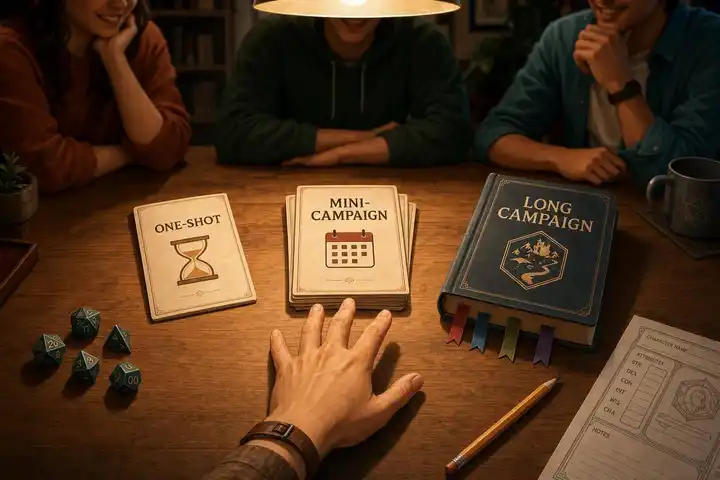
The best TTRPG format is the one your group can finish. If your schedule is loose, go with a one-shot. If you want a short arc, pick a mini-campaign. If your group can meet for 20 to 70+ sessions over 6 months to 2+ years, a long campaign gives you the most room for character and story growth.
I’d boil the choice down to three things:
- Time: one night, a few weeks, or many months
- Attendance: inconsistent, somewhat steady, or very steady
- Story depth: a single mission, one full arc, or a long arc with payoffs later
Here’s the short version:
- A one-shot usually lasts 3 to 5 hours and ends the same day.
- A mini-campaign often runs 3 to 12 sessions and gives you continuity without a huge time ask.
- A long campaign can last 20+ sessions, with some D&D games taking 50 to 70+ sessions from level 1 to 20.
If I had to give one rule, it would be this: pick the shortest format your group can commit to without strain. That cuts schedule problems, lowers GM prep, and gives you a much better shot at reaching the ending.
Quick Comparison
| Format | Time Ask | Scheduling Pressure | Story Room | Best Fit |
|---|---|---|---|---|
| One-Shot | 1 session, about 3–5 hours | Low | Low | Busy or uneven groups |
| Mini-Campaign | 3–12 sessions | Medium | Medium | Groups that can meet for a short run |
| Long Campaign | 20–70+ sessions | High | High | Steady groups that want deep character arcs |
In short: one-shots are safest, mini-campaigns are the middle ground, and long campaigns give the biggest payoff if your group can stay on track.

TTRPG Format Comparison: One-Shot vs Mini-Campaign vs Long Campaign
One Shots vs. Campaigns: Which Is Right for Your D&D Group?
One-Shot vs. Mini-Campaign vs. Long Campaign: Key Differences
These formats differ in a few big ways: schedule risk, prep time, and how much story room you get. The trade-offs are pretty simple once you put them side by side.
One-Shot: Complete a Full Story in One Session
A one-shot is a self-contained story that begins and ends in a single session. The scope stays tight: one goal, one timeline, one ending. Since everything needs to wrap in one sitting, the GM has to keep the game moving so the story actually finishes that same session.
Prep is light. Many one-shot systems use pre-generated characters, which cuts out long character creation. Games like Dread and Lasers & Feelings are built for this exact setup, and some systems can get from setup to play in under 30 minutes. That makes one-shots a good fit for shaky schedules or groups that want to test a new system. Put plainly, this is the lowest-risk format.
Mini-Campaign: Get Story Continuity Without a Long Commitment
A mini-campaign usually lasts 2 to 12 sessions, which gives you a full arc, recurring characters, and faster leveling without asking for the kind of time a long campaign needs. Blades in the Dark works well here, especially in seasonal play. GM prep sits in the middle too: more connected than a one-shot, but still focused on a single arc. It’s the middle ground between a one-night game and a long-running campaign.
Long Campaign: Develop Characters and World Over Many Sessions
A long campaign is the highest-commitment format. The upside is depth. Characters change over dozens of sessions, the world responds to player choices, and plotlines have time to twist, branch, and pay off in ways shorter formats just can’t handle.
Examples include Dungeons & Dragons 5e and Pathfinder 2e. A level 1-to-20 D&D campaign can take 50 to 70+ sessions. GM prep is high: world-building, NPC tracking, and overlapping plot threads all need steady attention. You get more depth, but you also take on more schedule pressure and more work behind the screen.
| Format | Session Count | Total Duration | GM Prep Level |
|---|---|---|---|
| One-Shot | 1 session | 3–8 hours | Low |
| Mini-Campaign | 2–12 sessions | Weeks to months | Moderate |
| Long Campaign | 20+ sessions | 6 months to 2+ years | High |
Comparison Table: Commitment, Flexibility, and Payoff by Format
Use this side-by-side view to compare commitment, flexibility, and payoff at a glance.
| Feature | One-Shot | Mini-Campaign | Long Campaign |
|---|---|---|---|
| Session Length | 3–5 hours | 3–4 hours | 3–6 hours |
| Total Commitment | 1 session | 3–12 sessions (weeks to months) | 20–70+ sessions (months to years) |
| Scheduling Flexibility | High - works with inconsistent attendance | Moderate - regular attendance over a few sessions | Low - requires a dependable long-term schedule |
| Character Depth | Low - experimental or pre-gen | Moderate - some growth and arc completion | High - deep development over time |
| Story Scope | Single objective or location | Contained arc or focused season | Layered plots and recurring subplots |
| Prep Load | Low (~2 hours) | Moderate - focused on one arc | High - up to 10–20 hours per session |
| Best For | Quick fun and experimentation | Contained character arc | Long-term character and world growth |
The choice usually comes down to one thing: how much schedule pressure your group can handle.
How Time and Scheduling Affect the Best Choice
Time commitment is the first filter. Long campaigns ask for steady attendance over months or even years, while one-shots are far more forgiving if people miss sessions or plans keep changing.
If your group has a hard time locking in dates, a one-shot or mini-campaign is often the safer pick. If everyone can show up on a steady schedule, a long campaign becomes much easier to pull off.
How Story Depth Affects the Best Choice
Short formats give you speed. You can jump in, play, and wrap up fast. The tradeoff is less room for character growth, slower-burn plot turns, and big world changes.
Long campaigns do the opposite. They take more time and more planning, but they give characters space to change, relationships room to build, and plot threads time to hit harder.
How to Choose the Right Format for Your Group
The right format isn't the one that sounds the most fun. It's the one your group can actually finish.
So keep it simple. Look at your group's limits and choose from there. The three big things to judge are time, attendance reliability, and how much story depth you want. Then match those limits to the format that fits.
Choose a One-Shot for Low Commitment and a Fast Ending
If your group has an uneven schedule, a one-shot is usually the safest bet. This format works best when attendance is hard to predict - think parents with young kids, shift workers, or anyone who can only meet now and then.
Games like Lasers & Feelings are a good fit because they move from setup to play fast. You can get people to the table and into the game without much ramp-up.
One-shots also give you a low-risk way to test a new group. If you're not sure how new players will mesh, this lets you find out before anyone signs up for something longer.
Choose a Mini-Campaign for a Short Arc With Some Room to Grow
If your group can stick with a game for a handful of sessions, a mini-campaign makes sense. A 10- to 12-session season gives characters room to change and gives the GM a clear stopping point, which can help avoid burnout.
A focused adventure path like Waterdeep: Dragon Heist fits this format well. It has a clear scope, and it can wrap up within a calendar year.
Choose a Long Campaign for Groups With a Steady Schedule and a Want for Depth
If your group can hold the same time slot for months, a long campaign can pay off in a big way. It works best when the same core group - ideally 4 to 5 players - can stick to a steady schedule over months or even years.
In modern D&D, reaching level 20 usually takes about 60 sessions. That's roughly one year of weekly play, or two to three years if you meet every other week.
That longer runway gives you more room for character growth and story arcs that stretch over time. Early choices can come back much later, and that's part of the fun. But there's a catch: if attendance starts slipping, the campaign can lose momentum before the story gets where it's going.
Conclusion: Pick the Format You Can Actually Complete
The best format is the one your group will finish. One-shots are the lowest-risk option, mini-campaigns give you some continuity without asking for too much, and long campaigns offer the most depth.
So the main question isn't what sounds best on paper. It's what your group can keep going. For most groups, the biggest roadblock with long campaigns is time.
Once you know your limits, choose the format that fits. TTRPG Games Directory can help you find games that match your group's commitment level.
FAQs
How do I know if my group is ready for a long campaign?
Your group is probably ready when scheduling is steady, communication is clear, and everyone wants to tell the same kind of story. A long campaign tends to work best when both players and GMs can keep things moving through character growth and a plot that plays out over months - or even years.
If you're not sure yet, start small. Try a one-shot or a mini-campaign and see how the group clicks. If that goes well, moving into a longer campaign will feel a lot more natural.
What if my group wants depth but can’t commit for months?
A mini-campaign is usually the best fit. At around three to 10 sessions, it gives you more room than a one-shot without asking for the long haul of a full campaign.
That extra space matters. It gives characters time to change, relationships time to click, and the story time to build toward an ending that feels earned. If scheduling is a headache - and let’s be honest, it often is - a seasonal setup can help. Think 10-to-12-session blocks with a clear arc and stopping point.
Can I turn a one-shot into a mini-campaign later?
Yes. If the session clicks and your group wants more, you can keep going from there. The choices people made, the alliances they formed, and the plot threads that showed up in that first game can all carry into the next session.
A one-shot can also work like a low-pressure test run for character and story ideas. It gives you a simple way to see if the narrative has enough depth to keep going.


