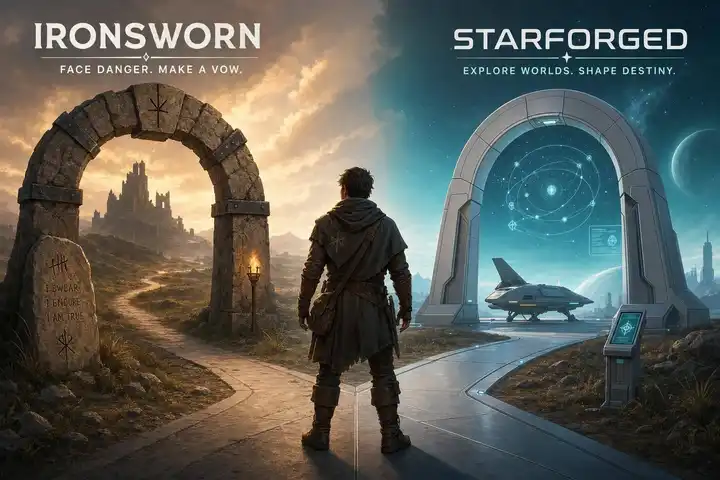
If I had to give the short answer: I’d pick Ironsworn for grim fantasy and lean vow-focused play, and I’d pick Starforged for sci-fi campaigns with more built-in tools.
Both games use the same core dice system: 1d6 vs. 2d10. But they do not feel the same in play. One stays close to harsh personal quests. The other opens the door to ships, planets, ruins, factions, and 200+ oracle tables.
Here’s the simple breakdown:
-
Ironsworn
- Best for low-fantasy solo or co-op play
- Centers on Iron Vows, hardship, and survival
- Keeps play leaner and more local
- Has a free PDF core rulebook
-
Starforged
- Best for sci-fi solo or co-op campaigns
- Adds starships, vaults, derelicts, and deeper travel rules
- Uses Legacy Tracks for growth through quests, bonds, and discoveries
- Gives solo players more built-in prompts and structure
Bottom line: if you want personal vows in a harsh frontier, I’d go with Ironsworn. If you want space travel, discovery, and more campaign support, I’d go with Starforged.
Ironsworn RPG (The Gold Standard for Solo and Co Op RPGs... and it's FREE?!?)

Quick Comparison
| What I’d compare | Ironsworn | Starforged |
|---|---|---|
| Setting | Viking-style frontier fantasy | Gritty space frontier |
| Core feel | Personal, harsh, vow-led | Broader, travel-led, discovery-led |
| Progression | Mostly through fulfilled vows | Quests, Bonds, and Discoveries |
| Travel | More abstract | More procedural |
| Exploration tools | Best with Delve | Built into core rules |
| NPC ties | Lighter structure | Connection-focused rules |
| Oracle support | Strong, but simpler | Deeper and more specialized |
| Best fit | Solo/co-op fantasy questing | Solo/co-op sci-fi campaigns |
I’d use this comparison to make one call: Do you want tighter fantasy pressure or a bigger sci-fi campaign frame? That choice decides most of the rest.
Ironsworn: Gritty Fantasy, Vows, and Low-Prep Co-op Play
Setting and Tone in the Ironlands
The Ironlands is a harsh, Viking-inspired frontier. Magic is rare and dangerous, and it usually shows up as rituals or tech-magic. Play centers on survival, vows, and steady pressure from the land itself. Unlike a broader campaign frame, Ironsworn keeps things local and personal.
What makes that setting hit home is the 14 Truths. Before play starts, you shape your version of the Ironlands by choosing truths about its history, the nature of magic, and the catastrophe that drove your ancestors there. That setup makes the world feel like yours. Every vow, setback, and oracle result grows out of the version of the Ironlands you chose.
Core Mechanics, Oracles, and Quest Flow
Ironsworn resolves actions with one Action Die (1d6 plus a relevant stat) against two Challenge Dice (2d10). If you beat both, you get a Strong Hit. Beat one, and you get a Weak Hit: you succeed, but you pay for it. Beat neither, and you Miss, which brings failure or a complication.
Iron Vows - sacred oaths sworn on iron - sit at the center of quests and advancement. You mark progress through successful moves, then roll that progress when it's time to fulfill the vow. Oracle tables generate NPCs, locations, and twists on the fly, which supports zero-prep play. Action/Theme tables give you quick prompts that you read in context.
In practice, this means the game does a lot of the heavy lifting without feeling pushy. You swear a vow, follow the trail, and let the dice and oracles shove the story into trouble. That's why Ironsworn works so well for players who want improvisation and quest pressure to carry the session. The system stays lean, so it's fast to run and easy to riff with.
How Solo and Co-op Play Feels
Ironsworn is built for solo and co-op play without a GM, so the experience stays locked on personal stakes and story that grows out of play. Momentum rewards strong rolls, while Supply abstracts gear and resources so attention stays on the fiction instead of inventory math.
The practical takeaway is lean, vow-driven, GMless play. Starforged keeps this core loop but adds more structure and more specialized tools.
Starforged: Space Exploration, Stronger Subsystems, and Polished Solo Tools

Setting and Campaign Scope in the Forge
The Forge is a rough sci-fi frontier shaped by humanity's flight after a cataclysm. You’ve got planets, stations, wrecks, ruins, and factions all close enough to matter within a single jump. That bigger canvas changes the feel of play. Starforged keeps the Ironsworn core, but it gives solo and co-op play more support for handling that scale.
Like Ironsworn, Truths define your version of the Forge, from AI and FTL to alien life. In Starforged, those choices do a bit more than color the setting. They also shape the size and reach of the campaign itself.
Refined Mechanics, Starships, and Oracle Depth
Starforged adds more moves and much deeper oracle support, which gives solo play more prompts and clearer procedures built right into the game. The book spends a lot of time on oracles for planets, settlements, starships, creatures, and factions.
Travel is also split in a clean way between known routes and risky expeditions. That means you can move fast when the path is clear, but still keep tension when you’re pushing into the unknown. On top of that, the Delve mechanics from Ironsworn are reshaped into Derelicts and Precursor Vaults, with focused procedures for abandoned ships, stations, and ancient ruins.
Your starship matters too. It works almost like a character, with its own history, integrity, and modular upgrades. Put all of that together, and Starforged feels less stripped down than Ironsworn, especially once you begin tracking travel, ships, and longer campaign arcs.
Why Starforged Often Feels Smoother in Solo Play
For solo players, the biggest quality-of-life step forward is the Legacy Track system. Legacy tracks reward quests, bonds, and discoveries, so growth comes from the whole campaign, not only from completed vows. That shift is small on paper, but at the table it helps a lot.
Clocks - borrowed from Blades in the Dark - give you a simple way to track faction threats, long-running projects, or environmental pressure without a GM behind the curtain.
Starforged also adds Connection moves to give long-term NPC relationships a clear structure. And the Continue a Legacy move lets a retired or deceased character pass assets, bonds, or unfinished vows to a new protagonist. If you like the idea of a campaign stretching across generations, that tool makes it much easier to pull off.
Next, the key question isn’t what changed. It’s which of those changes you’ll actually feel at the table.
Direct Comparison: Setting, Mechanics, Oracles, and Campaign Feel

Ironsworn vs Starforged: Side-by-Side TTRPG Comparison
Here’s where the two games start to feel different at the table. The biggest shifts show up in pacing, exploration, and how much support you get for solo or co-op play.
| Feature | Ironsworn | Starforged | Solo/Co-op Notes |
|---|---|---|---|
| Setting | Gritty frontier fantasy (Ironlands) | Gritty space-western (The Forge) | More personal stakes vs. broader scope |
| Progression | XP from fulfilled vows | XP via Quests, Bonds, and Discoveries | More ways to earn XP |
| Travel | Abstract journeys | Procedural expeditions | More procedural travel |
| Exploration Depth | Requires the Delve expansion | Derelicts and Vaults built into core rules | Built-in exploration |
| NPC Relationships | Simple interaction moves | Formal Connections and Bonds system | Starforged is more explicit about ongoing relationships |
| Oracle Support | Action/Theme tables, wilderness focus | Broader, more specialized oracle support | More solo prompts |
Those differences do a lot of the heavy lifting when you're picking the right game for your campaign.
How Fantasy vs Sci-Fi Changes Campaign Tone
Ironsworn’s Ironlands feel tight, harsh, and personal. The danger is right in front of you: bad weather, rival clans, and things lurking in the dark. Because of that, stories often stay close to the people, promises, and places tied to your vows. That smaller scale isn’t a drawback. It’s part of the appeal.
The Forge pushes things outward. In Starforged, trouble can come from rival factions, failing ships, or ancient alien ruins. Even with that larger backdrop, the tone stays gritty. It doesn’t turn into glossy space opera. It still feels rough around the edges, just with more room to roam.
So the split is pretty simple: personal vows in a tighter world or a campaign with more range and discovery.
Vows, Exploration Structure, and Progression
Ironsworn ties progression closely to finishing vows. That keeps the loop focused. You make a promise, chase it, deal with setbacks, and get XP when you see it through.
Starforged opens that up with three Legacy tracks: Quests, Bonds, and Discoveries. That means XP can come from exploration and relationship-building, not just mission payoffs. In play, that changes the rhythm from one session to the next. You’re not always driving toward a single vow. Sometimes the session is about what you found, who you met, or what connection got deeper.
It also bakes expeditions, derelicts, and vaults into the core rules. For no-GM play, that matters a lot. It gives each scene more shape and gives you more prompts when you need to know what happens next.
Ironsworn is still the lighter way in. The rules are leaner, and the core rulebook is available as a free PDF. Starforged adds more guidance for solo play, which helps keep pressure and momentum in place without a GM. That extra structure is the main thing that sets it apart for GMless campaigns, and it’s the point that tends to make the final choice easier.
Which Game Fits Your Campaign Best
Choose Ironsworn for Vow-Driven Questing
If tone and table structure are the main deciding points, start with Ironsworn. It fits best when you want a harsher fantasy campaign centered on one clear vow at a time.
The Ironlands feel gritty and close at hand. And the focus on Iron Vows, frontier pressure, and low-prep co-op play makes each journey feel like it matters. Because it uses fewer subsystems, it also works well for a co-op group that wants to sit down and get going without much setup.
Choose Starforged for Spacefaring Campaigns and More Structure
If you want the same core engine with more campaign support, Starforged is the cleaner pick. It gives you more scaffolding for play and stronger solo tools for sci-fi travel and structured progression.
The three Legacy tracks - Quests, Bonds, and Discoveries - offer a compact way to track growth between sessions. Its oracle support also goes deep on planets, derelicts, factions, and starships. That extra support helps solo scenes move faster and stay productive without a GM.
Final Takeaway and Next Step
In practice, this choice comes down to tone and how much worldbuilding and campaign scaffolding you want built into play. Ironsworn is the better solo/co-op fit for gritty fantasy and lean questing. Starforged is the stronger choice for sci-fi campaigns with more built-in support.
FAQs
Which game is easier for beginners?
For beginners, Ironsworn is usually easier to get into than Starforged.
Starforged is a standalone game, but its broader rules and more detailed session zero can feel like a lot at first. There’s simply more to take in.
Because both games use the same core mechanics, starting with Ironsworn can make the jump to Starforged feel much smoother later on. New players may also find the original fantasy setting easier to learn, since it has a tighter scope.
Can I switch between Ironsworn and Starforged later?
Yes. They use the same core engine, along with the same momentum and condition mechanics, so moving from one to the other is very doable.
Starforged is a standalone game built for sci-fi, with setting-specific assets and moves. Ironsworn leans fantasy. You can usually reskin or reword assets to fit the new setting without much trouble.
That said, a few mechanics tied to space travel or fantasy may need small tweaks so the theme still feels right.
Do I need extra supplements to enjoy either game?
No. Ironsworn and Ironsworn: Starforged are both complete, standalone games.
That means each one gives you everything you need for solo play, co-op play, or a more standard GM-led game.
Each rulebook includes:
- Core rules
- Character creation
- Oracle tables for low-prep or no-prep play
Extra tools can make tracking and bookkeeping easier, but you don't need them to play.


