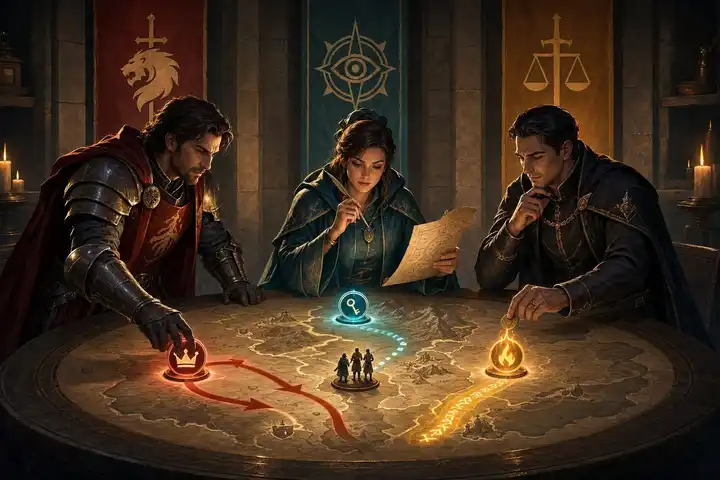
Most players won’t remember your faction lore. They will remember the group that blocked a plan, offered a bad deal, or hit a backstory nerve.
If I want rival groups to stick, I keep each one simple and active. In this article, the core idea is clear: build factions around what they want, how they act, what line they won’t cross, and how they pressure the party. Then I keep them moving between sessions so the world feels alive.
Here’s the whole playbook in plain terms:
- Start with 2–3 factions, not a huge cast
- Give each faction:
- one goal
- one method
- one hard limit
- Define their resources and the kind of pressure they use
- Give them a public face players can spot at once
- Decide each faction’s role: patron, obstacle, rival, or controller
- Link every faction to:
- one ally
- one enemy
- one hidden dependency
- Put rewards, costs, and fallout behind every player choice
- Tie at least one faction to a player backstory
- Advance faction plans between sessions
- Let leaders, tactics, and alliances change after losses and wins
A few points matter more than the rest:
- Rivalries work best when values clash, not just goals
- Pressure must match resources, or threats feel empty
- Failure has to change something, or the faction has no weight
- Recurring factions need a next move, every time they return
In other words: memorable factions don’t sit in notes. They act, react, and make the party pay attention.
That’s what this article shows step by step.

D&D Faction Builder: The Complete Checklist for Memorable Rival Groups
How To Run Faction Intrigue in Dungeons and Dragons 5e
Faction Basics for Lasting Rivalries
Write each faction in a single sentence: its goal, its method, and its limit. That one line gives you a fast way to run the group when it shows up at the table.
Set a Goal, Method, and Hard Limit
A goal by itself doesn't make a faction interesting. Two groups can both want “order in the city” and still end up as very different enemies.
A zealous church goes after order through doctrine and moral authority. A mercenary company goes after it through paid muscle and enforced contracts. Same end point, different path. And that difference is where the tension starts to feel real.
The hard limit matters too. It tells you what the faction will not do. It also shows you how far that group will go when the party gets in its way.
Choose Resources, Reach, and Pressure Tactics
A faction's resources shape the kind of pressure it can apply. A group with gold and soldiers leans on the world in a very different way than one with secrets and informants.
The thieves' guild uses blackmail and information. The church uses sanctuary, public trust, and moral authority. Neither one has to throw a punch to make the party's life harder.
| Faction Type | Primary Resource | Pressure Tactic |
|---|---|---|
| Zealous Church | Influence, sanctuaries | Moral authority, public shame |
| Mercenary Company | Gold, soldiers | Paid force, contract leverage |
| Thieves' Guild | Information, spies | Blackmail, information |
Match the pressure tactic to the resource. If a faction can't back up its threats, it stops feeling dangerous in a hurry.
Give the Group a Public Face Players Can Spot
Give the faction a marker players can notice right away: a symbol on a cloak, a certain weapon, a greeting phrase, or a meeting place everyone in town knows.
Once players can spot a faction on sight, they can start tracking it on their own. That makes the group feel less like background lore and more like a living force in the campaign.
For the leader or spokesperson, keep it simple:
- one motive
- one secret
- one quirk
With a clear public face, the faction is ready to take a more active role in the campaign.
Define Each Faction's Role in the Campaign
Once you know how a faction works, figure out the part it plays in the party’s life. Not every faction needs the same amount of detail. But every faction does need a clear place in the party’s story. A faction might help the party, get in their way, chase the same goal, or try to control what the party does. If it doesn’t have a clear party-facing role, it tends to drift into the background.
Tie each faction to what it wants from the party. A patron hires them. An obstacle crashes into their plans. A competitor goes after the same prize. The best rivals are easy to understand and easy to remember: groups with goals that directly clash with the party’s. Once that’s in place, opposing values make each faction feel sharper at the table.
Pair Factions With Opposing Values to Create Fast Table Tension
A lawful church that offers protection in exchange for obedience has built-in tension with a thieves’ guild that prizes freedom and works outside the law. Both sides want things that make sense. But they can’t both win. Keep the cast small so each rivalry stays clear.
Start Small: Two or Three Factions Before Adding More
Start with two or three factions so the campaign stays manageable. For each one, define what it wants, how it acts, and why the party should care. Leave the rest loose for now.
Build the Conflict Web and Put Stakes on the Party
Once each faction has a clear role, the next step is to show how those roles crash into each other. Alliances, feuds, and quiet dependencies turn a plain list of groups into a living network that can push the whole campaign in new directions. That web helps you see who comes out ahead when the party backs one side over another.
Map Alliances, Feuds, and Hidden Dependencies
For each faction, give it one ally, one enemy, and one hidden dependency.
That last part matters a lot. Public enemies might still trade favors behind closed doors. A faction that talks big about honor may still rely on smugglers. A merchant house that funds the city guard may also be paying off a rebel cell. Those tensions make the setting feel alive.
More importantly, they make player choices hit harder. When the party supports one group, they aren't just helping a single faction. They're shifting the balance across the whole web.
Tie Every Faction to Rewards, Costs, and Fallout
These links only matter if they change what happens next.
Every alliance or clash should affect access, safety, and leverage. If the party works with a faction, they might gain renown, protection, or resources. If they work against one, doors may close. Old friends may stop helping. Retaliation may show up at the worst time.
If failure changes nothing, the rivalry has no weight. Let mistakes matter. Close off options. Trigger payback. Change how factions deal with the party after the dust settles.
Use Player Backstories to Make Rivalries Personal
The strongest rivalries don't stay abstract. They connect to someone at the table.
Tie at least one faction to a character's past. A missing relative, an old debt, or a broken oath can turn a faction from background noise into something the player can't ignore. That's when the tension starts to stick.
A rival becomes a lot more memorable when it can threaten someone the party already cares about.
Turn Factions Into Recurring Story Forces
Once a faction has a goal, methods, and rivals, keep it active off-screen. The factions players remember don’t just sit there waiting for the party to show up. They keep moving. If they only appear inside their own turf, they start to feel stuck in place.
Advance Faction Agendas Between Sessions
Between sessions, decide what each faction is doing off-screen. One group might be recruiting. Another could be bribing officials. A third may be trying to recover a relic. Then update the status quo: what changed, what do they still want, and what do they do next?
A short update is usually enough. When the players come back, they should be able to see that the world didn’t pause for them. The faction’s goals, wins, and losses should have left a mark.
Change Leaders, Methods, and Alliances Over Time
When the party takes out a faction leader, don’t swap in the same person with a different name. Let the new leader change the faction’s tone and tactics. If the old leader liked negotiation, the next one might lean into threats. If the faction lost a key resource, it may change how it operates while still chasing the same goal.
Define a successor with three things: a goal, a secret, and one detail players will remember. That detail could be a scar, a habit, or a catchphrase. The point is simple: the faction should feel changed by what happened, not snapped back to normal.
Recurring NPCs help sell that shift. A pressured ally, a rival, or a villain who makes a fair point can make the faction feel personal instead of abstract.
Alliances should shift for the same reason. If a faction gets blocked one way, it should turn to another method that still serves its goal. A group that once fought an old enemy might later make a quiet deal after losing too much ground. That keeps the conflict alive and hands the players a new problem.
Faction-Building Checklist
Use this list when a faction returns after downtime or a major setback.
| Element | Question to Answer |
|---|---|
| Goal | Has the goal shifted after recent losses or wins? |
| Values | Did they cross a line they said they wouldn't? |
| Leader | Who runs it now, and what's their hidden weakness? |
| Visual identity | What visible mark changed, if any? |
| Resources | What did they gain or lose since last session? |
| Party relationship | How has the faction's stance toward the party changed? |
| Key rival | Which faction now threatens them most? |
| Rewards | What new opportunity appeared for players who work with them? |
| Consequences | What new pressure emerged from the party's last move? |
| Next move | What are they doing right now, off-screen? |
That last row matters most. A faction with a next move always has somewhere to go in the story.
FAQs
How do I make two factions feel different fast?
Define each faction by setting goals, methods, and values against each other. One group might care about honor, duty, and old customs. The other might chase wealth, trade, and influence. That contrast gives players something they can feel right away, not just read in a lore entry.
Give each faction its own clear look, way of ruling, and set of resources. Their clothes, banners, buildings, and gear should reflect what they stand for. A rigid, tradition-bound faction might favor formal armor, old family symbols, and stone strongholds. A trade-driven faction might use bright fabrics, coin marks, merchant fleets, and busy market hubs. Leadership should fit too. If a faction believes in order, it may follow a strict chain of command. If it cares most about profit, power may sit with guild masters, merchant princes, or a council of investors.
Keep the factions close enough that conflict feels natural. Neighbors compete. They clash over land, roads, ports, water, labor, taxes, faith, or prestige. When their interests overlap, tension shows up on its own. You don’t need to force it.
Most of all, tie what they do and how they look to what they believe. Players should be able to spot a faction at a glance and think, I know what these people are about.
What should I do if players ignore a faction?
Let the faction keep moving. If the party turns its attention somewhere else, that doesn’t mean the faction hits pause. It should still chase its aims while the world keeps shifting around everyone.
Then make that inaction visible through plain, concrete fallout. Maybe a trade route closes. Maybe a region slips into the hands of a rival group. Small details like that make the setting feel lived-in, and they show that player choices carry weight.
How can I tie a faction to a character backstory?
Use player backgrounds as built-in plot hooks. They give you an easy way to tie a character’s past to the larger world.
An NPC might spot a family crest, remember serving in the same military unit, or pick up on some other personal detail that links the character to a faction. Small moments like that make the world feel less like a stage set and more like a place with memory.
Session zero can help here too. Let players add local customs, old legends, or bits of history that connect their motives to faction goals. That way, those links don’t feel pasted on later.
When a faction wants what a character already cares about at their core, the bond feels personal. And that usually gives players a much stronger reason to pay attention.


