CAIN is Tom Bloom's occult-horror TTRPG about psychic exorcists working inside a brutal institution. Its play is structured around Hunts: the team investigates a supernatural wrong, confronts the forces around it, and moves toward an Execution. SINS are the monsters they hunt; Blasphemies are their psychic powers; an Imago is what an exorcist risks becoming.
The short verdict: CAIN suits a group that wants disturbing cases, powerful but vulnerable characters, and investigations that affect the final confrontation. Its appeal is the pressure of deciding how far to push those characters. A group looking for reassuring heroism, cozy mysteries, or detailed grid combat should choose something else.
This review explains the mechanics, campaign structure, and table fit. For the encyclopedic game profile, publication details, and starting path, read the Cain game guide. For a choice between adjacent occult-horror games, use the Cain, Monster of the Week, and Liminal Horror comparison.
Psychic exorcists inside a hostile institution
The exorcists and their targets share an uncomfortable connection: both can become psychic monstrosities. CAIN employs its agents as weapons against other SINS, so being useful to the organization does not make an exorcist safe. That premise gives the group a reason to work together without requiring everyone to believe their employer is right.
For campaign play, make that tension specific. An administrator can care about whether the target was eliminated while the team cares about a surviving witness. A successful mission can leave an exorcist afraid of using the same power again. These are suggested situations for your table, not additional setting rules or mandatory outcomes. They give players something to discuss between Hunts besides the next target.
What a Cain Hunt is built to do
A Hunt gives the GM and players a shared dramatic arc. The table begins with a problem that is supernatural, personal, and entangled with the world. Investigation makes that problem legible. Escalation turns information into pressure. An Execution forces the group to act, usually without a clean or morally neutral solution.
That structure is useful for a GM because it answers a common horror-campaign problem: how do you make a mystery feel consequential without writing a fixed plot? Prepare the situation, the people affected by it, the evidence available, and what will worsen if the exorcists do nothing. Let player choices determine the path through it.
Key terms at the table
SINS
SINS are supernatural monsters born when a human host's latent psychic powers break loose through trauma and suffering. They have origins the exorcists can investigate, rather than being interchangeable enemies. The official description makes the connection explicit: understanding the host's history can weaken the SIN in the final confrontation.
When introducing a SIN, establish what it looks like in the fiction, what it changes for ordinary people, and what the exorcists risk by engaging with it. Keep the person behind the threat in view. That gives the investigation a subject and makes the choice to execute the target more than a routine monster fight.
Blasphemies
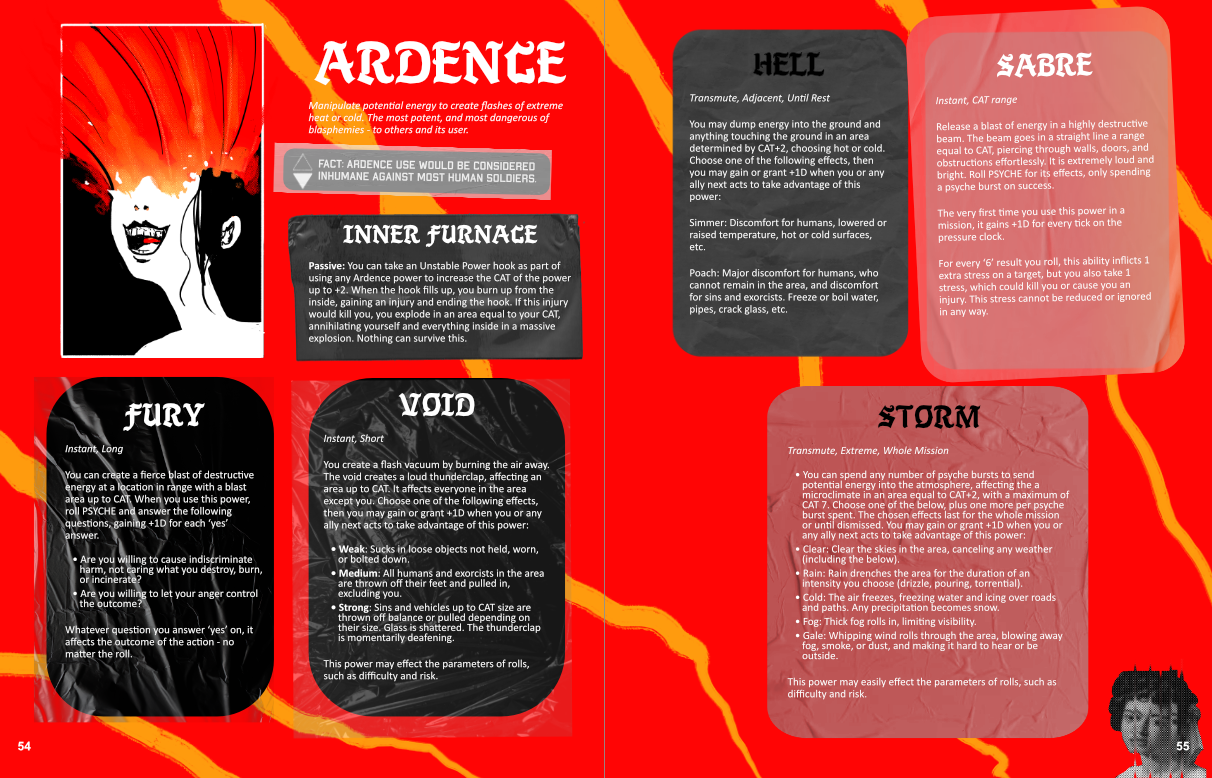
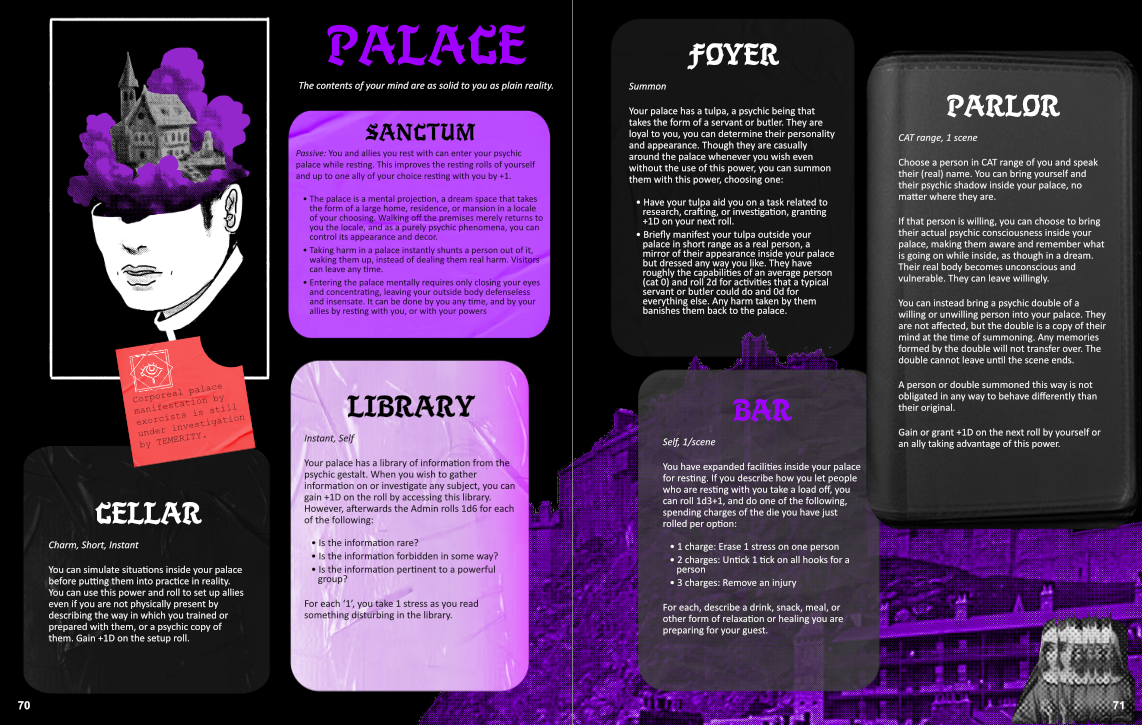
Blasphemies are the exorcists' psychic powers. They give a character a distinctive way to affect a situation, with abilities and limitations to learn. The official preview offers concrete examples: Ardence manipulates energy into extreme heat or cold, while Palace provides a psychic interior with possibilities for rest, research, and preparation.
At the table, ask what an ability lets the character attempt and what its written costs and limits require. Make those boundaries visible before the player commits. Let a suitable power solve a problem; the GM does not need to cancel every advantage with an invented complication. Resource costs and the consequences already established in the Hunt can supply the pressure.
Imago
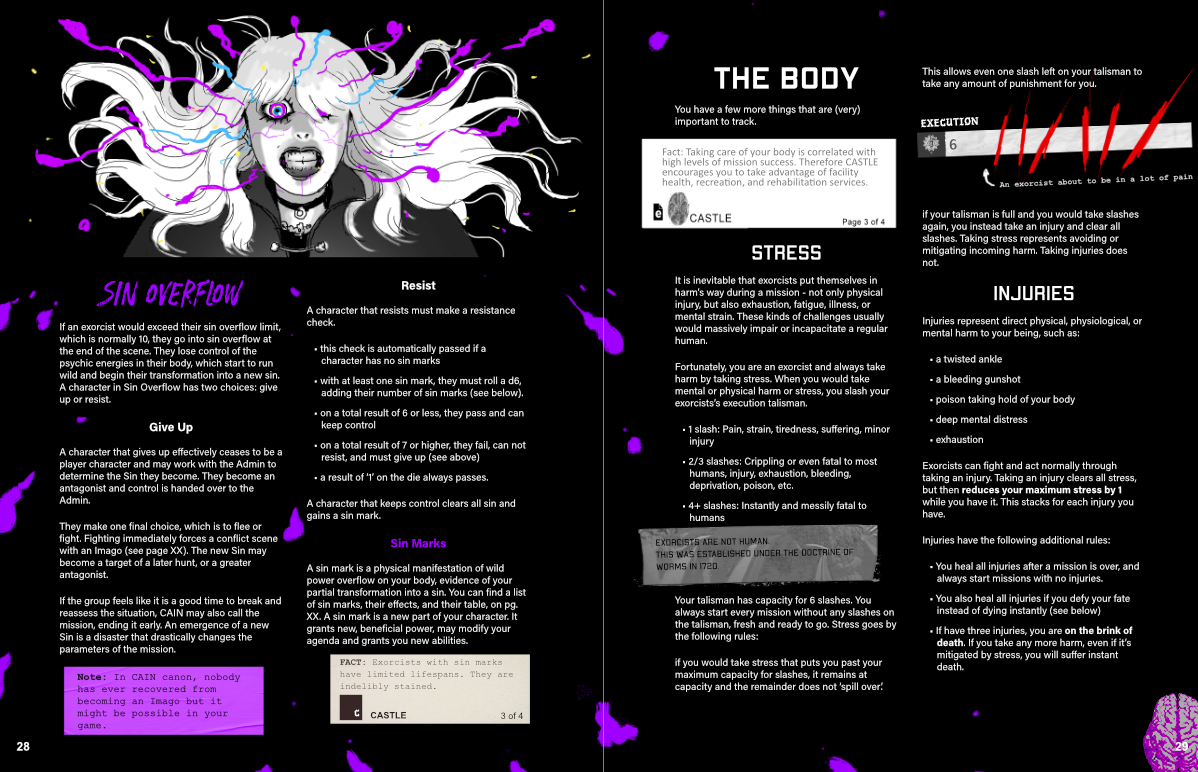
An Imago is the SIN an exorcist becomes when they lose control, not a clue, recurring symbol, or general name for occult imagery. The official Overflow preview connects this transformation to Sin Overflow and the loss of the character as a player-controlled exorcist. That is why the threat matters even when a psychic power is strong enough to solve the immediate problem.
Sin, Stress, and the cost of pushing harder
Sin accumulation and Stress are different pressures. Sin leads toward Overflow and the danger of transformation. Stress represents an exorcist enduring or mitigating physical and mental harm; injuries can leave continuing consequences. Treating both as a single generic corruption meter hides the decisions the game asks players to make.
The public Overflow preview shows a choice between resisting and giving in. Keeping control can still leave a Sin Mark: a lasting manifestation of the change taking place in the exorcist. Giving in can end that character's role as a player character and leave the Admin controlling the resulting threat. This is a conceptual overview, not a substitute for the current rulebook's thresholds and exceptions.
The pressure is deliberate. In the version 1.3 update, Bloom said he increased attrition and adjusted abilities that undermined resource pressure. For a group choosing the game, that means costs are part of the intended experience. If everyone expects their characters to use their strongest abilities indefinitely and recover without lasting trouble, settle that expectation before the first Hunt.
As a teaching approach, explain each player's chosen abilities and resource costs before introducing the entire menu of character options. Ask players to say what they are trying to achieve, then consult the relevant ability together. This keeps a striking power description from becoming an unlimited permission to rewrite the scene.
From briefing to Execution: a practical Hunt flow
The following is GM advice for organizing a Hunt around the game's investigation and Execution structure. The extra scene beats and preparation checklist are suggestions, not a replacement for CAIN's procedures.
- The briefing: establish the immediate problem, who wants it solved, and what the institution expects. Give the team one detail that is clearly wrong and one detail that is unclear.
- The first scene: put the exorcists in contact with a person, place, or aftermath that makes the cost human. Let them choose their first lead.
- Investigation: prepare several discoverable clues rather than one required answer. A failed approach should change the situation, add pressure, or reveal a different route—not end the Hunt.
- Escalation: bring the threat closer. A witness becomes endangered, the institution interferes, a consequence of an earlier choice appears, or the supernatural logic becomes harder to ignore.
- The Execution: frame the final confrontation around a decision. The group should understand what they can attempt, what it may cost, and why delay matters.
- Aftermath: give the table room to see what changed. This is where recurring consequences, institutional pressure, and personal fallout become campaign material.
How to prepare a Hunt without scripting it
Prepare a situation, not a sequence of scenes. A compact Hunt sheet can include:
- The wound: what harm or injustice is present before the exorcists arrive?
- Three active forces: people, factions, or supernatural influences with conflicting aims.
- Three clues: each pointing toward a different person, place, or truth.
- A clock or escalation list: what worsens when time passes or the team makes a costly move?
- The Execution question: what must the group decide or sacrifice to resolve the Hunt?
- Fallout: one likely consequence whether the mission goes well, badly, or ambiguously.
This is enough structure to support investigation while leaving the players room to surprise you. Avoid designing a single “correct” ritual, suspect, or clue chain. Cain is stronger when the exorcists’ approach changes what the finale becomes.
Clues that make an occult investigation move
A useful clue answers one question and opens another. It should point somewhere actionable: a location to visit, a person to confront, a pattern to test, a debt to investigate, or a symbol to interpret. Give the group redundant routes toward core information. If a clue is missed, move its essential fact into another scene with a different cost.
Vary the evidence. Mix ordinary consequences—records, debts, injuries, testimony, a family argument—with the strange evidence that marks the Hunt as Cain: impossible repetitions, an image that keeps returning, a contradiction no one can explain, or an effect that changes how people remember an event. The ordinary evidence makes the horror matter; the occult evidence makes it uncanny.
A recurring image, phrase, object, location, or behavior can help tie those clues together. Give it a concrete presence in the scene and let the players test what it means. Its purpose is to provide usable information as well as atmosphere. This is a clue-design technique, separate from CAIN's Imago rules.
A worked investigation example
For an invented Hunt, suppose an abandoned apartment block keeps appearing in the memories of people who never lived there. The team finds a tenant list, a witness who refuses to enter one particular room, and a recording that contradicts an official account. Each lead points toward the same person but reveals a different part of what happened.
If the players miss the tenant list, the witness can still name the person. If they frighten the witness away, the recording still gives them somewhere to go. Failure changes who cooperates, what the team risks, or how the situation worsens; it does not require the investigation to stop.
Before the Execution, ask what the team now understands that it did not know at the briefing. Use the actual SIN and investigation rules to determine the mechanical benefit. Do not award a bonus merely because an invented example says a clue is important. The point of this preparation is to give players multiple ways to uncover the information those rules need.
Making the Execution feel earned
The Execution should not arrive as a cutscene. By the final phase, the players should know enough to make a choice, but not so much that every consequence is predictable. State the immediate stakes clearly. If the group can negotiate, bargain, destroy, expose, contain, or walk away, make the likely cost of each route legible in the fiction.
Strong Executions often return to something from the opening: a promise from the briefing, an image from the first scene, an NPC the players chose to trust, or a compromise they made while gathering clues. That creates a finale that feels like the result of the Hunt rather than a separate boss encounter.
Campaign play: use aftermath as fuel
After a Hunt, write down three things: who remembers the team, what the institution now wants, and what the exorcists have made worse or more complicated. These are better campaign hooks than a completely disconnected next case. A surviving witness might call again. An administrator might demand a different outcome. A Blasphemy might leave a personal cost that changes how a character approaches the next mission.
Do not make every consequence catastrophic. A campaign needs small victories, changed relationships, and moments of control as well as pressure. The point is that choices persist.
Safety and tone are part of the rules conversation
Cain’s occult horror can touch difficult material. Before the campaign, discuss the themes the group wants to explore, the material to avoid, and how anyone can pause or redirect a scene. Revisit that conversation when a Hunt introduces a new kind of horror or a new player joins.
Use content notes in a briefing, especially when a case involves abuse, coercion, religion, bodily harm, addiction, or other topics that can be personally charged. A horror game works better when the table can lean into the fiction voluntarily.
Who will enjoy this structure?
Cain is a strong fit for a group that enjoys case-based stories with consequences, symbolic horror, and powers that complicate decisions. It is less natural for a table looking for tactical-grid optimization, a long equipment progression loop, or an adventure where the right answer is always to defeat a monster in a fair fight.
For publication details and where to start, read the CAIN game profile. For more games by mood and procedure, browse TTRPG Games categories.
How much learning and preparation should you expect?
Do not assume that narrative play means the game has no procedures. In a 2025 interview, Bloom described CAIN as a narrative game with substantial procedure, distinguished it from tactical combat, and compared that approach to Blades in the Dark. The structure can help a new group find its footing, but someone still needs to learn how a Hunt runs and how the chosen powers work.
For a first outing, keep the cast and locations manageable and leave time to look up an ability. Players need a willingness to make decisions with incomplete information; the Admin needs to present clues and consequences clearly. Familiarity with Lancer does not mean CAIN will provide the same kind of combat puzzle.
Which version should you read?
The official download lists CAIN 1.4.5 as of September 17, 2026. Bloom's July 2026 update describes editing fixes, clarifications, and nested bookmarks. Public preview pages can show earlier rules, so use the current PDF when checking exact costs, resistance thresholds, or ability wording. This review uses the official description, public previews, development notes, and the creator interview; it does not claim to be a playtest report.
FAQ
How long should a Cain Hunt take?
Let the material determine the length. A short Hunt can move from briefing to aftermath in one focused session; a larger one can unfold over several sessions if each investigation scene changes the situation. Do not add scenes only to delay the Execution.
Do players need to know all the lore before playing Cain?
No. Teach the terms that are active in the current Hunt and let the rest emerge through play. A useful piece of lore should change a decision, reveal a cost, or provide a lead.
What is the most important GM preparation for Cain?
Prepare the people affected by the Hunt, several actionable clues, an escalation path, and a difficult final choice. Those support responsive play better than a scripted solution.
Is an Imago the same thing as an investigative symbol?
No. An Imago is the monster an exorcist can become. Repeated symbols can be useful clues in a Hunt, but they are a GM technique rather than the meaning of this rules term.