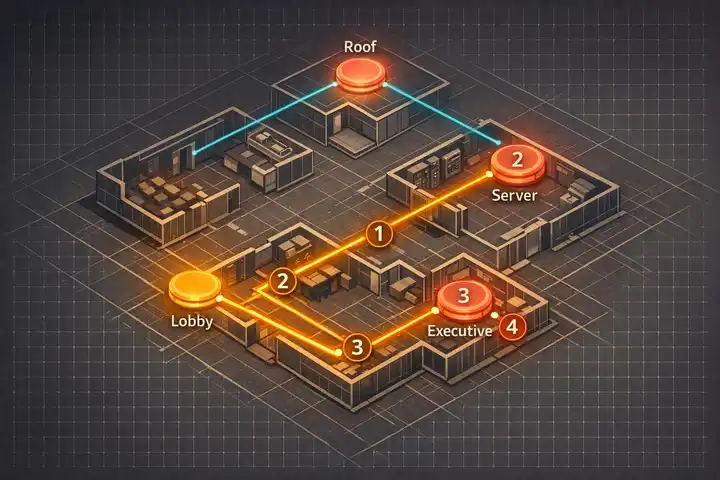
Netrunning in Cyberpunk 2020 is an exciting concept but often disrupts gameplay. It involves hackers (Netrunners) diving into a virtual world (the NET) to bypass security, steal data, and manipulate systems. However, its complex mechanics can sideline other players, with long hacking sequences and intricate setups.
Here’s how to fix it:
- Simplify mechanics: Use linear "floor-based" system structures instead of complex grids. This reduces prep time and keeps gameplay flowing.
- Integrate with group actions: Sync Netrunner turns with the team’s initiative to maintain engagement.
- Use visual aids: Node maps and countdown timers help everyone follow the action.
- Streamline roles and tools: Focus on key programs and reduce unnecessary complexity.
- Adopt community fixes: Popular tweaks like "Fast and Loud" vs. "Slow and Quiet" modes balance tension and pace.
The goal? Keep Netrunning fast, impactful, and connected to the story so everyone stays involved.
Netrunning Tutorial: Part One | Cyberpunk 2020
Netrunning Mechanics Broken Down
This section breaks down the essentials of Netrunning mechanics, making it easier to weave cybernetic heists into a smooth group experience.
The Basics: Gear and Actions
Every Netrunner starts with three key tools: a cyberdeck, interface plugs, and a selection of programs. The cyberdeck serves as the central piece of hardware - a compact device weighing about 1.1 lbs (0.5 kg) - that runs all the software needed for a hack. Interface plugs are neural implants, typically located in the wrists, temples, or the back of the neck, allowing a direct connection between the runner's brain and the deck via cables. For a less invasive option, trodes (electrodes) can be used. While cheaper and safer, trodes sacrifice speed and responsiveness.
When connected, a Netrunner experiences the NET as a fully virtual world where systems are visualized as fortresses, gates, and walls. Actions in this digital realm rely on programs, but the deck's memory (measured in MU) limits how many can be loaded at once. Carefully choosing the right program loadout before a mission is a critical strategic decision.
With the hardware and basics in place, the following rules outline how these tools function during gameplay.
The Rules That Matter Most for Smooth Play
The Interface special ability is the cornerstone of any Netrunner’s effectiveness. This stat directly determines how well they interact with programs during a hack.
To simplify gameplay, it helps to group programs into categories based on their purpose. Here's a quick reference table of common program types:
| Program Type | Examples | What It Does |
|---|---|---|
| Intrusion | Hammer, Worm | Breaks through Data Walls to access systems |
| Decryption | Codecracker, Wizard's Book | Unlocks Code Gates and encrypted files |
| Detection | Watchdog, Bloodhound | Identifies intruders and tracks their movements |
| Anti-System | Flatline, Krash | Disables enemy cyberdecks or causes hardware malfunctions |
| Remote Management | Open Sesame, Hotwire | Controls physical devices like cameras and doors |
| Protection | Shield, Armor | Defends against virtual attacks |
Another key element is ICE (Intrusion Countermeasures Electronics). Standard ICE acts as a barrier, slowing or blocking a Netrunner’s progress. However, Black ICE is far more dangerous, capable of causing severe physical harm, including heart attacks or brain death.
Building a One-Page Quick Reference Sheet
Creating a single reference sheet can save time and reduce confusion during sessions. For players, this sheet should include a list of their loaded programs, each program's Strength (STR) rating, and a short description of its function. Adding a column for any required rolls ensures most scenarios are covered.
Game Masters (GMs) can prepare their own version tailored to the encounter. This might include the system's architecture, such as details about the CPU, RAM, Data Walls, and Code Gates. When both players and GMs come prepared with these tools, Netrunning sequences can flow much more efficiently, keeping the action engaging for everyone involved.
Running Netrunning Without Sidelining the Group
The real challenge with netrunning isn't its complexity - it’s how it can leave the rest of the group waiting around. A single hacking sequence can take 10–15 minutes, making non-hacking players feel disconnected. Let’s explore how to keep everyone engaged while the Netrunner works their magic.
Integrating Netrunning Into the Narrative
A great way to make netrunning more engaging is to tie it directly into the action happening in the physical world. The hack shouldn’t feel isolated. For example, imagine the party is in the middle of a firefight, sneaking through a corporate facility, or pinned down on a rooftop. The Netrunner’s actions - like disabling a turret or unlocking a critical door - can create dramatic, immediate effects that impact everyone.
Adding vivid descriptions of the virtual world also helps keep the table invested. Instead of just asking for a roll, paint a picture: a towering black wall of ICE, a cascade of glowing data streams, or a pulsing red gate blocking access. This turns the hack into a shared story. And if the Netrunner fails a roll? Don’t let it end there. Offer a meaningful choice, like risking exposure for valuable data, to keep the momentum going. These narrative elements naturally sync the Netrunner’s actions with the rest of the team’s activities.
Synchronizing Netrunner Turns
To keep the game flowing, integrate the Netrunner into the same initiative queue as the rest of the group. When their turn comes up, they perform their NET actions just like any other character takes their turn. As R. Talsorian Games explains:
"While a Netrunner's player may make a few more rolls than the other people at the table during their turn, everything resolves quickly and the action moves on to the next person in the Initiative queue."
During their turn, the Netrunner can choose between one Meat Action (like firing a weapon or using a medkit) or their full set of NET Actions, depending on their Interface rank, while still being able to move physically. This approach keeps their turn focused and impactful without dominating the round. Every action carries weight - whether it’s a success or a failure, such as triggering an alarm or locking a door, the whole group feels the consequences. Pairing this with simple node maps makes hacking even smoother.
Using Simple Node Maps to Show Progress
Instead of complex 3D mazes, use linear node diagrams - a series of labeled boxes - to represent challenges like Passwords, Black ICE, and Control Nodes. This visual aid keeps the process clear and easy to follow for everyone at the table.
For more tactical depth, a hub-and-spoke layout can add layers of choice. One branch might lead to critical files, while another could control security systems like turrets. This setup gives the Netrunner meaningful decisions while inviting the rest of the group to stay involved. As RPG author Dennis Laffey puts it:
"The netrun becomes its own adventure, and everyone participates."
To add tension, introduce a visible countdown clock - starting at 20 and ticking down with each failed roll or suspicious action. When it hits zero, the whole group faces consequences, such as corporate security showing up. This shared pressure ensures that every player feels invested in the Netrunner’s progress, reinforcing the idea that their digital actions have real-world stakes.
House Rules and Frameworks That Cut Complexity

Cyberpunk 2020 Netrunning Rules Compared: RAW vs. House Rules vs. Red Framework
Popular Community Fixes for Netrunning
The original Cyberpunk 2020 Netrunning rules (referred to as RAW, or Rules As Written) come with a lot of complexity. Over the years, though, the community has worked hard to simplify and refine these mechanics. The good news? There are some well-tested frameworks you can plug into your game right away.
One of the most effective changes is swapping the traditional 2D/3D grid dungeon for a floor-based architecture. Here’s how it works: each "floor" represents a single obstacle - like a Password, Black ICE, or a locked Control Node - that the Netrunner must overcome with just one check. This streamlined approach was officially introduced in July 2019 by R. Talsorian Games in the Cyberpunk Red Jumpstart Kit. In their playtest scenario, a Netrunner named "Redeye" cracked a password, mapped out a system, and even fired a physical pistol at a guard - all within two combat rounds. This effectively solved the infamous "pizza time" problem, where hacking slowed the game down for everyone else at the table.
Another popular fix is the "Fast and Loud" vs. "Slow and Quiet" framework. If a Netrunner opts to Conceal their actions, they remain undetected but progress more cautiously. However, the moment they trip an alarm, they shift into "Fast and Loud" mode. At this point, the Target Difficulty increases by 1–3 points each turn as the system's security ramps up. This creates a natural sense of escalating tension without needing extra rules.
"Unless the entire game is about hacking, the interesting aspect isn't how the hacking is accomplished but rather what can be done on success and/or how the situation changes on failure." - sptrashcan, RPG Stack Exchange
These fixes lay the groundwork for a smoother experience, but there are additional tweaks to fine-tune the balance.
Modular Rule Tweaks for Balance and Tension
To keep gameplay flowing and maintain tension, a few smaller adjustments can make a big difference. Here are three targeted tweaks that work well at most tables:
- Limit datafortress depth to 3–5 floors for standard encounters. This keeps Netrunning objectives on pace with typical combat encounters.
- Simplify ICE encounters by using just one Black ICE per floor. One opposed check, one outcome - no juggling multiple programs at once.
- Set clear failure consequences. A failed roll should carry weight, whether it triggers an alarm, locks an exit, or forces a "Dumpshock" penalty (leaving the Netrunner dazed for 3d6 minus their Body Type Modifier turns).
These tweaks ensure that every roll matters and that the whole team feels the impact of success or failure, keeping the shared narrative front and center.
For Game Masters looking to simplify further, consider condensing deck stats into just three core values: Speed, Memory, and Data Wall. This reduces bookkeeping while still allowing players to enjoy upgrading their gear.
Comparison of Rules Approaches
| Feature | RAW 2020 Netrunning | Simplified 2020 (House Rules) | Hybrid/Red Framework |
|---|---|---|---|
| Turn Length | 1 second | 3 or 6 seconds | 6 seconds (synced to meat-space) |
| Map Structure | 2D/3D grid dungeons | Linear node path | Vertical "floors" |
| Action Economy | Multiple turns per meat round | 1 command per round | Actions = Interface level |
| Stealth | Complex visibility/detection | "Conceal" vs. "Fast & Loud" | Pathfinding/Backdoor checks |
| Difficulty | Static System Strength | Scaling difficulty (+1–3/turn) | Fixed Target Numbers (DV) |
The RAW rules offer depth but require heavy prep and can slow the game down. Simplified house rules are the easiest to learn and quickest to run. The Hybrid/Red framework strikes a balance, offering enough structure to feel tactical while staying streamlined enough to keep everyone engaged.
Tools and Resources for GMs and Players
Simplified mechanics and streamlined rules make Netrunning more accessible, but the right tools can take it to the next level. These resources help Game Masters (GMs) and players keep the action flowing and the gameplay engaging.
GM Prep Tools for Netrunning Encounters
Preparation is key to running smooth Netrunning scenes. A simple floor-based template can outline obstacles like Passwords, Black ICE, and Files, giving everyone at the table a clear step-by-step path to follow. Setting this up usually takes just 5–10 minutes and ensures sessions run without a hitch.
Digital tools can make this process even easier:
- Chartopia Net Architecture Builder: Quickly generates floor layouts, branching paths, and obstacle details, complete with Difficulty Values, all for free. It’s perfect for creating encounters on the spot.
- Magnus Laser: This free, open-source desktop app includes a floor-based hacking simulator, a GM reference library with 65 corebook tables, and stats for Black ICE.
- Arkenforge: With this tool, you can create animated node maps and export them to virtual tabletops like FoundryVTT or Roll20. It requires a one-time purchase.
A useful tip for GMs is to decide on specific ICE triggers before the session starts. For instance, you could pre-plan that a "Hellhound" Black ICE activates if the Netrunner fails a Password check on a certain floor. This approach keeps rulings consistent and gameplay moving smoothly.
Player Reference Sheets for Netrunners
Nothing slows down a game like flipping through rulebooks mid-session. A Cyberdeck Loadout Sheet can solve this problem by listing the programs currently loaded in the deck, along with their key stats like Strength (Str), Memory Units (MU), and pre-written dice formulas (e.g., Hammer: 1D10 + Interface + 4).
Having a quick Password DV cheat sheet is another time-saver. Password Difficulty Values typically range from DV4 (simple passwords like birthdays) to DV12 (high-end quantum-level encryption). With this info at hand, players can quickly assess challenges and act without delays.
| Interface Rank | NET Actions Per Turn |
|---|---|
| 1–3 | 2 |
| 4–6 | 3 |
| 7–9 | 4 |
| 10 | 5 |
| Source: |
These tools keep gameplay fast-paced while ensuring players stay immersed in the story.
Comparison Table: Prep Tool Options
| Tool | Prep Time | Variety | GM Control | Best Use Case |
|---|---|---|---|---|
| Chartopia | Near instant | High | Low | Quick encounters or minor corporate servers |
| System Templates | 5–10 minutes | Medium | Medium | Standard security for banks or government offices |
| Magnus Laser | Low | High | High | Floor-based hacking with built-in references |
| Arkenforge | High | High | Total | Animated maps for virtual tabletop play (FoundryVTT, Roll20) |
| Custom Builds | 30+ minutes | Infinite | Total | Major "boss" Data Fortresses or plot-critical servers |
"A common complaint about Netrunning in Cyberpunk 2020 was how long it took. It was practically its own game!" - R. Talsorian Games
These tools aim to address that issue, making Netrunning faster and more integrated into the main game. Whether you're looking for quick setups or detailed simulations, there’s an option to match your style so you can focus more on the action and less on setup.
Conclusion: Making Netrunning Work at the Table
Netrunning doesn’t have to be the part of the game where players check out or lose interest. The key is to align the Netrunner’s actions with the rest of the group. By replacing sprawling, overly complex virtual landscapes with a simpler, floor-based structure and incorporating tools like Virtuality Goggles, the Netrunner can stay involved in both the digital and physical aspects of the mission. This approach ensures that every player stays connected to the action.
The core mechanics don’t need to be abandoned. Automating repetitive tasks like looping cameras or unlocking doors, while saving the real challenges for high-security Datafortresses, keeps the pacing tight without losing the tension that defines Cyberpunk. Community-created frameworks, such as Interlock Unlimited, show that hacking rules can be condensed into just two pages, simplifying gameplay while keeping it exciting. As R. Talsorian Games puts it:
"Netrunning in Cyberpunk has been transformed from its own minigame to just part of the flow of a mission." - R. Talsorian Games
Using streamlined prep tools also cuts down on setup time, letting the group focus on the story rather than being bogged down by overly complex mechanics. With these methods, digital heists can be just as gripping and dynamic as the rest of the tabletop experience. A well-synced Netrunning scenario creates those unforgettable Cyberpunk moments that players crave.
FAQs
What’s the easiest way to run Netrunning without pausing the session?
Streamline netrunning by simplifying its mechanics: replace intricate mini-games with one or two critical checks. For routine tasks, consider granting automatic successes to keep things moving smoothly. When it comes to high-stakes hacks, treat them as urgent, time-sensitive missions where the entire team can assist the netrunner. To maintain immersion, describe the virtual environment as an extension of the current scene, blending it seamlessly into the group's shared experience rather than isolating it as a separate activity.
How do I build a quick floor-based NET architecture for a one-shot?
To set up a simple floor-based NET architecture for a one-shot session, think of it as a vertical column with 2–3 levels. Each level represents a "room" containing a single challenge, such as an obstacle, virtual object, or piece of data.
Netrunners will navigate from the top level to the bottom, encountering challenges on each floor. These challenges might include:
- Files: Valuable data or information to extract.
- Passwords: Examples include DV 6 or DV 8 difficulty levels.
- Basic Defensive Programs: Such as Skunk or Wisp, which add a layer of danger or complexity.
The goal is for the netrunner to clear each level's challenge before progressing to the next, creating a straightforward yet engaging structure for quick gameplay.
How can non-Netrunner players stay involved during a hack?
To keep non-Netrunners involved during a hacking sequence, weave their actions into the narrative. They can step up as defenders for the Netrunner, distract enemies to buy time, or dig up critical intel like passwords or system overrides.
Mechanically, they might help by rerouting programs, boosting the Netrunner’s skills, or managing physical dangers such as turrets or guards. Shift the spotlight between the Netrunner and the rest of the team, making the hack feel like a group effort where every contribution matters.


