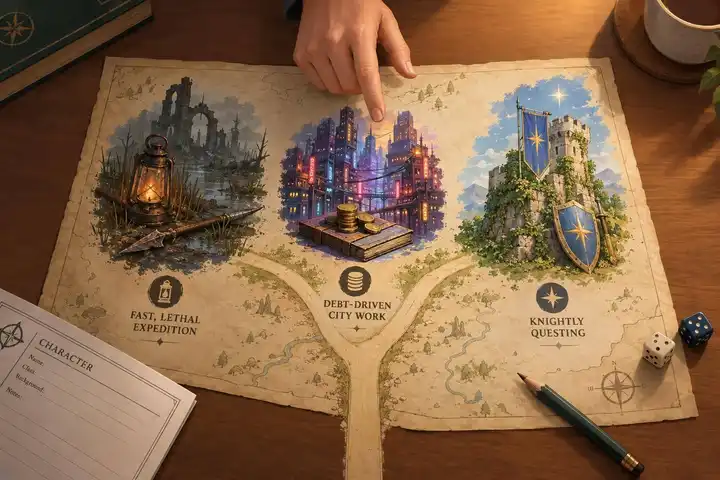
I’d start with Into the Odd for light rules and dangerous expeditions, Electric Bastionland for city jobs and shared debt, or Mythic Bastionland for knightly quests. My first question: What does your group want to spend its sessions doing?
- Into the Odd: Search ruins, find strange artifacts, and get home alive. Fast character creation and a starter adventure make it my default pick for a first session.
- Electric Bastionland: Turn odd past careers into ways to tackle a shared £10,000 debt in the game’s fictional currency. I’d pick it for social problems and city play - and a referee comfortable making things up during play.
- Mythic Bastionland: Choose from 72 Knights, travel a mythic realm, and balance quests with duties. I’d pick it for more combat options, travel rules, and a longer campaign.
Quick Comparison
| Game | Setting and focus | Rules | Referee workload | Campaign fit |
|---|---|---|---|---|
| Into the Odd | Industrial fantasy; ruins and loot | Light; no attack rolls | Prepare sites, hazards, and rewards | One-shots or linked expeditions |
| Electric Bastionland | Strange city; careers and debt | Light; career-led problem-solving | Connect jobs, factions, and creditors | City-based campaigns |
| Mythic Bastionland | Mythic realm; knights and quests | More travel and combat procedures | Track journeys, duties, and realm changes | Longer campaigns |
My tie-breaker: choose the activity your players want, not just the lightest rules. If you’re unsure, try one expedition, debt-driven job, or local knightly quest before committing.

Which Bastionland Game Should You Start With?
Electric Bastionland Review,Weird Fantasy at Its Best
Into the Odd: Industrial-Fantasy Expeditions
Compared with the other Bastionland games, Into the Odd puts the expedition first: explore, survive, and bring back treasure. Bastion serves as your home base for supplies and recovery. The Underground and Deep Country send you into dangerous ruins, where strange machinery and Arcana await. Finding loot is only half the job - you still have to get it home.
Character Rolls and Dangerous Combat
Roll 3d6 for Strength, Dexterity, and Willpower, then 1d6 for Hit Protection. Your highest ability and Hit Protection determine your starting gear. There are no classes or skill trees. To make a save, roll a d20 equal to or below the relevant ability. A natural 1 succeeds; a natural 20 fails.
Combat is fast and lethal. There is no attack roll. Roll weapon damage, subtract Armor, and apply what’s left to Hit Protection first, then Strength. A failed Strength save can lead to critical damage. A short rest restores Hit Protection, but ability damage takes longer to recover. Your judgment matters more than build choices - and sometimes the best choice is not to fight.
Location-Based Campaigns and Referee Prep
Simple rules put more of the work on the referee. Prepare a site, not a plot. Map its areas, inhabitants, hazards, rewards, and exits. For a first site, aim for six to ten meaningful areas, one hazard tied to the surroundings, and two rival factions. The referee makes clear rulings, makes danger visible, and calls for saves only when the risk matters. This approach works well for one-shots and rotating parties.
Electric Bastionland: Failed Careers and Urban Debt
Where Into the Odd sends players into ruins, Electric Bastionland brings the same rules engine to Bastion’s streets. The city’s oddball characters begin as treasure hunters trying to pay off a shared fictional £10,000 debt. Tie the debt holder to the youngest player’s character’s Failed Career. That gives the party a reason to work together and links its money troubles to Bastion’s people and institutions.
Failed Careers and Simple Rules
Players roll 3d6 for Strength, Dexterity, and Charisma to help determine their character’s Failed Career. More than 100 careers replace standard classes, giving characters histories, equipment, connections, and complications instead.
The game keeps Into the Odd’s lean core. Most of the learning comes from figuring out how to use a character’s career and gear. Light rules don’t mean passive play: players still need to ask questions and make plans.
The official 42-page free edition includes the core rules, equipment lists, and 10 Failed Careers for a one-session trial. Those careers and connections make the city itself as important as any dungeon.
City Campaigns and Referee Improvisation
Bastion’s shifting districts, odd jobs, rival factions, and social problems fuel darkly comic adventures built around problems to solve. For the first session, prepare one source of debt pressure, three locations, three factions, one discovery, and two consequences. Link these pieces through the characters’ careers and random details rather than scripting how things will end.
The later comparison section weighs these demands on referee improvisation against the other games’ campaign structures.
Mythic Bastionland: Knights and Quests
Mythic Bastionland is the Arthurian Bastionland game for groups who want a longer-running campaign. Knights travel a mythic realm, pursue quests, and work toward rulership, with rules for travel, knightly combat, aging, and succession. These give Mythic the strongest campaign structure among the Bastionland games.
Knight Creation, Travel, and Combat
Choose or generate one of 72 Knights, each with equipment, a signature ability, and a Passion. Your core Virtues are Vigor, Clarity, and Spirit.
Combat is direct. Armor reduces damage, while Guard absorbs hits before Vigor. Lose half or more of your remaining Vigor, and you suffer a mortal wound. Gambits let you break shields or pull enemies from their mounts.
Travel across a hex map reveals Myths and connects your journeys to courts, rival Knights, and legendary sites. Earn Glory, and you may take on the City Quest: a search for the City seen in dreams.
Knightly Commitments and Running the Realm
In Mythic, oaths, relationships, passions, and ambitions matter as much as survival. Before play, define someone or something to protect, a troublesome promise, and a long-term ambition. Acting on a Passion can restore Spirit.
The referee runs a changing realm, not a series of isolated expeditions. Start with a hex map, a seat of power, several holdings, and Myth-marked locations. Then track what happens when threats go ignored. The tradeoff is a greater campaign commitment from both players and referee.
Compare Rules, Player Demands, and Campaign Styles
Match the rules to your play style. These games share a lean core, but where you start depends on the atmosphere, complexity, and campaign structure your group prefers.
This table compares each game’s rules, player activities, and referee workload.
| Category | Into the Odd | Electric Bastionland | Mythic Bastionland |
|---|---|---|---|
| Atmosphere | Industrial expedition | Urban improvisation | Knightly questing |
| Campaign focus | Explore sites and recover loot | Take jobs to address shared debt | Pursue quests and serve a living realm |
| Rules demands | Lean saves and direct damage | Similar core; careers add fictional capabilities | More travel and combat procedures; Passions and feats drive play |
| What players do most | Investigate, use equipment, and judge risk | Turn careers and relationships into opportunities | Balance quests, ambitions, and duties |
| What the referee tracks | Routes, hazards, discoveries, and resources | Connected factions, jobs, creditors, and consequences | Travel, Myths, relationships, and realm pressures |
| What carries forward | Explored locations and discoveries | Debt and city relationships | Oaths, reputation, and realm responsibilities |
| Group preference | Discovery with little character upkeep | Social improvisation backed by shared debt | A defined heroic role with lasting obligations |
The next table puts those differences in terms of group fit - why you might start with each game and where players or referees might struggle.
| Game | Why start here | Potential friction |
|---|---|---|
| Into the Odd | Fast-start expeditions built around dangerous discovery | Random characters and open-ended exploration may frustrate players who want customization or a scripted plot |
| Electric Bastionland | Strong city hooks and a clear reason to take jobs | Players need to improvise with unusual careers, while referees must keep urban connections active |
| Mythic Bastionland | Knightly quests that can grow into court or domain play | A fixed knightly premise and more lasting obligations to track |
To test the fit, run one introductory session: an expedition, a debt-driven score, or a local quest with a return journey. Afterward, ask what the group wanted most: dangerous discovery, urban pressure, or knightly duty. Use the strongest response as your tie-breaker.
Conclusion: Choose What Your Group Wants to Do
With setting, rules, and campaign demands compared, the choice comes down to what your group wants: expeditions, city improvisation, or knightly duty.
Into the Odd offers the simplest start, with quick character creation and deadly industrial-fantasy exploration.
Electric Bastionland puts character hooks first. Failed Careers give each character a strong identity, while shared debt drives city play. Pick it for urban improvisation.
Mythic Bastionland fits groups looking for knightly growth, recurring NPCs, political consequences, and longer story arcs built around quests and obligations.
Let atmosphere and campaign structure guide your choice - not small differences in the rules.
FAQs
Can I move characters between these three games?
Yes. Into the Odd, Electric Bastionland, and Mythic Bastionland are highly compatible. They share a design philosophy and a simple set of core mechanics, so you can convert characters and gear - and borrow concepts - across all three games.
The New School Revolution (NSR) community encourages this do-it-yourself approach. Players and referees can mix elements, borrow mechanics, and adjust the rules to fit their group.
Which game is easiest for a first-time referee?
Into the Odd is the easiest starting point for a first-time referee. Its stripped-down rules, simple d20 roll-under system, and automatic damage keep the focus on exploration and storytelling - not complex mechanics.
Electric Bastionland is beginner-friendly, too, but its expanded systems make Into the Odd the simpler entry point.
How does character advancement differ between the games?
In Into the Odd, characters level up mainly by completing successful expeditions. Electric Bastionland makes scars a core advancement mechanic, turning near-death experiences into chances to grow. Mythic Bastionland ties progress to achievements and experiences earned on knightly quests.
Across all three games, growth centers on gear, story choices, and adventure outcomes - not complex skill trees or abstract point-tracking.


