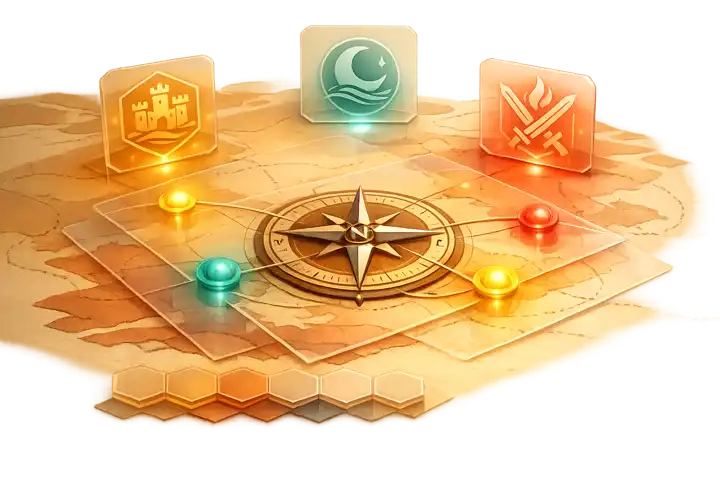
Sandbox campaigns let players shape the story, offering freedom to explore a dynamic world. Unlike linear campaigns with fixed paths, sandbox games rely on player decisions to drive the plot. This approach uses open-ended objectives - problems with no set solutions - allowing creativity and choice. For example, players might choose between investigating a missing caravan, mediating guild conflicts, or tackling a lurking sewer creature, each with unique consequences.
Key strategies for sandbox campaigns:
- Limit active objectives to 3–5 to avoid overwhelming players.
- Design maps with layered regions and evolving events.
- Use factions and timed events to create ongoing challenges.
- Tie objectives to players' backstories for emotional investment.
- Prepare modular content for improvisation when players go off-script.
The balance lies in providing structure without railroading, ensuring the world feels alive and reactive to choices. By focusing on dynamic systems, GMs can create campaigns that remain engaging over long-term play.

Key Strategies for Running Successful Sandbox TTRPG Campaigns
What Open-Ended Objectives Are and Why They Matter
Defining Open-Ended Objectives
Open-ended objectives are challenges presented by the Game Master (GM) with no predetermined solutions. Instead, they encourage players to use their creativity, resources, and character skills to find their own way forward.
"The Game Master didn't have a particular solution in mind but instead just built a situation and intends to just sit back and watch the players create their own solutions." - The Angry GM
Think of these objectives as a web of interconnected problems. Players decide when and how to engage with each issue, effectively shaping the direction of the campaign. For instance, the GM might present three active situations: a missing merchant caravan, rising tensions between two guilds, and rumors of a mysterious creature in the sewers. The players decide which to address first, which to ignore, and which to revisit later.
To keep the game manageable and avoid overwhelming players with too many options, many GMs limit the number of active objectives to three to five at a time. This balance ensures that decisions remain meaningful without leading to "analysis paralysis."
Now, let’s explore how this approach differs from traditional linear quests.
How They Differ from Linear Quest Structures
Linear objectives guide players through a set sequence of events, with the GM pre-planning the narrative flow. In these campaigns, player choices may influence the tone or tactical outcomes, but the overall path is fixed. Open-ended objectives, on the other hand, are rooted in situation-based design. Players interact with a dynamic world filled with evolving factions, NPC motivations, and problems that shift based on their actions - or inaction.
The preparation process is another key distinction. Linear campaigns require detailed planning of specific scenes and dialogue, while open-ended campaigns involve creating systems like faction politics, resource dynamics, and NPC agendas that evolve independently of the players. If players ignore an objective in an open-ended campaign, it doesn’t disappear - it develops, often with consequences that ripple across the game world.
To help players navigate these choices, GMs often use "cost tags" to provide context. These tags estimate factors like time and risk (e.g., "two days of travel and a likely hard fight"). This approach allows players to weigh their options without feeling directed. Many GMs also end sessions by asking players what they plan to do next. This gives the GM time to prepare for the next session without needing to map out the entire world in advance.
How to Create a Sandbox Campaign
Building a World That Enables Open-Ended Objectives
A sandbox world feels alive when it evolves on its own, driven by conflicts, factions, and challenges that unfold independently of the players. These elements give players real choices, shaping your campaign's narrative as it develops. The world should feel like it exists beyond the players' actions, with ongoing events, rivalries, and problems that continue whether or not the party intervenes.
Creating Maps That Encourage Exploration
A good sandbox map uses a layered approach - world, region, hub, and dungeon maps - allowing you to focus on immediate areas while keeping distant regions open for future development.
Start with the immediate region: one town, a nearby landmark, and a few key rumors. This keeps your preparation focused on where players are likely to engage first. As players make choices, expand the map outward based on their direction. For unexplored areas, leave room for flexibility, so you can adapt as the story progresses.
"Conflict arises from the friction of motivations, so don't design a world map that fundamentally diminishes the possible conflicts in your story."
– Rokas Malinauskas, Dungeon Goblin
Geography itself can spark adventures. Avoid isolating cultures or kingdoms - place competing factions close enough that their motivations naturally clash. For example, a border town between rival kingdoms creates instant narrative tension. Use your world’s theme to shape the physical layout: fractured islands work well for a theme of "isolation", while concentric defensive walls around a hive city build tension for "creeping chaos".
Attach travel times and danger levels to locations so players can make informed decisions without you needing to over-plan. Keep your map dynamic - if players ignore a quest, show the consequences. A village could be overrun by monsters, or a trade route might shut down.
As players make choices, the evolving map can open up new opportunities, keeping the world engaging and unpredictable.
Writing Quest Hooks That Adapt to Players
The best quest hooks aren’t rigid storylines - they’re flexible situations that allow players to approach them in different ways. Instead of scripting "the players will rescue the merchant and fight the bandits", design a scenario like "a bandit-occupied temple", which works no matter how the players decide to handle it.
"The trick to a sandbox is that you don't prep plots: You prep situations."
– Justin Alexander, Author and Game Master
To create hooks, include four essential elements: the situation, the stakes, the first actionable step, and a cost tag (time and danger). For example: "Smoke rises from the west road (situation). A vital trade route is at risk (stakes). Investigate the source of the smoke (action). Half-day ride; unknown high danger (cost)."
During Session Zero, have players create one or two NPCs their characters care about. Connect these NPCs to other players’ characters to build a web of relationships. Players are more likely to follow hooks that involve people they care about rather than abstract objectives.
"The most important thing to defeat choice paralysis is that the setting is thick with people they love and care about."
– Matt Balogh, Professional Game Master
Design hooks so player actions naturally lead to new opportunities. For instance, offending a noble house while solving one problem might attract the interest of a rival house offering an alliance. At the end of each session, ask players what they plan to do next. This helps you focus your preparation on the areas they’ll explore rather than mapping out the entire world. Combining thoughtful mapping with adaptive hooks ensures players stay engaged through meaningful choices without losing the structure they need to navigate the world.
Adding Factions, Events, and World Changes
Factions, timed events, and world changes breathe life into a sandbox setting, turning it into a dynamic, ever-evolving world. These elements give the game its own momentum - conflicts intensify, opportunities fade, and new challenges emerge, regardless of whether players intervene. The key is to design these systems to evolve independently while still reacting meaningfully to player decisions.
Using Factions to Create Player Opportunities
Factions are a powerful tool to keep a sandbox campaign feeling fresh and engaging. Each faction should have its own clear agenda - like a thieves' guild expanding its influence, a temple rallying for a crusade, or a rival adventuring party stealing the spotlight by undercutting prices. These agendas naturally create opportunities for players to interact, whether by supporting, opposing, or exploiting these groups.
"The thieves' guild expands. The temple launches a crusade. The rival party undercuts prices and steals glory."
– Alexander Cosic, TTRPG Author and Worldbuilder
Factions should also respond dynamically to the players' actions. For example, humiliating a gang might provoke retaliation, while saving a village could earn the party a hero's welcome. Simple tools like escalation tracks - 3 to 5-step progress clocks - help factions advance their goals even when players aren't directly involved. If players ignore a smuggling ring, for instance, the faction could eventually dominate the local black market, creating new challenges and storylines.
Adding Timed Events and Their Consequences
Timed events push the story forward and remind players that the world doesn't revolve around them. These events add urgency, showing that delays have consequences. They generally fall into three categories:
- Worsening: A killer who initially targets drunks may escalate to high-profile city officials.
- Expiring: A royal invitation might lose its relevance once the event has passed.
- Transforming: Failing to protect a caravan could lead to market shortages, creating new opportunities for the party to exploit.
"This is not punishment. It is the difference between a living setting and a theme park ride that waits politely."
– Alexander Cosic, TTRPG Author and Worldbuilder
Introduce these evolving circumstances through in-game channels like town criers, broadsheets, or visible signs such as smoke on the horizon or displaced refugees. To avoid overwhelming players, keep around 3–5 active hooks at any given time. As one event resolves or expires, bring in a new opportunity tied to faction agendas or player choices.
Showing How the World Changes Over Time
The interplay between factions and timed events creates ripple effects that visibly alter the campaign world. These changes demonstrate that player actions - or inaction - have lasting consequences. A saved village might thrive and reopen trade routes, while a neglected minor threat could escalate into a full-blown crisis, like a demon portal threatening the region.
Social dynamics also shift as the world reacts to the party's reputation. NPCs may offer discounts, share critical information, or even refuse service based on how they perceive the group. These tangible changes reinforce the idea that the players' decisions leave a permanent mark on the world.
Balancing Player Freedom with Story Structure
Finding the right balance between player freedom and a structured story is at the heart of creating a great sandbox experience. Lean too heavily on structure, and it can feel like players are being railroaded. On the other hand, too much freedom can leave them feeling lost. The trick is to design systems that subtly guide players toward meaningful decisions without dictating their choices.
Guiding Players Without Forcing Choices
Open-ended gameplay doesn’t mean abandoning structure altogether. A few thoughtful strategies can keep players engaged without making them feel boxed in.
One effective approach is to maintain three to five active leads for players to explore. This keeps options manageable and avoids overwhelming them with too many choices. Each lead should clearly outline the stakes, provide a concrete next step, and include a "cost tag" - details like how much time it will take or the level of danger involved. For instance, saying, "Investigating the missing caravan will take two days and involves a hard fight", gives players the tools to make informed decisions about their next move.
"The issue is not 'too many choices' in the abstract. It is too many active leads with unclear costs." - Alexander Cosic, Author
Session debriefs are another valuable tool. Use these moments to adjust hooks based on player actions. For example, once a lead is resolved or ignored, it can evolve into something new or move to a "dormant" state. A mystery like strange lights in the forest could eventually escalate into a demon attack, creating natural consequences without locking players into a fixed path.
Connecting Character Backstories to the World
While clear leads guide external decisions, tying the story to the players' personal stakes helps shape their internal motivations.
Personal connections are a powerful way to ground players in the world. Strengthen character backstories by linking important NPCs to both the players' personal narratives and larger world events. This creates emotional ties that naturally influence player decisions and deepen their engagement with the setting.
"The most important thing to defeat choice paralysis is that the setting is thick with people they love and care about." - Matt Balogh, Pro GM
Handling Improvisation and Unexpected Player Actions
Players have an uncanny knack for throwing curveballs. The trick to managing these surprises isn’t about predicting every move - it’s about creating a game world that’s flexible enough to adapt while staying immersive and consistent.
Preparing Modular Content You Can Use on the Fly
Improvisation starts long before the players sit down at the table. Having modular, pre-prepared content at your fingertips can make all the difference. For instance, keep a stash of resources like “One Page Dungeons” or “5 Room Dungeons” handy for those times when players decide to veer off into uncharted territory. Use the MAP Method to quickly generate NPCs, and maintain a list of names from diverse backgrounds for smooth introductions when new characters pop up unexpectedly.
It’s important to remember that you’re not creating the world in real-time - you’re revealing it. The groundwork you’ve laid during Session 0, such as outlining the world’s history and defining key villains, provides the framework for improvisation. As Andrew (Lord High PigMonkey), a professional improviser and GM, explains:
"Improvisation is about practice. People seem to think Improv is just making it up on the spot. This is not true."
Having modular content ready to go not only saves you time but also helps you seamlessly adapt to the unexpected twists your players might throw your way.
Letting Player Choices Drive the Story
Once you’ve got your modular prep in place, let the players’ decisions shape the direction of the campaign. When they come up with a plan you didn’t see coming, treat it as an opportunity rather than a roadblock. You can even put one of your preplanned story hooks on hold to make room for their new ideas, ensuring the narrative stays organized.
Every improvised addition to your game becomes part of its permanent lore, so maintaining consistency is essential for keeping the world believable.
Also, remember that the world doesn’t stop moving just because the players shift their focus. If they ignore a prewritten hook to pursue their own path, let the consequences of that choice unfold naturally. Maybe the bandits they avoided attack a nearby village, or the disappearance of a merchant caravan causes a spike in local prices. This approach keeps the setting dynamic and alive while rewarding player creativity without punishing their choices.
Conclusion
Creating open-ended objectives is all about designing systems that naturally adapt to player decisions while maintaining a smooth game flow. Instead of scripting every scene or trying to predict every player action, focus on crafting mechanics that respond organically to their choices. As Alexander Cosic, TTRPG Writer, explains:
"The GM's job is not to delete options from the world. The job is to manage visibility and urgency so the table always has a clear next step without being railroaded".
The key is to highlight possibilities without narrowing the players' freedom. Keep 3 to 5 active hooks available at all times, clarify the tradeoffs between objectives using cost tags, and let the world evolve based on player decisions - or their inaction. For example, if players ignore a growing threat, escalate it. If they take an unexpected route, let their actions shape the campaign in surprising ways. Matt Balogh, Pro GM, offers this advice:
"The most important thing to defeat choice paralysis is that the setting is thick with people they love and care about".
To bring these concepts to life, create a web of meaningful relationships that provide players with an emotional anchor. Introduce faction dynamics and timed events to demonstrate that the world moves forward regardless of their actions. This kind of adaptive design keeps your sandbox unpredictable while ensuring it remains engaging and immersive.
For game systems that align with this style, the TTRPG Games Directory is a great resource. It features a wide range of tabletop RPGs across genres, from OSR games like Old School Essentials, designed for sandbox exploration, to systems that emphasize player-driven narratives and emergent storytelling. The directory offers detailed insights into mechanics and themes, helping you find the perfect match for your group.
Over the course of 30 to 100 sessions - spanning 1 to 3 years - your sandbox campaign will take on a life of its own. By leaning into unpredictability, each session becomes a unique and memorable chapter in your shared story.
FAQs
How do I keep a sandbox from feeling aimless?
To keep a sandbox campaign from feeling aimless, it’s important to make every choice matter. Highlight the tradeoffs players face - like the time or resources they might lose by chasing a particular lead. This adds weight to their decisions and creates a sense of purpose.
Balance freedom with structure by introducing clear consequences for actions. Manage active leads carefully, ensuring risks and rewards are well-defined. Keep the game moving by offering a steady flow of narrative hooks to maintain engagement while still embracing the open-ended nature of the sandbox.
What should I do if players ignore a major hook?
When running sandbox campaigns, it's smart to have multiple hooks ready, along with fallback options, to keep the gameplay flowing smoothly. Design scenarios with various potential leads and give players the freedom to explore at their own pace. If they miss a major hook, you can rely on default actions like spreading rumors or using environmental cues to draw their attention and keep them engaged. This way, the story remains active and adaptable without pushing players down a rigid path.
How can I improvise without breaking consistency?
To keep your improvisation consistent, lean on your world’s core themes, major factions, and key locations as your anchor. When players take unexpected actions, integrate their choices into this framework by adding creative twists that still align with the established logic of the world. Make sure the pacing stays steady and that the consequences of their actions are clear - this keeps their decisions impactful. By doing this, you can stay flexible and spontaneous without losing the structure that holds your story together.


