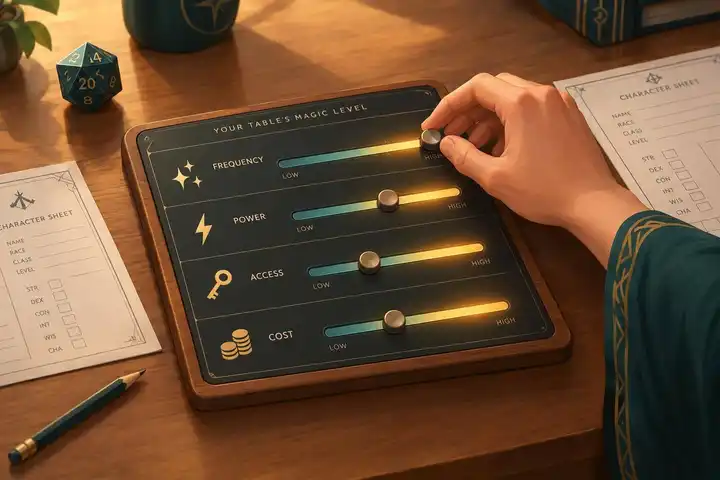
I’d choose your table’s magic level before anyone builds a character. Low-magic play puts more weight on tools, supplies, and planning. High-magic play gives spells a larger role in combat, travel, and daily life - but doesn’t have to give players unlimited access.
My starting point is 4 questions: How common is magic? How powerful is it? Who can use it? What does it cost? Fantasy labels alone won’t answer those questions: an invented world can still have rare spellcasters.
Quick Comparison
| What I’d compare | Low-magic play | High-magic play |
|---|---|---|
| Frequency and power | Rare effects; major magic stands out | Routine effects; major magic may shape society |
| Access and cost | Few casters, scarce items, costly services | More casters, items, and services; limits still apply |
| Combat and healing | Weapons, positioning, and recovery matter more | Spells add options and can shorten recovery |
| Travel and investigation | Supplies, tools, and clues take center stage | Flight, teleportation, and divination change the obstacles |
| Character choices | Some caster options may be restricted | More magical options fit the setting |
I’d use those answers to choose restrained, selective, or abundant magic, then write a one-page agreement covering character options, items, healing, resurrection, and travel. That gives your group a clear basis for choosing rules - and lets players know what to expect.

Low vs High Magic TTRPGs: Set Your Table’s Magic Level
High Magic vs Low Magic Settings
Low-Fantasy Play: Rare Magic with a Cost
In low fantasy, magic may be dangerous, feared, or controlled by temples and guilds. Practical goals, grounded heroes, and lasting consequences suit this style. But rare magic doesn't have to mean a grim tone or weak characters.
Spellcaster Limits, Casting Costs, and Rare Items
Set spellcaster limits before character creation. Agree on which classes are available, what training they need, and whether advanced effects belong only to powerful nonplayer characters (NPCs). Make it clear whether noncasters can use scrolls, potions, rituals, or relics.
Give casting predictable costs, such as scarce spell slots, consumed components, preparation time, or legal penalties. Corruption, injury, and exhaustion can fit harsher campaigns, but players should agree to them - not discover them through surprise penalties.
Keep basic class abilities reliable while making extraordinary effects harder to access. Favor useful mundane equipment, named relics, and single-use magical objects over routine enchanted upgrades.
Combat, Travel, and Nonmagical Skills
When magic is limited, planning, terrain, and logistics carry more weight. Weapons, positioning, cover, and scouting matter more in combat. Maps, supplies, weather, and travel time shape expeditions, while locks, witness accounts, and records give players reasons to use tools and investigate.
Let mundane expertise solve problems. Give martial abilities, professions, contacts, alchemy, and preparation a clear role alongside approved spells. If healing is scarce, offer access to medicine and recovery instead of simply making every fight more punishing.
Magic's Limits in Everyday Life
Treat these as adjustable defaults, not universal bans. The table shows how scarce magic can shape adventures and daily life. Keep costs visible so players can plan.
| Effect | Suggested low-fantasy availability | Cost or access requirement | Narrative consequence |
|---|---|---|---|
| Healing | Herbs, potions, and limited healing magic; fast recovery stays rare. | Rare ingredients, skilled healers, spell slots, or several days of care | Wounds, downtime, and medical expertise still matter |
| Resurrection | Legendary, forbidden, or unavailable except through a major quest. | A one-of-a-kind relic, powerful patron, a life-for-life bargain, or permanent sacrifice | Death has lasting weight, and returning characters may be changed |
| Teleportation | Restricted to known sites, ancient gates, or a few powerful NPCs. | Rare components, dangerous routes, or a sanctioned circle | Geography, roads, borders, and travel time still matter |
| Divination | Possible but incomplete, symbolic, or hard to verify. | Ritual time, offerings, specialized tools, or risk of detection | Investigation yields clues rather than automatic answers |
| Flight | Temporary, item-based, hazardous, or limited to rare specialists. | Potions, concentration, weather limits, or a fragile relic | Fortifications and terrain matter, while aerial access stays rare |
| Magical weapons | Named relics and a few specialized weapons; routine magical upgrades are rare. | Discovery, attunement, a service owed, or a costly repair | Mundane weapons remain useful, and each relic can shape the story |
| Communication | Messengers, letters, and signal systems dominate; magical messages are scarce. | Trained operators, charges, expensive components, or risk of interception | Distance, secrecy, and delays create plot opportunities |
High-Fantasy Play: Other Worlds and Magic
Low fantasy keeps magic scarce. High fantasy weaves it into society. It takes place in an invented world where magic is common enough to shape customs, conflict, and daily life. The question isn’t whether magic exists, but how common, powerful, accessible, and costly it is.
Even abundant magic needs rules: who can learn it, how it works, and what using it costs.
Spell Access, Powerful Rituals, and Magic Items
Academies teach spells, temples require vows, bloodlines pass down abilities, and guilds license professionals. Keep everyday magical services separate from powerful rituals that require several casters, rare materials, or special dates.
If character progression assumes enchanted gear, give players a reliable way to get it - through shops, crafting, inheritance, or quests.
Magic in Combat, Exploration, and Daily Life
Broad access to magic changes medicine, transportation, trade, diplomacy, and law. In combat, area spells, flight, teleportation, and battlefield control alter where characters stand and which objectives matter. Let magical solutions work.
During exploration, extradimensional storage, translation, divination, survival spells, and supernatural navigation move the focus beyond basic obstacles. The challenges become unfamiliar destinations, hidden motives, and competing goals.
Magical subclasses, unusual ancestries, familiars, artifacts, organizations, and approved custom spells give players more character choices. But a world full of magic doesn’t give every character every tool.
A Magic-Rich World Does Not Mean Unlimited Access
Magic can be common in the world without being freely available to players.
For example, teleportation circle is a 5th-level spell requiring 50 gp in consumed materials per casting; creating a permanent circle requires daily casting for one year.
Those rules allow magical transportation to exist without letting beginning characters build it themselves.
| Magic factor | Magic-rich world, limited player access | Unrestricted player access |
|---|---|---|
| Public infrastructure | Guild-operated teleportation gates work even though beginning characters cannot cast teleportation circle. | Characters can create or use equivalent infrastructure whenever the rules allow. |
| Spellcaster numbers | Visible professionals meet civic, religious, and commercial needs. | Spellcasting is broadly available across the population or to nearly every player character. |
| Nonplayer magic strength | Institutional rituals can exceed beginning characters’ abilities. | Players can readily access comparable effects. |
| Player spells | Class, level, training, and components determine access. | Broad spell access has few campaign-specific restrictions. |
| Items | Utility items are sold; powerful artifacts require quests or approval. | Powerful equipment is routinely purchased, crafted, or commissioned. |
| Other limits | Finances, licenses, destinations, and milestones control access. | Access depends mainly on the game’s normal rules and available money. |
Low vs High Magic: How Play Changes
Once you’ve set the magic level, look at what the rules let characters do, not just the setting’s label. Neither approach is better. Each asks different things of players and the GM.
The same world can play very differently depending on how magic affects combat, travel, and problem-solving. Frequency, power, access, and cost all shape that experience.
| Play area | Restrained magic: benefit / tradeoff | Abundant magic: benefit / tradeoff |
|---|---|---|
| Combat | Positioning and weapons stay central / healing may take longer. | More tactical choices / characters may bypass planned threats. |
| Exploration | Navigation, tools, and survival matter / travel takes more table time. | More routes and faster travel / terrain alone presents fewer challenges. |
| Character building | Nonmagical specialists have clear roles / caster concepts may face limits. | More magical concepts fit / spell and item choices add rules to learn. |
| Pacing | Setbacks carry weight / recovery may require downtime. | Faster movement between crises / small obstacles matter less. |
| World design and challenges | Magic stays mysterious / rare powers still need clear boundaries. | Magical institutions shape society / prep must account for more abilities, who gets magic, who controls it, and what it costs. |
How Common, Powerful, Accessible, and Costly Is Magic?
Treat frequency, power, access, and cost as separate dials. They don’t all have to sit at the same level.
| Variable | Restrained magic | Abundant magic |
|---|---|---|
| Frequency | Supernatural encounters and magic items are rare. | Magical creatures, effects, and objects appear routinely. |
| Power | Effects usually affect one scene: light, a roll, or a wound. | Effects may change battles, regions, or kingdoms. |
| Accessibility | Few characters can learn magic; buying services means finding specialists. | More characters can learn or buy magic, though access can still differ for players and NPCs. |
| Cost | Money, materials, time, risk, exhaustion, or permanent consequences make casting a serious choice. | Costs are predictable enough to plan around, though major effects can still be expensive or dangerous. |
These differences matter most when the party turns to magic rather than force to solve a problem.
Designing Challenges Around Magical Solutions
Healing changes attrition; resurrection changes death. Set their limits before they come into play, and apply those limits consistently to characters, allies, and villains.
With restrained magic, physical barriers matter - but a single spell can still overturn the plan. Abundant magic puts more pressure on timing, objectives, and counterplay.
Flight and teleportation change how characters move. Keep physical, social, and magical routes available, and follow the chosen rules. Establish wards beforehand, not the moment a player casts a useful spell.
Divination shifts mysteries from finding information to interpreting it and deciding what to do next. Don’t put the whole mystery behind one clue. Keep interviews, evidence, and local knowledge useful without weakening the spell’s stated result. When an ability solves an obstacle, let it work - and follow the consequences.
Choosing Your Table's Magic Level
Turn those dials into table rules before character creation. A high-fantasy world can still make spellcasting rare, while a familiar setting can put supernatural services within easy reach.
Agree on Tone, Access, and Challenges
At Session Zero, decide how ordinary people view magic: terrifying, unusual, professional, or routine. Discuss whether nonmagical solutions should solve most problems and whether roads, weather, and supplies should shape travel. Set these expectations before players create characters.
Then agree on access: who can play a spellcaster, how characters get healing and resurrection, and whether enchanted items are rewards, purchases, or expected equipment. Keep institutional powers separate from player options, and spell out who grants access and what it costs. Record these rules in a campaign agreement.
Choose Restrained, Selective, or Abundant Magic
Start with one of these profiles, then adjust individual elements to fit your table.
| Profile | Spellcaster availability | Magic-item frequency | Costs and services | Typical magical solutions |
|---|---|---|---|---|
| Restrained | Rare in communities and among player characters | Scarce story rewards | Expensive effects; mostly mundane services | Special tools; skills and preparation handle most problems |
| Selective | Familiar magic; few trained casters | Occasional and costly | Specialists or institutions offer limited services | Shortcuts that require resources, preparation, or permission |
| Abundant | Common casters; reliable specialists | Frequent; enchanted gear may be expected | Dependable daily services; major effects may still cost plenty | Routine solutions; challenges account for available powers |
Write Down the Agreement and Choose a Game
Once you've set the profile, put the agreement in writing and match it to your game.
Keep a one-page campaign agreement that covers permitted character options, spell limits and costs, item rewards, public services, and travel assumptions. Plan to review it after the first few sessions. Compare game descriptions by their mechanics, themes, and character options - not fantasy labels alone. Check that healing, advancement, and equipment rules fit both the setting and the access you've agreed to give players.
FAQs
Can we change magic levels mid-campaign?
Yes, you can adjust magic levels during a campaign to maintain balance and keep players engaged. Tie those changes to the story: disruptions might temporarily suppress enchantments, curses could weaken items, or certain areas could make specific types of magic stronger or weaker.
You can also reveal item abilities over time or use built-in drawbacks. These story and rules adjustments help maintain the game’s balance and tone without taking choices away from players.
How can we limit magic without weakening spellcasters?
Rather than removing spells or limiting access, give magic risks and story consequences. Mishap or corruption tables can make casting dangerous. Spellburn lets casters trade health or resources for powerful magic - but that power comes at a personal cost.
Treat magic as leverage or an event tied to a specific scene, not an everyday convenience. Players then have to decide when using their power is worth the risk.
How do we keep noncasters useful in high-magic play?
Give noncasters chances to shine through clever ideas, tactical support, and cinematic action. Specific martial maneuvers can let them pull off feats that rival magic’s impact. Reward political influence, secret knowledge, and reputation so progression matters without relying on magic.
Build encounters around problem-solving, hazards in the surroundings, and careful planning - not just encounter budgets. Give every character a meaningful role in the party’s success.


