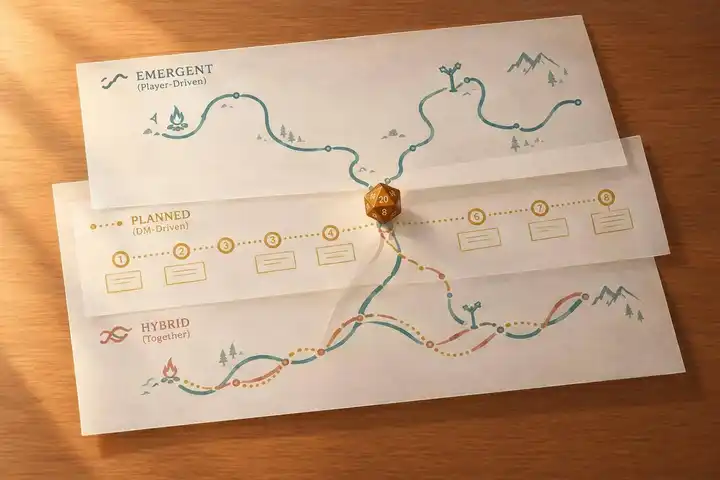
I’d choose based on how your group wants to play: discover the story together, follow prepared beats, or mix both. For a 2–3-hour session, start with one clear objective, two possible complications, and room for players to change the outcome.
Here’s what I compare: prep time, improvisation, player freedom, GM control, pacing, clues, unexpected choices, and tracking changes between sessions. More planning doesn’t have to mean less freedom. My test is simple: <u>Can player choices change what happens?</u>
Quick Comparison
| Factor | Emergent narrative | Planned plot | Hybrid play |
|---|---|---|---|
| Prep focus | Threats, places, NPC goals | Encounters, reveals, turning points | Situations and possible beats |
| Improvisation | Build from player actions | Revise or replace prepared scenes | Use prepared material as needed |
| Player freedom | Players set much of the direction | Players work within a defined premise | Shared goals, open routes |
| GM control | Shape pressures and reactions | Plan scene timing and order | Set stakes, leave outcomes open |
| Pacing | Decisions and mounting threats | Prepared milestones | Deadlines plus optional beats |
| Clues and reveals | Follow investigation | Support planned turning points | Offer several paths to key facts |
| Unexpected choices | Drive new scenes | Can require rewriting prep | Change which material gets used |
| Session notes | Track changes and loose ends | Also mark skipped or changed beats | Track both |
I’d agree on goals and boundaries before play, share the spotlight, and revisit the balance after a few sessions. The aim isn’t to defend a style - it’s to give your group direction without making their decisions pointless.

Emergent Narrative vs Planned Plot vs Hybrid TTRPG Play
Emergent Narratives in TTRPGS
Compare Preparation, Player Freedom, and Pacing
Emergent narrative and planned plots offer different ways to control story pressure - not fixed rules. More detail means more prep in either style.
| Comparison factor | Emergent narrative | Planned plot |
|---|---|---|
| Pre-session workload | Focuses on factions, locations, motivations, threats, and consequences | Focuses on encounters, clues, set pieces, revelations, and turning points |
| In-session improvisation | Builds scenes from player decisions and consequences | Adjusts, replaces, or reorders prepared scenes |
| Player freedom | Choices often shape the campaign’s direction | Choices can still change routes, alliances, priorities, and outcomes |
| GM control | Centers on pressures, NPC goals, and consequences | Often gives the GM more control over scene timing and order |
| Pacing predictability | Depends more on player priorities, threats, and consequences | Follows an intended rhythm, though timing can still shift |
| Prepared revelations | Information can surface through several routes or at different times | Information often supports specific turning points |
| Unexpected choices | Create new conflicts and scenes | May require reworking prepared material or using it elsewhere |
| Campaign continuity | Tracks changing relationships, threats, and unresolved threads | Also tracks which beats were used, changed, skipped, or made irrelevant |
These differences affect both your session notes and what you improvise at the table.
Preparation Before and During Sessions
Test your notes by imagining that players skip a scene. Prepare pressures, not solutions. Your notes should help you work through open-ended consequences or keep a planned beat’s purpose intact without requiring that scene.
After play, record changed alliances, discovered information, resource losses, unresolved promises, and active threats. Mark unused or obsolete scenes as such - don’t treat them as events that happened.
How Player Choices Change the Story
Agency means choices change the fiction. It doesn’t mean players can force any result. Players decide what to attempt; the rules and established circumstances determine resistance and consequences.
In a rescue before a dawn execution, emergent play builds from security and faction motives, while planned play may prepare steps that remain replaceable or avoidable.
| Player choice | Emergent narrative tendency | Planned plot tendency |
|---|---|---|
| Negotiate | Faction demands can create debts or alliances | Negotiation can replace a prepared obstacle |
| Infiltrate | Alarms and guard reactions shape what follows | Prepared maps remain useful; complications can change later beats |
| Abandon the mission | The prisoner’s fate follows established threats | The rescue arc changes or ends; another objective takes focus |
When choices redirect the story, consequences can do more of the work of setting the pace.
Pacing Through Consequences or Milestones
Emergent narrative sets timing through consequences; planned plot uses milestones. Flexible beats keep a scene’s dramatic purpose without fixing its route or outcome.
| Pacing tool | Benefit | Limit |
|---|---|---|
| Advancing threats and faction actions | Make delay matter | Players must be able to learn about the stakes and influence them |
| Resource pressure and player priorities | Turn time, supplies, and goals into decisions | Heavy pressure can crowd out other choices |
| Prepared milestones and escalating encounters | Support a clear dramatic rhythm | Mandatory order can override player decisions |
| Timed revelations | Give information dramatic weight | Withholding earned clues undermines investigation |
| Flexible beats | Allow different routes and outcomes | Require revising how - or whether - the beat occurs |
Strengths, Risks, and Ways to Avoid Problems
These tradeoffs can lead to predictable problems at the table.
| Failure point | Practical safeguard |
|---|---|
| Railroading: Hidden steering undercuts player agency; fixed scenes override choices. | Define fixed elements as threats, locations, or questions - not required actions. |
| Aimless sessions: Emergent play can lose direction; planned play can limit players’ sense of ownership. | End each session with a clear problem, decision, or time-sensitive opportunity. |
| Over-preparation: Emergent prep may miss key rules or motivations; unused planned material can tempt you to force scenes. | Prepare reusable locations, factions, motivations, encounters, and consequences - not a complete scene order. |
| Too much improvisation: On-the-spot invention can make emergent play inconsistent; unexpected routes can expose gaps in planned material. | Keep brief reference notes. Pause to clarify details rather than invent facts that clash. |
| Uneven spotlight: Assertive players can dominate emergent play; a central character can overshadow others in planned plots. | Take turns inviting players to act. Track who changes the fiction, not who talks most. |
| Disrupted pacing | Use flexible clocks, scene cuts, and consequences to maintain urgency without requiring a specific route. |
| Contradictory setting details: Shared invention can clash with established facts; constant lore corrections can discourage contributions. | Label setting facts firm, flexible, or unknown. |
| Mismatched expectations: Players asked to direct emergent play may need prompts; a planned arc may limit those who want more control. | Agree on responsibilities and revisit them during play. |
Here’s how to put those safeguards into practice.
Give Emergent Sessions Direction
Emergent play needs visible pressure, not a hidden script. Keep two or three active threats, with notes on each faction’s agenda, next action, and countdown. Show the consequences and tie those pressures to shared character goals - but let players decide whether to step in.
After play, record two or three ways player actions changed the world, including changes that don’t help the party. Use those developments to draw quieter players into the next session. Share the spotlight so everyone gets a choice that matters.
Leave Room for Changes in Planned Plots
Planned plots need flexible beats, not fixed outcomes. A beat should be able to move without breaking the plot.
Give players several ways to find important information. Never make progress depend on one exact action or successful roll. Failure can bring a cost or delay without closing every route.
Leave outcomes open to change, and focus prep on the next session or two. Reuse unused material only when it fits the new situation - not by moving an avoided obstacle somewhere players can’t escape it.
Set Shared Campaign Expectations
Use session zero to agree on how much freedom or direction the group wants, along with the premise, tone, safety boundaries, and player responsibilities. Decide whether characters must pursue a central objective or set their own priorities. Be clear about cooperation: is everyone working toward one shared goal, or several personal ones?
Revisit those agreements every few sessions. If players want more direction, clarify short-term goals. If they want more control, let them set priorities and cut back on required beats. Set a trial period, then check how the balance is working.
Choose the Right Structure for Your Group
Once you’ve compared prep load, freedom, and pacing, choose a structure that fits your group. Follow player preferences, not labels. Terms like “sandbox” or “story-driven” don’t determine how a campaign plays.
The best fit depends on how much improvisation, direction, and nonlinear play your group wants.
| Group preference | Emergent fit | Planned fit | Hybrid fit |
|---|---|---|---|
| Comfort with improvisation | Strong fit; players discover solutions and accept unexpected consequences | Moderate fit; improvise within a prepared premise or sequence | Strong fit; prepare situations, then improvise responses |
| Need for clear objectives | Moderate fit; offer visible stakes and leads players can act on | Strong fit; define missions, milestones, and immediate goals | Strong fit; set short-term objectives but leave solutions open |
| Preference for nonlinear progress | Strong fit; player priorities set the order and direction | Weaker fit unless the plot uses movable parts rather than fixed scenes | Strong fit; offer branching locations, factions, and multiple information paths |
| Character-driven direction | Strong fit; personal goals can drive the campaign | Moderate fit; tie prepared objectives to character motives | Strong fit; pair character goals with prepared outside pressures |
| Enjoyment of dramatic reveals | Moderate to strong fit; reveals grow from investigation and consequences | Strong fit; arrange timing, foreshadowing, and escalation in advance | Strong fit; prepare possible reveals without fixing when or how players find them |
| Limited session time | Weaker fit if finding direction takes the group time | Strong fit for focused sessions with one clear objective | Strong fit; use concise objectives and flexible prepared content |
When to Choose Emergent Narrative
Choose emergent play when players enjoy finding out what the campaign is about as they play. They pursue character goals and accept unpredictable consequences and unanswered questions.
Give them enough information to act: visible stakes, useful leads, and risks they can understand. Shared worldbuilding is optional. The GM can build the setting while players decide where the campaign goes.
When to Choose a Planned Plot
Choose planned play when your group wants a defined premise, clear objectives, prepared dramatic beats, and focused sessions built around one clear objective. For a 2- to 3-hour session, prepare one central objective, two likely complications, and a few reusable NPCs instead of a long sequence of scenes.
If players want direction without a fixed outcome, use a mixed structure.
Hybrid Play: Prepare Situations, Not Outcomes
Use this checklist to prepare the situation, not the solution.
- [ ] Premise: Set the current conflict, stakes, and tone.
- [ ] Locations: Identify places with decisions, danger, or information.
- [ ] NPC motivations: Note what NPCs want, fear, and know, plus the risks they’ll accept.
- [ ] Independent faction goals: Record what each faction does if nobody intervenes.
- [ ] Advancing threats: Define deadlines and mounting pressures.
- [ ] Information paths: Offer two or three ways to learn each key fact.
- [ ] Flexible dramatic beats: Prepare possible discoveries or reversals, not required scenes.
- [ ] Plausible consequences: Plan reactions to intervention, delay, and inaction.
The Three-Way Dispute Over Greywater Pass. Three factions want different things: the Crown needs military access, the Free Carters’ League demands toll-free trade, and the Ashen Covenant seeks a buried device. Without intervention, the Crown sends troops, the League escalates the strike, and the Covenant gains access to the device. Players choose their alliances and priorities, then approach through the fort, settlement, tunnels, or shrine. The ending could be Crown control, an autonomous trade route, a destroyed no-man's-land, or a new alliance - not a winner chosen during preparation.
Conclusion: Match Story Structure to Your Priorities
Emergent play builds stories through decisions and consequences. Planned plots use prepared beats. Hybrid play blends the two. All three depend on meaningful choices, prep you can handle, and shared expectations.
Start by comparing mechanics and prep demands. Use TTRPG Games Directory to check mechanics, themes, rules weight, and GM prep needs. Before choosing by genre, check whether a game suits one-shots or long campaigns.
Your group decides how those tools work at the table. Rules shape play, but table habits determine how the story feels. Choose a structure your group can maintain, then adjust as needed.
FAQs
How can I make a published adventure more emergent?
Prepare situations, not fixed plots. Develop characters, locations, and conflicts that can shift with player choices. Use node-based design so players can choose paths between story elements. Apply the Three-Clue Rule to give them multiple ways to find the information they need.
During play, use “Yes, and...” to build on player ideas without losing sight of the stakes. When players surprise you, follow through with logical consequences rather than steering them back to a planned plot. Give players a stake in the story by drawing on their backstories or letting them define minor setting details.
Can we switch story structures mid-campaign?
Yes. TTRPG storytelling is collaborative, so you don’t have to stick with one approach for the entire campaign. Many groups mix player-driven and GM-led styles.
If your current structure no longer fits, try this approach for more flexibility:
“prepping situations, not plots”
Use session debriefs to talk about where the campaign is headed. Then adjust your preparation based on player feedback and how the characters’ arcs develop.
How do we balance different players’ story preferences?
Give players room to choose while keeping the story connected. Start by openly discussing campaign expectations. Prepare situations rather than fixed plots, letting player decisions shape what happens without losing the campaign’s core themes.
Use techniques like “Yes, and” or the Three-Path Framework to honor each player’s input and keep the story on track. Tie character growth to the larger plot so every player feels their choices matter.


