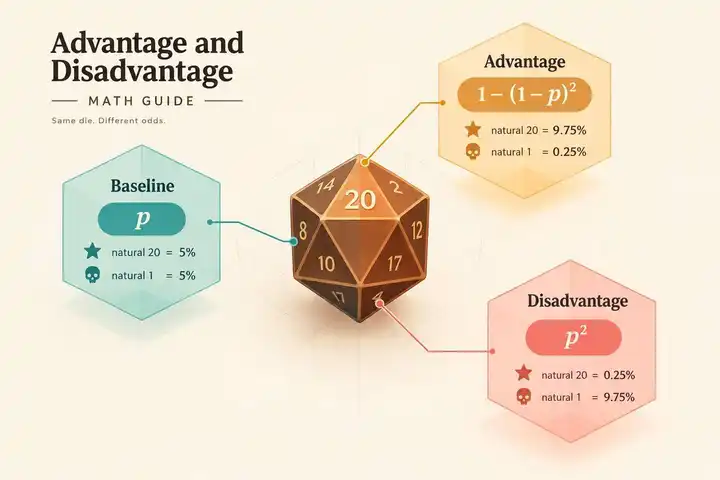
A 50% success chance becomes 75% with advantage - or 25% with disadvantage. My starting point is simple: roll two d20s, keep the higher result for advantage or the lower result for disadvantage, then add your modifier.
Here’s the math I use:
- Normal: Your success chance is p - the number of successful die faces divided by 20.
- Advantage: Success chance = 1 − (1 − p)².
- Disadvantage: Success chance = _p_².
The change tops out at 25 percentage points, so neither mode equals a fixed bonus or penalty. In standard TTRPG games, multiple sources don’t stack, and advantage plus disadvantage cancels out.
I also check <u>natural results separately</u>: a kept natural 20 occurs 9.75% of the time with advantage and 0.25% with disadvantage, versus 5% normally. Natural 1s reverse those odds. Whether those results mean an automatic hit, miss, or critical depends on the roll’s rules.

D20 Advantage and Disadvantage Odds
Advantage & Disadvantage - The math of this 5e mechanic
Calculate Success and Failure Odds
Subtract your modifier from the target number to find the required roll: $t = \text{target number} - \text{modifier}$. For standard target-number checks, the baseline success probability is $p = \max(0,\min(1,(21-t)/20))$.
Without automatic-result rules, $t \le 1$ guarantees success, while $t > 20$ makes success impossible. Advantage and disadvantage don’t change those limits. Apply any game-specific automatic-result rules before using your final baseline probability.
Success and Failure Formulas
For required rolls from 1 through 20, $p=(21-t)/20$. In plain terms, count the successful faces and divide by 20. Advantage succeeds unless both dice fail. Disadvantage succeeds only when both dice succeed. For independent, fair dice, use your baseline probability, $p$, in these formulas.
| Roll mode | Success probability | Failure probability |
|---|---|---|
| Normal | $p$ | $1-p$ |
| Advantage | $1-(1-p)^2$ | $(1-p)^2$ |
| Disadvantage | $p^2$ | $1-p^2$ |
Success Odds by Required Roll
For a fast lookup at the table, find your required roll and read across its row. “5+” means a die result of 5 or higher; “20” means only a 20 meets the threshold.
| Required roll | Normal success | Advantage success | Advantage change | Disadvantage success | Disadvantage change |
|---|---|---|---|---|---|
| 5+ | 80% | 96% | +16 percentage points | 64% | −16 percentage points |
| 10+ | 55% | 79.75% | +24.75 percentage points | 30.25% | −24.75 percentage points |
| 15+ | 30% | 51% | +21 percentage points | 9% | −21 percentage points |
| 20 | 5% | 9.75% | +4.75 percentage points | 0.25% | −4.75 percentage points |
Changes are percentage points, not percentages. To find failure odds, subtract success odds from 100%.
For the 5+ row, that gives 20% failure normally, 4% with advantage, and 36% with disadvantage.
Natural Results and Critical Rules
Advantage changes both your chance of success and how often you keep an extreme result. A natural result is the kept die’s face before modifiers.
Under D&D’s 2024 Basic Rules, a natural 20 on an attack roll automatically hits and scores a critical hit. A natural 1 automatically misses. Other roll types follow their own rules.
Calculate Natural-20 and Natural-1 Odds
With advantage, you keep a natural 20 if at least one die shows 20: $1-(19/20)^2=9.75%$. With disadvantage, both dice must show 20: $(1/20)^2=0.25%$.
Natural 1s reverse that pattern. With advantage, both dice must show 1: $(1/20)^2=0.25%$. With disadvantage, at least one die must show 1: $1-(19/20)^2=9.75%$.
Advantage adds 4.75 percentage points to the critical-hit rate when the roll type treats natural 20s as critical hits. Expanded critical-hit ranges and rerolls need different math.
Natural-Result Odds Table
The table shows the odds for the die you keep - not either physical die.
| Roll mode | Natural 20 on the kept die | Natural 1 on the kept die |
|---|---|---|
| Normal | 5% | 5% |
| Advantage | 9.75% | 0.25% |
| Disadvantage | 0.25% | 9.75% |
Estimate Odds at the Table
For a fast answer at the table, use these shortcuts rather than working through the full calculation.
Count Successful Faces and Apply the Formula
Count the die faces that succeed, then divide by 20. That’s your baseline chance, $p$. Plug it into the formulas: advantage = $1-(1-p)^2$; disadvantage = $p^2$.
Use 50% and 80% as Mental Benchmarks
A 50% baseline becomes 75% with advantage or 25% with disadvantage. An 80% baseline becomes 96% or 64%, respectively. If you round your baseline to make the math easier, label the result approximate, not exact.
Why the Change Peaks at 25 Percentage Points
Advantage adds $p(1-p)$ to your success chance. Disadvantage subtracts that same amount. The change peaks at $0.50\times0.50=0.25$, or 25 percentage points. Neither roll mode acts as a fixed numerical modifier.
Check Which Dice Rules Apply
These success/failure shortcuts assume two independent, fair d20s, keeping the highest or lowest result. Rerolls, dice pools, and exploding dice need different math. For critical outcomes, use the separate natural-20 and natural-1 rules covered above.
The conclusion below puts these roll modes into a quick reference table.
Conclusion: Quick d20 Odds Reference
Use the mental rules above for a quick estimate, then check this table for exact odds. Find your baseline success probability, $p$, from the roll you need, then apply the formula for your roll mode.
Roll-Mode Formula Table
| Roll mode | Success probability | Failure probability | Kept natural 20 | Kept natural 1 |
|---|---|---|---|---|
| Normal | $p$ | $1-p$ | 5% | 5% |
| Advantage | $1-(1-p)^2$ | $(1-p)^2$ | 9.75% | 0.25% |
| Disadvantage | $p^2$ | $1-p^2$ | 0.25% | 9.75% |
Kept-die odds refer to the d20 you keep, not a universal crit rule. Apply automatic success, automatic failure, and crit rules separately. Each face on a fair d20 has a 5% chance.
FAQs
When is advantage better than a +2 bonus?
Advantage beats a +2 bonus when you need an 11 or higher on a d20. A +2 bonus moves your chance of success from 50% to 60% - a gain of 10 percentage points. Advantage lets you roll twice and take the higher result, giving you a 75% chance of success.
The difference depends on the target number. A +2 bonus adds 10 percentage points when both added results can turn failure into success. Advantage helps most near the middle of the d20’s range, not when you need the highest rolls.
How does advantage affect an expanded critical-hit range?
The provided search results cover advantage and dice probability, but they don’t explain how advantage works with an expanded critical-hit range.
How can I estimate my odds of hitting at least once across multiple attacks?
Use the rule of complements: find the probability of missing every attack, then subtract it from 1.
If each attack is independent and has the same miss probability, multiply that probability by itself n times, where n is the number of attacks:
Chance of at least one hit = 1 − (miss probability)ⁿ


