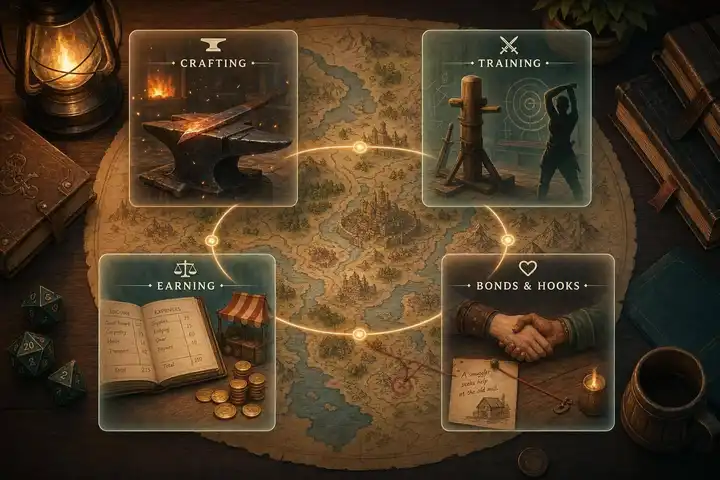
Downtime is how I turn “time between quests” into character growth, story hooks, and world change. If I use it well, players can craft items, train, earn money, build ties, recover, and get pulled into new trouble without dragging the campaign down.
Here’s the short version:
- Downtime has a job: it gives the campaign space between big adventures.
- Players get choices: crafting, research, work, business, faction tasks, social scenes, rest, gambling, and underworld jobs.
- GMs get tools: pacing, gold sinks, rumor delivery, NPC development, and future plot hooks.
- The best way to run it is simple: set a goal, name the cost, resolve the outcome.
- Not every game handles downtime the same way: some focus on bills and debt, some on territory, some on relationships.
I’d treat downtime as more than filler because it can affect all 3 major parts of play mentioned in the piece: combat, exploration, and social play. And even small scenes can matter. A repaired inn sign, a new tavern owner, or a debt to the wrong person can change the feel of the next session.
What this article covers at a glance:
- How downtime works in D&D and other TTRPGs
- Which activities give players the most to do
- When to roleplay, roll dice, or skip ahead
- How to turn side scenes into later problems
- Which systems lean on money pressure, neighborhood control, or personal ties
Running Downtime Activities - D&D/OSR
Quick Comparison
| Focus | What I use it for | What players usually do | What it often leads to |
|---|---|---|---|
| Progress | Character growth between adventures | Craft, train, research | New gear, skills, lore |
| Money & position | Put characters into the setting | Work, run a shop, help a faction | Income, staff, debts, rivals |
| Social play | Build NPC ties and pass rumors | Carouse, visit contacts, make deals | Trust, favors, requests |
| Recovery | Slow the pace after major events | Rest, heal, clear stress | Readiness for the next arc |
| System style | Shape the campaign loop | Pay bills, defend turf, deal with relationships | Pressure, hooks, repeatable play cycles |
If I want downtime to work, I keep it short, clear, and tied to the world so every choice leaves a mark.
Core Downtime Activities in D&D
Crafting, Training, and Research
Crafting lets players turn downtime into gear, consumables, or long-term projects by spending gold, using tools, getting access, and sometimes bringing in extra help. Training and research follow the same basic idea: downtime turns time into new skills, spells, or lore. In each case, the project often depends on support that isn’t bought off a shelf, like a workshop, a library, or a favor from an NPC.
These activities tend to work best when the DM sets clear limits around cost, time, or access. That gives the project weight. It also makes the choice feel like part of the world instead of a vague between-adventures task.
Work, Business, and Faction Goals
Downtime can also put money in a character’s pocket or deepen their place in the setting. A character who works their trade, runs a business, or pushes faction goals forward might not end up loaded, but they can pick up contacts, staff, and obligations that make the campaign feel lived in.
A business does more than produce income. It can also bring headaches, rivals, and people who now expect something from the party. Faction work does something similar. It ties a character’s personal goals to the setting and gives GMs future hooks through favors, debts, and obligations. That tension makes these activities easy to turn into recurring story threads.
Relationships, Recovery, and Risky Side Activities
Some downtime helps characters recover. Some of it pulls them deeper into the world around them.
Carousing, gambling, and underworld dealings are strong options because they create complications fast. One night of carousing might uncover rumors or spark a new contact. Gambling can lead to extra gold or a nasty accusation of cheating. Underworld dealings can turn up clues, but they can also draw the wrong kind of attention from a guild.
Recovery is the safest use of downtime, but it still moves the campaign forward. Relationship-building works best when the NPC has something at stake, like a want, debt, fear, or loyalty. After a few repeat visits, that NPC might become a source of rumors, a safe house, or the kind of person who shows up later asking for help.
| Activity Type | Typical Time | Likely Cost | Common Checks | Main Rewards | Possible Complications |
|---|---|---|---|---|---|
| Carousing | 1 evening/day | 4 cp – 2 gp | Persuasion, Insight | Rumors, contacts | Unpaid tabs, brawls, rivals |
| Gambling | 1 evening | Wager (variable) | Deception, Sleight of Hand | Gold, clues | Accusations of cheating, debts |
| Underworld Dealings | 1+ days | Bribes, lifestyle | Stealth, Deception | Faction renown, clues | Guild feuds, suspicious regulars |
| Recovery/Rest | 1+ days | 2 cp – 6 sp | None (or Con save) | HP, removal of stress | Missing patrons, local news leaks |
| Building Relationships | Recurring visits | Lifestyle costs | Persuasion, Performance | Trust, safe houses | Obligations, personal requests |
Those complications also help signal when a downtime scene should be roleplayed, handled with a roll, or skipped ahead with a fast-forward.
How to Run Downtime Without Slowing the Game
A Simple Downtime Process for GMs
Once a player picks a downtime activity, run it the same way each time: goal, cost, outcome.
When a downtime window opens, ask each player for one goal. Then spell out the cost and the payoff. That keeps things moving and helps everyone stay on the same page.
Resources can be anything a project needs: a workshop, trainer, favor, library, staff, or plain old time. Some costs get spent once and are gone. Others stick around as lasting assets. That means characters can build up downtime infrastructure over time instead of starting from zero whenever a new project comes up.
When to Use Roleplay, Rolls, or a Quick Montage
After the goal and cost are clear, decide how much table time the scene should get.
Use roleplay for high-stakes moments. Use rolls when the outcome is in doubt. Use a montage for routine tasks that don’t need a full scene.
Clear downtime rules make this choice much easier. You’re not guessing how long to linger on a moment. You’re matching the spotlight to what matters.
How to Turn Downtime Complications into Story Hooks
The best downtime results don’t just wrap up a task. They tee up the next problem.
If a character calls in a favor to get access to a restricted library, that favor can come due later. If hired staff make a mistake - or ask for better pay, a safer space, or clearer expectations - that can turn into a roleplay scene or a follow-up adventure.
A good rule of thumb: turn complications into debts, favors, mistakes, or obligations the party can deal with later.
Downtime in Other TTRPG Systems

TTRPG Downtime Systems Compared: D&D, Blades in the Dark, Shadowrun & More
Some games treat downtime like a short break between adventures. Others make it part of the engine that keeps the whole campaign running.
How Downtime Rules Differ Across Systems
Not every TTRPG handles downtime the same way. The big differences come down to structure, how often it shows up, and what it gives players or puts at risk.
In Shadowrun and Traveller, downtime is pushed by recurring costs. In Shadowrun, characters deal with lifestyle and medical expenses, so they need jobs to pay the bills. In Traveller, ship debt creates that same pressure: find work, make the payment, or lose the ship.
That kind of repeatable loop helps sandbox campaigns keep moving. The pattern matters more than the game title. Downtime can put pressure on the economy, shape control over territory, or keep relationships moving from one session to the next. That gives the campaign pressure, direction, and a reason to come back to downtime instead of skipping past it.
Downtime in Blades in the Dark and Related Systems

Blades in the Dark and games built in a similar style use downtime to support territory control and community upkeep. Common activities include gaining resources, resolving conflicts, and defending territory.
In A/state 2E, that same idea leans even harder into neighborhood defense. Downtime is about building up one specific corner of the city and keeping it safe from outside threats.
Other systems use downtime to carry relationships and consequences forward. Cyberpunk 2020 uses lifepath mechanics to create enemies, friends, and relationships that still matter between missions, which turns downtime into a source of narrative complications.
| System | Primary Downtime Driver | Common Activities | Risk/Consequences | Feel |
|---|---|---|---|---|
| Blades in the Dark | Territory control and community upkeep | Gain resources, resolve conflicts, defend territory | Outside threats and pressure to defend territory | Strategic and structured |
| A/state 2E | Neighborhood defense | Build up a specific corner of the city | Outside threats taking over the neighborhood | Community-focused |
| Shadowrun | Lifestyle and medical costs | Take jobs to cover expenses | Missing payments; inability to afford medical care | Financial pressure loop |
| Traveller | Ship debt | Find work and patrons | Skipping debt payments; loss of the ship | Economic survival loop |
| Cyberpunk 2020 | Relationship-driven complications | Lifepath relationships | Narrative complications and personal loss | Character-driven |
Those differences matter when you're deciding what kind of campaign you want to run.
Using Downtime to Choose and Shape Better Campaigns
Finding Games That Support the Downtime Style You Want
Those system differences matter because the best downtime rules should match the kind of campaign your group wants to play.
Start there. Figure out what your group wants from downtime before you pick a system. A short session zero chat can make this clear fast. Ask if players want to track long-term projects, get mechanical rewards from relationship scenes, or just have a brief story recap before the next quest.
Then look at game summaries and rule descriptions with that goal in mind. They can tell you a lot about how a system treats downtime. Terms like "downtime phase", "project clocks," or "domain play" usually point to a more structured setup. Phrases like "free play" or "advancement tied to bonds" usually mean a lighter, story-first style.
So the choice isn't just about how many rules a game has. It's about the kind of play you want between adventures. Tiny Taverns fits groups that want cozy, low-stakes downtime. Knowing that before you commit to a campaign can save a lot of frustration later.
Conclusion: Make Time Between Adventures Count
Once you know the style you want, choose the system to fit that style - not the other way around.
Downtime is part of the campaign, not filler. Pick a few meaningful downtime options, resolve them cleanly, and let the results change the campaign.
FAQs
How much downtime should a campaign include?
There’s no hard rule here. Downtime should match the campaign’s pace and story while keeping the world alive and reactive to what the players do.
In sandbox campaigns, GMs can keep active objectives to three to five at a time. Downtime starts to matter when players have to decide how to spend it, and when travel and tasks take time in ways that steer the story.
What makes a good downtime complication?
A good downtime complication should grow out of what the characters are already doing. That way, it doesn’t feel random. It adds friction in a way that turns rest, recovery, or prep into actual play.
It works best when it connects to the campaign itself. Maybe a faction spots the party’s business, a secret gets out, or an NPC relationship starts to fray. The best complications also push the group to make hard calls about limited time and resources. That’s where the fun is: choices that shape the characters and leave effects that stick.
How do I adapt downtime to different RPG systems?
Handle downtime by tying your goals to the system’s existing mechanics instead of forcing one template on every game. First, check what the game already leans toward. Some systems are more narrative, like D&D 5E. Others rely on tighter subsystems, like Pathfinder 2E or Blades in the Dark.
From there, match downtime activities to that framework. If the game already has reputation, resource, or faction rules, use them. That gives crafting and social goals clear in-game effects instead of making them feel hand-wavy.
For longer efforts, track them with tools the system already supports. That might mean progress clocks, long-term project trackers, or short session-end summaries that note how faction ties, research, or item work moved forward.


