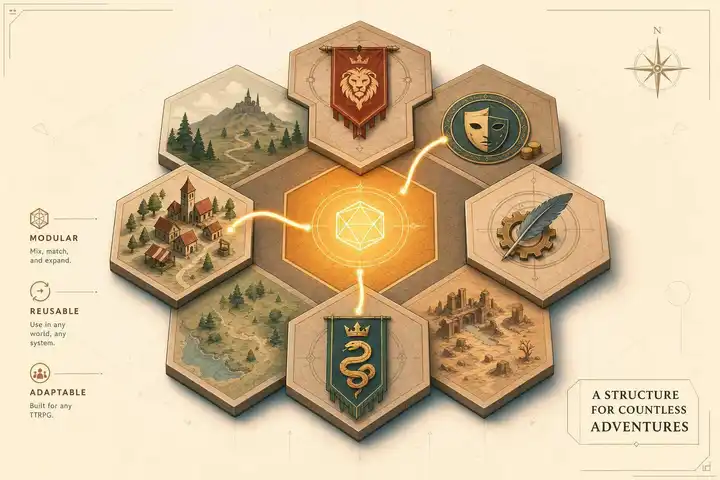
You do not need a giant setting bible to run a good campaign. I’d start with one clear premise, one small starting area, 3–5 factions, 3 main conflicts, and short 3–6 session arcs. That gives me enough to run D&D, sci-fi, or horror without writing 50 pages before Session 1.
Here’s the full idea in plain terms:
- I build the campaign around premise, place, factions, and pressure
- I tie each PC to a faction, a location, and a personal issue
- I plan in short arcs instead of one giant story
- I prep each session with an obstacle, a clue, an NPC moment, a scene shift, and fallout
- I keep story notes separate from rules notes so I can move the same campaign frame into another game
A few numbers from the article matter right away:
- 3–5 factions is the target range
- 3 conflicts keep the world in motion
- 3–6 sessions is a solid arc length
- 12–30 sessions is a common full campaign range
- I only prep the next 2–3 sessions in detail
This article is, at its core, a simple campaign planning frame. Not a script. Not a full plot. Just a clean way to set up a world that reacts to player choices and stays easy to run week to week.
The Core Campaign Template: Premise, Setting, Factions, and Conflict
Write a One-Sentence Premise and Set the Campaign Tone
The fastest way to lock in a campaign’s direction is to write one sentence that names the central conflict, the stakes, and the tone. A premise is not a plot summary. It’s a situation with built-in tension that pushes characters to act. A premise gives players room to respond; a plot can shove them down a single road.
A simple formula works well: name the conflict, add what happens if no one steps in, and hint at what the campaign will focus on. For example, “A frontier town is caught between two warring factions, and winter is coming” points toward roleplay and investigation. “The crew stole something powerful from someone dangerous, and now they need to survive the fallout” signals stealth and combat. Once that sentence is in place, the tone starts to lock in, and the rest of your planning gets a lot easier.
Once the premise is clear, define the first place where play will start.
Build a Small Starting Area Before Expanding the World
Start small: one town, one district, one space station, or one isolated region. You only need enough ground to support the first few sessions. Then prep four concrete details:
- One major location like a tavern, a collapsed temple, or a docking bay
- One immediate problem
- One nearby threat
- A few memorable NPCs
For each NPC, jot down what they want, what they’re hiding, and one quirk. That tiny bit of prep goes a long way. It gives you people who feel like people, not cardboard cutouts.
From that starting zone, figure out which groups want control of it.
Create Factions and Three Ongoing Conflicts
Factions are the engine that keeps a campaign moving between sessions. Aim for 3 to 5 factions. For each one, define a clear goal, the methods they use to chase it, and a specific reason the player characters should care. Each faction needs a goal, and each goal should clash with someone else’s.
After that, set up reasons for those groups to collide. Plan three ongoing conflicts that can fuel more than one adventure without wrapping up too fast. Each conflict should connect at least two factions and tie back to the campaign premise. That part matters. If the conflict pulls in a totally different direction, the campaign can start to feel scattered.
Keep the structure the same. Just swap in the factions and stakes that fit your genre.
An EASY template for writing your FIRST CAMPAIGN
Turn the Template Into Character Hooks and Campaign Arcs

D&D Campaign Template: Arc Types at a Glance
Connect Character Backstories to Places, Factions, and Stakes
Once your factions and conflicts are in place, connect each PC to at least:
- one faction
- one location
- one unresolved personal stake from their past
That turns a backstory from trivia into something the campaign can actually use.
If a player says their character wants revenge, redemption, a lost heirloom, or answers about a missing mentor, bring that goal onto the stage early. Don’t leave it sitting in a notes file. Make it part of the campaign’s first pressure point.
A good way to think about backstories is as a relationship map. Link each PC to faction ties, location ties, and named NPC ties. That gives every character a direct reason to care when the first conflict kicks off. It also helps you decide which faction pressure should hit first.
Plan Adventure Arcs as Short, Playable Seasons
Most arcs run 3–6 sessions and move through four beats: Introduction, Escalation, Crisis, Resolution. Prep the next 2–3 sessions in detail, then keep the rest at the outline level.
Each arc should push forward one faction goal or one unresolved conflict. That keeps the campaign moving without turning prep into a second job.
A typical campaign runs 3 to 5 arcs, which puts it in the 12–30 session range.
Think of each arc like a short TV season. You know the shape, the pressure, and what’s at stake. But you still leave room for the players to throw a wrench into the whole thing.
Use Arc Types to Vary Play from Session to Session
Rotate between investigation, war, heist, travel, and social arcs so the game doesn’t start to feel samey. The frame changes, even when the world and factions stay the same. What shifts is the conflict, the NPC roles, and what success looks like.
| Arc Type | Conflict | NPC Roles | Typical Locations | Goal |
|---|---|---|---|---|
| Investigation | Hidden secrets / Mystery | Informants, Liars, Witnesses | Urban centers, Libraries, Crime scenes | Uncover a specific truth or secret |
| War / Combat | Physical threat / Territory | Commanders, Soldiers, Refugees | Battlefields, Fortifications, Sieges | Defeat a threat or hold a position |
| Heist / Stealth | Security / Acquisition | Fixers, Guards, Inside agents | Vaults, Manors, High-security zones | Steal an object or plant information |
| Travel / Exploration | Environment / Discovery | Guides, Nomads, Rivals | Wilderness, Ruins, Uncharted lands | Reach a destination or map a site |
| Social / Negotiation | Differing interests / Patience | Diplomats, Rivals, Power brokers | Courts, Embassies, Neutral ground | Reach an agreement or gain an ally |
Keep encounters and NPCs modular, so you can drop them in wherever the players decide to go. That gives you room to react without scrambling every week.
Let factions and backstory hooks point toward the next arc, then build around player choices. Pick the arc type, lock in the main goal, and prep the next session from there.
Use the Template for Session Prep and Weekly Play
Prep Each Session Around Goals, Questions, and Consequences
This is the point where a campaign outline turns into week-by-week play.
Use the campaign template to build each session from the same five parts: one obstacle, one clue, one NPC scene, one scene change, and one consequence from the last session’s events. That is the session skeleton.
| Prep Element | Description | Purpose |
|---|---|---|
| The Obstacle | A physical or social barrier | Tests player resources or skills |
| The Clue | A piece of information or secret | Moves the plot forward or reveals faction motives |
| NPC Scene | A social encounter with a specific goal | Makes the world feel human and adds hooks |
| Scene Change | Moving the action to a new environment | Keeps pacing active and visual |
| Consequence | The world’s reaction to previous acts | Shows players their choices have weight |
Tie the whole session to one clear session question that the players can answer by the end of play. That question should guide every choice, clue, and consequence in the session. If the question is fuzzy, the session can drift. If it’s sharp, the session tends to hold together.
Use a Simple Encounter-Response Loop
Each session can run on the same basic loop: present a situation, let the players act, then show how the world reacts. That reaction becomes the next situation.
It’s simple, but it works. Players push on the world, and the world pushes back. That back-and-forth is what makes a campaign feel alive.
Let factions respond based on their goals and methods, so events feel driven by the setting instead of forced by the GM. And when you end a session, aim for a revelation, a sudden choice, or a door opening - not a long rest.
The best stopping points make players say, “Wait, that’s where we’re ending?”
Start With Session Zero and Keep Notes Lightweight
Session Zero turns the template into table expectations. Use it to lock in tone, boundaries, campaign scope, and character fit before play starts. Talk through which themes are on the table, what is off-limits entirely (lines), and what can exist in the story without detailed description (veils). Set a shared tone reference too, so everyone knows whether the game is heroic, grim, or horror.
After that, keep your notes lean. A simple Markdown file with headers for Session Number, Last Session Recap, Current Scene, Key Plot Points, NPCs, and Loot is enough for most tables. Carry those same three NPC notes into session prep. That usually gives you plenty to run them well on the fly.
Different session types put the weight in different places:
- Mystery sessions lean on clues and NPC secrets
- Travel sessions lean on locations and hazards
- Combat sessions lean on obstacles and consequences
Start each session by asking the players to recap the last one. It checks alignment, brings out anything they misread, and gives them a hand in shaping the story. Then run the loop, track what changed, and write down those changes before you stop.
The same weekly structure also works in fantasy, sci-fi, and horror.
Adapt the Template to Fantasy, Sci-Fi, and Horror
How the Same Template Looks Across Three Genres
Keep the structure. Change only the genre skin.
Your factions, premise, and core conflict still do the same job no matter what game you run. What changes is the surface: castles become space stations, spies become corrupt officers, and war pressure turns into dread. The table below shows how the same campaign skeleton can shift across three genres.
| Template Field | Fantasy (D&D) | Sci-Fi (Stars Without Number) | Horror (Vampire: The Masquerade) |
|---|---|---|---|
| Premise | A frontier town is caught between two warring kingdoms as winter approaches | A crew steals a powerful prototype from a megacorp and must survive the fallout | A dead god's corpse crashes into the ocean, leaking madness into nearby coastal villages |
| Faction | The Iron Crown (expansionist kingdom) | Interstellar Dynamics (resource-hungry corp) | The Camarilla (secretive ruling sect) |
| NPC Secret | The local priest spies for the enemy kingdom | The station commander takes bribes from a rival corp | The police chief is a ghoul serving a hidden master |
| Arc Structure | Escalating war leads to a siege | Escalating corporate sabotage leads to a station-wide blackout | Escalating disappearances lead to a ritualistic crisis |
What Stays System-Neutral and What Becomes Rules-Specific
Once the story layer is in place, map it to the rules layer.
Your premise, NPC motives, faction goals, and arc structure are system-neutral. Write them once, then carry them into any game. If you switch systems, only the mechanical layer changes.
In D&D, that means monster stat blocks, magic item DCs, and spell slots. In Stars Without Number, it means ship combat rules, hacking DCs, and tech levels. In Vampire: The Masquerade, it means stress and panic mechanics, sanity checks, and hidden weaknesses.
A simple way to handle this? Keep two sets of notes:
- Story layer: premise, secrets, factions, motives, and campaign arc
- Rules layer: stat blocks, DCs, mechanics, subsystems, and game-specific traits
When you move to a new system, you rebuild the rules layer. The story layer stays the same.
Use TTRPG Games Directory to Match the Template to a System

Once your campaign skeleton is built, the next move is picking a ruleset that fits.
TTRPG Games Directory helps you browse games by genre, mechanics, and play style, so you can line up your campaign idea with a system that supports it. That matters more than people sometimes think. A sci-fi story about corporate espionage and scarcity will land better in a game built to handle pressure, limited resources, and hostile factions. A premise built on secrecy and dread works better in a horror system that leans into those feelings.
Use TTRPG Games Directory to find a system that matches your campaign's genre, mechanics, and tone.
Conclusion: A Reusable Structure You Can Start Using Tonight
With the template set, the next step is simple: start small.
You don't need a finished world before you begin. Start with a tense premise, a small opening area, and 3–5 factions that each want something clear.
That setup gets to play fast. Tie the PCs to the world, then run short 3–6 session arcs around one conflict at a time.
It also moves cleanly across systems. The story layer stays the same. Only the rules layer shifts. That's why the template still works even when you change games.
The aim here is a structure that cuts prep and lets the world react to player choices. Build the skeleton tonight. Fill in the rest at the table.
FAQs
How do I start this template with almost no prep?
Keep your scope small at the start. Focus on the opening area and only the next two or three sessions. That does two things at once: it makes prep lighter, and it gives the game some pressure right away.
Build the campaign around a central premise with tension baked in. Not a locked-in, long-range plot. Think of it like a live wire, not a railroad. Maybe a mining town struck gold on land claimed by a vanished order. Maybe a border village needs help, but the people offering help want control in return. The point is simple: something important is off-balance, and the players step into the middle of it.
Use the 3-2-1 Mapping Rule to shape the area:
- 3: one starting hub where people gather, trade, argue, and ask for help
- 2: two to three nearby locations tied to trouble, rumors, or chance for reward
- 1: one far-off, strange site that feels bigger than the current moment
This gives you a map with room to breathe without turning prep into homework. The hub is where the party gets context. The nearby places are where action happens early. The far site hangs over everything like a storm on the horizon.
Add a Party Seed so the group begins with a shared reason to stick together. Maybe they all owe money to the same patron. Maybe they survived the same disaster. Maybe they were hired for one job and got trapped in something much messier. This shared thread matters because it answers the question every table runs into: Why are we together at all?
Then start in medias res. Skip the long tavern warm-up. Open with motion, danger, or a choice that can't wait.
The caravan is already under attack.
The mayor is dead, and the crowd thinks the party did it.
The ferry is sinking halfway across the river, with something moving below the surface.
That kind of opening gives the group an instant problem, a reason to act, and a fast path into the premise. You’re not telling them what the whole campaign will be. You’re dropping them into a tense situation and letting the next few sessions show what kind of story this wants to become.
What if my players ignore the main conflict?
If your players ignore the main conflict, let the world move forward on its own instead of shoving them back onto the path you planned. A village might get overrun. A trade route might shut down because no one stepped in.
That kind of fallout keeps the stakes clear and the story in motion. It also shows players something important: the world doesn’t pause and wait for them to act.
How do I convert this campaign template to another TTRPG system?
Keep the narrative framework and swap out system-specific rules. The core structure - premise, factions, arcs, and session planning - works across systems and genres.
Replace D&D-specific stat blocks and mechanics with the matching values, threat levels, or skill checks in your target system. Keep hooks, NPCs, and world-building in line with that system’s lore and setting, and use its rules to back up your themes.


