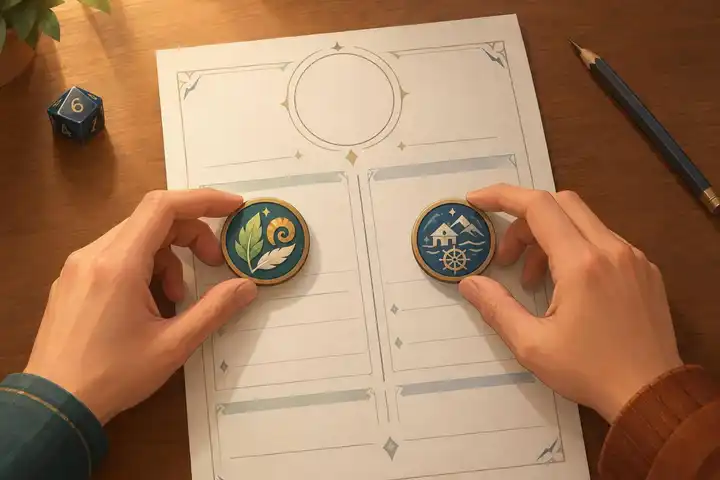
Choose an ancestry for the features you want to use and a community for the upbringing that shaped your character. Together, they form your heritage: two ancestry features and one community feature. Neither choice sets your class or personality.
The core rules offer 18 ancestries and 9 communities. To narrow the choices:
- Match features to playstyle. Check their triggers, costs, and limits against scenes likely to happen in your campaign.
- Connect the pair through backstory. Name a person, value, or past event that links your lineage and upbringing.
- Mix lineages within the rules. Mixed Ancestry takes the first-listed feature from one ancestry and the second-listed feature from another.
- Confirm and record. Check approved sources with your GM, then add your heritage and all three features to your character sheet.
The goal isn’t the strongest combination on paper. It’s a character whose story and features suit how you want to play.

Daggerheart Heritage: Choose Your Ancestry and Community
Heritage in Daggerheart! | Get Your Sheet Together
Step 1: Choose an Ancestry for Your Character Concept
Write a one-sentence concept that names your character’s role, goal, and vibe. Then decide which playstyle matters most to you: mobility, resilience, exploration, stealth, or social interaction. Start with what you want to do, rather than looks or genre assumptions. Once you have a shortlist, compare each ancestry’s features side by side.
Compare the 18 Core Ancestries
The core list is Clank, Drakona, Dwarf, Elf, Faerie, Faun, Firbolg, Fungril, Galapa, Giant, Goblin, Halfling, Human, Infernis, Katari, Orc, Ribbet, and Simiah. Pick two or three and compare the top and bottom features on their ancestry cards. Check each feature’s action type, trigger, cost, and limits, plus whether it uses a roll or reaction.
For mobility, look for features that help with movement or positioning. For resilience, compare features that help you withstand danger. For exploration, focus on handling unusual environments or gathering information. For social interaction, look for ways to open up communication or influence others.
Choose the ancestry that fits both your character concept and the actions you want to take most often. Treat appearance as a final flavor check - not the deciding factor.
Combine Lineages With Mixed Ancestry
Use the same feature-first approach for mixed ancestry. Mixed Ancestry pairs the top feature from one ancestry with the bottom feature from another; you can’t choose just any two features. Check with your GM if you’re unsure how those features interact.
Step 2: Choose a Community for Your Upbringing
Choose the upbringing that most shaped your character. Your community gives you one feature tied to its culture, class, or surroundings. Grew up in several places? Pick the one that most influenced your formative years, and keep the others as backstory. Use the table to find a match for both your feature and your story.
Compare the 9 Core Communities
Here’s how the nine Core Set communities compare by feature theme. Before choosing, check your community card for the feature’s exact name, trigger, limit, and effect.
| Community | Culture or Environment | Feature Theme | Best For | Backstory Questions |
|---|---|---|---|---|
| Highborne | Wealth, status, and elite circles | Social privilege and access to elite spaces | Someone connected to powerful families or institutions | What did your status give you - and cost you? |
| Loreborne | Scholarship and accumulated knowledge | Research and information-gathering | Researcher, investigator, or keeper of records | Who taught you to find reliable information? |
| Orderborne | Shared principles, discipline, or faith | Living by principles, discipline, or faith | Devoted member or former follower of an institution | Which teaching do you still follow? |
| Ridgeborne | Mountains and rugged terrain | Survival in difficult terrain | Mountain traveler or settlement defender | Who taught you to handle dangerous terrain? |
| Seaborne | Waterways and maritime life | Familiarity with water and maritime life | Sailor or coastal traveler | How did life near water shape your habits? |
| Slyborne | Criminal networks and underworld ties | Criminal, deceptive, or underworld connections | Someone familiar with intrigue or criminal circles | Which relationships did you keep or leave behind? |
| Underborne | Subterranean communities | Life beneath settled communities | Underground resident or explorer | What did growing up below ground teach you? |
| Wanderborne | Travel and nomadic life | Portable resources, improvisation, and nomadic experience | Itinerant traveler or wanderer who adjusts to change | Who taught you to make do while traveling? |
| Wildborne | Wilderness communities | Wilderness knowledge and stealth | Wilderness scout or homeland protector | Which habits helped you move without being seen? |
Tie Your Community Feature to Your Backstory
Once you’ve narrowed your options, give the choice a story. Name one person who shaped you, one value you kept, and one you rejected. Then connect those experiences to your feature. The card’s six adjectives are prompts, not rules.
Before you commit, name two likely scenes where the feature would matter. Compare the card’s actual conditions with the scenes you expect in your campaign - not just the feature’s theme. If those situations seem unlikely, consider another community or clarify how your upbringing will connect to play.
Step 3: Pair Your Ancestry and Community
Put your ancestry and community choices side by side. Review their three features together to see whether the story and mechanics fit your character concept.
Consider 5 Example Pairings
These prompts show how lineage and upbringing can support each other. Treat them as starting points, not required backgrounds.
Pairing What Lineage Contributes What Upbringing Could Contribute Elf–Loreborne archivist or oral historian Elven physical identity and two ancestry features A childhood among keepers of records or spoken histories; the character might now question what those keepers left out. Dwarf–Ridgeborne mountain traveler Dwarven physical identity and two ancestry features Life among guides or isolated mountain settlements; a failed rescue could explain leaving home. Faerie–Seaborne sailor Faerie physical identity and two ancestry features A childhood aboard ships or around ports; crew relationships could matter more than a particular homeland. Orc–Orderborne rescue corps member Orc physical identity and two ancestry features Training centered on duty; the character might keep the institution’s code while rejecting its leaders. Human–Wanderborne traveler Human physical identity and two ancestry features Life with traveling traders; the character might value movement - or want a permanent home.
Check How the Features Fit Your Playstyle
For each of the three features, check what activates it. Does it depend on an action, situation, resource, or consequence? Is there a usage limit? Does it overlap with another feature or role?
Test each feature against two or three likely scenes, such as social investigation, wilderness travel, or combat. Ask your GM about any unclear timing or wording.
Keep the pair that fits your story, even if another looks stronger mechanically. A situational feature doesn’t need to come up in every scene. Write one sentence naming your lineage, upbringing, and the influence or tension that connects them.
Conclusion: Review and Record Your Heritage
Ancestry sets your lineage and two features; community sets your upbringing and one feature. Together, they form your heritage.
Once you’ve narrowed down your pairing, give it one last check.
Check Your Playstyle and Story Choices
Make sure your ancestry supports the actions you enjoy and your community fits a believable upbringing. The pairing should also suggest relationships, places, or formative experiences you want to explore.
When it works for both your story and your playstyle, write it down.
Record Your Choices on the Character Sheet
Enter both ancestry and community in the Heritage field. Copy your two ancestry features and one community feature into their designated areas using the approved rules text. Then add a one-sentence background note that connects your lineage and upbringing.
For Mixed Ancestry, check that you chose the first-listed feature from one ancestry and the second-listed feature from another. Also note how your character names their heritage.
Before your first session, confirm approved sources with your GM, especially for Mixed Ancestry or material outside the core rules.
FAQs
Can I choose a community unrelated to my ancestry?
Yes. Ancestry covers inherited traits, while community covers learned social influences, such as customs, languages, and connections. You can choose any community that fits your character concept, regardless of ancestry.
For example, your character could be an elf brought up in a Loreborne community or a dwarf from a Ridgeborne community.
Then tie that upbringing to your character’s skills, motivations, and relationships.
How do I avoid features that rarely come into play?
Before choosing features, ask your Game Master how often combat will happen, what terrain and climate to expect, and how much travel the campaign involves. Pick features you’ll use, whether that means helping with exploration, social interaction, or combat.
Check how passive benefits apply and what triggers or costs come with active abilities. Let your character’s intended role at the table guide your choices - not lore alone.
How can I portray mixed ancestry in my backstory?
Show how both sides of your character’s lineage shaped their identity by weaving their heritage into their personal history. Daggerheart separates ancestry from community: ancestry covers biological traits, while community covers shared knowledge and social ties. That distinction leaves room for an upbringing that draws from both.
Describe how those influences shaped your character’s skills, motivations, and worldview. If explicit mixed-ancestry mechanics aren’t available, work with your Game Master to reflect that background through your character’s training and personal journey.


