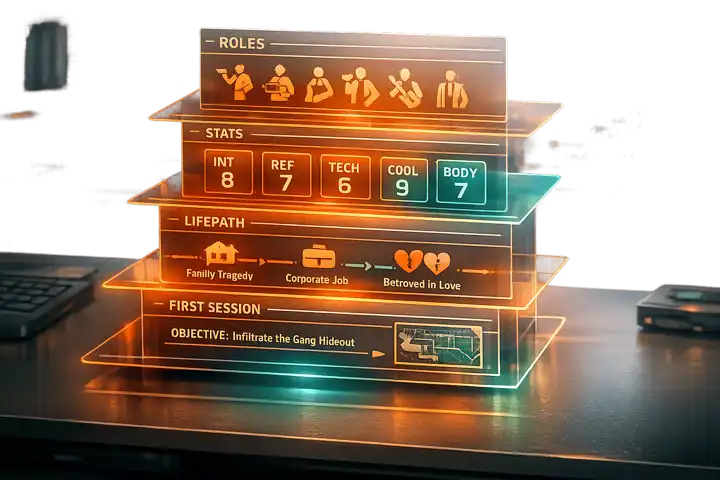
Creating a character in Cyberpunk 2020 goes beyond stats - it’s about building a story. Here’s how to get started:
- Choose a Role: Each Role (like Solo, Netrunner, or Fixer) comes with a unique Special Ability that defines your character’s strengths.
- Distribute Stats: Assign points to nine core stats, such as Intelligence (INT), Reflexes (REF), and Empathy (EMP). EMP is crucial if you plan to install cyberware, as it prevents cyberpsychosis.
- Use the Lifepath System: Roll for or select your character’s backstory, including family, friends, enemies, and significant life events.
- Balance the Party: Combine combat, tech, and social Roles for a well-rounded team.
- Start with a Hook: Build your first session around the characters’ Lifepath details to make the story personal.
Whether you’re crafting a street-level survivor or a corporate operative, the steps above ensure your character is ready for Night City’s chaos.
Cyberpunk 2020 Character Creation: The Basics
Character Creation Steps at a Glance
Creating a character in Cyberpunk 2020 is a structured process. First, you choose a Role, which determines your Special Ability and career path. After that, you’ll assign points to your nine core stats and distribute skill points. You’ll get 40 points to allocate among your 10 Career Skills (including your Special Ability) and additional "Pickup Skill" points equal to the sum of your INT and REF stats. Once that’s done, you’ll run through the Lifepath system to flesh out your character’s backstory, then finalize gear and derived stats like movement and damage resistance.
Your starting funds are tied to your Special Ability level. For example, a level 1 Solo earns about $2,000 per month, scaling up to $12,000 at level 10. Meanwhile, a Nomad caps out at around $5,000 per month. For players looking for a quick cash boost, there’s an optional rule: take a $2,000 bonus upfront by agreeing to be "Owned" by a corporation or gang. This adds immediate narrative tension to your character’s story. Now, let’s dive into the core stats that define your character’s abilities.
The Nine Core Stats and What They Do
Your character’s capabilities stem from nine stats, each ranging from 2 to 10. These stats directly affect what your character can achieve during gameplay. The basic mechanic is simple: add your Stat, Skill, and a roll of 1d10, then compare that total to the Difficulty Value (DV) set by the Referee.
Here’s a quick breakdown of the nine stats:
| Stat | What It Covers | Roles That Rely on It |
|---|---|---|
| Intelligence (INT) | Problem-solving, memory, noticing details | Netrunner, Corporate |
| Reflexes (REF) | Combat accuracy, coordination, initiative | Solo, Nomad, Rockerboy |
| Cool (CL) | Stress and pain resistance, combat morale | Solo, Fixer, Rockerboy |
| Technical (TECH) | Repairing and using hardware | Techie, Medtechie |
| Luck (LK) | Points spent to influence outcomes | All Roles |
| Attractiveness (ATT) | Physical appearance, personal magnetism | Media, Rockerboy |
| Movement (MA) | Running speed (MA × 3), jumping distance | All Roles |
| Empathy (EMP) | Social skills, Humanity buffer against cyberware | Rockerboy, Media, Fixer |
| Body Type (BT) | Damage resistance, carrying and lifting capacity | Solo, Nomad |
One stat that stands out is Empathy (EMP). This stat not only governs social skills but also acts as a safeguard against cyberpsychosis. Every 10 points of Humanity Cost from cyberware permanently reduces your EMP by 1. If EMP ever drops to 0, your character succumbs to cyberpsychosis and becomes an NPC under the Referee’s control. If you’re planning to heavily augment your character, it’s wise to invest in a high EMP early on.
Point-Buy vs. Dice Rolling for Stats
When it comes to assigning your stats, you have two main options: point-buy or dice rolling. The point-buy method gives you a pool of 55 points to distribute across all nine stats on a 1-to-1 basis. This approach is straightforward and allows you to fine-tune your character to match your vision.
Alternatively, the dice rolling method adds an element of chance. You roll 10d10 and distribute the total points as you see fit.
"To calculate your character's attributes, you have 55 points to distribute among them. The points have a 1-to-1 relationship... Alternatively, if you're feeling adventurous, roll 10d10 and distribute the points as you wish." - Clon01 Database
Some Game Masters (GMs) tweak these methods to suit their campaign tone. For example, a 54-point pool can be used to create a grittier, street-level feel. Another variation involves rolling 9d10 and re-rolling any 2s to balance unpredictability with fairness. Ultimately, the best method depends on whether your group prioritizes balance or the thrill of randomness.
Creating A Character In Cyberpunk 2020 and Red (A to Z Breakdown)
Roles in Cyberpunk 2020: What Each One Does

Cyberpunk 2020: All 10 Roles, Special Abilities & Monthly Earnings
All Ten Roles and Their Special Abilities
In Cyberpunk 2020, every character belongs to one of ten distinct Roles. These aren't just job descriptions - they determine your Special Ability, a unique skill that sets your character apart. This ability is something only your Role can fully master, making it a defining feature of your gameplay.
| Role | Special Ability | Key Function | Group Function |
|---|---|---|---|
| Solo | Combat Sense | Enhances combat awareness and reaction time | Combat expert & bodyguard |
| Netrunner | Interface | Hacks systems and manipulates digital networks | Cyber warfare & data theft |
| Rockerboy | Charismatic Leadership | Inspires and leads crowds | Social influence & crowd control |
| Techie | Jury Rig | Quickly repairs or modifies equipment | Gear repair & improvisation |
| Medtech | Medical Tech | Conducts surgery and installs cyberware | Healing & cyberware expertise |
| Media | Credibility | Gains trust and accesses sensitive information | Information & PR |
| Cop | Authority | Commands respect and utilizes police resources | Law enforcement & intimidation |
| Corporate | Resources | Leverages corporate wealth and security | Funding & corporate access |
| Fixer | Streetdeal | Locates people, items, or info for a price | Networking & procurement |
| Nomad | Family | Calls on their pack for support and transport | Mobility & reinforcements |
Take the Solo's Combat Sense, for instance. It directly boosts their Awareness and Initiative, making them faster and harder to surprise in a fight - an edge no other Role can replicate. Similarly, the Medtech's Medical Tech is the go-to ability for performing life-saving surgeries or safely installing cyberware. These abilities aren't just flavor; they're core mechanics that define gameplay.
Picking a Role That Fits Your Campaign
The type of campaign you're running plays a big role in determining which Roles will shine. For a corporate intrigue setting - full of espionage and boardroom drama - you'll want a Corporate (to open doors with wealth and influence), a Media (to manipulate public perception), and a Fixer (to handle shady dealings). On the other hand, a street-level survival campaign thrives with a Solo for protection, a Techie to maintain gear, and a Nomad for transportation when things go south.
If your campaign revolves around data heists, a Netrunner is non-negotiable. They're the ones who crack security systems, disable alarms, and steal sensitive files using their Interface ability. Pair them with a Techie for handling physical locks or a Fixer to source high-end gear, and you've got a solid heist crew.
"The quintessential Cyberpunk character is a rebel with a cause." - Cyberpunk 2020 Character Generation
Even starting salaries reflect how these Roles fit into Night City. For example, a Medtech with a maxed-out Special Ability earns $15,000 per month, the highest among all Roles. Meanwhile, a Nomad caps out at $5,000. These numbers don't just dictate earnings; they highlight the social status and resources each Role commands in the game.
Role Synergy and Party Balance
Role selection isn't just about individual abilities - it's about creating a balanced team. In Night City, a successful group typically covers three essential areas: combat, technology, and social interaction. A well-rounded party might include a "Muscle" (Solo or Nomad), a "Tech" (Netrunner or Techie), and a "Face" (Rockerboy, Media, or Fixer). Missing any one of these can leave the team vulnerable when challenges arise.
Healing is a common blind spot for new groups. Without a Medtech, you're stuck paying $300 to $1,000 per day for hospital care or relying on basic first aid, which won't cut it after a serious firefight. Another pitfall is redundancy - a party full of Solos might crush every combat encounter but struggle when faced with hacking, negotiations, or medical emergencies. Every Role brings something essential to the table, so diversity isn't just a good idea; it's a survival strategy. Once you've chosen your Role, the Lifepath system can help you weave your character's backstory into the campaign, adding depth to your choices.
The Lifepath System: Building a Character's History
How the Lifepath System Works
The Lifepath system uses charts and tables to craft a detailed personal history for your character. As described in the Cyberpunk 2020 Core Rules:
"The Lifepath is a flowchart of 'plot complications', designed to help you give your Cyberpunk character an authentically dark future background."
This system dives into various aspects of a character's life, including their ethnic origins, family background, personal goals, and yearly life events. Starting at age 16, you roll for each year of your character's life to uncover key moments - anything from lucky breaks and personal disasters to gaining new allies, enemies, or romances. You can roll a 1d20 for random results or handpick outcomes that align with your character's concept.
A handy tip is to roll for Life Events before locking in your character's Motivations. These events often reveal unexpected traits that can shape your character in ways you might not have initially considered. If you roll "Nothing Happened That Year", some Game Masters (GMs) recommend re-rolling twice and combining the results to ensure every year adds depth to your character's background. These events don’t just flesh out your character - they also provide excellent story hooks for the campaign.
Using Lifepath Results to Drive the Campaign
The Lifepath system doesn’t just build a character’s backstory; it creates immediate narrative opportunities for your campaign. For example, the "Make a Friend" and "Make an Enemy" tables help generate non-player characters (NPCs) with clear motivations and ties to your character. Imagine a Fixer who has a strong bond with a Nomad pack leader or a Solo who has unresolved tension with a former employer. These relationships give the GM a treasure trove of plot threads to weave into the story.
Additionally, some Lifepath outcomes have mechanical effects. For instance, disasters involving injuries or illnesses - like lingering shrapnel or a fractured skull - can permanently impact a character’s stats. This interplay between backstory and gameplay mechanics adds weight to your character's history, making their past feel relevant in the present.
Linking Characters Through Shared Lifepaths
The Lifepath system truly shines when used collaboratively. Running it during a Session 0, where all players create their characters together, can reveal natural connections between their histories. Maybe two characters have the same corporate rival, or perhaps a shared Sensei trained multiple party members. These links not only enrich the story but also create a sense of camaraderie before the campaign even begins.
"Session zero of CP2020 essentially builds a soap opera powderkeg for you." - Underground Adventures
With about a 50% chance each year of generating a significant NPC, even a small group of players can collectively create dozens of relationships. The GM’s task is to tie these threads together - placing most NPCs in Night City to keep the story grounded, while scattering a few in distant locations like Chiba or Rio to encourage travel. This approach results in a campaign that feels vibrant and interconnected, with a shared history that players have actively shaped. These connections not only deepen the characters' backstories but also seamlessly feed into the broader narrative of the campaign.
Planning and Running Your First Session
Your first session should build on your players’ characters - their stats, roles, and Lifepath choices - while setting the tone for the campaign. It’s your chance to make the world feel personal and immediately engaging.
Setting the Campaign's Tone and Scope
Before diving in, decide the tone of your campaign. Will it be a gritty street-level survival story or a high-stakes corporate espionage thriller? Cyberpunk 2020 offers the flexibility to explore both extremes. You could focus on scraping together eddies in Night City’s roughest neighborhoods or dive into corporate intrigue where Militech and Arasaka pull the strings. Each style demands different skills, gear, and mindsets, so it’s crucial to nail this down during Session 0. This ensures players can create characters that fit the story you want to tell.
"The Lifepath is meant to give you a character with 'Plot Complications' built into them. That the GM can bring up in gameplay to make the story more interesting." - Phillip Ribbink, Tabletop RPG Writer
For example, a street-level campaign might feature personal enemies, gang affiliations, or family debts. On the other hand, a corporate-focused game benefits from characters with advantages like Resources or Brotherhood, which tie them to the world of power and influence. As the GM, review the Lifepath details from Session 0 and align the campaign’s scope with the characters’ backstories. With the tone set, you can design missions that immediately pull the players into the action.
Designing an Opening Mission Around Your Characters
Your opening mission should directly tie into the characters’ Lifepath details. Use one or two elements from each player’s background to craft a job that feels personal. Maybe a character’s old enemy now leads a gang, or a contact owes a dangerous favor. These connections make the story feel like it revolves around the players from the very start.
Here’s an example: In November 2025, a GM ran a Session 0 for Cyberpunk 2020 with a Fixer named TTK hiring a Solo (Defrag) and a Medic (Slap-Patch) to extract a Militech defector hiding out with a booster gang in Northside. The mission was straightforward but tailored to the players’ Roles, ensuring everyone had a chance to shine. When the GM noticed the players’ starting gear wasn’t up to par against the enemies’ body armor, they adjusted the difficulty on the fly to keep things moving smoothly.
"Start with a simple run featuring a location-based crawl. Keep it simple! Make it a single building with maybe a dozen rooms." - Justin Alexander, The Alexandrian
Using an NPC Fixer to assign the job is a great way to unite characters with different skills. It gives a logical reason for a Solo, Medic, and even a Netrunner to team up without forcing connections.
Managing Pacing and Keeping Players Engaged
Once the mission kicks off, pacing becomes key. The Friday Night Firefight combat system in Cyberpunk 2020 is fast, brutal, and unforgiving. Players need to understand this upfront - combat here isn’t about grinding down hit points; a single well-placed shot can end a character’s run entirely.
"One of the big differences between D&D and Cyberpunk is that combat is a lot more lethal, fast moving and dynamic." - Sam's Hobby Cave
To keep players engaged, even when the dice aren’t on their side, lean into Cyberpunk 2020’s “Style Over Substance” mantra. Describe missed shots in a cinematic way - imagine characters sliding across car hoods, firing wildly, or diving behind cover. Even when the mechanics say “miss,” the story stays exciting.
Wrap up the session with a hook for the next adventure. Maybe the team recovers a valuable piece of gear, steals a car that needs to be sold at a chop shop, or has a contact suddenly go dark. These loose ends will keep players eager to return for the next session.
Conclusion: Putting It All Together for Your First Cyberpunk 2020 Game
Everything in Cyberpunk 2020's character creation process fits together like pieces of a puzzle. Your Role sets the tone for the game - whether you're playing a Solo ready for intense combat, a Fixer brokering deals and gathering intel, or a Rockerboy challenging authority, your Role shapes what the story focuses on. Then there are your stats, which define your character's raw abilities, and the Lifepath, which turns numbers into a fully fleshed-out character with a past, rivals, debts, and personal connections.
This combination of Roles, stats, and Lifepath doesn't just build a character - it sets the stage for storytelling. With about a 50% chance per year of character history to introduce a new NPC, even a small group of players can create a web of contacts, adversaries, and unresolved storylines before the first dice roll. This isn't extra effort; it's the foundation for your campaign's future twists and turns.
"The quintessential Cyberpunk character is a rebel with a cause. As a Cyberpunk roleplayer, it's up to you to find that cause and go to the wall with it." - Datafortress 2020
For your first sessions, stick to clear, mission-based objectives. This approach helps players understand their Roles and get comfortable with the mechanics. Once the group finds its rhythm, let their backstories take the lead - relationships, grudges, and unfinished business will naturally drive the plot forward. The hardest part is just getting started. Pick Roles that match the vibe of your campaign, create an opening mission with personal stakes for the players, and let the chaos of Night City unfold from there.
FAQs
How do I keep Empathy high with cyberware?
If you want to keep your Empathy (EM) score high in Cyberpunk 2020, you’ll need to be cautious about how much cyberware you install. Each piece of cyberware can lower your EM by 1 point for every 10 Humanity points you lose. To avoid this, steer clear of cyberware with steep Humanity costs.
You might also consider using house rules or alternative systems to better manage the emotional toll of cyberware. This can help prevent your character from slipping into cyberpsychosis. Keeping a close eye on Humanity loss is essential if you want to maintain your character's mental stability.
What’s a good balanced party for beginners?
A well-rounded party for newcomers includes characters with varied roles and compelling backstories that work together seamlessly. By using the Lifepath system, you can craft distinct personal histories - like an ex-cop who became a private investigator - to add layers of depth and give the GM plenty of story hooks to work with. This mix not only keeps gameplay interesting but also helps maintain balanced party dynamics.
How do I turn Lifepath NPCs into session hooks?
To make Lifepath NPCs a driving force in your sessions, dive into their backstories and relationships. Look closely at each character's Lifepath details - things like old enemies, trusted allies, or pivotal past events. These elements can seamlessly blend into your plot, creating organic motivations, unexpected conflicts, or even crucial alliances.
By weaving these NPC elements into your story, their actions feel like a natural part of the narrative. This not only deepens immersion but also makes the world feel more connected and alive for your players.


