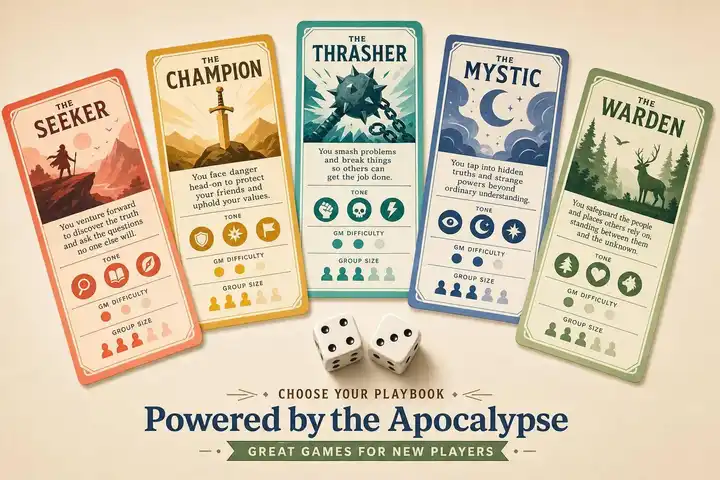
If I had to give one short answer, it’s this: Monster of the Week is the best first PbtA game for most new groups. It uses the same core 2d6 system as the others, but the episode-style setup is easier to follow, and the GM gets more support than in many other PbtA games.
Here’s the full takeaway in plain terms:
- Best first pick for most groups: Monster of the Week
- Best for fantasy fans: Dungeon World
- Best for superhero drama: Masks: A New Generation
- Best for dark teen horror: Monsterhearts
- Best for gritty survival fiction: Apocalypse World
All five games use the same basic roll:
- 10+ = full success
- 7–9 = success with a cost
- 6 or less = the GM makes a move
So the main difference is not the dice. It’s the tone, the GM workload, and how much improv or emotional buy-in your group wants.

Best PbtA Games for New Players: Side-by-Side Comparison
How to Play PbtA (Powered by the Apocalypse)
sbb-itb-b8b00a5
Quick Comparison
| Game | Genre | Rules Weight | GM Difficulty | Best For | Main Issue |
|---|---|---|---|---|---|
| Apocalypse World | Post-apocalyptic survival | 2/5 | 4/5 fit for new GMs | Groups that want harsh, messy drama | Heavy themes and lots of improv |
| Monster of the Week | Supernatural mystery | 2/5 | 4/5 fit for new GMs | Most first-time PbtA groups | Some mystery prep can be uneven |
| Dungeon World | Fantasy adventure | Light to mid | Harder to run than to play | D&D players moving to PbtA | GM has more to juggle |
| Masks: A New Generation | Teen superhero drama | Mid | Mid | Groups that want feelings-first hero stories | Needs strong group buy-in |
| Monsterhearts | Teen horror romance | 3/5 | 3/5 | Tables fine with intense drama | Heavy subject matter and safety needs |
A few facts stand out fast:
- 2 of the 5 best entry points for most new players are Monster of the Week and Dungeon World
- Character creation can be as short as 5–10 minutes in Monster of the Week
- Dungeon World gives 1 XP on a miss, which helps play keep moving
- Masks works best with 3–5 players
- Monster of the Week costs $20 for the PDF or $40 for hardcover + PDF
If you want the safest first step, I’d start with Monster of the Week. If your group wants swords and dungeons, I’d go with Dungeon World instead. After that, your pick comes down to one simple question: Do you want mystery, fantasy, superheroes, survival, or teen horror?
1. Apocalypse World

Genre: Post-Apocalyptic Survival | Complexity: 2/5 | New GM Fit: 4/5
Published in 2010, Apocalypse World kicked off the PbtA framework. It throws players into a ruined world, but with one neat twist: the group decides what caused the collapse. From there, play centers on scarcity, power, and conflict between people who are all trying to get by. Characters come from Playbooks like the Battlebabe, the Chopper, and the Brainer, so everyone steps into the wasteland with a clear role and built-in friction right away. That setup makes the game easier to run, even if it doesn’t click with every new group.
The GM is called the Master of Ceremonies (MC). Instead of guiding play through a planned plot, the MC uses a set of reactive moves. For a new GM, that’s a big help: you get structure without needing much prep, and the game gives you a clear sense of what to do next.
The main issue is the tone. Apocalypse World goes straight at heavy material, including power, betrayal, trauma, and sex. It also has Sex Moves, though groups can handle those with a simple fade-to-black and skip any explicit roleplay. So while the game is strong at showing a new GM how to run PbtA, it can be a tougher first pick for groups that want a softer landing or aren’t comfortable with messy moral choices and improv-heavy play.
If your table wants a lighter first PbtA game, the next entry is a smoother start.
2. Monster of the Week

Genre: Supernatural Mystery | Complexity: 2/5 | New GM Fit: 4/5
If your group wants a TV-style supernatural mystery, Monster of the Week is one of the easiest ways into PbtA. It gives both players and the Keeper a clear rhythm, which helps a lot when everyone is still learning. Compared with Apocalypse World, it has a more direct episode setup and far less tonal baggage. A session usually runs like an episode of TV: the hunters get a hook, dig into the case, figure out the monster’s weakness, and then face it. That pattern makes the game easy to follow from scene to scene.
Character creation is fast, usually 5 to 10 minutes, and each playbook comes with moves, gear, and a History section that sets up relationships before play starts. Players pick from playbooks like The Chosen, The Mundane, and The Professional. The main mechanic is simple: roll 2d6 and add one of five stats - Charm, Cool, Sharp, Tough, or Weird. Because each sheet is built around those playbooks and stats, it’s easy to scan at the table.
The GM is called the Keeper. Instead of writing out a fixed plot, the Keeper builds the mystery: threats, locations, bystanders, and a Countdown that tracks what happens if the hunters fail to stop the danger. That setup gives each session a built-in objective. For new groups, that can feel much easier than games that lean more on tactical fantasy or teen drama.
One small catch: some starter mysteries can feel uneven, so new Keepers may be better off writing their own. The core rulebook costs $20 for the PDF or $40 for the hardcover with PDF.
3. Dungeon World

Genre: Fantasy Adventure
If your group wants to jump from modern monster-hunting into classic fantasy, Dungeon World is probably the smoothest switch. It takes the usual fantasy setup - dungeons, dragons, and familiar classes - and turns it into a light PbtA game. Character creation is fast, usually 10–20 minutes, and the one-page playbooks put the main stuff right on the sheet.
One thing the game does well is make failed rolls matter. On a miss, the GM still makes a move, and the player gets 1 XP. So even when a roll goes sideways, the scene doesn’t stall out.
That said, Dungeon World is easier to play than it is to run. Players can pick it up without much trouble, but new GMs have more to juggle: GM Moves, Fronts, and making up consequences on the fly. That can make it tougher behind the screen than many first-time groups expect. That’s the big tradeoff here. It clears the “easy to learn, easy to enjoy” bar for players, but it asks more from the GM than some beginner-friendly games do.
People coming from D&D may also notice that Dungeon World keeps the classic six ability scores along with modifiers. Some players see that as extra baggage compared with other PbtA games.
The rules text is free to read online under a Creative Commons Attribution license, and you can also buy physical books or PDFs. If your group wants a very different mood next - more teen drama, less dungeon crawl - the next game takes PbtA in a very different direction.
4. Masks: A New Generation

Genre: Teen Superhero Drama
Where Dungeon World leans into dungeon-crawl adventure, Masks pushes PbtA toward identity, relationships, and emotional stakes. Masks: A New Generation is a teen superhero RPG set in Halcyon City, and it cares as much about who the heroes are as what they do. The game puts identity at the center, not combat.
Characters use five Labels - Danger, Freak, Savior, Superior, and Mundane - to show how they see themselves. Other characters can shift those Labels through Influence, which gives peer pressure real weight at the table. And instead of hit points, the game uses five Conditions - Afraid, Angry, Guilty, Hopeless, and Insecure. So when a character takes a hit, the fallout is usually emotional, not just physical.
For new players, the learning curve is pretty manageable. Each playbook comes with a built-in arc, like The Janus or The Nova, so players usually have a clear personal story from the start. That said, the bigger lift is often on the GM side. Halcyon City is left intentionally open-ended, and the game expects the group to help define it during a built-in session zero. That setup makes Masks a strong fit for group-driven storytelling, but it also means the GM needs to be comfortable improvising, since there’s very little pre-written plot to fall back on. The game works best with 3–5 players.
Masks is rated Teen, but the emotional intensity can still be a lot for groups that want straightforward combat or a clear win condition. It’s a better match for groups who want superhero fiction built around feelings, relationships, and self-definition.
5. Monsterhearts

Genre: Teen Horror Romance
If Masks is about teen identity, Monsterhearts takes that same pressure and pushes it into horror. Avery Alder’s game casts players as teenage monsters - Vampires, Witches, and Werewolves - trying to survive high school while their supernatural side stands in for the confusion and intensity of adolescence. That’s what makes it the heaviest game on this list.
Each Skin comes with a Sex Move and a Darkest Self, which kicks in when a character gets pushed too far. There are no hit points here. Instead, the game runs on Strings, a social currency that shows the emotional leverage characters have over each other. Players use Strings to tempt people or give them conditions, so the system leans on social power more than combat. The four stats - Hot, Cold, Volatile, and Dark - track social and supernatural pressure, not raw physical skill.
The rules themselves are pretty light. The harder part is the tone. The MC doesn’t guide players through a fixed plot so much as push the fallout higher and higher as relationships crack, twist, and blow up. Monsterhearts is rated 3/5 for complexity and 3/5 for new GM fit, which puts it a bit above something like Monster of the Week.
That intensity also means boundaries can’t be treated as an afterthought. The game deals head-on with sexuality, shame, queer identity, and personal horror. Because of that, safety tools like the X-Card and Lines and Veils are a must. A full session zero is also strongly recommended so the group can set boundaries and build the high school setting together before play starts.
Monsterhearts works best for groups that want character-driven drama, sexual content, and emotional risk. It’s a bad first pick for tables looking for light, low-pressure play.
Pros and Cons for New Players
Every game on this list runs on the same 2d6 core. What changes is how much improv it asks for and how much emotional investment it needs from the table. For first-time players, that difference matters a lot.
| Game | Biggest Strength | Biggest Hurdle | Ideal Group Type |
|---|---|---|---|
| Apocalypse World | Raw narrative impact; gritty, player-driven fiction | High improv demand; dark, morally complex themes | Fans of Mad Max-style survival |
| Monster of the Week | Familiar episodic TV structure; excellent GM scaffolding | Mystery prep can trip up first-time GMs | Fans of Buffy or Supernatural |
| Dungeon World | Bridges D&D habits directly to PbtA | May feel unfocused to both D&D and PbtA players | Traditional fantasy RPG players making their first switch |
| Masks: A New Generation | Identity-driven "Labels" system creates instant drama | Requires emotional vulnerability and buy-in | Fans of Teen Titans or Young Justice |
| Monsterhearts | Deep, character-driven emotional arcs | Requires high trust and emotional buy-in | Drama-focused tables comfortable with intense fiction |
Some games are simply easier to grasp because the fiction feels familiar. Dungeon World leans on D&D-style party roles, so fantasy players can get their footing fast. Monster of the Week helps in a different way: its episode-of-the-week format clicks right away for people who grew up on shows like Buffy or Supernatural.
GM support is where the gap gets a bit sharper. Apocalypse World asks a lot from the GM in the moment, with more improvisation and heavier themes. Monster of the Week gives new GMs clearer guardrails, which can make those first few sessions feel less shaky.
For most new tables, Monster of the Week or Dungeon World is the easiest place to start. That side-by-side view makes the starter pick pretty clear.
Final Recommendation
If your group is brand new to PbtA, Monster of the Week is the safest place to start. It uses a familiar supernatural mystery setup, so people can get the idea fast, and it gives new Keepers a clear frame to work from. As Rob Wieland notes, it is the game he recommends most often for people learning PbtA or bringing friends into RPGs for the first time.
If your group wants fantasy instead of supernatural mystery, Dungeon World is the next-best pick. It keeps the fantasy roles most players already know, which makes the shift into fiction-first play feel a lot less awkward.
For superhero fans, Masks: A New Generation works best when the group wants character drama right alongside the action. Its Labels system pushes that Young Justice or Teen Titans style of play, where identity matters just as much as punching the villain.
If your group wants even more drama, Monsterhearts is the heavier option. It’s a great game, but it asks for stronger buy-in, clearer boundaries, and a group that’s okay with messy teen emotions. Apocalypse World fits groups that want gritty, high-stakes survival fiction and are comfortable with heavy themes right away.
As Saffron Quill notes: "The 'best' game is the one that fits your group's tone, preferences, and desired level of emotional investment." Once your group knows the tone it wants, the choice gets much easier.
FAQs
Which PbtA game is easiest for first-time GMs?
Monster of the Week is often the easiest game for first-time Game Masters to run. Its episodic setup, mystery-building tools, and investigation rules make low-prep, self-contained sessions feel simple and smooth at the table.
Dungeon World is also a good pick for beginners. Its playbooks and bonds help the group click into place fast, and they make the move toward story-first play feel less intimidating.
What if my group wants more action and less drama?
Monster of the Week is a great pick if you want fast, cinematic play. It takes its cue from supernatural TV, so sessions usually revolve around digging into a mystery and then facing off with the monster behind it.
Dungeon World is another strong choice. It leans into classic fantasy adventure and uses quick, dynamic combat that keeps the story moving instead of slowing it down.
How do I choose between Monster of the Week and Dungeon World?
Choose Monster of the Week if your group likes modern supernatural mysteries, episodic adventures, and clear mission-based play. It’s also a strong fit if you want low-prep support and a game that makes it easy to jump into the next case.
Choose Dungeon World if your group leans toward high-fantasy dungeon crawling and wants a story-first option instead of a more tactical style of play. It works especially well for players coming from rules-heavy systems who still want familiar classes like wizards and fighters, just with more freedom and a looser, fiction-first approach.


