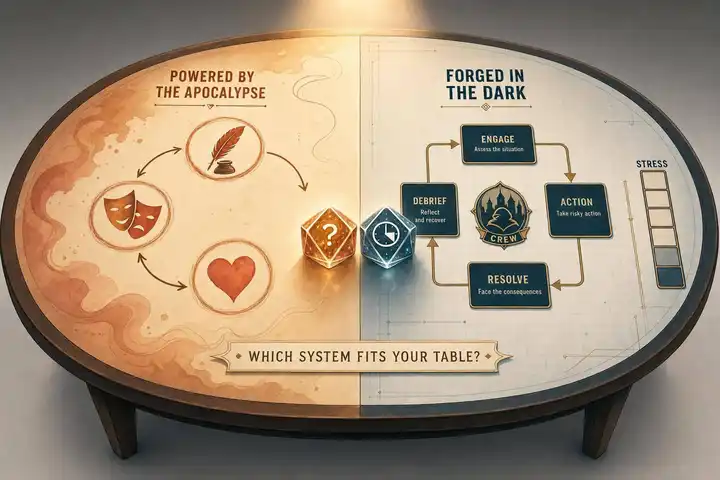
If you want loose, character-led scenes, pick PbtA. If you want mission loops, stress choices, and tighter procedures, pick FitD.
I’d sum it up like this: PbtA is lighter in the moment, with moves triggered by the fiction and a strong focus on character trouble. FitD adds more structure before and after each roll, then builds play around scores, downtime, and group progress. Both use mixed results, but they push play in different ways.
Here’s the short version:
- PbtA uses 2d6 + stat
- FitD uses a d6 dice pool and keeps the highest die
- PbtA tends to suit shorter arcs, often around 8–12 sessions
- FitD often fits longer campaigns, often 20+ sessions
- PbtA puts more weight on individual playbooks and personal drama
- FitD puts more weight on crew goals, stress, heat, and downtime
- PbtA usually asks the GM to react in the moment
- FitD usually asks the GM to track more moving parts between jobs
If you’re choosing for your table, I’d use this rule of thumb:
- Pick PbtA if your group likes play to find out, open scenes, and lighter rules overhead
- Pick FitD if your group likes heists, pressure management, and a repeatable score → fallout → recovery loop

PbtA vs FitD: Which RPG System Fits Your Table?
Mastering the Art of PbtA and Forged in the Dark - Strategies for common problems - Livestream #166

sbb-itb-b8b00a5
Quick Comparison
| Criteria | Powered by the Apocalypse | Forged in the Dark |
|---|---|---|
| Core roll | 2d6 + stat | d6 dice pool, highest die counts |
| Main result band | 10+, 7–9, 6- | 6, 4–5, 1–3 |
| Roll setup | Fiction triggers a move | Intent, action, position, and effect set first |
| Player pressure tool | Fictional choices, move outcomes | Stress, resistance, flashbacks, trauma |
| Session flow | Open scene play | Free play, score, downtime |
| Campaign focus | Character arcs | Crew progress |
| Best fit | Drama, mystery, monster-of-the-week | Heists, jobs, underworld pressure |
So if you want a simple answer, here it is: PbtA feels looser; FitD feels more structured. That one difference shapes almost everything at the table.
Core mechanics: moves and 2d6 vs dice pools, position, and stress
How Powered by the Apocalypse resolves action

In PbtA, rules kick in only when the fiction calls for a move. A player says what their character does, rolls 2d6 + a relevant stat, and gets one of three results: 10+ is a full success, 7–9 is a success with a complication, and 6 or less is a miss.
That 7–9 result is where a lot of the game lives. Instead of stopping the action, it pushes the story forward with a cost, twist, or hard choice. On a miss, the GM makes a move, and the character will often gain XP.
So the GM usually reacts to what just happened, instead of spelling out every stake in advance.
How Forged in the Dark resolves action
FitD starts from a different place. The player says what they want to do and picks an action. Before anyone rolls, the GM and player set Position and Effect. From there, the player can change the approach or spend Stress to improve the odds or the impact. If the roll still goes sideways, a Resistance Roll can reduce or cancel the consequence.
Stress does a lot of work in FitD. You spend it for extra dice, flashbacks, and resistance. If you max it out, you take Trauma, and that can remove the character from play.
The roll itself uses a pool of d6s, and only the highest die matters. A 6 is a full success, 4–5 is a success with a complication, and 1–3 is a failure with consequences.
That same setup carries through the rest of the game, including scenes, missions, and downtime.
What these mechanics feel like at the table
At the table, the difference is pretty easy to feel. In Apocalypse World or Monster of the Week, the fiction triggers the move. In Blades in the Dark, the player and GM pause before the roll to set Position and Effect. That pre-roll talk gives players more say over the terms of the action, but it also adds a bit more back-and-forth at the table.
| Aspect | PbtA | FitD |
|---|---|---|
| Core roll | 2d6 + Stat | Dice pool of d6s; highest die counts |
| Full success | 10+ | 6 |
| Partial success | 7–9, varies by move | 4–5, success with a complication |
| Failure | 6 or less, GM makes a move | 1–3, failure with consequence |
| Stakes setting | Implicit in the fiction and move text | Explicit via Position and Effect |
| Player control | Fictional positioning | Stress, Resistance, Flashbacks |
| Resolution trigger | Fiction triggers a move | Player declares intent and action |
| XP reward | Rolling a miss (6 or less) | Attempting a Desperate action |
The better match comes down to what your group wants more: a system where fiction leads and the move follows, or one where the roll setup helps frame the fiction. Those choices also shape scene flow and GM workload, which leads into the next big difference.
Play structure and GM work: open scenes vs score-downtime loops
How PbtA sessions run in Apocalypse World and Monster of the Week
Those differences in action resolution shape the rhythm of play.
In PbtA, sessions move through table conversation first. The GM - called the MC in Apocalypse World - frames scenes around the pressure happening right now, not around a preset chain of scenes. The basic flow is simple: fiction pressure → GM move → scene changes.
For prep, the GM usually works from Fronts or Threats. These are groups of linked dangers with their own agendas, often tracked with Countdown Clocks. Instead of mapping scenes in advance, the GM keeps an eye on what matters in the fiction and responds with a GM Move after a miss or when the fiction stalls. Moves like separate them, announce future badness, or put someone in a spot give the GM a rules-based list of consequences.
That setup makes PbtA feel fluid and centered on the characters. The GM reacts more than they script, so play tends to work best when everyone at the table is fine making things up on the fly.
How FitD sessions run in Blades in the Dark and Scum and Villainy
FitD takes that loose flow and turns it into a repeating mission loop.
Sessions in FitD run through Free Play, Score, and Downtime again and again. That loop lets the table zoom in for a job, then pull back out for recovery, fallout, and longer-term crew play.
One of the biggest pacing tools here is the Engagement Roll. Instead of spending a big chunk of the session planning every step, the group picks an approach, rolls, and drops straight into the action. Stress, flashbacks, and downtime keep that engine moving. Players spend Stress to push through a score, use flashbacks to account for earlier prep, and then use downtime to recover before the next job.
The GM's work in FitD is more structured, too. Along with running scenes, they track Clocks for threats and projects, plus Heat, Rep, Coin, and faction status. That visible tracking helps keep pressure steady as the campaign moves forward.
| GM Responsibility | PbtA | FitD |
|---|---|---|
| Session structure | Open scenes, driven by table conversation | Structured loop: Free Play, Score, Downtime |
| Prep focus | Fronts, NPC motivations, Countdown Clocks | Clocks, score hooks, faction status |
| Consequence style | Improvised from fiction after the roll | Negotiated via Position/Effect before the roll |
| Player planning | Handled in-character during scenes | Replaced by Engagement Rolls and Flashbacks |
| Campaign tracking | Character-focused threats | Heat, Rep, Turf, Coin, Faction Status |
Characters, progression, and campaign tone
Once the roll structure and session loop are clear, the next thing to look at is what each game rewards over time.
Playbooks, advancement, and spotlight in PbtA
In PbtA, the playbook acts like a lens for the character, not just a sheet of stats. A playbook like The Hocus or The Chosen shapes how that character reads people, what matters to them, and the kinds of trouble that keeps landing on their doorstep. That lines up with PbtA’s fiction-first, GM-reactive approach.
Advancement stays tied to playbook-specific triggers, so growth feels personal and driven by the character’s own choices. PbtA tends to work best for shorter, character-focused campaigns. As a result, advancement stays close to individual decisions and spotlight time.
Playbooks, crew sheets, and stress economy in FitD
FitD takes a different path. A character like The Cutter in Blades in the Dark is built around action ratings from 0 to 4. The center of play is less about archetype and more about what the character can do when pressure starts closing in.
That same Stress economy also creates long-term strain. When the track fills up, the character takes Trauma, which adds a lasting flaw. Because the crew advances together, the campaign feels more like one continuing operation than a set of separate character arcs. The Crew Sheet tracks the group’s shared progress and pressure. In plain terms, the system nudges everyone to move as a unit.
FitD also supports longer campaigns. That shared progression is what makes the score-downtime loop build on itself over time.
Which tones each framework handles best
Those progression tools shape the tone at the table.
PbtA fits character-driven drama and monster-of-the-week play. FitD fits heists, crews, and life under pressure.
| Feature | PbtA Example | FitD Example |
|---|---|---|
| Character identity | Individual playbook (e.g., The Hocus, The Chosen) | Playbook + Crew Sheet (e.g., The Cutter in a Smuggler Crew) |
| Advancement trigger | Playbook-specific triggers, fiction-driven XP | Desperate rolls, end-of-session questions, crew upgrades |
| Character endurance | Harm tracks and narrative debilities | Stress economy; a full track causes permanent Trauma |
| Party focus | Personal arcs and interpersonal drama | Shared reputation, resources, and pressure |
| Campaign length | Shorter, character-focused arcs | Longer campaigns |
| Tone | Genre emulation, character drama, mystery | High-pressure operations, heists, scrappy survival |
From here, the choice comes down to the play pattern that fits your table.
Which system fits your table best
After looking at rolls, pacing, and campaign shape, the choice mostly comes down to one thing: how your group likes to play. Some tables like to sketch a plan and jump in. Others want a clear mission loop with pressure that keeps building from session to session.
Choose PbtA if your group wants fiction-first, open-ended play
PbtA works best for groups that want to build the story together in the moment. Rules stay light, scenes stay open, and play tends to lean hard into character tension and drama. It’s a strong pick for groups that want low prep and a tighter arc instead of a long campaign built around repeated operations.
Choose FitD if your group wants structured missions and sustained pressure
FitD fits better when your group wants a repeatable session loop: plan, run the score, recover, repeat. The system pushes resource tradeoffs through Stress, Trauma, Coin, and Heat, and crew progression stacks up over time. That often makes it a better home for longer campaigns, including games that run 20+ sessions.
Final takeaway: match the framework to how your group actually plays
Here’s the quick version:
| Preference or Need | Better match: PbtA | Better match: FitD |
|---|---|---|
| Story structure | Open-ended, fluid scenes | Structured Score-Downtime loops |
| Planning style | Improvisational; "play to find out" | Flashbacks replace long planning sessions |
| Group dynamic | Individual goals; supports PvP conflict | Unified crew with shared goals |
| Mechanical depth | Low overhead; fiction-first | Granular risk/reward via Position & Effect |
| Campaign length | Often 8–12 sessions | Often 20+ sessions |
Neither framework is better across the board. PbtA suits tables that want looser structure and shared fiction. FitD suits tables that want mission loops, clear procedures, and pressure that builds across a campaign.
Pick the one that matches your group’s pace, prep style, and comfort with structure.
FAQs
Can PbtA handle long campaigns well?
PbtA usually works best for short- to medium-length campaigns, often in the 6 to 20 session range. These games tend to put character arcs front and center early on, and they usually don’t lean on long-term power growth.
Some PbtA games can support longer play, especially 8- to 12-session story arcs. But in most cases, they aren’t built around extended loot gains or slow, tactical power buildup.
Is FitD too rules-heavy for new players?
It depends on how you look at it, but Forged in the Dark is usually seen as more granular and crunchy than Powered by the Apocalypse.
Its set systems - phases, stress, position and effect, and group mechanics - can feel like a lot at first. That said, the core action rules are pretty simple and can be summed up in just a few pages.
Which system is easier for a first-time GM?
Forged in the Dark is usually easier for a first-time GM because it gives you more structure at the table.
You get clear tools to lean on, like the Position and Effect conversation, along with set phases such as mission scores and downtime. That kind of framework can take a lot of pressure off when you're still finding your footing.
By contrast, Powered by the Apocalypse often asks more from the GM in the moment. You need to improvise more often and read moves through the fiction, which can feel a bit less guided for someone new behind the screen.


