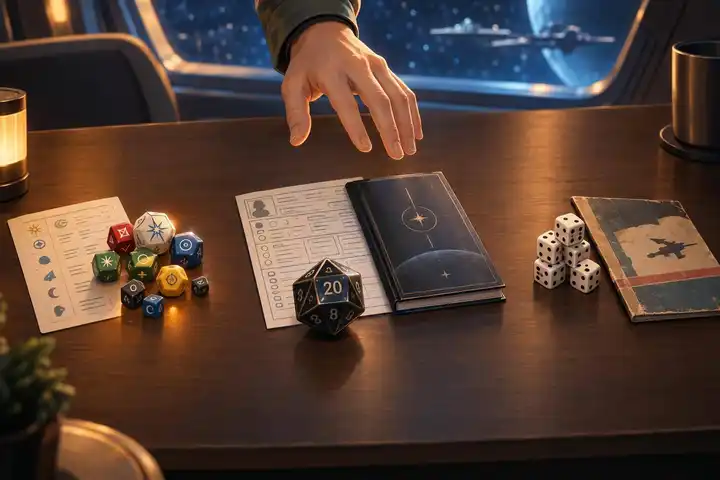
My pick: narrative dice for story twists, Saga Edition for tactical battles, or West End Games d6 for simple skill rolls. Start with 1 core rulebook, not a stack of supplements, and choose based on how your group likes to play.
I’d compare the three by their dice, combat, character options, Force rules, and book availability. All support Jedi and non-Jedi, but mixed groups need scenes where pilots, technicians, and negotiators matter - not just lightsaber users.
Quick Comparison
| System | Dice and combat | Character and Force options | What you need |
|---|---|---|---|
| Fantasy Flight narrative dice | Custom symbols create success, failure, and twists; combat uses range bands | Careers, talent trees, and Force powers; moderate learning curve | Edge of the Empire, Age of Rebellion, or Force and Destiny, plus narrative dice or a digital roller |
| Saga Edition | d20 checks; positioning and action choices drive combat | Classes, feats, talents, and detailed Jedi builds; more rules to learn | Out-of-print core book and standard polyhedral dice |
| West End Games d6 | Six-sided dice pools; skill-based combat | Templates, skill upgrades, and 3 Force skills; simplest starting rolls | A WEG rulebook - this guide uses 1996 Revised and Expanded - plus d6s and a separate Wild Die |
I’d check book availability before committing, especially for Saga and d6. Then I’d pick the rules the whole group wants to learn - not just the system with the most Jedi options.

Which Star Wars TTRPG Should You Play?
WEG Star Wars RPG (My Definitive Guide to the Greatest Game in a D6 Galaxy Far, Far,Away)
Fantasy Flight Narrative Dice: Rolls That Shape the Story
Fantasy Flight’s system is the most cinematic of the three. Its dice don’t just count hits - they help shape what happens next.
Dice Pools and Combat
Build a dice pool from a characteristic and a skill, then add difficulty, challenge, boost, or setback dice to match the situation. Success and failure cancel each other out, as do Advantage and Threat. Triumph adds a success plus a major benefit. Despair adds a failure plus a serious complication.
Combat still uses initiative, turns, actions, maneuvers, damage, and critical injuries. But instead of exact grid measurements, it uses engaged, short, medium, long, and extreme range bands. Moving, aiming, and taking cover still matter tactically. The symbols add benefits and complications that give fights their cinematic feel.
Character Creation and Force Powers
That story-first approach also shapes character creation and advancement.
Characters combine species, career, specialization, characteristics, skills, talents, and equipment, supporting broad, story-driven campaigns. Advancement happens through small, specific upgrades, and learning the options takes time. Force and Destiny uses the same core engine but focuses on Jedi training, lightsaber combat, and moral pressure. In mixed parties, give non-Jedi plenty of chances to use technical, social, piloting, and combat skills.
Each core book adds its own pressure mechanic:
- Obligation in Edge of the Empire centers on debts, enemies, family responsibilities, and other burdens.
- Duty in Age of Rebellion focuses on contributions to the Rebel cause.
- Morality in Force and Destiny focuses on ethical choices and dark-side temptation. Questionable actions and dark-side use can generate Conflict.
These mechanics work best when the GM brings them into the story regularly, rather than treating them as background bookkeeping.
Required Core Rulebook and Narrative Dice
Choose Edge of the Empire for fringe adventures, Age of Rebellion for Rebel campaigns, or Force and Destiny for Force-centered play. Before your first session, get Star Wars roleplaying narrative dice or a compatible digital roller. Standard polyhedral dice can’t display the symbol results.
Saga Edition: Tactical Combat and Detailed Builds
Choose Saga Edition for tactical, rules-forward Star Wars play. Where narrative dice lean into cinematic effects, Saga puts planning, grid play, and detailed builds first. The trade-off? More preparation. Learning feats, talents, prerequisites, and situational modifiers takes time.
d20 Checks and Combat Actions
Saga Edition rewards careful positioning and planning your actions. Attacks target Reflex, Fortitude, or Will Defense. A turn usually includes a standard action, a move action, and a swift action, with initiative setting the order.
Characters track hit points as damage adds up, but conditions and penalties can weaken them before they drop. Movement, cover, range, reach, and threatened spaces all matter. A battle map helps you keep track.
Classes, Talents, and Jedi Builds
That tactical focus carries into character creation. The five core heroic classes are Jedi, Noble, Scoundrel, Scout, and Soldier. Species, skills, feats, class features, and talents shape each build, while multiclassing gives you more options.
Nobles focus on leadership, Scoundrels on deception, Scouts on reconnaissance, and Soldiers on frontline combat. Picking a role early makes character creation easier to navigate.
Jedi builds bring together lightsaber proficiency, combat talents, and Use the Force. The Force Training feat grants access to powers used through Use the Force, and Force sensitivity isn’t limited to Jedi. Saga supports both Jedi and non-Jedi characters, but Force-heavy Jedi can overshadow others in mixed parties. Give everyone clear combat and support roles, including piloting, slicing, and negotiation.
Required Core Rulebook and Polyhedral Dice
To get started, you’ll need the Star Wars Roleplaying Game Saga Edition Core Rulebook and standard polyhedral dice: a d20 for checks, plus d4s, d6s, d8s, d10s, and d12s for damage. Supplements are optional. The core book is out of print, so plan to find a used copy or borrow one from a library.
West End Games d6: Skill-Based Adventures
If Saga felt too crunchy, d6 brings Star Wars back to quick rolls and flexible roleplay.
Choose d6 for straightforward dice pools and a low-fuss route into pulp-style adventures. This overview uses the 1996 Revised and Expanded edition.
d6 Pools and Combat Rules
Roll attribute and skill dice against a difficulty. The Wild Die adds unpredictability: it can explode on a 6 or cause complications on a 1, depending on the GM’s call. Every action beyond the first applies −1D to every action that round. Dodging, using Force powers, or maintaining powers can count as extra actions.
Combat uses the same skill framework for blaster fire, melee, vehicles, and starships. Resolve damage separately against the target’s resistance. Armor, multiple actions, and scale can slow complex fights, while large space battles add extra steps.
Character Templates and Force Skills
Templates give smugglers, scouts, soldiers, pilots, technicians, bounty hunters, and droids a clear starting point. To build a custom character, combine species, six attributes, skill dice, and equipment.
Force users invest in Control, Sense, and Alter to use powers with their own requirements and difficulties. Jedi and non-Jedi follow the same basic skill framework, but choosing Force skills means giving up other starting options. As Force users advance, GMs should make sure non-Jedi still get their time in the spotlight.
Required Rulebook and Six-Sided Dice
You need the 1996 Revised and Expanded core rulebook, standard d6s, and a distinct Wild Die. The dice are easy to find. The out-of-print book is the main hurdle, so check the edition before buying a used copy.
Final Comparison: Find Your Group's Best Fit
Your choice comes down to cinematic chaos, tactical planning, or fast skill checks.
| Category | Fantasy Flight narrative dice | Saga Edition | West End Games d6 |
|---|---|---|---|
| Resolution | Custom dice combine success/failure with Advantage/Threat; Triumph and Despair add bigger twists | d20 checks against target numbers or defenses | Roll a skill-based pool of six-sided dice and compare the total with a difficulty |
| Combat | Cinematic, with consequences that shape the action | Tactical, focused on positioning, and action-heavy | Fast, flexible, and suited to pulp adventures |
| Character-building depth | Moderate to high: careers, specializations, talents, skills, gear, and Force trees | High: classes, levels, feats, talents, species, gear, and Force powers | Moderate: templates for quick starts, plus skills, special abilities, and Force skills |
| Jedi support | Strongest in Force and Destiny for Force-sensitive characters | Extensive Jedi, lightsaber, and Force options | Force-sensitive characters use Control, Sense, and Alter within the same broad skill framework |
| Non-Jedi support | Strong options for smugglers, soldiers, spies, pilots, explorers, and similar archetypes | Strong support for soldiers, scouts, nobles, scoundrels, officers, and other non-Force builds | Especially strong for pilots, smugglers, soldiers, scouts, mechanics, and other ordinary heroes |
| Learning curve | Moderate: learn the symbols and mixed result types | Moderate to high: d20 basics plus many interacting rules | Low to moderate: a simple core dice procedure, with deeper Force and vehicle rules later |
| Storytelling | Very high: one roll can succeed and still create a complication | Moderate: story often depends on how the GM interprets conventional checks | High for loose, cinematic campaigns built around broad skill use |
| Required dice | Custom narrative dice or a digital roller | Standard polyhedral dice | Standard d6s plus a Wild Die |
| Core book | Choose the book for your campaign line: Edge of the Empire, Age of Rebellion, or Force and Destiny | Star Wars Saga Edition Core Rulebook | A West End Games d6 core rulebook, such as Star Wars, Second Edition, Revised and Expanded |
The narrative-dice books are separate campaign lines - not three required purchases. Saga rewards planning your character build, while d6 favors fast character creation.
Jedi and Non-Jedi Play
Force-sensitive doesn’t automatically mean trained Jedi. All three systems support mostly non-Jedi campaigns. Choose the Force rules your players want rather than assuming lightsabers have to drive the story.
For groups mixing Force users with ordinary heroes, these differences can help settle the choice.
| Consideration | Fantasy Flight narrative dice | Saga Edition | West End Games d6 |
|---|---|---|---|
| Jedi starting options | Force-focused careers or Force-sensitive specializations | Jedi class and hybrid builds | Force-capable templates or custom characters |
| Force use | XP-funded powers and talents support Force abilities and lightsaber skills | Level-based powers, feats, and talents support tactical Force and lightsaber builds | Control, Sense, and Alter govern powers; skill advancement supports Force use and lightsaber combat |
| Moral consequences | Morality and Conflict in Force and Destiny; campaign-dependent elsewhere | Dark Side Points | Dark Side Points |
| Non-Jedi specialization | Careers and talent trees | Classes, feats, and talents | Skill investment |
| Mixed-party tip | Give non-Jedi challenges that use their specialties and personal stakes in the story | Watch Force-heavy builds and keep party roles distinct | Monitor Force advancement and protect non-Jedi specialties |
Build missions with social, technical, piloting, and combat scenes so every character gets time in the spotlight.
Learning Time and Book Availability
Once you’ve found rules that fit, book availability can break the tie.
Narrative dice take some symbol practice. Saga uses familiar d20 mechanics but brings more rules to learn. d6 has the simplest starting procedure.
Start with one core book and the required dice. Supplements can wait. Before buying, check an official publisher, retailer, library, or authorized digital store for availability - especially for older Saga and d6 books.
Which System Should You Choose?
Match the system to the play your group enjoys: narrative dice for cinematic scenes and complications, Saga Edition for tactical d20 battles, or d6 for fast, flexible adventures.
FAQs
Can I combine the three narrative-dice core books?
Yes. The Fantasy Flight/Edge narrative-dice core books use a modular system, so you can mix rules and content from all three books to shape your space-opera game.
Can I convert characters between these systems?
Not directly. These systems use different dice mechanics, combat rules, and character-building structures. A character built for one system won’t reliably work as-is in another.
Instead, carry over the character’s concept: match their role, pick similar skills or talents, and keep their backstory. Rebuild the character using the new system’s rules and books, then use that system’s dice and combat rules during play.
Which system works best for a one-shot?
The best Star Wars system for a one-shot depends on how your group likes to play. Narrative dice suit cinematic storytelling and help players get into the action right away. Saga Edition works well for tactical, structured combat and character builds. West End Games d6 keeps things simple, with fast play and straightforward mechanics.
In general, fewer rules and less prep make it easier to finish a complete story in one session.


