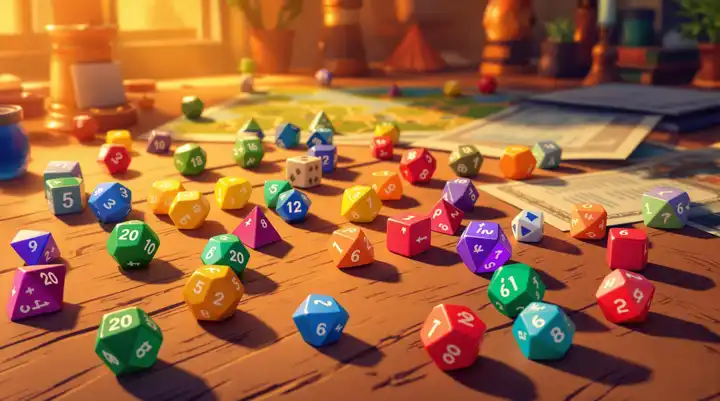
A TTRPG dice system does more than decide whether an action succeeds. It determines how predictable competence feels, how often complications appear, how much players can judge risk before rolling, and whether one throw answers a simple yes-or-no question or creates several consequences at once.
The most useful way to compare dice mechanics is not by asking which die is best. Ask what information the roll produces, how characters change the odds, and what decisions happen before and after the dice hit the table.
Major TTRPG dice systems at a glance
| System | Probability and resolution | Typical table feel | Examples |
|---|---|---|---|
| d20 plus modifier | One flat die roll against a target number | Fast, legible, and relatively swingy | Dungeons & Dragons, Pathfinder |
| 2d6 plus modifier | Two dice create a bell-shaped distribution, often with outcome bands | Middle results are common; mixed outcomes can drive play | Apocalypse World, many PbtA games |
| Percentile roll-under | Roll d100 at or below a skill rating | Transparent odds and granular skills | Call of Cthulhu, Basic Roleplaying |
| Success-counting dice pool | Roll several dice and count results that meet a threshold | Competence becomes tangible as the pool grows | Shadowrun, Year Zero Engine games |
| Keep-highest dice pool | Roll several dice and read the highest result | One roll can establish success, cost, and severity | Blades in the Dark |
| Step dice | Ability changes the size of the die rather than only adding a modifier | Advancement feels tactile and easy to see | Savage Worlds, Cortex games |
| Fudge or Fate dice | Four dice cluster around zero, then add a skill | Characters feel consistent; aspects create leverage | Fate Core |
| Symbol or custom dice | Different symbols can cancel or coexist | Success and side effects can be independent | Star Wars Roleplaying, Genesys |
Flat dice versus curves
A single d20 has a flat distribution: every face is equally likely, so each +1 changes the chance of meeting a fixed target by five percentage points. That makes bonuses easy to understand, but it also means extreme natural results occur as often as any other individual face.
Rolling two or more dice and adding them creates a curve. On 2d6, results near seven appear much more often than two or twelve. Small modifiers therefore matter most around the common middle of the range. This is one reason many Powered by the Apocalypse games can make a +1 feel substantial without building long modifier lists.
Neither shape is inherently more realistic or more narrative. A flat die is useful when designers want broad uncertainty and simple arithmetic. A curve is useful when ordinary outcomes should cluster and exceptional results should be genuinely exceptional.
d20 roll-over systems
The familiar d20 pattern is straightforward: roll a twenty-sided die, add relevant modifiers, and meet or exceed a difficulty number. The core roll is fast, and players can usually tell whether a bonus is helpful. Much of the system's actual texture comes from everything around that roll: advantage, disadvantage, proficiency, critical rules, resource spending, and the consequences of failure.
A d20 does not automatically create tactical play. Dungeons & Dragons and Pathfinder build tactical depth through action economies, character options, positioning, and encounter rules. Lighter d20 games can use the same die while producing a very different experience.
2d6 and tiered outcomes
Many 2d6 games use outcome bands rather than a single target. In Apocalypse World, moves are triggered by events in the fiction; the roll then directs the move's specific result. A 10+ usually provides the move's strongest outcome, a 7–9 creates a weaker result, cost, or hard choice, and a 6 or less gives the MC an opportunity to respond. The important design is not simply “roll 2d6.” It is the connection between fictional triggers, move-specific choices, and consequences.
With no modifier, 7–9 and 6 or less are equally likely: each accounts for 15 of the 36 possible results, or about 41.7 percent. A 10+ accounts for the remaining six results, or about 16.7 percent. Modifiers shift the balance among miss, mixed result, and strong hit. This produces a rhythm in which capable characters succeed more cleanly while complications remain part of play.
Percentile and roll-under systems
Percentile systems make competence immediately readable. If a skill is 65, the basic chance of rolling at or below it is 65 percent before difficulty adjustments. Call of Cthulhu uses this transparency to support a large skill list and degrees of success based on fractions of a skill rating.
Roll-under systems can use other dice as well. The appeal is the same: the character sheet often shows the target directly, reducing the need for the GM to announce a new number for every ordinary task. Difficulty may instead modify the rating, require a stronger degree of success, or change the consequences.
Success-counting dice pools
In a success-counting pool, ability is often represented by how many dice a player rolls. Each die meeting a threshold contributes a success, and the number of successes can determine quality, speed, damage, or additional effects. Adding a die changes both the chance of getting at least one success and the potential ceiling.
Dice pools vary dramatically. Shadowrun builds pools from attributes and skills. Year Zero Engine games often make equipment, stress, attributes, and skills visible in the pool and may let players push a roll at a cost. The shared handful of dice does not mean the games create the same decisions.
Forged in the Dark action rolls
Blades in the Dark uses a pool of d6s and reads the highest die. A 6 is a full success, 4–5 succeeds with a consequence, and 1–3 goes badly. Two or more sixes create a critical. Before rolling, the table establishes position—controlled, risky, or desperate—and effect—limited, standard, or great.
That order matters. The player knows the likely danger and potential impact before committing. The roll then resolves action and consequence together, while resistance rolls and stress let players decide how much of a consequence they are willing to absorb. The system's identity comes from that complete conversation, not only from keeping the highest d6.
Step dice, roll-and-keep, and dice chains
Step-die systems express ability through die size: a stronger trait might rise from d6 to d8 or d10. This makes advancement visible at a glance. In Savage Worlds, traits use different die types and important characters also roll a Wild Die, keeping the better result.
Roll-and-keep systems separate how many dice you roll from how many you retain. That creates design space for choosing between reliability, high individual results, and the number of useful outcomes. Other games use dice chains, moving up or down through d4, d6, d8, d10, d12, and beyond as circumstances change.
Fate dice and centered results
Fate Core rolls four Fate dice, each showing plus, minus, or blank. The total ranges from −4 to +4 but clusters strongly around zero, so a character's skill rating usually remains the largest part of the result. Aspects, invokes, and fate points then let players spend narrative leverage when a result matters.
This produces a different kind of uncertainty from a d20. The dice usually nudge competence rather than replacing it, while the economy around aspects determines when players exceed their normal limits.
Custom symbols and multidimensional results
Custom dice can encode more than magnitude. In Star Wars Roleplaying and Genesys, success and failure symbols cancel on one axis while advantage and threat interact on another. A character can therefore succeed while creating a complication or fail while gaining a useful side benefit.
The strength is expressive output from one roll. The tradeoff is learning proprietary symbols and interpreting results consistently. These systems work best when the table enjoys turning mechanical side effects into concrete fictional changes.
How to choose a dice system for your table
- Choose d20 roll-over when you want familiar procedures, clear target numbers, and room for tactical rules around a simple core.
- Choose 2d6 bands when mixed results, move-specific consequences, and a predictable middle should keep the fiction moving.
- Choose percentile roll-under when players should understand their basic odds directly from the character sheet.
- Choose a success-counting pool when competence, help, gear, or stress should become a visible handful of dice.
- Choose a keep-highest pool when one roll should quickly establish both outcome and consequence.
- Choose step dice when changes in ability should feel tactile without relying on long modifier totals.
- Choose custom symbols when the table wants success and side effects to vary independently.
Rules weight does not follow directly from dice choice. A d20 game can be extremely light or highly tactical; a dice-pool game can resolve an entire conflict in one roll or require several subsystems. Compare the complete procedure, not just the dice in the tray.
Questions to ask when evaluating a resolution mechanic
- Can players estimate risk before committing?
- Does the roll answer only success or failure, or also cost, effect, and collateral consequences?
- How does character competence change the odds?
- How often does the system ask for a roll?
- Can players spend resources, accept danger, or change their approach before rolling?
- What happens after failure: a dead end, a new problem, lost resources, or a change in position?
- Does the mechanic remain fast when the table is tired or the scene becomes complicated?
Frequently asked questions
What is the most common TTRPG dice system?
The d20 roll-over format is the most widely recognized because of Dungeons & Dragons and related games. Six-sided dice pools, 2d6 outcome bands, and percentile roll-under systems are also common across major TTRPG families.
Are dice pools less random than a single die?
Not automatically. A pool changes the distribution and can make competence more consistent, but the result depends on how successes are counted, whether dice explode, whether players keep only some dice, and what target the roll must reach.
Why do PbtA games use partial successes?
Many PbtA moves use a middle band so an action can work while introducing a cost, reduced effect, danger, or choice. This prevents many rolls from ending with “nothing happens,” but each move defines its own outcomes.
What is the easiest dice system for beginners?
A single roll-over or roll-under check is usually quickest to explain. Ease at the table depends more on how many exceptions, modifiers, resources, and follow-up steps surround the roll than on the die itself.
Do narrative TTRPGs use fewer dice?
Some do, but “narrative” does not describe one mechanic. Fate, PbtA, Forged in the Dark, Genesys, and many GM-less games all use dice differently. What they often share is that a roll changes the fictional situation rather than merely checking whether a task works.


