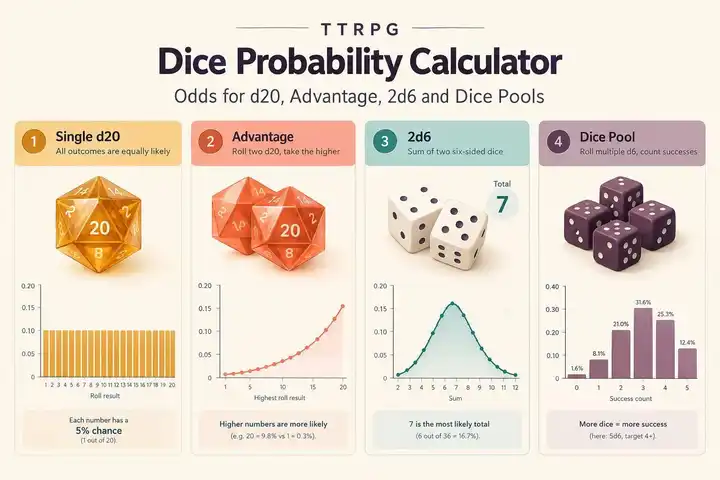
A 15+ d20 check succeeds 30% of the time - or 51% with advantage. I use this calculator to compare success odds and result distributions, starting with the roll rule your game uses.
The four modes answer different questions:
- Single d20: Does your roll plus modifier meet the target? Each added successful face changes the odds by 5 percentage points.
- d20 advantage: Roll twice and keep the higher die. The boost depends on the target.
- 2d6 totals: Add both dice and any modifier. Results cluster around 7; an 8+ total succeeds 41.7% of the time.
- Success-counting pools: Count dice that meet a threshold. Five d6s needing 5+ per die have a 53.9% chance of at least two successes.
I check the success rule before the percentage: exactly two successes isn’t the same as at least two. Natural 1s and 20s, rerolls, exploding dice, and other special rules may need a different model.

TTRPG Dice Odds: d20, Advantage, 2d6 and Dice Pools
Pro GM Explains Dice Rolls In DND VS OTHER TTRPGs
1. d20 Checks
A single d20 check is the baseline: a +1 bonus improves the odds by 5 percentage points, while a +1 target reduces them by the same amount - when that change adds or removes one successful face.
Inputs and Success Conditions
Enter an integer target number and modifier. Add all bonuses and penalties into one modifier, using negative values for penalties. A check succeeds when d20 + modifier ≥ target. Meeting the target counts.
Probability Calculation
The minimum roll needed is r = target − modifier. Calculate the success chance as min(1, max(0, (21 − r) / 20)), then multiply by 100 for a percentage.
Target 15 with a +3 modifier requires 12+. Faces 12–20 give 9/20 = 45% success and 55% failure. Increasing the modifier to +5 lowers the required face to 10 and raises success to 55%.
Distribution and Target Sensitivity
Each d20 face accounts for 5 percentage points. A +1 bonus adds that much to the success chance if it makes one more face succeed. A +1 target removes that much if it makes one successful face fail.
Task Difficulty and Reliability
Judge difficulty by the final odds, not just the target number. Show minimum roll, success count, success chance, and failure chance together so they're easy to compare. Use this flat-probability baseline to compare difficulty and reliability across advantage, 2d6, and dice pools below.
These calculations assume an ordinary threshold check. Treat 0% and 100% as final only when the roll’s rules allow it; some attack rolls still have natural 1/20 exceptions.
2. d20 Advantage
Inputs and Success Conditions
Choose Normal or Advantage, then enter your modifier (positive or negative) and target. Advantage rolls two d20s and keeps the higher die. The roll succeeds when the total meets or beats the target. Its boost follows a curve rather than adding a flat bonus.
Probability Calculation
If normal success is p, advantage success is 1 − (1 − p)²: both dice must fail for the attempt to fail. Show the selected mode’s success chance alongside normal odds, advantage odds, and the percentage-point gain.
For 15+ on a d20 with no modifier, six faces succeed: 30% normal success. Advantage reduces failure from 70% to 0.70² = 49%, raising success to 51% - a 21-percentage-point gain without changing the die size or target.
Distribution and Target Sensitivity
Advantage helps most when normal success is 50%. It brings that chance to 75%, a 25-percentage-point gain. At a 5% baseline, success reaches just 9.75%. The target determines how much advantage helps.
Task Difficulty and Reliability
Read the result as the odds for one attempt, not a guarantee. Even 51% success leaves 49% failure.
Use advantage only when the rules grant it. Under D&D rules, multiple sources don’t add more dice, and advantage plus disadvantage cancels to a normal roll. Comparing this curve with 2d6 totals and dice pools makes the difference easier to see.
3. 2d6 Totals
Inputs and Success Conditions
2d6 results cluster around 7, so small target changes affect your odds more than they do on a d20. Enter the target as a minimum total, not an exact result. For additive modifiers, use effective target = base target − modifier. An effective target of 2 or less means automatic success; 13 or higher means automatic failure.
Probability Calculation
Two fair d6s have 36 equally likely ordered outcomes. To find your success probability, count the outcomes that meet or exceed the effective target, then divide by 36.
For 8+, totals 8–12 contribute 5 + 4 + 3 + 2 + 1 = 15 successful pairs. That gives 15/36 = 41.7% success, leaving 58.3% failure. Exactly 8 accounts for only 5/36 = 13.9% - so excluding higher totals would understate your odds.
Distribution and Target Sensitivity
A d20 gives each result the same chance. With 2d6, the odds peak at 7: six ordered pairs total 7, but only one pair each totals 2 or 12.
Against an 8+ requirement, +1 raises success to 58.3%; −1 lowers it to 27.8%.
Task Difficulty and Reliability
Use these odds bands to judge how much risk a task carries.
6+ succeeds 72.2% of the time, while 10+ succeeds only 16.7%.
4. Dice-Pool Successes
Inputs and Success Conditions
Unlike d20 checks or 2d6 totals, dice pools count successes instead of adding die results.
Enter the pool size (n), die size (d), success threshold (t), and required successes (k). Then choose exactly k or at least k. All inputs must be whole numbers: n ≥ 0, 1 ≤ t ≤ d, and 0 ≤ k ≤ n.
Probability Calculation
For independent, fair dice that share a success threshold, each die succeeds with probability p = (d − t + 1) / d. Calculate exactly k successes with the binomial formula, or add the probabilities for k through n successes to find at least k.
Here’s how that works in play:
Enter five d6s, a 5+ threshold, and two required successes. Each die succeeds with probability (1/3). Exactly two successes gives (80/243=\mathbf{32.9%}); at least two gives (1-32/243-80/243=131/243=\mathbf{53.9%}). Selecting “exactly” would leave out rolls with three, four, or five successes.
Distribution and Target Sensitivity
Show success counts from 0 to n and highlight the selected result band. Expected successes are E[X] = np, or 1.67 for this five-die pool. That’s an average, not a guaranteed result.
Adding dice or lowering the success threshold increases the average, but each changes the distribution differently. Compare the chance of meeting your target, not just the average.
Task Difficulty and Reliability
Requiring at least one success gives 86.8% odds. Requiring at least two drops those odds to 53.9%. Increasing k makes the task harder without changing the pool.
This model requires identical, independent, fair dice. Rerolls, exploding dice, mixed pools, and opposed rolls need separate rule support. Within those limits, you can tune the pool’s difficulty against the d20 and 2d6 odds above.
Compare Success Odds and Roll Distributions
Each mode handles difficulty differently: even steps, curved boosts, totals clustered around the middle, or counted successes.
With no modifier, a d20 check succeeds when you roll the target or higher. Each one-point change shifts success odds by 5 percentage points, within the 0%–100% limits.
| d20 target | Required faces | Successful-face count | Success odds |
|---|---|---|---|
| 5 | 5–20 | 16 | 80% |
| 10 | 10–20 | 11 | 55% |
| 11 | 11–20 | 10 | 50% |
| 15 | 15–20 | 6 | 30% |
| 20 | 20 | 1 | 5% |
That makes d20 odds easy to read - and shows exactly how much a one-point change matters.
For 15+, normal success is 30%, advantage is 51%, and disadvantage is 9%.
Advantage gives its largest boost near a 50% baseline, increasing success to 75%.
| Needed roll | Normal | Advantage | Disadvantage* |
|---|---|---|---|
| 5+ | 80% | 96% | 64% |
| 11+ | 50% | 75% | 25% |
| 15+ | 30% | 51% | 9% |
| 20+ | 5% | 9.75% | 0.25% |
Disadvantage figures are mathematical reference values for keeping the lower of two d20s.
2d6 works differently: totals cluster around the middle rather than occurring equally often. The most common total is 7.
8+ succeeds on 15/36 outcomes, or 41.67%. Dropping the target to 7+ adds six successful outcomes, a 16.67-percentage-point gain.
| 2d6 total | Ordered-pair count | Probability |
|---|---|---|
| 2 | 1 | 2.78% |
| 3 | 2 | 5.56% |
| 4 | 3 | 8.33% |
| 5 | 4 | 11.11% |
| 6 | 5 | 13.89% |
| 7 | 6 | 16.67% |
| 8 | 5 | 13.89% |
| 9 | 4 | 11.11% |
| 10 | 3 | 8.33% |
| 11 | 2 | 5.56% |
| 12 | 1 | 2.78% |
For d6 pools where 5–6 count as successes, check the column for the number of successes you need - not just the expected count.
For 5d6, at least two successes is 53.91%.
| Pool size | Expected successes | At least one success | At least two successes |
|---|---|---|---|
| 3d6 | 1.00 | 70.37% | 25.93% |
| 5d6 | 1.67 | 86.83% | 53.91% |
| 7d6 | 2.33 | 94.15% | 73.66% |
These rolls aren't equivalent difficulty tests. Each uses different thresholds, possible outcomes, and success rules. The numbers provide baselines for comparing roll engines and task difficulty; rerolls, explosions, botches, and crit rules can change the odds.
Strengths, Limits, and Rule Support
Check that the calculator’s mode matches the game’s resolution rules - not just its dice. The percentage is only correct if the rule model is correct.
| Mechanic | Distribution | Main Input | Output Type | Strength | Limitation |
|---|---|---|---|---|---|
| Normal d20 | Uniform faces | Target number and modifier | Chance of meeting or exceeding target | Easy to audit | Limited precision |
| d20 advantage | Maximum of two d20s | Target number and modifier | Chance that at least one die meets target | Reduces low results | Boost varies by target |
| 2d6 total | Center-weighted | Target total and modifier | Chance of meeting or exceeding target | More predictable middle totals | Uneven modifier effects |
| Success-counting pool | Binomial | Pool size, per-die success chance, required successes | Chance of exactly or at least k successes | Separates pool size from success requirements | Identical, independent dice only |
With the right model, you can compare the odds across these mechanics. Judge difficulty by the odds and stakes, rather than a generic easy/hard label. Check the output wording, too: “exactly two successes” and “at least two successes” answer different questions.
Pool rules call for extra care. This calculator’s success-counting model requires identical, independent dice. Sum-based, highest-die, mixed-probability, and dependent pools need different models.
Before trusting a result, define how the game handles ties, threshold modifiers, natural 1s or 20s, rerolls, exploding dice, and partial successes. Label unsupported rules instead of silently ignoring them. Return 0% or 100% only when no special rule overrides the threshold. To interpret the odds, make the rule model, threshold, and outcome bands explicit - the same percentage can mean different things under different rules.
Conclusion: Choose the Mode That Matches the Roll
These benchmarks show how flat d20, advantage, 2d6, and success-counting pools handle the same challenge differently. For a 15+ d20 check, advantage adds 21 percentage points to the chance of success - but failure still happens nearly half the time.
Choose the calculator mode that matches the game’s roll rule, including any supported rerolls or automatic failures. Treat the odds as tendencies, not guarantees: probability tells you how often a roll succeeds, while the game’s resolution method tells you how to interpret that result.
FAQs
When is advantage better than a +2 bonus?
Advantage generally beats a flat +2 bonus when the target number falls near the middle of the d20 range. It gives you a bigger boost when your base chance of success is between 45% and 85%.
A +2 bonus adds a steady 10 percentage points to your success chance. The boost from advantage, on the other hand, depends on your starting chance.
How do I calculate success odds across repeated attempts?
Treat each attempt as independent, with the same success probability, p, for your chosen dice mechanic. The chance of at least one success in N attempts is:
1 − (1 − p)^N
That’s one minus the chance that every attempt fails.
For at least k successes - such as 2+ successes on five dice - use the same per-attempt probability, p, and add up the probabilities of all outcomes with k or more successes.
How can I match difficulty across different dice systems?
Compare the odds of success, not just target numbers. On a single die, such as a d20, every result has the same chance. With 2d6, results near the average are more likely than either extreme.
Check each task’s success threshold against the probabilities for its dice. For dice pools, adjust either the number of dice or the threshold each die must meet. Aim for similar success odds when matching difficulty, while keeping the level of risk and story tension you want.


