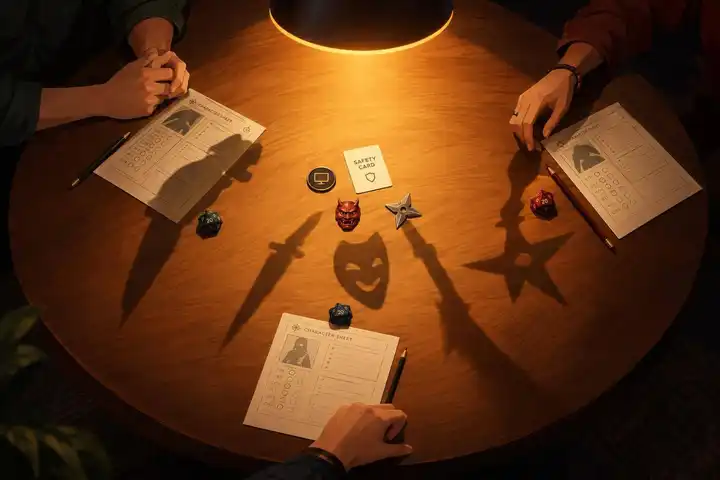
I’d pick Paranoia for comic sabotage, The Mountain Witch for painful choices, and Shinobigami for tactical rivalry. Before choosing, agree on whether lying, theft, attacks, and character death belong at your table.
All 3 games use secrets, but they make betrayal feel different:
- Paranoia: Hidden loyalties, conflicting orders, and replacement clones turn backstabbing into dark comedy. Best for episodic missions and players who enjoy losing with a laugh.
- The Mountain Witch: Secret Dark Fates and spendable Trust put relationships at risk. Best for a short samurai story where cooperation comes before betrayal.
- Shinobigami: Private missions, information gathering, and structured combat drive shifting alliances. Best for scenario-based ninja rivalry - though some scenarios favor cooperation.
Quick Comparison
| Game | Hidden information | Alliances and PvP | Tone and length | Prep focus |
|---|---|---|---|---|
| Paranoia | Affiliations and orders | Unstable; frequent sabotage | Dark comedy; episodic missions | Choose an edition and play style |
| The Mountain Witch | Dark Fates | Trust can turn against you; conflict builds | Samurai tragedy; short arc | Explain Trust and allow relationships to develop |
| Shinobigami | Secrets and missions | Shifting teams; scenario sets competition | Tactical ninja drama; structured scenario | Prepare handouts and check PvP intensity |
My rule: keep the secrets in the fiction, not in the consent agreement. Set limits on betrayal themes, decide how private information works, and give everyone a way to pause. That leaves room for surprise without making another player’s discomfort part of the game.
1. Paranoia
Setting and Hidden Information
Paranoia turns secrecy into sabotage. Players live in Alpha Complex, a sealed society ruled by Friend Computer. They hide mutant powers and secret-society ties, making divided loyalties and treason part of every assignment.
How Betrayal Works
Friend Computer demands teamwork but withholds useful information and gives conflicting orders. Secret societies pile on competing goals. Accusing a teammate can shift suspicion away from your own treason, while hiding evidence and exploiting security procedures lets you deny involvement in sabotage.
Tone and Consequences
Lies become useful tools, and failures become punch lines. A six-clone backup system keeps play moving after death, so executions sting without ending the session. Betrayal still costs players gear, status, and mission progress.
Preparation and Group Fit
Stick with one edition. Paranoia XP supports Classic, Zap, and Straight play, ranging from dark comedy to slapstick chaos to more serious survival. Allow three to six hours, keep replacement clones ready, and don’t get too attached to character survival.
Harmony Ginger Betrayed Me!
2. The Mountain Witch
If Paranoia makes betrayal loud, The Mountain Witch makes it personal.
Setting and Hidden Information
Ronin team up to climb Mount Fuji and kill O-Yanma, the Mountain Witch. Each receives a secret Dark Fate: a hidden motive or personal conflict that could threaten the mission. It stays hidden until choices and clues reveal it during play, making every alliance a gamble.
How Betrayal Works
Each player assigns Trust to other ronin. Recipients can spend those points only in conflicts involving the character who gave them. They can help that character, betray them by hindering them, or take control of the narration without changing the result. At each chapter’s end, players reassess their Trust as loyalties shift. The ally you rely on now could use that Trust against you later.
Tone and Consequences
Cooperation puts something personal at stake. The ronin must depend on one another before their competing motives come to light. Trust-based help keeps the company alive - which makes betrayal hurt when someone turns that support against the person who gave it.
Preparation and Group Fit
Choose this game for emotional pressure and delayed conflict, not constant PvP. The tension comes from turning Trust into leverage. Plan a short arc rather than a fixed number of sessions: give the ronin time to build trust before the cracks begin to show.
3. Shinobigami
If The Mountain Witch makes betrayal personal, Shinobigami makes it tactical.
Setting and Hidden Information
Each ninja gets a public Mission and a private Secret. That gap is where betrayal begins. Scenario handouts, clan goals, and the Prize determine who wins - and who has reason to sabotage someone else.
How Betrayal Works
Play alternates between Drama and Combat scenes. In Drama scenes, players reveal Secrets, form Bonds, or restore Life Points. Bonds let characters share information, change rolls, or draw allies into combat. Learning a rival’s Location lets you start a Combat Scene.
Drama scenes build leverage. Combat scenes put it to use. Every clue becomes a tactical move, not just another story beat.
Tone and Consequences
Information gathering feeds direct conflict. Combat is fast and turn-based, with a focus on timing. Initiative and distance use a simple 1–6 scale, so positioning matters.
Secrets shape play from the start, which makes preparation part of the table dynamic.
Preparation and Group Fit
Prepare character sheets and Mission/Secret handouts before play. The GM should also prepare faction goals, while players need a short briefing on Secrets, Bonds, and combat.
Many scenarios run for three Cycles, followed by a Climax and Ending. Pick a scenario whose intended PvP intensity suits your group. Shinobigami fits groups that want tactical PvP driven by hidden objectives and shifting alliances.
Strengths, Drawbacks, and Group Fit
Each game handles betrayal differently. The right fit depends on whether your group wants comedy, tragedy, or competition. These trade-offs reflect taste, not a ranking.
| Game | Tone | Core secret | Betrayal mechanism | PvP intensity | Alliance stability | Session structure | Player profile | Main strength | Trade-off |
|---|---|---|---|---|---|---|---|---|---|
| Paranoia | Dark, absurd comedy | Hidden loyalties and competing orders | Accusations, sabotage, and disposable clones | High; often immediate | Very low | Episodic missions | Enjoys theatrical suspicion | Chaos and punishment fuel comedy | Best for players who enjoy comic punishment |
| The Mountain Witch | Samurai tragedy | Private Dark Fates | Trust becomes leverage | Escalating | Conditional | Finite, chapter-based journey | Enjoys emotional tension | Betrayal lands as tragedy | Requires separating player and character knowledge |
| Shinobigami | Competitive ninja drama | Secret objectives and rival intelligence | Investigation turns into tactical rivalry | High; explicit | Temporary by design | Structured scenario and climax | Enjoys tactical competition | Clear objectives drive rivalry | Direct competition can overshadow the shared story |
Paranoia: Make sure players enjoy losing comically - not just making someone else lose. Groups that want continuity or sincere cooperation may find the punishment tiring.
The Mountain Witch: Use hidden motives to build tension, not as proof of betrayal. Let Trust change at chapter breaks so suspicion grows from play rather than what players know outside their characters.
Shinobigami: Before the first scene, check that everyone is comfortable with openly competing goals and possible character loss. Agree on the style of conflict and set PvP limits before play begins.
Agree on PvP Before Play

TTRPG Betrayal: A Pre-Play PvP Safety Checklist
These games work only when everyone agrees on where betrayal ends and player safety begins. Before the first session, send a one-page PvP checklist. Mark lying, theft, sabotage, fighting, killing, character death, permanent harm, and permanent losses - including equipment, relationships, reputation, and future choices - as allowed, off-screen, ask first, or prohibited. Agree on when permission is needed: before an action starts or before its harm becomes final.
Use the same checklist for Paranoia, The Mountain Witch, and Shinobigami, but adjust how much direct conflict each table allows. List betrayal limits separately: intimacy, torture, coercion, blackmail, humiliation, and using identity, trauma, family, or backstory against a character. Secret objectives don’t grant consent for every betrayal theme.
Agree on how private information works. Who can read notes and direct messages? May the GM relay them? Who can request private scenes, and how long can those scenes last? Decide who makes hidden rolls, who sees the results, and whether private scenes get a short public summary. Also agree on how eliminated players stay involved - as replacement characters, NPCs, or in another role. These agreements keep secrets part of the game rather than a source of rules disputes.
Let anyone stop play by saying “pause,” messaging the GM, or using a pause tool. Unwanted content can then be changed or removed without a public explanation.
Treat discovered lies, failed rolls, and surviving rivals as game outcomes, not personal insults. Settle rules disputes before resolving consequences. End each session with a brief check-in on how intense play felt, whether everyone felt treated fairly, and how hidden information worked. Offer a private feedback option, too.
Final Verdict: Choose Your Style of Betrayal
Tone, secrecy, and PvP intensity all shape how betrayal feels at the table. Set PvP limits before picking a game. If your group can’t agree on betrayal, none of these systems will work.
Choose Paranoia for funny, chaotic, low-stakes betrayal. It’s a fit for comic treason, not emotional fallout.
Choose The Mountain Witch for an emotionally charged journey where Trust drives betrayal - and betrayal grows from the trust players build.
Choose Shinobigami for open conflict, hidden objectives, and tactical rivalry. Check the scenario first: Shinobigami supports cooperative, mixed, or PvP-heavy play, so pick one that matches your group’s taste for funny, tragic, or adversarial betrayal.
FAQs
Which game works best for first-time PvP players?
Paranoia is a great place to start. Competing loyalties and game mechanics reward accusations, sabotage, and comedic betrayal. Its high-pressure, one-shot format makes character conflict feel deliberate and fun rather than too heavy.
Whatever system you choose, hold a session zero to agree on player-versus-player (PvP) play and set boundaries. Tools like Lines and Veils or an X-Card help keep betrayal fun at the table without causing friction between players.
How can I bluff without metagaming?
Base your actions on what your character knows, wants, and feels, not on secrets you know about other players. Focus on your intent and approach - whether you’re making a logical argument or an emotional appeal - not on delivering a perfect performance.
Use game mechanics, such as social combat, to give conflicts clear rules and meaningful stakes. Treat social skills as tools for gathering information or setting conditions. This keeps discovery rooted in the characters rather than in players manipulating one another.
What if betrayal causes real hurt feelings?
Before play begins, agree on boundaries for player-versus-player conflict, including which types the group allows. Use safety tools like X-cards or timeout signals so players can pause situations that make them uncomfortable.
If feelings get hurt, the Game Master should address the issue privately and promptly. Put group harmony first, and encourage players to resolve conflicts in character when appropriate. Use “fail-forward” mechanics to turn story setbacks into new opportunities instead of personal grievances.


